







Passive Components Blog
No Result
View All Result
  • Home
  • News
    • All
    • Aerospace & Defence
    • Antenna
    • Applications
    • Automotive
    • Capacitors
    • Circuit Protection Devices
    • electro-mechanical news
    • Filters
    • Fuses
    • Inductors
    • Industrial
    • Integrated Passives
    • inter-connect news
    • Market & Supply Chain
    • Market Insights
    • Medical
    • Modelling and Simulation
    • New Materials & Supply
    • New Technologies
    • Non-linear Passives
    • Optoelectronics and Isolation
    • Oscillators
    • Passive Sensors News
    • Resistors
    • RF & Microwave
    • Telecommunication
    • Weekly Digest
    YAGEO Nexensos M422 Pb-free platinum RTD graphic showing the operating temperature range, nominal resistance options and joining methods.

    YAGEO Introduces Pb-Free Platinum RTD Temperature Sensor

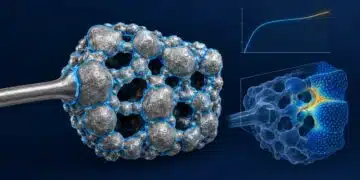
    Reference tantalum capacitor anode characterization, tantalum anode modeling, process selection and life-test verification.

    Tantalum Anode Design Combines Structural Benchmarks and Modeling

    Wk 45 Electronics Supply Chain Digest

    SCHURTER TCS6F IP67 sealed SMD tactile switch with white silicone actuator on dark background

    SCHURTER Unveils IP67 Tactile Switch in 6.2 × 6.2 mm Package

    YAGEO SMD 0603 ST Pt1000 chip sensor shown in front of rooftop HVAC equipment

    YAGEO SMD 0603 ST Pt1000 Sensor with Standard SMD Termination

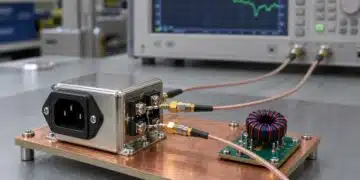
    Power line EMI filter on a copper ground-plane fixture connected to a vector network analyzer with a toroidal balun

    How to Measure Filter Performance: Insertion Loss, VNA Fixtures and CM/DM Separation

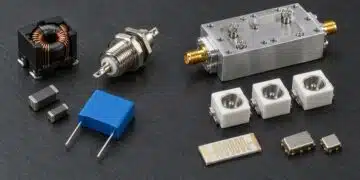
    Assorted EMI and RF filter components: common mode choke, ferrite beads, feedthrough filter, X2 capacitor, cavity filter, ceramic coaxial resonators, thin-film filter and SAW/BAW packages

    Passive Filter Technologies Compared: LC, Ferrite, Feedthrough, Ceramic, Cavity, Microstrip, SAW and BAW

    Illustration of a thin-film capacitor stack with TiN electrodes and an ultrathin hafnium zirconium oxide ferroelectric layer on silicon

    Sub-Volt Ferroelectric HZO Capacitor Pairs Speed and Endurance

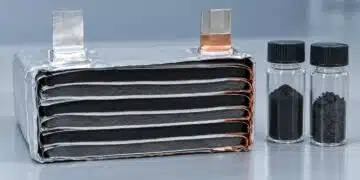
    Cut-open lithium-ion capacitor pouch cell showing stacked carbon electrodes and separators, with vials of carbon powder

    Lithium-Ion Capacitor Review Backs Hard Carbon//AC Pairing

    Trending Tags

    • Ripple Current
    • RF
    • Leakage Current
    • Tantalum vs Ceramic
    • Snubber
    • Low ESR
    • Feedthrough
    • Derating
    • Dielectric Constant
    • New Products
    • Market Reports
  • Knowledge Blog
  • Dossiers
    • Aerospace and Defense Passive Components Dossier
    • AI Hardware Dossier
    • Automotive Dossier
    • Industrial Robotics Dossier
    • Power Converter Dossier
    • Capacitor Dossier
    • Circuit Protection Dossier
    • Inductor Dossier
    • Resistor Dossier
    • Silicon Capacitors and Integrated Passives Dossier
  • Suppliers
    • Who is Who
  • PCNS
    • PCNS 2025
    • PCNS 2023
    • PCNS 2021
    • PCNS 2019
    • PCNS 2017
  • Events
No Result
View All Result
Passive Components Blog
No Result
View All Result

YAGEO Introduces Pb-Free Platinum RTD Temperature Sensor

9.11.2026
Reading Time: 6 mins read
A A
YAGEO Nexensos M422 Pb-free platinum RTD graphic showing the operating temperature range, nominal resistance options and joining methods.

YAGEO Nexensos has introduced the M422 Pb-free platinum resistance temperature detector (Pt-RTD), extending its lead-free M-Series temperature-sensor portfolio.

The YAGEO wired sensor provides resistance-based temperature measurement across an operating range of −70 °C to +500 °C. Nominal resistance options are 100 Ω, 500 Ω and 1000 Ω, with three tolerance classes defined according to DIN EN 60751.

RelatedPosts

YAGEO SMD 0603 ST Pt1000 Sensor with Standard SMD Termination

AI and Passive Components: Structural Growth Beyond Data Centers

YAGEO Releases Push-Pull Transformers for Isolated 3 W Supplies

Key features and benefits

  • Pb-free version of the M422 platinum temperature-sensor platform.
  • Operating temperature range from −70 °C to +500 °C.
  • Nominal resistance choices of 100 Ω, 500 Ω and 1000 Ω.
  • Tolerance classes F 0.1 (1/3 B), F 0.15 (A) and F 0.3 (B), according to DIN EN 60751.
  • Connection options include welding, brazing and crimping.

Technical highlights

A platinum RTD converts temperature into a change in electrical resistance. Its resistance increases with temperature and follows a standardized, nearly linear characteristic. Measurement electronics determine the sensor’s voltage drop and convert the resulting resistance measurement into a temperature value.
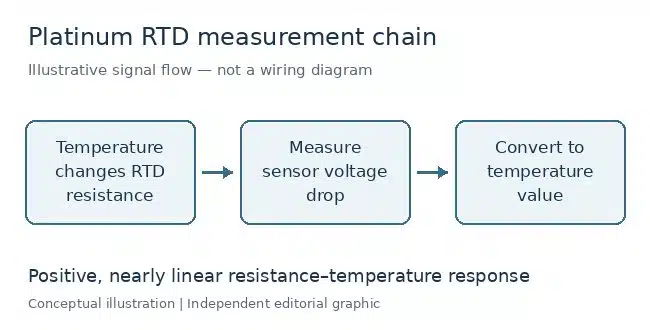
	Illustrative platinum RTD measurement chain from temperature-dependent resistance through voltage measurement to temperature conversion.
Figure 1. Conceptual platinum RTD measurement chain. The diagram shows signal flow, not an electrical connection schematic. Image credit: original editorial illustration.
ParameterM422 Pb-free
Sensor technologyPlatinum RTD
Operating temperature−70 °C to +500 °C
Nominal resistance100 Ω / 500 Ω / 1000 Ω
Tolerance classesF 0.1 / F 0.15 / F 0.3
Tolerance standardDIN EN 60751
Joining technologiesWelding / brazing / crimping

Tolerance class and measurement accuracy

The tolerance-class designation describes permitted deviation from the standardized platinum resistance–temperature characteristic. At 0 °C, F 0.1 corresponds to ±0.10 °C, F 0.15 to ±0.15 °C and F 0.3 to ±0.30 °C. These reference-point values are not constant error limits across the operating range.

Sensor operating range and tolerance-class validity are separate selection criteria. Match the required measurement accuracy to the applicable class over the intended temperature interval, rather than selecting from the 0 °C tolerance alone. The complete measurement chain also needs to match the sensor characteristic: sensor tolerance does not by itself define the accuracy of the finished instrument.

Resistance and tolerance selection

Nominal resistance and tolerance class address different parts of the measurement design. The resistance option must match the readout electronics, while the tolerance class forms part of the temperature-error budget.

The operating temperature range and tolerance-class designation should be treated as separate selection criteria. Choose the required accuracy over the actual measurement interval rather than treating a class label as a temperature-independent error figure.

Connection technology

Welding, brazing and crimping support different sensor-assembly processes. The selected joining method should be considered together with the mechanical arrangement and thermal exposure of the completed sensing assembly.

A lead-free sensing element is also a component-level choice. The connection materials and assembly process remain part of the finished product’s material-compliance assessment.

Typical applications

Target applications for the M422 Pb-free include:

  • Pyrolytic ovens.
  • Home appliances.
  • Heating, ventilation and air-conditioning equipment.
  • Medical devices.
  • Industrial process monitoring.

For sensor-technology selection, the distinction between the positive, nearly linear response of a platinum RTD and the negative, nonlinear response of an NTC thermistor affects signal conversion and interface compatibility. The thermistor-based temperature sensing system guide provides further context on these measurement approaches.

The +500 °C upper operating limit is relevant to temperature sensing in pyrolytic ovens and elevated-temperature industrial processes. The −70 °C lower limit also accommodates measurement duties extending below freezing, including HVAC applications.

Across these markets, the three nominal resistance options allow the sensing element to be selected around the intended measurement electronics. The tolerance-class choice then addresses the sensor’s contribution to measurement accuracy.

Design-in notes for engineers

  • Match the nominal resistance to the measurement front end and its resistance-to-temperature conversion.
  • Select the tolerance class against the required accuracy over the application’s measurement interval.
  • Keep the sensor’s local operating temperature within −70 °C to +500 °C, accounting for both normal operation and thermal excursions.
  • Include the joining method in the assembly design. Welding, brazing and crimping require different tooling and connection arrangements.
  • Assess the sensing element, electrical joints and mechanical installation together before production release.
  • Validate the final sensor assembly under the actual operating conditions.

Further reading

  • Thermistor Basics: NTC and PTC Selection Guide
  • Thermistor Temperature System Optimization and Evaluation

Source

This article is based on the YAGEO Group product announcement and official product documentation. Engineers should refer to the current manufacturer datasheet for final design and qualification.

References

  1. YAGEO Group, M422 Pb-Free Pt-RTD.
  2. YAGEO Group, Product Brief: Wired Pt-RTD M-Series — M422 Pb-free, Rev. A, July 2025.
  3. YAGEO Group, Pt and NTC Temperature Sensors: A Comparison of their Advantages Including Accuracy, Long-Term Stability and Repeatability.


Related

Recent Posts

SCHURTER TCS6F IP67 sealed SMD tactile switch with white silicone actuator on dark background

SCHURTER Unveils IP67 Tactile Switch in 6.2 × 6.2 mm Package

7.11.2026
2
YAGEO SMD 0603 ST Pt1000 chip sensor shown in front of rooftop HVAC equipment

YAGEO SMD 0603 ST Pt1000 Sensor with Standard SMD Termination

7.11.2026
13
Rack power shelf in an AI data center with film DC-link capacitors, a supercapacitor bank and a converter board

800 VDC AI Data Centers Reshape Capacitor Demand for 2027

6.11.2026
29

AI and Passive Components: Structural Growth Beyond Data Centers

5.11.2026
36
YAGEO PMT6397 push-pull transformer with a segmented toroidal winding and surface-mount terminals

YAGEO Releases Push-Pull Transformers for Isolated 3 W Supplies

5.11.2026
12
Bourns MSF series four-terminal current-sense shunt resistor with radial PCB terminals

Bourns Introduces Four-Terminal Shunt Resistors for Current Sensing

4.11.2026
22
Würth Elektronik WE-SLSP SMT common-mode choke with a square package and four terminals.

Würth Elektronik Releases Common-Mode Chokes for 100 V Data and Power Lines

4.11.2026
32
Bourns PWR163 DPAK-style surface-mount power resistor with moulded housing, metal backplate and terminals

Bourns Releases Power Resistor Adds Reverse-Pin Configuration

3.11.2026
10
Conceptual polypropylene DC-link film capacitor module with parallel cells and copper interconnections

DC-Link Film Capacitor Modules: Inductance and Thermal Design, Jianghai-Europe Tech Memo

3.11.2026
34

Upcoming Events

Nov 24
16:00 - 17:00 CET

Select the Correct Components for Your DC/DC Converter

Dec 1
16:00 - 17:00 CET

Developing low-noise mixed-signal systems

Dec 8
16:00 - 17:00 CET

WE-CCMF: Design Principles, Layout Guidelines and Measurement Results for High-Speed EMI Filtering

View Calendar

Popular Posts

  • Buck Converter Design and Calculation

    0 shares
    Share 0 Tweet 0
  • September 2026 Interconnect, Passives and Electromechanical Components Market Insights

    0 shares
    Share 0 Tweet 0
  • Boost Converter Design and Calculation

    0 shares
    Share 0 Tweet 0
  • Capacitor Charging and Discharging

    0 shares
    Share 0 Tweet 0
  • LLC Resonant Converter Design and Calculation

    0 shares
    Share 0 Tweet 0
  • RF Connector Types: How To Choose the Right One

    0 shares
    Share 0 Tweet 0
  • Passive Low Pass Filters: Fundamentals and EMI Design

    0 shares
    Share 0 Tweet 0
  • Flyback Converter Design and Calculation

    0 shares
    Share 0 Tweet 0
  • MLCC and Ceramic Capacitors

    0 shares
    Share 0 Tweet 0
  • Audio Capacitors: Choosing Capacitors for Crossover Circuits

    0 shares
    Share 0 Tweet 0

Newsletter Subscription


Passive Components Blog

© 2015–2026
All rights reserved

  • Home
  • Privacy Policy
  • EPCI Membership & Advertisement
  • About

No Result
View All Result
  • Home
  • Knowledge Blog
  • Dossiers
  • PCNS

© 2015–2026
All rights reserved