





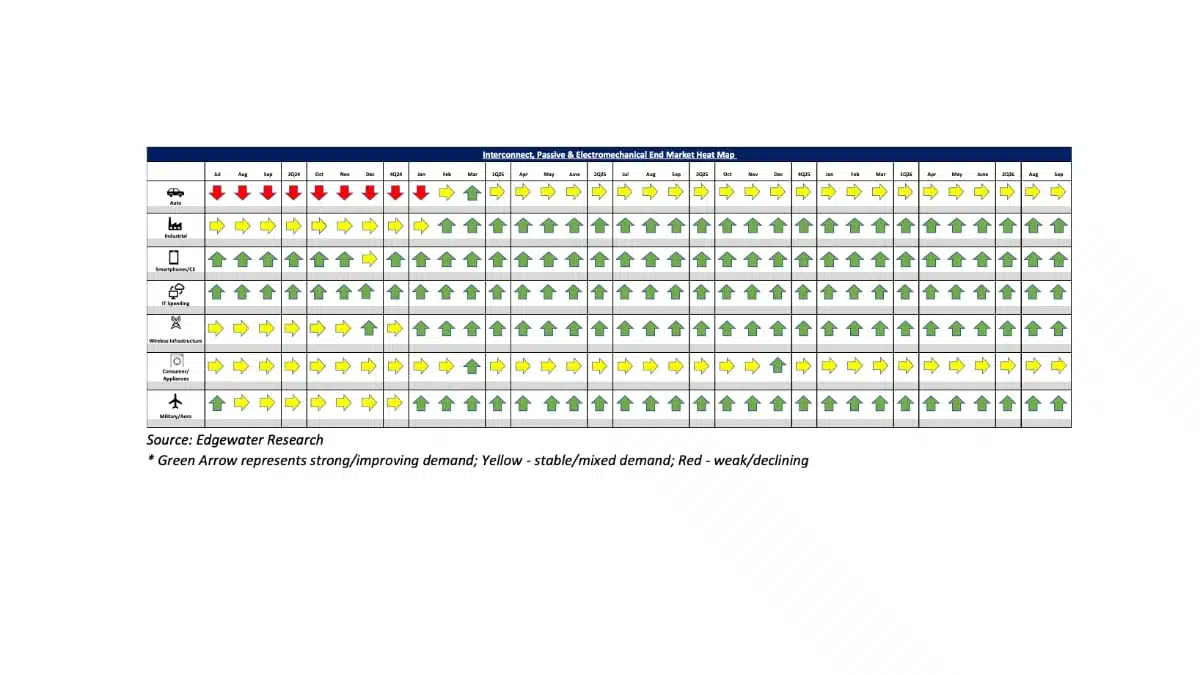
Edgewater Research’s latest IP&E report points to growing confidence in the VR Ultra design, while AI-driven connectivity opportunities continue to expand.
This September 2026 collection of news summaries, survey results, and channel market insights, covers Interconnect, Passives, and Electromechanical Components from Edgewater Research.
What’s Changed/What’s New?
- Broad demand reads still constructive, with bookings/POS accelerating exiting the summer and B2B still in the 1.2–1.3x range.
- Connector supply tightening incrementally, with lead times extending and pockets of constraints emerging in Industrial/Mil/Aero.
- CY27 visibility improving, with early planning pointing to sustained double-digit growth across most major markets outside Auto.
- Confidence in the technical feasibility of VR Ultra’s 2x backplane density improving as architecture/design plans firm up M/M.
- Amphenol is expected to license VR Ultra backplane IP to Foxconn Interconnect Technology/TE Connectivity at NVIDIA’s request;
TE Connectivity participation contingent on execution/yields. - TPU9i likely adopting cabled backplane with Amphenol as lead designer, driving connector TAM to >$750/TPU vs $300-$350 in
TPU7/8. - CCS/Amphenol fiber lead times extending to ~50 weeks as hyperscalers increasingly secure capacity years ahead through LTAs/POs.
Top 3 Channel Comments:
- Model sizes, workload complexity, duration, and context windows are growing much faster than the underlying hardware is
improving. Don’t see demand plateauing because we don’t see hardware performance improving quickly enough to close that gap. - Hyperscalers generally qualify fiber to a performance spec rather than requiring a specific supplier. Amphenol/CCS can source from
two or three different fiber suppliers as long as they meet the spec. We’re now seeing customers go to Amphenol with a Corning spec
and ask them to source an equivalent because they can’t get enough supply directly from GLW. - Inference architectures are becoming increasingly disaggregated, separating prefill from decode and potentially attention from other
compute functions. As functions that historically ran within the same accelerator move onto specialized hardware, more data—
including large KV caches—has to traverse the network, increasing networking intensity per unit of compute.
Other Key Takeaways:
- VR Ultra backplane content still estimated +60-70% vs. VR NVL72, with mass production targeted for 2H27.
- Inference disaggregation and workload growth outpacing hardware performance seen driving increased connectivity intensity
across both scale-up and scale-out networks in next-gen AI systems.
NPO momentum cont. building for rack-to-rack scale-up, with AWS Trn4, Advanced Micro Devices MI500 and Alibaba all pursuing
architectures with high NPO attach rates.
CCS fiber multi-sourcing viewed as advantageous; customers short on Corning supply seen as turning to CCS for alternatives.
Nvidia rack-to-rack scale-up path remains less clear, with Nvidia seen actively evaluating NPO, CPO and OCS implementations.
Industrial/Mil/Aero demand reads still robust, with demand chasing supply and lean inventory; Auto demand resilient/stable.
MLCC supply likely to tighten further into 1H27, new capacity potentially easing S/D 2H27/2028, though AI remains a swing factor.
Conclusions:
IP&E fundamentals remain strong exiting 3Q26, with demand continuing to strengthen across Industrial, Mil/Aero and AI/DC markets,
while bookings, POS and B2B ratios remain healthy and visibility into CY27 continues to build. At the same time, supply conditions are
tightening, with connector lead times extending, pockets of shortages emerging and MLCC/fiber availability becoming increasingly
constrained.
Within AI, rising connectivity intensity across next-generation scale-up/scale-out architectures, higher backplane content
and accelerating optical requirements continue to expand the addressable opportunity for interconnect suppliers. Taken together, we
remain constructive on IP&E fundamentals into CY27, supported by improving underlying demand, lean channel inventories and an
increasingly favorable supply/demand environment.
Full report available from: Dennis Reed, Sr. Research Analyst, Edgewater Research