






Passive Components Blog
No Result
View All Result
  • Home
  • NewsFilter
    • All
    • Aerospace & Defence
    • Antenna
    • Applications
    • Automotive
    • Capacitors
    • Circuit Protection Devices
    • electro-mechanical news
    • Filters
    • Fuses
    • Inductors
    • Industrial
    • Integrated Passives
    • inter-connect news
    • Market & Supply Chain
    • Market Insights
    • Medical
    • Modelling and Simulation
    • New Materials & Supply
    • New Technologies
    • Non-linear Passives
    • Oscillators
    • Passive Sensors News
    • Resistors
    • RF & Microwave
    • Telecommunication
    • Weekly Digest

    Top 10 Connector Vendors by Product Type

    Bourns Releases High‑Q Air Coil Inductors for RF Aplications

    CMSE 2026 Announces Call for Presentations on High-Reliability Military and Space Electronics

    ESA Call for Papers 6th Space Passive Component Days – SPCD 2026

    Würth Elektronik Offers Halogen‑Free EMC Gaskets for Displays and Housings

    Component Distribution Supply Chain January 2026

    Binder Unveils M8 Flange Solder Connectors for Flexible Cabling

    Power Electronics Tools for Passives and Magnetic Designs

    Modelithics Releases Component Model Library for SIMULIA CST Studio Suite

    Trending Tags

    • Ripple Current
    • RF
    • Leakage Current
    • Tantalum vs Ceramic
    • Snubber
    • Low ESR
    • Feedthrough
    • Derating
    • Dielectric Constant
    • New Products
    • Market Reports
  • VideoFilter
    • All
    • Antenna videos
    • Capacitor videos
    • Circuit Protection Video
    • Filter videos
    • Fuse videos
    • Inductor videos
    • Inter-Connect Video
    • Non-linear passives videos
    • Oscillator videos
    • Passive sensors videos
    • Resistor videos

    One‑Pulse Characterization of Nonlinear Power Inductors

    Thermistor Linearization Challenges

    Coaxial Connectors and How to Connect with PCB

    PCB Manufacturing, Test Methods, Quality and Reliability

    Transformer Behavior – Current Transfer and Hidden Feedback

    Choosing the Right Capacitor: The Importance of Accurate Measurements

    RF Inductors: Selection and Design Challenges for High-Frequency Circuits

    Transformer Safety IEC 61558 Standard

    3-Phase EMI Filter Design, Simulation, Calculation and Test

    Trending Tags

    • Capacitors explained
    • Inductors explained
    • Resistors explained
    • Filters explained
    • Application Video Guidelines
    • EMC
    • New Products
    • Ripple Current
    • Simulation
    • Tantalum vs Ceramic
  • Knowledge Blog
  • DossiersNew
  • Suppliers
    • Who is Who
  • PCNS
    • PCNS 2025
    • PCNS 2023
    • PCNS 2021
    • PCNS 2019
    • PCNS 2017
  • Events
  • Home
  • NewsFilter
    • All
    • Aerospace & Defence
    • Antenna
    • Applications
    • Automotive
    • Capacitors
    • Circuit Protection Devices
    • electro-mechanical news
    • Filters
    • Fuses
    • Inductors
    • Industrial
    • Integrated Passives
    • inter-connect news
    • Market & Supply Chain
    • Market Insights
    • Medical
    • Modelling and Simulation
    • New Materials & Supply
    • New Technologies
    • Non-linear Passives
    • Oscillators
    • Passive Sensors News
    • Resistors
    • RF & Microwave
    • Telecommunication
    • Weekly Digest

    Top 10 Connector Vendors by Product Type

    Bourns Releases High‑Q Air Coil Inductors for RF Aplications

    CMSE 2026 Announces Call for Presentations on High-Reliability Military and Space Electronics

    ESA Call for Papers 6th Space Passive Component Days – SPCD 2026

    Würth Elektronik Offers Halogen‑Free EMC Gaskets for Displays and Housings

    Component Distribution Supply Chain January 2026

    Binder Unveils M8 Flange Solder Connectors for Flexible Cabling

    Power Electronics Tools for Passives and Magnetic Designs

    Modelithics Releases Component Model Library for SIMULIA CST Studio Suite

    Trending Tags

    • Ripple Current
    • RF
    • Leakage Current
    • Tantalum vs Ceramic
    • Snubber
    • Low ESR
    • Feedthrough
    • Derating
    • Dielectric Constant
    • New Products
    • Market Reports
  • VideoFilter
    • All
    • Antenna videos
    • Capacitor videos
    • Circuit Protection Video
    • Filter videos
    • Fuse videos
    • Inductor videos
    • Inter-Connect Video
    • Non-linear passives videos
    • Oscillator videos
    • Passive sensors videos
    • Resistor videos

    One‑Pulse Characterization of Nonlinear Power Inductors

    Thermistor Linearization Challenges

    Coaxial Connectors and How to Connect with PCB

    PCB Manufacturing, Test Methods, Quality and Reliability

    Transformer Behavior – Current Transfer and Hidden Feedback

    Choosing the Right Capacitor: The Importance of Accurate Measurements

    RF Inductors: Selection and Design Challenges for High-Frequency Circuits

    Transformer Safety IEC 61558 Standard

    3-Phase EMI Filter Design, Simulation, Calculation and Test

    Trending Tags

    • Capacitors explained
    • Inductors explained
    • Resistors explained
    • Filters explained
    • Application Video Guidelines
    • EMC
    • New Products
    • Ripple Current
    • Simulation
    • Tantalum vs Ceramic
  • Knowledge Blog
  • DossiersNew
  • Suppliers
    • Who is Who
  • PCNS
    • PCNS 2025
    • PCNS 2023
    • PCNS 2021
    • PCNS 2019
    • PCNS 2017
  • Events
No Result
View All Result
Passive Components Blog
No Result
View All Result

Samsung Electro-Mechanics Joins Global Supply Chain RBA, Focus Sustainability

17.7.2023
Reading Time: 3 mins read
A A

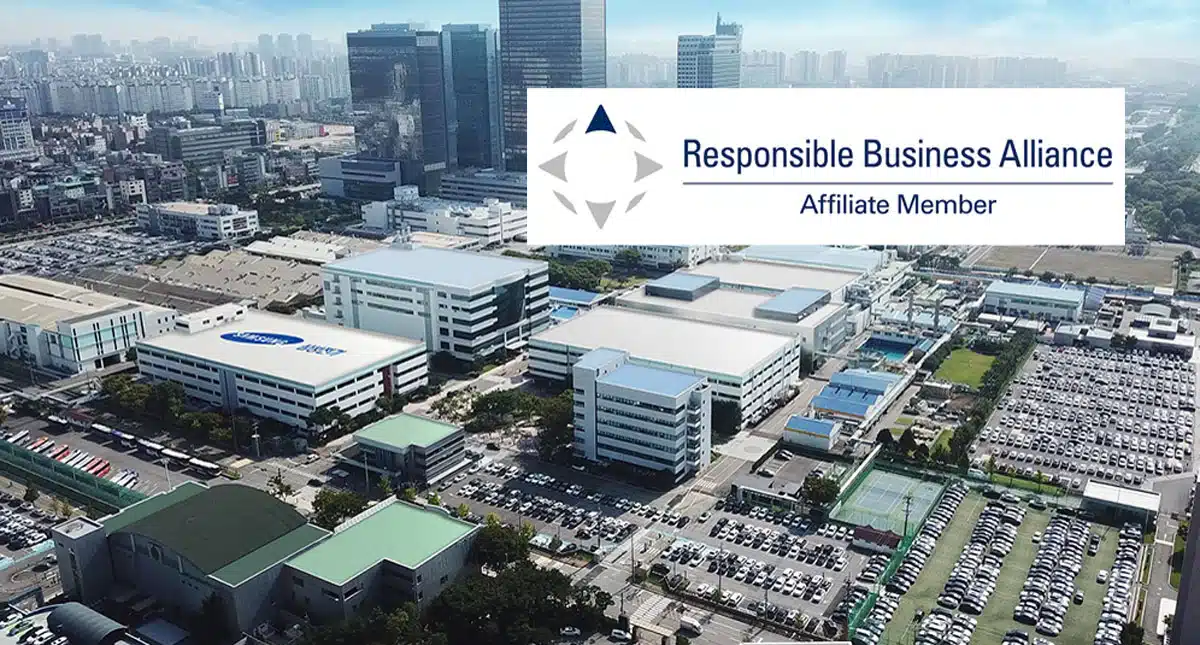
Samsung Electro-Mechanics announced that it has joined the Responsible Business Alliance (RBA) and Drive+ (automotive electronic component supplier council) to promote ESG management according to global standards.

RBA is a non-profit organization formed for responsible management activities of companies affected by the global supply chain, with more than 220 global companies participating as members.

RelatedPosts

Samsung Q4 2025 Results: MLCC focus for AI, Server and Automotive

Samsung Unveils World First CLLC Resonant 1kV 33nF C0G MLCC in 1210 Size

Samsung MLCC Replacing Aluminum Polymer Capacitors in AI Systems

Since 2017, Samsung Electro-Mechanics has established self-assessment standards such as the “Code of Conduct for Business Partners” based on the “RBA Code of Conduct” to check compliance management, including safety, environment, and human rights.

By joining the RBA, Samsung Electro-Mechanics will strengthen its application of the RBA’s proposed global Code of Conduct in five areas: labor, health and safety, environment, business ethics, and management systems.

Samsung Electro-Mechanics plans to review and improve the entire supply chain to ensure that its domestic and overseas business sites, and business partners operate in accordance with RBA standards. Accordingly, Samsung Electro-Mechanics will actively participate in the RBA VAP Audit (conducted by a third-party organization) for domestic and overseas business sites to maintain a global level of working environment for workers at Samsung Electro-Mechanics and its business partners.

Samsung Electro-Mechanics is also strengthening ESG management in its automotive electronic component business by joining Drive+, a council of automotive electronic component suppliers formed to fulfill social responsibility within the supply chain of the automobile industry.

Based on global international norms of the automotive industry, Drive+ pursues sustainability based on five strategies:

  • supply chain
  • raw materials
  • working environment
  • carbon neutrality
  • circular value chain

through three codes of conduct:

  • business ethics
  • environment
  • human rights and working conditions

More than 30 global automotive electronic component companies, including Continental, HARMAN and BASF are active in Drive+. 

Samsung Electro-Mechanics CEO Chang Duckhyun said, “As a leading company in the global automotive electronic components industry, Samsung Electro-Mechanics will strengthen our supply chain management to global standards and grow into a global company trusted by our customers and stakeholders.”

Samsung Electro-Mechanics’ sustainability management activities have been recognized by various rating agencies. It has been recognized as a leading ESG company by being the first company in Korea to be included in the DJSI World Index for 14 consecutive years, the first in the industry to be certified by the Carbon Trust for “Carbon Footprint”, and certified for “Zero Waste to Landfill” at all business sites in Korea.

Meanwhile, Samsung Electro-Mechanics has been conducting “ZERO WAVE”, an ESG campaign involving employees, since June to commemorate its 50th anniversary. The program aims to achieve “zero” in five areas of ESG practices:

  • Zero waste (reducing waste)
  • Net Zero (reducing carbon)
  • Zero bias (reducing discrimination)
  • Zero Water scarcity (saving water)
  • Zero social distance (reducing social distance).
Related

Source: Samsung Electro-Mechanics

Recent Posts

Top 10 Connector Vendors by Product Type

29.1.2026
12

Component Distribution Supply Chain January 2026

28.1.2026
29

Samsung Q4 2025 Results: MLCC focus for AI, Server and Automotive

26.1.2026
50

Capacitor Technology Dossier

26.1.2026
70

ROHM Extends 2012 Shunt Resistors Power Rating up to 1.25 W

23.1.2026
23

January 2026 Interconnect, Passives and Electromechanical Components Market Insights

22.1.2026
147

Passive Components in Quantum Computing

22.1.2026
122

0603 Automotive Chip Varistors as TVS Diode Replacements, TDK Tech Note

21.1.2026
29

Conductive Polymer Capacitor Market and Design‑In Guide to 2035

20.1.2026
139

Upcoming Events

Feb 24
16:00 - 17:00 CET

Designing Qi2 Wireless Power Systems: Practical Development and EMC Optimization

Mar 3
16:00 - 17:00 CET

Cybersecurity at the Eleventh Hour – from RED to CRA – Information and Discussion

Mar 21
All day

PSMA Capacitor Workshop 2026

View Calendar

Popular Posts

  • Buck Converter Design and Calculation

    0 shares
    Share 0 Tweet 0
  • Boost Converter Design and Calculation

    0 shares
    Share 0 Tweet 0
  • LLC Resonant Converter Design and Calculation

    0 shares
    Share 0 Tweet 0
  • Flyback Converter Design and Calculation

    0 shares
    Share 0 Tweet 0
  • Ripple Current and its Effects on the Performance of Capacitors

    3 shares
    Share 3 Tweet 0
  • How Metal Prices Are Driving Passive Component Price Hikes

    0 shares
    Share 0 Tweet 0
  • MLCC and Ceramic Capacitors

    0 shares
    Share 0 Tweet 0
  • Dual Active Bridge (DAB) Topology

    0 shares
    Share 0 Tweet 0
  • Degradation of Capacitors and its Failure Mechanisms

    0 shares
    Share 0 Tweet 0
  • What is a Dielectric Constant and DF of Plastic Materials?

    4 shares
    Share 4 Tweet 0

Newsletter Subscription


Passive Components Blog

© EPCI - Leading Passive Components Educational and Information Site

  • Home
  • Privacy Policy
  • EPCI Membership & Advertisement
  • About

No Result
View All Result
  • Home
  • Knowledge Blog
  • PCNS

© EPCI - Leading Passive Components Educational and Information Site

This website uses cookies. By continuing to use this website you are giving consent to cookies being used. Visit our Privacy and Cookie Policy.
Go to mobile version