










Passive Components Blog
No Result
View All Result
  • Home
  • NewsFilter
    • All
    • Aerospace & Defence
    • Antenna
    • Applications
    • Automotive
    • Capacitors
    • Circuit Protection Devices
    • electro-mechanical news
    • Filters
    • Fuses
    • Inductors
    • Industrial
    • Integrated Passives
    • inter-connect news
    • Market & Supply Chain
    • Market Insights
    • Medical
    • Modelling and Simulation
    • New Materials & Supply
    • New Technologies
    • Non-linear Passives
    • Oscillators
    • Passive Sensors News
    • Resistors
    • RF & Microwave
    • Telecommunication
    • Weekly Digest

    Bourns SSD‑1000A AEC‑Q Digital Current Sensors

    YAGEO High‑Capacitance X7R Automotive MLCC Extensions

    How Metal Prices Are Driving Passive Component Price Hikes

    Modelithics COMPLETE Library v25.8 for Keysight ADS

    Taiyo Yuden Releases 165C Automotive Multilayer Metal Power Inductor in 1608 Size

    Energy-Controlled Structural Evolution of Amorphous Ta₂O₅ in Tantalum Anodes

    Jianghai Vibration‑Resistant Aluminum Capacitors Guidelines for Industrial Electronics

    2025 Top Passive Components Blog Articles

    Exxelia Releases Custom Smart Integrated Magnetics for Space Applications

    Trending Tags

    • Ripple Current
    • RF
    • Leakage Current
    • Tantalum vs Ceramic
    • Snubber
    • Low ESR
    • Feedthrough
    • Derating
    • Dielectric Constant
    • New Products
    • Market Reports
  • VideoFilter
    • All
    • Antenna videos
    • Capacitor videos
    • Circuit Protection Video
    • Filter videos
    • Fuse videos
    • Inductor videos
    • Inter-Connect Video
    • Non-linear passives videos
    • Oscillator videos
    • Passive sensors videos
    • Resistor videos

    One‑Pulse Characterization of Nonlinear Power Inductors

    Thermistor Linearization Challenges

    Coaxial Connectors and How to Connect with PCB

    PCB Manufacturing, Test Methods, Quality and Reliability

    Transformer Behavior – Current Transfer and Hidden Feedback

    Choosing the Right Capacitor: The Importance of Accurate Measurements

    RF Inductors: Selection and Design Challenges for High-Frequency Circuits

    Transformer Safety IEC 61558 Standard

    3-Phase EMI Filter Design, Simulation, Calculation and Test

    Trending Tags

    • Capacitors explained
    • Inductors explained
    • Resistors explained
    • Filters explained
    • Application Video Guidelines
    • EMC
    • New Products
    • Ripple Current
    • Simulation
    • Tantalum vs Ceramic
  • Knowledge Blog
  • Suppliers
    • Who is Who
  • PCNS
    • PCNS 2025
    • PCNS 2023
    • PCNS 2021
    • PCNS 2019
    • PCNS 2017
  • Events
  • Home
  • NewsFilter
    • All
    • Aerospace & Defence
    • Antenna
    • Applications
    • Automotive
    • Capacitors
    • Circuit Protection Devices
    • electro-mechanical news
    • Filters
    • Fuses
    • Inductors
    • Industrial
    • Integrated Passives
    • inter-connect news
    • Market & Supply Chain
    • Market Insights
    • Medical
    • Modelling and Simulation
    • New Materials & Supply
    • New Technologies
    • Non-linear Passives
    • Oscillators
    • Passive Sensors News
    • Resistors
    • RF & Microwave
    • Telecommunication
    • Weekly Digest

    Bourns SSD‑1000A AEC‑Q Digital Current Sensors

    YAGEO High‑Capacitance X7R Automotive MLCC Extensions

    How Metal Prices Are Driving Passive Component Price Hikes

    Modelithics COMPLETE Library v25.8 for Keysight ADS

    Taiyo Yuden Releases 165C Automotive Multilayer Metal Power Inductor in 1608 Size

    Energy-Controlled Structural Evolution of Amorphous Ta₂O₅ in Tantalum Anodes

    Jianghai Vibration‑Resistant Aluminum Capacitors Guidelines for Industrial Electronics

    2025 Top Passive Components Blog Articles

    Exxelia Releases Custom Smart Integrated Magnetics for Space Applications

    Trending Tags

    • Ripple Current
    • RF
    • Leakage Current
    • Tantalum vs Ceramic
    • Snubber
    • Low ESR
    • Feedthrough
    • Derating
    • Dielectric Constant
    • New Products
    • Market Reports
  • VideoFilter
    • All
    • Antenna videos
    • Capacitor videos
    • Circuit Protection Video
    • Filter videos
    • Fuse videos
    • Inductor videos
    • Inter-Connect Video
    • Non-linear passives videos
    • Oscillator videos
    • Passive sensors videos
    • Resistor videos

    One‑Pulse Characterization of Nonlinear Power Inductors

    Thermistor Linearization Challenges

    Coaxial Connectors and How to Connect with PCB

    PCB Manufacturing, Test Methods, Quality and Reliability

    Transformer Behavior – Current Transfer and Hidden Feedback

    Choosing the Right Capacitor: The Importance of Accurate Measurements

    RF Inductors: Selection and Design Challenges for High-Frequency Circuits

    Transformer Safety IEC 61558 Standard

    3-Phase EMI Filter Design, Simulation, Calculation and Test

    Trending Tags

    • Capacitors explained
    • Inductors explained
    • Resistors explained
    • Filters explained
    • Application Video Guidelines
    • EMC
    • New Products
    • Ripple Current
    • Simulation
    • Tantalum vs Ceramic
  • Knowledge Blog
  • Suppliers
    • Who is Who
  • PCNS
    • PCNS 2025
    • PCNS 2023
    • PCNS 2021
    • PCNS 2019
    • PCNS 2017
  • Events
No Result
View All Result
Passive Components Blog
No Result
View All Result

Sintering Atomically Thin Materials with Ceramics Now Possible

28.6.2018
Reading Time: 3 mins read
A A

Source: Newswise article

Newswise — For the first time, researchers have created a nanocomposite of ceramics with a two-dimensional material that opens the door to new designs of nanocomposites with a variety of applications, such as solid-state batteries thermoelectrics, varistors, catalysts, chemical sensors and much more.

RelatedPosts

Bourns SSD‑1000A AEC‑Q Digital Current Sensors

YAGEO High‑Capacitance X7R Automotive MLCC Extensions

How Metal Prices Are Driving Passive Component Price Hikes

Sintering is a method that uses high heat to compact powder materials into a solid form. Widely used in industry, ceramic powders are typically compacted at temperatures of 800 degrees Celsius or higher. Many low-dimensional materials cannot survive at those temperatures.

But a sintering process developed by a team of researchers at Penn State, called the cold sintering process (CSP), can sinter ceramics at much lower temperatures, less than 300 degrees C, saving energy and enabling a new form of material with high commercial potential.

“We have industry people who are already very interested in this work,” said Jing Guo, a post-doctoral scholar working in the group of Clive Randall, professor of materials science and engineering, Penn State. Guo is first coauthor on a paper appearing online today in the journal Advanced Materials. “They are interested in developing some new material applications with this system and, in general, using CSP to sinter nanocomposites.”

The idea of trying to develop a ceramic-2D composite system was the result of a National Science Foundation workshop on the future of ceramics, organized by Dr. Lynnette Madsen, that drew 50 of the top ceramic scientists in the U.S. Yury Gogotsi, a Charles T. and Ruth M. Bach Distinguished University Professor and Director of the  A.J. Drexel Nanomaterials Institute, at Drexel University, heard Randall’s presentation on cold sintering and proposed a collaboration to develop a ceramic composite using a new class of two-dimensional materials, called MXenes, discovered by him and his collaborators at Drexel University.  MXenes, which are carbide and nitride sheets a few atoms thin, possess extreme strength and many of them are excellent metallic conductors.

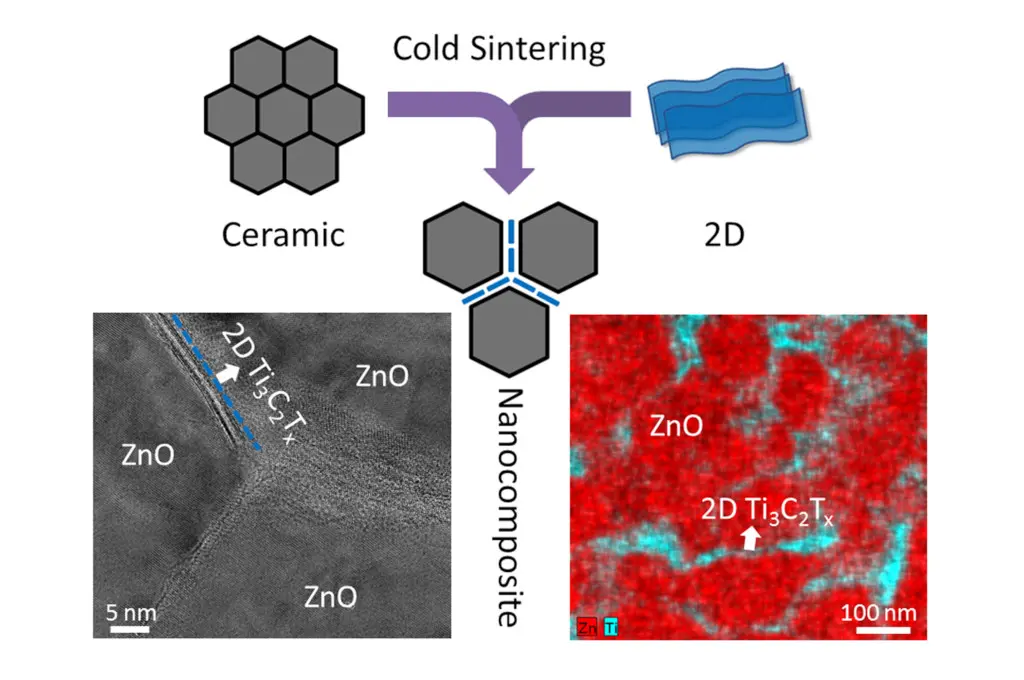
While it has been known that mixing even a very small amount of 2D materials, such as graphene, into a ceramic can dramatically change its properties, MXene has never been used in ceramic composites. In this work, Guo and Benjamin Legum, Gogotsi’s doctoral student, mixed 0.5-5 percent MXene into a well-known ceramic system called zinc oxide. The metallic MXene coated the ceramic powder and formed continuous two-dimensional grain boundaries, which prevented grain growth, increased the conductivity by two orders of magnitude, transforming semiconducting zinc oxide into a metallic ceramic, and doubled hardness of the final product. The addition of MXene also improved the ability of zinc oxide to transform heat to electricity.

“Ben came here quite frequently to work with Jing, and over time they overcame all of the problems involved with dispersing the 2D MXenes into the zinc oxide and then sintering it,” said Randall. “This opens a whole new world incorporating 2D materials into ceramics.”

Gogotsi added, “This is the first ceramic composite containing MXene. Taking into account that about thirty MXenes with diverse properties are already available, we are opening a new chapter in research on ceramic matrix composites, with potential applications ranging from electronics to batteries and thermoelectrics.”

Guo and Legum are co-first authors on the paper “Cold Sintered Ceramic Nanocomposites of 2D MXene and Zinc Oxide.” Gogotsi and Randall are corresponding authors. Other contributors are Dr. Babak Anasori and undergraduate student Pavel Lelukh from Drexel, and Ke Wang, staff scientist in Penn State’s Materials Research Institute.

The work was supported by the Air Force Research Laboratory and the National Science Foundation.

Featured image: The schematic illustration showing the co-sintering of ceramics and 2D materials using cold sintering processing, and TEM image and energy dispersive spectroscopy (EDS) map of cold sintered 99ZnO-1Ti3C2Tx nanocomposite. The MXene nanosheets are distributed homogeneously along the ZnO grain boundaries, as seen in the TEM image and EDS map. Image credit: MRI/Penn State


 

Related

Recent Posts

YAGEO High‑Capacitance X7R Automotive MLCC Extensions

8.1.2026
2

How Metal Prices Are Driving Passive Component Price Hikes

8.1.2026
7

Modelithics COMPLETE Library v25.8 for Keysight ADS

7.1.2026
18

Energy-Controlled Structural Evolution of Amorphous Ta₂O₅ in Tantalum Anodes

6.1.2026
24

Jianghai Vibration‑Resistant Aluminum Capacitors Guidelines for Industrial Electronics

6.1.2026
14

2025 Top Passive Components Blog Articles

5.1.2026
52
Credit: Institute of Science Tokyo

Researchers Demonstrated 30nm Ferroelectric Capacitor for Compact Memory

2.1.2026
25

Towards Green and Sustainable Supercapacitors

30.12.2025
37

Mechano-Chemical Model of Sintered Tantalum Capacitor Pellets

29.12.2025
46

Upcoming Events

Jan 27
16:00 - 17:00 CET

Simplifying Vehicle Development with Automotive Ethernet and Zonal Smart Switch Technologies

Feb 24
16:00 - 17:00 CET

Designing Qi2 Wireless Power Systems: Practical Development and EMC Optimization

View Calendar

Popular Posts

  • Buck Converter Design and Calculation

    0 shares
    Share 0 Tweet 0
  • Boost Converter Design and Calculation

    0 shares
    Share 0 Tweet 0
  • LLC Resonant Converter Design and Calculation

    0 shares
    Share 0 Tweet 0
  • Flyback Converter Design and Calculation

    0 shares
    Share 0 Tweet 0
  • Ripple Current and its Effects on the Performance of Capacitors

    3 shares
    Share 3 Tweet 0
  • What Electronics Engineer Needs to Know About Passive Low Pass Filters

    0 shares
    Share 0 Tweet 0
  • MLCC and Ceramic Capacitors

    0 shares
    Share 0 Tweet 0
  • Dual Active Bridge (DAB) Topology

    0 shares
    Share 0 Tweet 0
  • What is a Dielectric Constant and DF of Plastic Materials?

    4 shares
    Share 4 Tweet 0
  • SEPIC Converter Design and Calculation

    0 shares
    Share 0 Tweet 0

Newsletter Subscription


Passive Components Blog

© EPCI - Leading Passive Components Educational and Information Site

  • Home
  • Privacy Policy
  • EPCI Membership & Advertisement
  • About

No Result
View All Result
  • Home
  • Knowledge Blog
  • PCNS

© EPCI - Leading Passive Components Educational and Information Site

This website uses cookies. By continuing to use this website you are giving consent to cookies being used. Visit our Privacy and Cookie Policy.
Go to mobile version