










Passive Components Blog
No Result
View All Result
  • Home
  • NewsFilter
    • All
    • Aerospace & Defence
    • Antenna
    • Applications
    • Automotive
    • Capacitors
    • Circuit Protection Devices
    • electro-mechanical news
    • Filters
    • Fuses
    • Inductors
    • Industrial
    • Integrated Passives
    • inter-connect news
    • Market & Supply Chain
    • Market Insights
    • Medical
    • Modelling and Simulation
    • New Materials & Supply
    • New Technologies
    • Non-linear Passives
    • Oscillators
    • Passive Sensors News
    • Resistors
    • RF & Microwave
    • Telecommunication
    • Weekly Digest

    Sumida Introduces SMD Metal Inductors for High‑Current Automotive DC/DC Converters

    Hirose Releases 0.5 mm Floating Board-to-Board Connector for EV Powertrain Designs

    Imec Presents High-density MIMCAP RF interposer for III-V chiplets

    Wk 24 Electronics Supply Chain Digest

    Bourns Completes Rakon Acquisition, Enters Timing Market

    Knowles Releases 3825 X1/Y2 Safety MLCCs for High‑Voltage Applications

    Knowles Expands High Q Ceramic Core Inductors

    TAIYO YUDEN Releases 220uF 1210 Automotive MLCC

    HEICO’s Exxelia Expands High-Voltage Ceramic Capacitor Portfolio with CalRamic Acquisition

    Trending Tags

    • Ripple Current
    • RF
    • Leakage Current
    • Tantalum vs Ceramic
    • Snubber
    • Low ESR
    • Feedthrough
    • Derating
    • Dielectric Constant
    • New Products
    • Market Reports
  • VideoFilter
    • All
    • Antenna videos
    • Capacitor videos
    • Circuit Protection Video
    • Filter videos
    • Fuse videos
    • Inductor videos
    • Inter-Connect Video
    • Non-linear passives videos
    • Oscillator videos
    • Passive sensors videos
    • Resistor videos

    Why Isolated DC/DC Power Supplies Fail Late, Würth Elektronik Podcast

    Designing 800 V DC EMC Filters: Calculation, Simulation and Measurement

    Current Sense Transformer Datasheet and Design‑in Guide

    Designing a USB Type‑C Flyback Planar Transformer with Frenetic’s Planar Tool

    Magnetics Design in High‑Frequency GaN Converters

    Qi2 Wireless Charging: Inductors, Capacitors and EMC Filters

    Two‑capacitor paradox explained for engineers

    Capacitances of Nonlinear MLCCs: What Datasheets Don’t Tell You

    Tapped Inductor Buck Converter Fundamentals

    Trending Tags

    • Capacitors explained
    • Inductors explained
    • Resistors explained
    • Filters explained
    • Application Video Guidelines
    • EMC
    • New Products
    • Ripple Current
    • Simulation
    • Tantalum vs Ceramic
  • Knowledge Blog
  • DossiersNew
  • Suppliers
    • Who is Who
  • PCNS
    • PCNS 2025
    • PCNS 2023
    • PCNS 2021
    • PCNS 2019
    • PCNS 2017
  • Events
  • Home
  • NewsFilter
    • All
    • Aerospace & Defence
    • Antenna
    • Applications
    • Automotive
    • Capacitors
    • Circuit Protection Devices
    • electro-mechanical news
    • Filters
    • Fuses
    • Inductors
    • Industrial
    • Integrated Passives
    • inter-connect news
    • Market & Supply Chain
    • Market Insights
    • Medical
    • Modelling and Simulation
    • New Materials & Supply
    • New Technologies
    • Non-linear Passives
    • Oscillators
    • Passive Sensors News
    • Resistors
    • RF & Microwave
    • Telecommunication
    • Weekly Digest

    Sumida Introduces SMD Metal Inductors for High‑Current Automotive DC/DC Converters

    Hirose Releases 0.5 mm Floating Board-to-Board Connector for EV Powertrain Designs

    Imec Presents High-density MIMCAP RF interposer for III-V chiplets

    Wk 24 Electronics Supply Chain Digest

    Bourns Completes Rakon Acquisition, Enters Timing Market

    Knowles Releases 3825 X1/Y2 Safety MLCCs for High‑Voltage Applications

    Knowles Expands High Q Ceramic Core Inductors

    TAIYO YUDEN Releases 220uF 1210 Automotive MLCC

    HEICO’s Exxelia Expands High-Voltage Ceramic Capacitor Portfolio with CalRamic Acquisition

    Trending Tags

    • Ripple Current
    • RF
    • Leakage Current
    • Tantalum vs Ceramic
    • Snubber
    • Low ESR
    • Feedthrough
    • Derating
    • Dielectric Constant
    • New Products
    • Market Reports
  • VideoFilter
    • All
    • Antenna videos
    • Capacitor videos
    • Circuit Protection Video
    • Filter videos
    • Fuse videos
    • Inductor videos
    • Inter-Connect Video
    • Non-linear passives videos
    • Oscillator videos
    • Passive sensors videos
    • Resistor videos

    Why Isolated DC/DC Power Supplies Fail Late, Würth Elektronik Podcast

    Designing 800 V DC EMC Filters: Calculation, Simulation and Measurement

    Current Sense Transformer Datasheet and Design‑in Guide

    Designing a USB Type‑C Flyback Planar Transformer with Frenetic’s Planar Tool

    Magnetics Design in High‑Frequency GaN Converters

    Qi2 Wireless Charging: Inductors, Capacitors and EMC Filters

    Two‑capacitor paradox explained for engineers

    Capacitances of Nonlinear MLCCs: What Datasheets Don’t Tell You

    Tapped Inductor Buck Converter Fundamentals

    Trending Tags

    • Capacitors explained
    • Inductors explained
    • Resistors explained
    • Filters explained
    • Application Video Guidelines
    • EMC
    • New Products
    • Ripple Current
    • Simulation
    • Tantalum vs Ceramic
  • Knowledge Blog
  • DossiersNew
  • Suppliers
    • Who is Who
  • PCNS
    • PCNS 2025
    • PCNS 2023
    • PCNS 2021
    • PCNS 2019
    • PCNS 2017
  • Events
No Result
View All Result
Passive Components Blog
No Result
View All Result

Taiyo Yuden offers Li-ion capacitors to combine battery and super-cap behaviour

26.3.2019
Reading Time: 3 mins read
A A

Source: Electronics Weekly news

By Steve Bush. Taiyo Yuden to offer ‘lithium ion capacitors’ – devices that combine super-capacitor and lithium ion storage to create a component with twice the storage capacity of its own super-caps, a 3.8V terminal potential, and long cycle life – although the latter only if it is never discharged below 2.2V.

RelatedPosts

Sumida Introduces SMD Metal Inductors for High‑Current Automotive DC/DC Converters

Hirose Releases 0.5 mm Floating Board-to-Board Connector for EV Powertrain Designs

Imec Presents High-density MIMCAP RF interposer for III-V chiplets

Operation is over -25 to 85℃ (voltage caveats above 70℃), and the firm will offer four versions: 20, 40, 100 and 270F.

“It has superlative safety characteristics,” said Taiyo. “Since the amount of self discharge is small, self-ignition becomes extremely unlikely.”

Super capacitor Li-ion capacitor Li-ion battery
Operating voltage 2.7Vmax 2.2-3.8V
(2.5-3.5V at >70℃)
~2.7 – 3.6V
Operating temperature range -25 to 70℃ -25 to 85℃ -20 to 60℃
Electrode material Activated charcoal Activated charcoal
Carbon-based material
Li metal oxide
Carbon-based material
Electrolyte Organic solvent Organic solvent Organic solvent
Storage physics Electrical double-layer Electrical double-layer
Ion doping and de-doping
Oxidation-reduction reaction
Heavy metals None None None
Number of recharges > 100,000 times > 100,000 times 1,000 times
Relative cap/vol 1 2 100

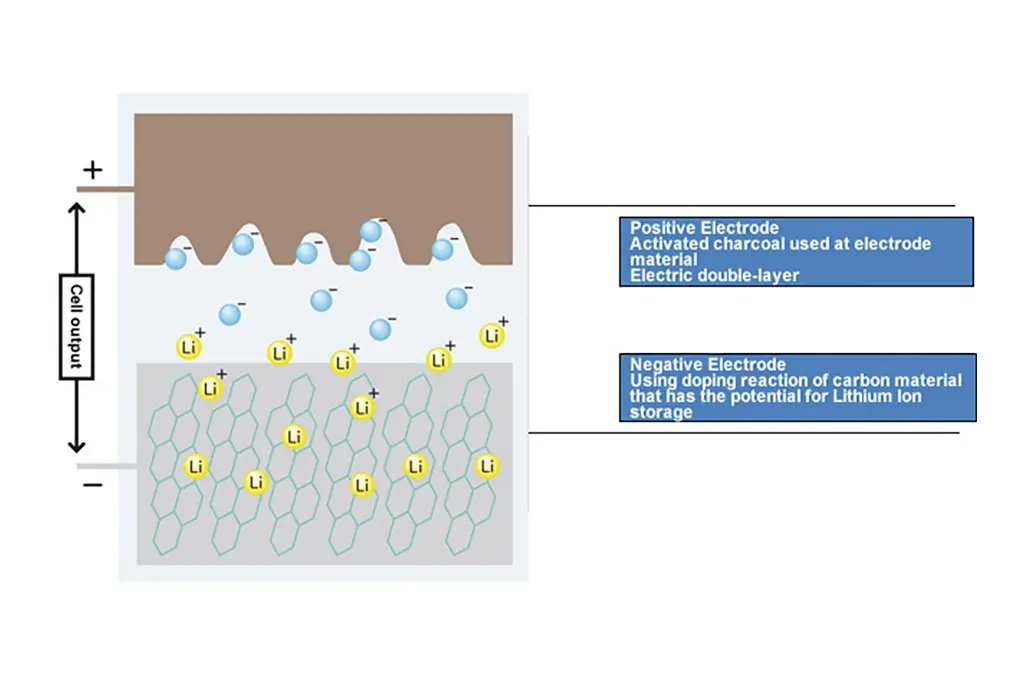
Lithium Ion Capacitors are a type of asymmetric capacitor, where the positive and negative electrodes use different principles.

They have the positive electrode of an electrical double-layer capacitor, which forms an electrical double-layer and is charged and discharged by a physical process, combined with the negative electrode of a lithium ion battery, where lithium undergoes reduction-oxidation (redox) reactions.

“Compared to existing capacitors, the energy density is high, a large reason for this is the fact that the static electricity capacity of the negative electrode is increased by pre-doping,” said the firm – also pointing out that this means the capacitors arrive pre-charged, and capable of delivering high currents into accidental short circuits.

Part capacitance
F
diameter
mm
length
mm
dc resistance
mΩ
LIC1030RS3R8206 20 10 30 250
LIC1235RS3R8406 40 12.5 35 125
LIC1840RS3R8107 100 18 40 60
LIC2540RS3R8277 270 25 40 60

Really, never discharge below 2.2V
The company has created a comprehensive application note (Notes on circuit design for lithium ion capacitor), and one warning entry reads: “Do not use the product at voltages below the lower limit voltage (2.2V). It may generate gas, causing it to leak, heat up, smoke, explode, or burst into flames. Take due care when designing circuits so that the voltage never falls below the lower limit voltage.”

On the plus side, unlike Li-ion batteries, penetration of the cell is unlikely to cause a fire. According to Taiyo Yuden: “The constituent materials do not contain oxygen, and the chemical reactions that would give rise to thermal runaway cannot occur solely based on Joule heating from the accumulated electrical charge. That means that energy is lost together with the release of electrical charge, and there is no danger of ignition.”

Test results for nail penetration – sideways through the cell – are: no explosion or ignition, and no opening or bulging of the safety valve. Cell surface did reach ~110°C after around two minutes.

According to product developer Mr Ishida (right), the firm had two use cases in mind Li-ion caps: “The first was to use the high power density to develop a high-volume capacitor for use in energy recovery, or as a back up, for automobiles and industrial machinery The other aim was to develop a low-volume capacitor, that could be used in consumer devices such as smartphones, tablets, mobile phones, digital cameras and PC’s.”

Most of the uses seen so far, according to the firm, is as back-up for rechargeable batteries, delivering high instantaneous power while the battery provides high capacity. Medical appliances is one application, where even momentary voltage drops can be critical. Automotive energy recovery is foreseen, as well as energy recovery in lifts (elevators). “In addition, lithium ion capacitors have started to be used by themselves in a stand alone role instead of rechargeable batteries in some applications,” said the firm.

Other companies making lithium ion capacitors:

  • JM Energy
  • Vinatech
  • JSR Micro

Related

Recent Posts

Sumida Introduces SMD Metal Inductors for High‑Current Automotive DC/DC Converters

15.6.2026
7

Bourns Completes Rakon Acquisition, Enters Timing Market

12.6.2026
25

Knowles Releases 3825 X1/Y2 Safety MLCCs for High‑Voltage Applications

11.6.2026
34

Knowles Expands High Q Ceramic Core Inductors

11.6.2026
27

TAIYO YUDEN Releases 220uF 1210 Automotive MLCC

11.6.2026
46

HEICO’s Exxelia Expands High-Voltage Ceramic Capacitor Portfolio with CalRamic Acquisition

10.6.2026
41

Vishay Extends Automotive Ferrite Beads for High‑Current EMC Noise Filtering

10.6.2026
29

CapXon Earns EcoVadis Bronze Medal for Sustainability Performance

10.6.2026
26

All‑Water Supercapacitor Based on 1‑nm Clay Channels and Nanoconfined Water Electrolyte

10.6.2026
39

Upcoming Events

Jun 16
16:00 - 17:00 CEST

EMC with EMC – EMC‑compliant design with electromechanical connectors

Jul 14
16:00 - 17:00 CEST

EMC Design Essentials: Mastering Varistors and Common Mode Chokes

Jul 21
16:00 - 17:00 CEST

Safety by design: X and Y Interference suppression capacitors for power line filters

View Calendar

Popular Posts

  • Buck Converter Design and Calculation

    0 shares
    Share 0 Tweet 0
  • Boost Converter Design and Calculation

    0 shares
    Share 0 Tweet 0
  • LLC Resonant Converter Design and Calculation

    0 shares
    Share 0 Tweet 0
  • MLCC and Ceramic Capacitors

    0 shares
    Share 0 Tweet 0
  • Flyback Converter Design and Calculation

    0 shares
    Share 0 Tweet 0
  • Earthing Systems and IEC Classification Explained

    0 shares
    Share 0 Tweet 0
  • SEPIC Converter Design and Calculation

    0 shares
    Share 0 Tweet 0
  • Dual Active Bridge (DAB) Topology

    0 shares
    Share 0 Tweet 0
  • What Electronics Engineer Needs to Know About Passive Low Pass Filters

    0 shares
    Share 0 Tweet 0
  • MLCC Case Sizes Standards Explained

    0 shares
    Share 0 Tweet 0

Newsletter Subscription


Passive Components Blog

© EPCI - Leading Passive Components Educational and Information Site

  • Home
  • Privacy Policy
  • EPCI Membership & Advertisement
  • About

No Result
View All Result
  • Home
  • Knowledge Blog
  • Dossiers
  • PCNS

© EPCI - Leading Passive Components Educational and Information Site

This website uses cookies. By continuing to use this website you are giving consent to cookies being used. Visit our Privacy and Cookie Policy.
Go to mobile version