



Passive Components Blog
No Result
View All Result
  • Home
  • NewsFilter
    • All
    • Aerospace & Defence
    • Antenna
    • Applications
    • Automotive
    • Capacitors
    • Circuit Protection Devices
    • electro-mechanical news
    • Filters
    • Fuses
    • Inductors
    • Industrial
    • Integrated Passives
    • inter-connect news
    • Market & Supply Chain
    • Market Insights
    • Medical
    • Modelling and Simulation
    • New Materials & Supply
    • New Technologies
    • Non-linear Passives
    • Oscillators
    • Passive Sensors News
    • Resistors
    • RF & Microwave
    • Telecommunication
    • Weekly Digest

    KYOCERA AVX Introduces Traction‑Grade DC Link Film Capacitors

    When More Capacitance Hurts Reliability: The Role of the Metallic Skeleton in Tantalum Anodes

    Why Power Inductors Use a Ferrite Core With an Air Gap

    Wk 16 Electronics Supply Chain Digest

    YAGEO Introduces High‑Current Y2/X1 Film Capacitors for Wide-bandgap Power Systems

    Amphenol Explanded Liquid Cooling Connectors for AI, ESS and EV Systems

    Hirose Introduced BGA connector for PCIe Gen6 for AI and Edge Computing

    YAGEO Introduces High Rel MLCCs Beyond MIL-Spec Limits

    Würth Elektronik Expanded Capacity for Validation and Services in Asia

    Trending Tags

    • Ripple Current
    • RF
    • Leakage Current
    • Tantalum vs Ceramic
    • Snubber
    • Low ESR
    • Feedthrough
    • Derating
    • Dielectric Constant
    • New Products
    • Market Reports
  • VideoFilter
    • All
    • Antenna videos
    • Capacitor videos
    • Circuit Protection Video
    • Filter videos
    • Fuse videos
    • Inductor videos
    • Inter-Connect Video
    • Non-linear passives videos
    • Oscillator videos
    • Passive sensors videos
    • Resistor videos

    Why Power Inductors Use a Ferrite Core With an Air Gap

    Transformer-Based Power-Line Harvester Magnetic Design

    Thermal Modeling of Magnetics

    Standard vs Planar LLC transformers Comparison for Battery Chargers

    How Modern Tools Model Magnetic Components for Power Electronics

    Advanced Loss Modeling for Planar Magnetics in the Frenetic Planar Tool

    2026 Power Magnetics Design Trends: Flyback, DAB and Planar

    Enabling Software‑Defined Vehicle Architectures: Automotive Ethernet and Zonal Smart Power

    Calculating Resistance Value of a Flyback RC Snubber 

    Trending Tags

    • Capacitors explained
    • Inductors explained
    • Resistors explained
    • Filters explained
    • Application Video Guidelines
    • EMC
    • New Products
    • Ripple Current
    • Simulation
    • Tantalum vs Ceramic
  • Knowledge Blog
  • DossiersNew
  • Suppliers
    • Who is Who
  • PCNS
    • PCNS 2025
    • PCNS 2023
    • PCNS 2021
    • PCNS 2019
    • PCNS 2017
  • Events
  • Home
  • NewsFilter
    • All
    • Aerospace & Defence
    • Antenna
    • Applications
    • Automotive
    • Capacitors
    • Circuit Protection Devices
    • electro-mechanical news
    • Filters
    • Fuses
    • Inductors
    • Industrial
    • Integrated Passives
    • inter-connect news
    • Market & Supply Chain
    • Market Insights
    • Medical
    • Modelling and Simulation
    • New Materials & Supply
    • New Technologies
    • Non-linear Passives
    • Oscillators
    • Passive Sensors News
    • Resistors
    • RF & Microwave
    • Telecommunication
    • Weekly Digest

    KYOCERA AVX Introduces Traction‑Grade DC Link Film Capacitors

    When More Capacitance Hurts Reliability: The Role of the Metallic Skeleton in Tantalum Anodes

    Why Power Inductors Use a Ferrite Core With an Air Gap

    Wk 16 Electronics Supply Chain Digest

    YAGEO Introduces High‑Current Y2/X1 Film Capacitors for Wide-bandgap Power Systems

    Amphenol Explanded Liquid Cooling Connectors for AI, ESS and EV Systems

    Hirose Introduced BGA connector for PCIe Gen6 for AI and Edge Computing

    YAGEO Introduces High Rel MLCCs Beyond MIL-Spec Limits

    Würth Elektronik Expanded Capacity for Validation and Services in Asia

    Trending Tags

    • Ripple Current
    • RF
    • Leakage Current
    • Tantalum vs Ceramic
    • Snubber
    • Low ESR
    • Feedthrough
    • Derating
    • Dielectric Constant
    • New Products
    • Market Reports
  • VideoFilter
    • All
    • Antenna videos
    • Capacitor videos
    • Circuit Protection Video
    • Filter videos
    • Fuse videos
    • Inductor videos
    • Inter-Connect Video
    • Non-linear passives videos
    • Oscillator videos
    • Passive sensors videos
    • Resistor videos

    Why Power Inductors Use a Ferrite Core With an Air Gap

    Transformer-Based Power-Line Harvester Magnetic Design

    Thermal Modeling of Magnetics

    Standard vs Planar LLC transformers Comparison for Battery Chargers

    How Modern Tools Model Magnetic Components for Power Electronics

    Advanced Loss Modeling for Planar Magnetics in the Frenetic Planar Tool

    2026 Power Magnetics Design Trends: Flyback, DAB and Planar

    Enabling Software‑Defined Vehicle Architectures: Automotive Ethernet and Zonal Smart Power

    Calculating Resistance Value of a Flyback RC Snubber 

    Trending Tags

    • Capacitors explained
    • Inductors explained
    • Resistors explained
    • Filters explained
    • Application Video Guidelines
    • EMC
    • New Products
    • Ripple Current
    • Simulation
    • Tantalum vs Ceramic
  • Knowledge Blog
  • DossiersNew
  • Suppliers
    • Who is Who
  • PCNS
    • PCNS 2025
    • PCNS 2023
    • PCNS 2021
    • PCNS 2019
    • PCNS 2017
  • Events
No Result
View All Result
Passive Components Blog
No Result
View All Result

Tantalum Capacitor Technology Advantages for Harsh Environment

24.9.2025
Reading Time: 4 mins read
A A

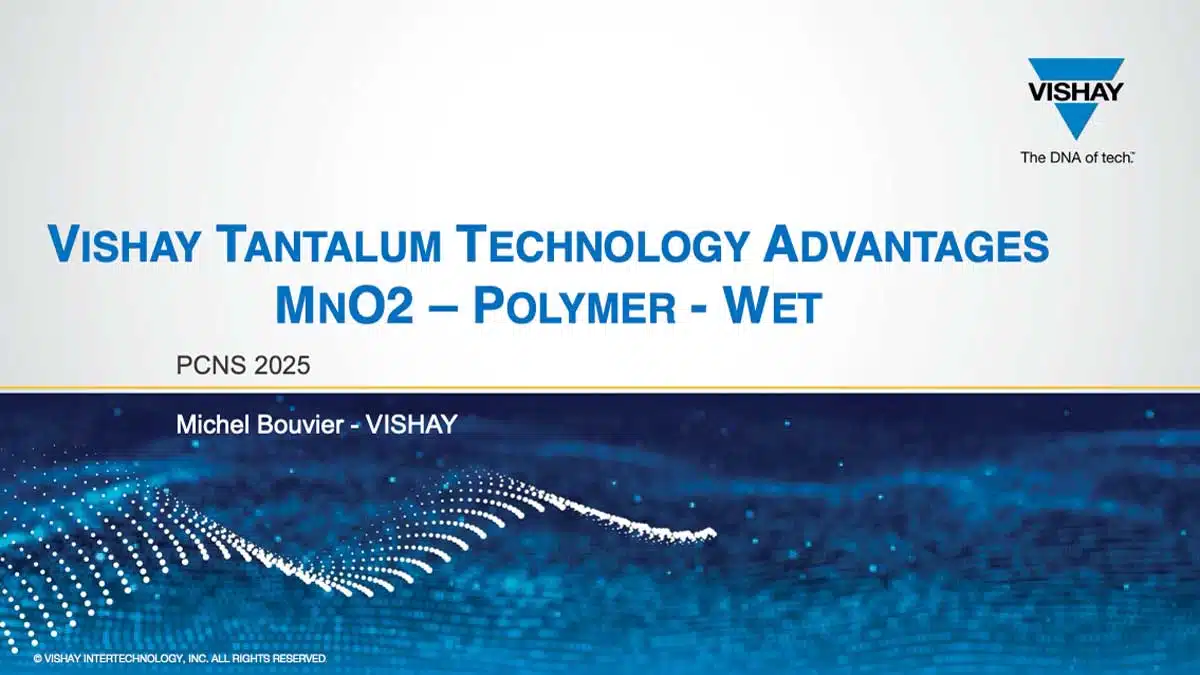
The paper “Tantalum Capacitor Technology Advantages for Harsh Environment” was presented by Michel Bouvier, Vishay Europe, Le Pecq, France at the 5th PCNS Passive Components Networking Symposium 9-12th September 2025, Seville, Spain as paper No. 1.2.

Introduction

Vishay has continuously developed advanced tantalum capacitor technologies to address the challenges of harsh environments such as aerospace, military, space, underwater, and critical industrial applications. Environments with extreme temperatures, high mechanical stresses, and severe electrical conditions demand components with exceptional reliability.

RelatedPosts

Vishay Extends Power Inductors for DC/DC with 1212 Compact Case

Vishay Releases 2-Way Wilkinson Divider / Combiner for 15–20 GHz RF Front Ends

Vishay Releases Compact High‑Accuracy Hall Effect Linear Position Sensor

Traditional commercial capacitors often fail under such conditions, prompting the need for enhanced material selection, refined manufacturing processes, and protective packaging solutions.

Vishay’s innovations—from advanced anode technologies to MAP packaging and hermetic designs—provide robust performance, long-term reliability, and low DC leakage.

Key Points

  • Advanced Tantalum anode technology using liquid delubrication, magnesium deoxidation, beveled pellet pressing, and welded wire attachment.
  • Defect-free Ta₂O₅ dielectric formation resulting in low DC leakage and improved reflow resistance.
  • MAP (Multiple Array Packaging) technology delivers ~40% increased capacitive volume with stable MSL performance.
  • HiRel screening and statistical DCL methods ensure high reliability under life testing.
  • Hermetically sealed polymer and wet tantalum capacitors provide enhanced stability in extreme conditions.
  • Specialized solutions for high temperature, mechanical stress, and mission-specific harsh environment applications.

Extended Summary

Vishay’s approach to harsh-environment capacitors begins with technological enhancements at the anode level. The company introduced top-down pressed beveled pellets, which solve the common issue of corner weaknesses in polymer-coated capacitors. This geometry ensures uniform cathode coverage, reducing short failures. Liquid delubrication replaces traditional high-temperature burn-out methods, reducing carbon residuals from ~300 ppm to ≤30 ppm, enabling the formation of defect-free Ta₂O₅ dielectric films. Magnesium deoxidation further enhances the dielectric’s integrity by lowering oxygen content, optimizing reliability and performance under stress.

Welded anode wire attachment strengthens mechanical connections, mitigating failures during thermal reflow. Vishay has also implemented Shell Formation, a process that creates a thicker dielectric layer on the anode’s outer surface to endure thermo-mechanical and electrical stress during soldering and testing.

Packaging innovations play a central role. The MAP (Multiple Array Packaging) technology allows for approximately 40% higher volumetric efficiency than traditional molded packaging, without sacrificing Moisture Sensitivity Level ratings. This brings advantages in module assembly, weight reduction, and improved high-frequency performance. Hermetic solutions, such as the T27 vPolyTan™ series, provide additional protection against conductive polymer degradation from thermo-oxidation, ensuring long-term parametric stability.

Reliability is reinforced through Vishay’s comprehensive testing and screening regime. Processes include reflow conditioning, surge current testing, accelerated voltage conditioning, thermal shock, and patented statistical DC Leakage (DCL) screening at elevated temperature and voltage. Life test results demonstrate that Vishay polymer capacitors maintain stable DCL values over 10,000 hours, while competitors often show increased leakage and early failures.

The company also addresses extreme temperature requirements. Tantalum MnO₂ capacitors can operate up to 200°C, making them suitable for oil drilling and aerospace applications. Polymer capacitors are typically rated for up to 125°C, with some limited solutions for 150°C, supporting automotive AEC-Q200 environments. Wet tantalum capacitors remain the choice for very high-temperature, high-voltage designs beyond 150°C.

Mechanical stress resilience is critical for applications like space launchers and oil drilling. Vishay products undergo rigorous vibration and shock testing, with hermetic and vibration-proven enclosures like T27 and T22/T24 ensuring electrical parameter stability even under 53G random vibration or 1000G shocks.

For failure-rate assessments, polymer tantalum capacitors exhibit such low intrinsic failure mechanisms that traditional 100% FR grading is not practical. Instead, lot-based accelerated testing is used under MIL-PRF-32700 guidelines, with Arrhenius and Prokopowicz-Vaskas models applied to calculate acceleration factors for temperature and voltage stress.

Conclusion

Vishay’s advanced Tantalum capacitor technology offers a complete solution for demanding, harsh-environment applications. By combining defect-free anode fabrication, innovative packaging such as MAP, hermetic sealing, and rigorous testing protocols, the company delivers components with exceptional stability, low DC leakage, and long service life. These innovations not only exceed industry reliability standards but also reduce system-level risk in critical missions. Future progress will focus on extending temperature ranges, improving lifetime performance, and working closely with system designers to achieve optimal solutions for the most challenging environments.
1_2_Vishay PCNS 2025 PaperDownload

Related

Source: PCNS

Recent Posts

KYOCERA AVX Introduces Traction‑Grade DC Link Film Capacitors

21.4.2026
3

When More Capacitance Hurts Reliability: The Role of the Metallic Skeleton in Tantalum Anodes

20.4.2026
16

Why Power Inductors Use a Ferrite Core With an Air Gap

20.4.2026
9

YAGEO Introduces High‑Current Y2/X1 Film Capacitors for Wide-bandgap Power Systems

17.4.2026
15

Amphenol Explanded Liquid Cooling Connectors for AI, ESS and EV Systems

17.4.2026
5

Hirose Introduced BGA connector for PCIe Gen6 for AI and Edge Computing

17.4.2026
5

YAGEO Introduces High Rel MLCCs Beyond MIL-Spec Limits

16.4.2026
42

Samsung Introduces Ultra-High-Voltage 1500 V MLCCs for xEV Powertrains

16.4.2026
21

YAGEO Q1 2026 Results: AI Servers and Pricing Power Behind a Moderate Q2 Outlook

16.4.2026
61

Upcoming Events

Apr 21
16:00 - 17:00 CEST

Heatsink Solutions: Thermal Management in electronic devices

Apr 22
17:00 - 17:30 CEST

Magnetics in a high frequency GaN era

Apr 22
17:00 - 18:00 CEST

Derating Tantalum, Film, and Ceramic Capacitors

View Calendar

Popular Posts

  • Buck Converter Design and Calculation

    0 shares
    Share 0 Tweet 0
  • Boost Converter Design and Calculation

    0 shares
    Share 0 Tweet 0
  • Flyback Converter Design and Calculation

    0 shares
    Share 0 Tweet 0
  • LLC Resonant Converter Design and Calculation

    0 shares
    Share 0 Tweet 0
  • Dual Active Bridge (DAB) Topology

    0 shares
    Share 0 Tweet 0
  • MLCC and Ceramic Capacitors

    0 shares
    Share 0 Tweet 0
  • Capacitor Charging and Discharging

    0 shares
    Share 0 Tweet 0
  • Ripple Current and its Effects on the Performance of Capacitors

    3 shares
    Share 3 Tweet 0
  • MLCC Case Sizes Standards Explained

    0 shares
    Share 0 Tweet 0
  • Plastic Materials Dielectric Constant and DF

    4 shares
    Share 4 Tweet 0

Newsletter Subscription


Passive Components Blog

© EPCI - Leading Passive Components Educational and Information Site

  • Home
  • Privacy Policy
  • EPCI Membership & Advertisement
  • About

No Result
View All Result
  • Home
  • Knowledge Blog
  • PCNS

© EPCI - Leading Passive Components Educational and Information Site

This website uses cookies. By continuing to use this website you are giving consent to cookies being used. Visit our Privacy and Cookie Policy.
Go to mobile version