



Passive Components Blog
No Result
View All Result
  • Home
  • NewsFilter
    • All
    • Aerospace & Defence
    • Antenna
    • Applications
    • Automotive
    • Capacitors
    • Circuit Protection Devices
    • electro-mechanical news
    • Filters
    • Fuses
    • Inductors
    • Industrial
    • Integrated Passives
    • inter-connect news
    • Market & Supply Chain
    • Market Insights
    • Medical
    • Modelling and Simulation
    • New Materials & Supply
    • New Technologies
    • Non-linear Passives
    • Oscillators
    • Passive Sensors News
    • Resistors
    • RF & Microwave
    • Telecommunication
    • Weekly Digest

    Exxelia to Exhibit at APEC 2026 in San Antonio, Texas

    Würth Elektronik Presents Differential Pressure Sensor for HVAC and Medical

    Thermal Modeling of Magnetics

    ESA SPCD 26 Call for Papers Extended to 30th March

    Wk 11 Electronics Supply Chain Digest

    Binder Extends NCC Circular Connectors for Harsh Environments

    Standard vs Planar LLC transformers Comparison for Battery Chargers

    Würth Elektronik and Grinn Launch Edge AI Cooperation

    Bourns Expanded Semi-Shielded Low Profile Automotive Power Inductor

    Trending Tags

    • Ripple Current
    • RF
    • Leakage Current
    • Tantalum vs Ceramic
    • Snubber
    • Low ESR
    • Feedthrough
    • Derating
    • Dielectric Constant
    • New Products
    • Market Reports
  • VideoFilter
    • All
    • Antenna videos
    • Capacitor videos
    • Circuit Protection Video
    • Filter videos
    • Fuse videos
    • Inductor videos
    • Inter-Connect Video
    • Non-linear passives videos
    • Oscillator videos
    • Passive sensors videos
    • Resistor videos

    Thermal Modeling of Magnetics

    Standard vs Planar LLC transformers Comparison for Battery Chargers

    How Modern Tools Model Magnetic Components for Power Electronics

    Advanced Loss Modeling for Planar Magnetics in the Frenetic Planar Tool

    2026 Power Magnetics Design Trends: Flyback, DAB and Planar

    Enabling Software‑Defined Vehicle Architectures: Automotive Ethernet and Zonal Smart Power

    Calculating Resistance Value of a Flyback RC Snubber 

    One‑Pulse Characterization of Nonlinear Power Inductors

    Thermistor Linearization Challenges

    Trending Tags

    • Capacitors explained
    • Inductors explained
    • Resistors explained
    • Filters explained
    • Application Video Guidelines
    • EMC
    • New Products
    • Ripple Current
    • Simulation
    • Tantalum vs Ceramic
  • Knowledge Blog
  • DossiersNew
  • Suppliers
    • Who is Who
  • PCNS
    • PCNS 2025
    • PCNS 2023
    • PCNS 2021
    • PCNS 2019
    • PCNS 2017
  • Events
  • Home
  • NewsFilter
    • All
    • Aerospace & Defence
    • Antenna
    • Applications
    • Automotive
    • Capacitors
    • Circuit Protection Devices
    • electro-mechanical news
    • Filters
    • Fuses
    • Inductors
    • Industrial
    • Integrated Passives
    • inter-connect news
    • Market & Supply Chain
    • Market Insights
    • Medical
    • Modelling and Simulation
    • New Materials & Supply
    • New Technologies
    • Non-linear Passives
    • Oscillators
    • Passive Sensors News
    • Resistors
    • RF & Microwave
    • Telecommunication
    • Weekly Digest

    Exxelia to Exhibit at APEC 2026 in San Antonio, Texas

    Würth Elektronik Presents Differential Pressure Sensor for HVAC and Medical

    Thermal Modeling of Magnetics

    ESA SPCD 26 Call for Papers Extended to 30th March

    Wk 11 Electronics Supply Chain Digest

    Binder Extends NCC Circular Connectors for Harsh Environments

    Standard vs Planar LLC transformers Comparison for Battery Chargers

    Würth Elektronik and Grinn Launch Edge AI Cooperation

    Bourns Expanded Semi-Shielded Low Profile Automotive Power Inductor

    Trending Tags

    • Ripple Current
    • RF
    • Leakage Current
    • Tantalum vs Ceramic
    • Snubber
    • Low ESR
    • Feedthrough
    • Derating
    • Dielectric Constant
    • New Products
    • Market Reports
  • VideoFilter
    • All
    • Antenna videos
    • Capacitor videos
    • Circuit Protection Video
    • Filter videos
    • Fuse videos
    • Inductor videos
    • Inter-Connect Video
    • Non-linear passives videos
    • Oscillator videos
    • Passive sensors videos
    • Resistor videos

    Thermal Modeling of Magnetics

    Standard vs Planar LLC transformers Comparison for Battery Chargers

    How Modern Tools Model Magnetic Components for Power Electronics

    Advanced Loss Modeling for Planar Magnetics in the Frenetic Planar Tool

    2026 Power Magnetics Design Trends: Flyback, DAB and Planar

    Enabling Software‑Defined Vehicle Architectures: Automotive Ethernet and Zonal Smart Power

    Calculating Resistance Value of a Flyback RC Snubber 

    One‑Pulse Characterization of Nonlinear Power Inductors

    Thermistor Linearization Challenges

    Trending Tags

    • Capacitors explained
    • Inductors explained
    • Resistors explained
    • Filters explained
    • Application Video Guidelines
    • EMC
    • New Products
    • Ripple Current
    • Simulation
    • Tantalum vs Ceramic
  • Knowledge Blog
  • DossiersNew
  • Suppliers
    • Who is Who
  • PCNS
    • PCNS 2025
    • PCNS 2023
    • PCNS 2021
    • PCNS 2019
    • PCNS 2017
  • Events
No Result
View All Result
Passive Components Blog
No Result
View All Result

W-band Self-Biased Circulators for Next Gen VHTS Satellites

1.5.2025
Reading Time: 4 mins read
A A

This paper Towards W-Band Self-Biased Circulators For Next Generation Of Vhts Payload Was presented by Evan Roue, Univ Brest, France during the 5th Space Passive Component Days (SPCD), an International Symposium held from October 15th to 18th, 2024, at ESA/ESTEC in Noordwijk, the Netherlands. Published under permission from ESA SPCD organizers.

Introduction:

RelatedPosts

ESA SPCD 26 Call for Papers Extended to 30th March

High-Density PCB Assemblies For Space Applications

Solid State Polymer Multilayer Capacitors For High Temperature Application

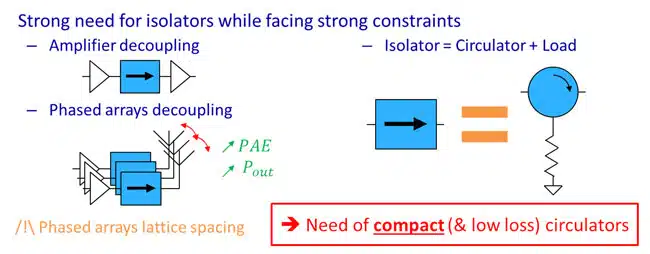
Circulators and isolators are pivotal non-reciprocal devices in satellite communication systems, primarily used to protect amplifiers from impedance mismatches and to maintain low reflection levels in electronically steerable antennas.

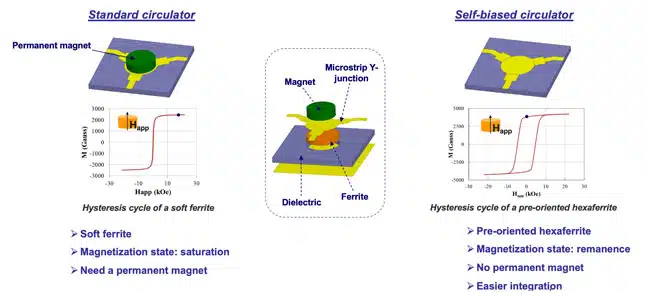
Conventional devices rely on soft ferrites and permanent magnets, which become bulky and inefficient at higher frequencies. This poses a challenge for future Very High Throughput Satellites (VHTS) utilizing W-band frequencies (71–76 GHz) to achieve higher data rates.

The study explores the fabrication and performance of compact, self-biased circulators and isolators using pre-oriented hexaferrites, eliminating the need for external magnets.

Key Points:

  • Non-reciprocal Devices: Traditional circulators require bulky magnets, limiting their application at W-band frequencies.
  • Self-biased Circulators: Utilizing pre-oriented hexaferrites allows the development of compact, magnetless circulators.
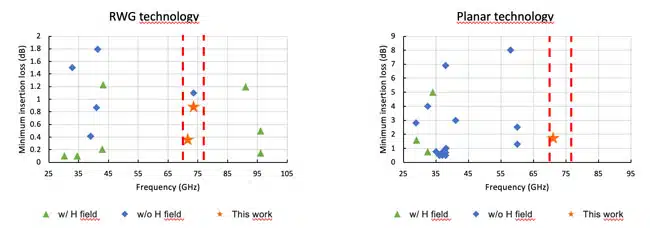
  • W-band Performance: The study demonstrates promising results with insertion losses lower than 1.06 dB and isolation above 14.5 dB for waveguide circulators, and planar isolators achieving up to 25.1 dB isolation.
  • Material Advantage: Strontium hexaferrites offer high anisotropy, robust performance against temperature and external magnetic fields.

Extended Summary:

The study investigates the feasibility of self-biased W-band circulators and isolators for next-generation VHTS payloads. Traditional soft ferrites, though effective, demand large permanent magnets that grow bulkier as operating frequencies increase. This issue is addressed by replacing soft ferrites with pre-oriented hexaferrites, specifically strontium hexagonal ferrites, which possess high anisotropy fields (18–20 kOe) and robustness against temperature variations and stray magnetic fields.
In the first phase, the researchers designed and fabricated WR-10 rectangular waveguide circulators optimized for 71–76 GHz. The circulators demonstrated insertion losses as low as 1.06 dB and isolation levels exceeding 14.5 dB. The performance indicates strong potential, especially as assembly and calibration processes are further refined.

Subsequently, ultra-compact planar microstrip isolators were developed within the same frequency range. These devices, measuring just 2 mm × 2 mm, incorporate coplanar waveguide-to-microstrip transitions to facilitate probe station measurements. Despite a slight frequency shift, the planar isolator achieved insertion losses below 2.29 dB and isolation levels peaking at 25.1 dB at 72.7 GHz, remaining above 11 dB across the operational band.
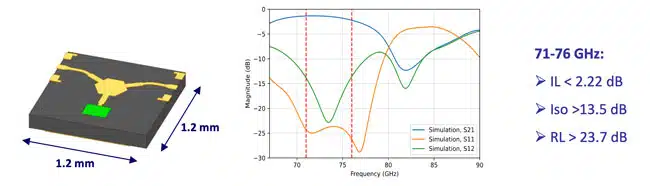
The study details the material properties of substituted hexaferrites used, emphasizing their high remanence-to-saturation ratio and coercive field, which eliminate the need for external magnetic biasing. The waveguide circulators employed a split-block aluminum design with silver-plated interiors to minimize metallic loss. Measurements conducted with Rohde & Schwarz network analyzers revealed results closely aligned with simulations, though minor discrepancies were noted due to technological tolerances and ferrite placement variations.

For planar technology, Y-junction circulators were adapted into isolators by terminating one port with a matched load. Fabrication involved standard ceramics-based microwave processing, including photolithography and selective etching. The devices were magnetized using a vibrating sample magnetometer at 23 kOe. Measurement data confirmed the feasibility of compact, efficient W-band self-biased isolators suitable for satellite applications.
Conclusion:

This research successfully demonstrates state-of-the-art performance for self-biased circulators and isolators operating in the W-band. Both rectangular waveguide and planar technologies achieved competitive insertion loss and isolation metrics compared to traditional magnet-based designs. Notably, the planar isolator represents the first of its kind in W-band, highlighting significant potential for integration into future VHTS payloads. The promising results pave the way for further development of compact, lightweight, and efficient non-reciprocal devices critical to next-generation satellite communication systems.

Read the full paper:
ORAL_Day 2_28_LabSTICC UBO France_W-band self biased circulators 1Download

Related

Source: ESA SPCD

Recent Posts

Exxelia to Exhibit at APEC 2026 in San Antonio, Texas

17.3.2026
18

ESA SPCD 26 Call for Papers Extended to 30th March

16.3.2026
80

Binder Extends NCC Circular Connectors for Harsh Environments

13.3.2026
2

Peak Nano to Develop Fusion Grade High Energy Film Capacitors

11.3.2026
30

ECIA February 2026 Industry Pulse Signals Strong Component Growth

6.3.2026
36

Samtec ANSI/VITA 90 Connectors: Rugged Small Form Factor Standard

5.3.2026
13

KYOCERA AVX Extends Ultra‑Broadband RF Capacitor Series

24.2.2026
53

Bourns Extends Multilayer Chip Inductors Offer for RF and Wireless Designs

20.2.2026
24

SCHURTER Introduces 2410 SMD Fuse for Robust AC/DC Protection

17.2.2026
20

Upcoming Events

Mar 19
13:00 - 14:00 CDT

Smart Consideration of Inductor Thermal Performance

Mar 21
All day

PSMA Capacitor Workshop 2026

Mar 24
9:00 - 10:00 CET

Power protection in the digital age – eFuse and hot-swap strategies for modern data center design

View Calendar

Popular Posts

  • Buck Converter Design and Calculation

    0 shares
    Share 0 Tweet 0
  • Boost Converter Design and Calculation

    0 shares
    Share 0 Tweet 0
  • Flyback Converter Design and Calculation

    0 shares
    Share 0 Tweet 0
  • LLC Resonant Converter Design and Calculation

    0 shares
    Share 0 Tweet 0
  • MLCC Manufacturers Consider Price Increase as AI Demand Outpaces Supply

    0 shares
    Share 0 Tweet 0
  • Dual Active Bridge (DAB) Topology

    0 shares
    Share 0 Tweet 0
  • Ripple Current and its Effects on the Performance of Capacitors

    3 shares
    Share 3 Tweet 0
  • MLCC and Ceramic Capacitors

    0 shares
    Share 0 Tweet 0
  • MLCC Case Sizes Standards Explained

    0 shares
    Share 0 Tweet 0
  • 3-Phase EMI Filter Design, Simulation, Calculation and Test

    0 shares
    Share 0 Tweet 0

Newsletter Subscription


Passive Components Blog

© EPCI - Leading Passive Components Educational and Information Site

  • Home
  • Privacy Policy
  • EPCI Membership & Advertisement
  • About

No Result
View All Result
  • Home
  • Knowledge Blog
  • PCNS

© EPCI - Leading Passive Components Educational and Information Site

This website uses cookies. By continuing to use this website you are giving consent to cookies being used. Visit our Privacy and Cookie Policy.
Go to mobile version