





Passive Components Blog
No Result
View All Result
  • Home
  • NewsFilter
    • All
    • Aerospace & Defence
    • Antenna
    • Applications
    • Automotive
    • Capacitors
    • Circuit Protection Devices
    • electro-mechanical news
    • Filters
    • Fuses
    • Inductors
    • Industrial
    • Integrated Passives
    • inter-connect news
    • Market & Supply Chain
    • Market Insights
    • Medical
    • Modelling and Simulation
    • New Materials & Supply
    • New Technologies
    • Non-linear Passives
    • Oscillators
    • Passive Sensors News
    • Resistors
    • RF & Microwave
    • Telecommunication
    • Weekly Digest

    Modelithics Library for MATLAB: Measurement-Based Models for Microwave and RF Passive Components

    Bourns Extends Multilayer Chip Inductors Offer for RF and Wireless Designs

    Researchers developed a polymer capacitor by combining two cheap, commercially available plastics. The new polymer capacitor makes use of the transparent material — pictured here, with vintage Penn State athletic marks visible through it — to store four times the energy and withstand significantly more heat.  Credit: Penn State

    Penn State Demonstrated Polymer Alloy Capacitor Film with 4× Energy Density up to 250C

    ECIA January 2026 Reports Strong Sales Confidence

    Vishay Unveils Ultra-Compact 0201 Thick Film Chip Resistors

    Würth Elektronik Component Data Live in Accuris

    Coilcraft Releases Automotive Common Mode Chokes

    MLCC Manufacturers Consider Price Increase as AI Demand Outpaces Supply

    YAGEO Extends Antenna Portfolio with Wi‑Fi 6E/7 and Tri‑band GNSS Solutions

    Trending Tags

    • Ripple Current
    • RF
    • Leakage Current
    • Tantalum vs Ceramic
    • Snubber
    • Low ESR
    • Feedthrough
    • Derating
    • Dielectric Constant
    • New Products
    • Market Reports
  • VideoFilter
    • All
    • Antenna videos
    • Capacitor videos
    • Circuit Protection Video
    • Filter videos
    • Fuse videos
    • Inductor videos
    • Inter-Connect Video
    • Non-linear passives videos
    • Oscillator videos
    • Passive sensors videos
    • Resistor videos

    2026 Power Magnetics Design Trends: Flyback, DAB and Planar

    Enabling Software‑Defined Vehicle Architectures: Automotive Ethernet and Zonal Smart Power

    Calculating Resistance Value of a Flyback RC Snubber 

    One‑Pulse Characterization of Nonlinear Power Inductors

    Thermistor Linearization Challenges

    Coaxial Connectors and How to Connect with PCB

    PCB Manufacturing, Test Methods, Quality and Reliability

    Transformer Behavior – Current Transfer and Hidden Feedback

    Choosing the Right Capacitor: The Importance of Accurate Measurements

    Trending Tags

    • Capacitors explained
    • Inductors explained
    • Resistors explained
    • Filters explained
    • Application Video Guidelines
    • EMC
    • New Products
    • Ripple Current
    • Simulation
    • Tantalum vs Ceramic
  • Knowledge Blog
  • DossiersNew
  • Suppliers
    • Who is Who
  • PCNS
    • PCNS 2025
    • PCNS 2023
    • PCNS 2021
    • PCNS 2019
    • PCNS 2017
  • Events
  • Home
  • NewsFilter
    • All
    • Aerospace & Defence
    • Antenna
    • Applications
    • Automotive
    • Capacitors
    • Circuit Protection Devices
    • electro-mechanical news
    • Filters
    • Fuses
    • Inductors
    • Industrial
    • Integrated Passives
    • inter-connect news
    • Market & Supply Chain
    • Market Insights
    • Medical
    • Modelling and Simulation
    • New Materials & Supply
    • New Technologies
    • Non-linear Passives
    • Oscillators
    • Passive Sensors News
    • Resistors
    • RF & Microwave
    • Telecommunication
    • Weekly Digest

    Modelithics Library for MATLAB: Measurement-Based Models for Microwave and RF Passive Components

    Bourns Extends Multilayer Chip Inductors Offer for RF and Wireless Designs

    Researchers developed a polymer capacitor by combining two cheap, commercially available plastics. The new polymer capacitor makes use of the transparent material — pictured here, with vintage Penn State athletic marks visible through it — to store four times the energy and withstand significantly more heat.  Credit: Penn State

    Penn State Demonstrated Polymer Alloy Capacitor Film with 4× Energy Density up to 250C

    ECIA January 2026 Reports Strong Sales Confidence

    Vishay Unveils Ultra-Compact 0201 Thick Film Chip Resistors

    Würth Elektronik Component Data Live in Accuris

    Coilcraft Releases Automotive Common Mode Chokes

    MLCC Manufacturers Consider Price Increase as AI Demand Outpaces Supply

    YAGEO Extends Antenna Portfolio with Wi‑Fi 6E/7 and Tri‑band GNSS Solutions

    Trending Tags

    • Ripple Current
    • RF
    • Leakage Current
    • Tantalum vs Ceramic
    • Snubber
    • Low ESR
    • Feedthrough
    • Derating
    • Dielectric Constant
    • New Products
    • Market Reports
  • VideoFilter
    • All
    • Antenna videos
    • Capacitor videos
    • Circuit Protection Video
    • Filter videos
    • Fuse videos
    • Inductor videos
    • Inter-Connect Video
    • Non-linear passives videos
    • Oscillator videos
    • Passive sensors videos
    • Resistor videos

    2026 Power Magnetics Design Trends: Flyback, DAB and Planar

    Enabling Software‑Defined Vehicle Architectures: Automotive Ethernet and Zonal Smart Power

    Calculating Resistance Value of a Flyback RC Snubber 

    One‑Pulse Characterization of Nonlinear Power Inductors

    Thermistor Linearization Challenges

    Coaxial Connectors and How to Connect with PCB

    PCB Manufacturing, Test Methods, Quality and Reliability

    Transformer Behavior – Current Transfer and Hidden Feedback

    Choosing the Right Capacitor: The Importance of Accurate Measurements

    Trending Tags

    • Capacitors explained
    • Inductors explained
    • Resistors explained
    • Filters explained
    • Application Video Guidelines
    • EMC
    • New Products
    • Ripple Current
    • Simulation
    • Tantalum vs Ceramic
  • Knowledge Blog
  • DossiersNew
  • Suppliers
    • Who is Who
  • PCNS
    • PCNS 2025
    • PCNS 2023
    • PCNS 2021
    • PCNS 2019
    • PCNS 2017
  • Events
No Result
View All Result
Passive Components Blog
No Result
View All Result

Würth Elektronik eiSos is Technology Partner to the Winner Team at the Berlin Formula E circus E-Prix

29.5.2019
Reading Time: 3 mins read
A A

Source: Würth Elektronik eiSos news

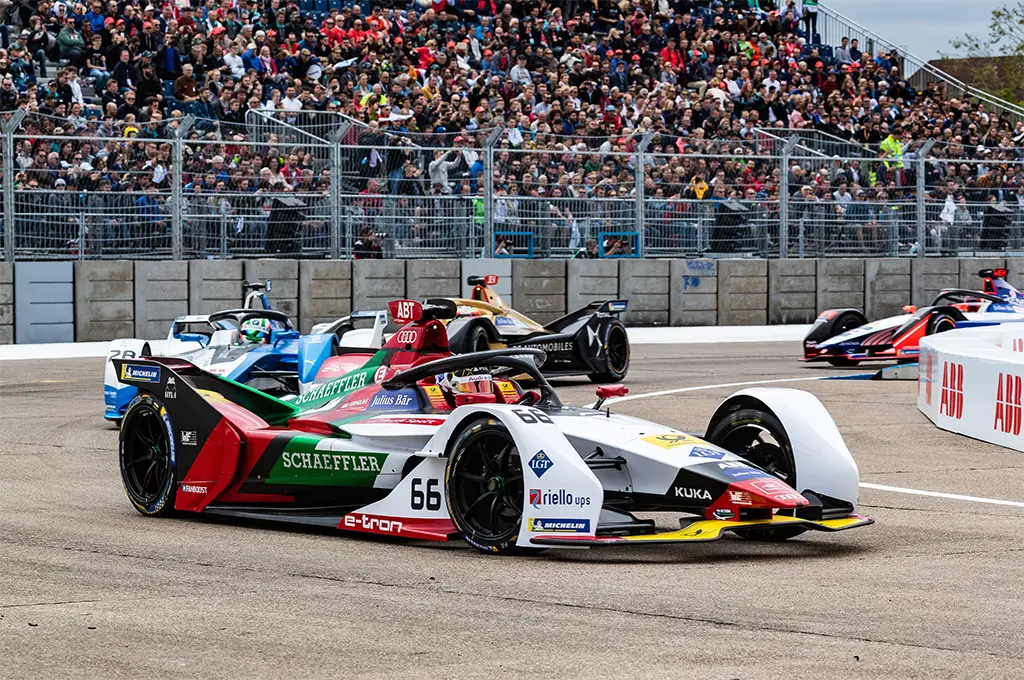
Waldenburg (Germany), 28 May 2019 – On 25 May the Formula E circus returned to the closed-down airfield at Berlin Tempelhof, transforming it into a suspense-packed venue for motor sport. And once again, Würth Elektronik was there as a technology partner: 70 customers and employees lined the race circuit, cheering on the Audi Sport ABT Schaeffler team with its pilots, Daniel Abt and Lucas di Grassi – with success.

RelatedPosts

Modelithics Library for MATLAB: Measurement-Based Models for Microwave and RF Passive Components

Bourns Extends Multilayer Chip Inductors Offer for RF and Wireless Designs

Penn State Demonstrated Polymer Alloy Capacitor Film with 4× Energy Density up to 250C

The home race in Germany heralded the hotly contested closing stages for the Audi Sport ABT Schaeffler race team in this year’s racing season. At the end, there was a clear winner among the 11 teams taking part: Lucas di Grassi won the Berlin race, while Daniel Abt crossed the finishing line in sixth place. This means now, after the tenth of the thirteen races this season, the team currently occupies second place in the Team World Constructors Championship.

There are just three races to follow: the Bern ePrix on 22 June, and the double race in New York on 13 and 14 July. Alexander Gerfer, CTO of the Würth Elektronik eiSos Group, is very pleased with the positive result of the Berlin race: “Once again it was an unbelievably exciting experience to follow the race from so close up. As the technology partner for Audi Sport ABT Schaeffler, we’re naturally particularly proud about this absolutely fantastic result.” Oliver Konz, CEO of the Würth Group, adds: “Yet again the team has shown what it’s capable of. Our success proves we’re all on the right track. For all of us, it was another great day beyond our expectations.”

On the race day itself, the spectators experienced highly tense moments and pure emotion – not just on the stands directly lining the circuit, but also in the eVillage, which again drew many visitors. This is where sport, technology, and entertainment meet: fans can meet and greet the pilots at the autograph sessions, get a close-up look at the cars of the future, and enjoy an exciting program of events in the area of e-mobility.

Peak innovation and technological performance

Würth Elektronik has been supporting the Audi Sport ABT Schaeffler team as a technology partner ever since the very first racing season in 2014. Back then, Lucas di Grassi brought home a historic win in the first fully electronic racing series in Beijing. In the third season (2016/2017), Lucas di Grassi won the world championship, and in the fourth season (2017/2018) Audi Sport ABT Schaeffler became the Team World Constructors Champion.

The technology behind the scenes has progressed rapidly too, and with each new season there are more technological in-house developments launched which advance e-mobility further still. This has led to the constant advances in the development of the components integrated in the cars and the growth of the group’s portfolio of electronic and electromechanical components.

As Alexander Gerfer points out: “For us, Formula E is a testing ground in which we can put components to the test under extreme conditions. This is where we draw essential impulses for the further development of our automotive and converter components. In return, the team gets full access to our ‘more than you expect!’ services: lab equipment, customer-specific solutions, and a swift delivery service are just some of the benefits our customers in the Formula E field have come to appreciate. The test labs, for example, are fitted out with state-of-the-art equipment: the team can run their tests here and take x-ray images to trouble-shoot in the event of malfunctions. Just like on the racetrack – what’s called for here is speed and swiftly finding solutions”.

Innovative areas of applications in which the components supplied by Würth Elektronik eiSos can be used include new mobility, 3D printing, and wireless connectivity. These topics are under continual development at the Competence Center and the eiCamp on the EUREF Campus of the Berlin facility, the center for start-ups and metropolis for the mobility of tomorrow.
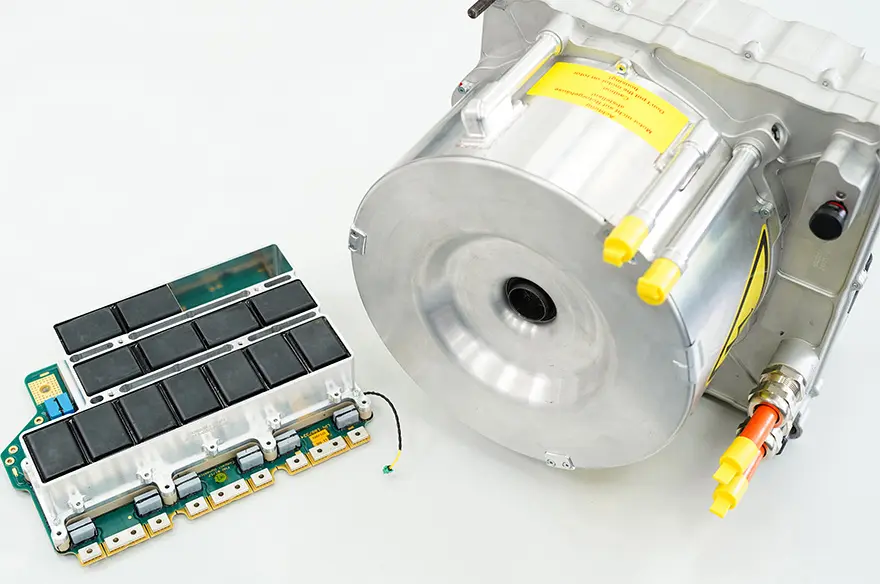
One of the components that makes up the car: PCB with REDCUBE terminals made by Würth Elektronik next to the e-motor casing.
Related

Recent Posts

Researchers developed a polymer capacitor by combining two cheap, commercially available plastics. The new polymer capacitor makes use of the transparent material — pictured here, with vintage Penn State athletic marks visible through it — to store four times the energy and withstand significantly more heat.  Credit: Penn State

Penn State Demonstrated Polymer Alloy Capacitor Film with 4× Energy Density up to 250C

19.2.2026
19

Vishay Unveils Ultra-Compact 0201 Thick Film Chip Resistors

19.2.2026
9

Würth Elektronik Component Data Live in Accuris

19.2.2026
14

Coilcraft Releases Automotive Common Mode Chokes

19.2.2026
10

SCHURTER Introduces 2410 SMD Fuse for Robust AC/DC Protection

17.2.2026
12

TDK Releases High Temp 175C Automotive NTC thermistors

17.2.2026
13

Vishay Releases Sulfur‑Resistant Chip Resistors

12.2.2026
11

Würth Elektronik Introduces Lead-Free SMT Spacers

11.2.2026
24

TDK Unveils 125C Compact DC Link Film Capacitors

11.2.2026
34

Upcoming Events

Feb 24
16:00 - 17:00 CET

Mastering Galvanic Isolation: Ensuring Safety in Power Electronics

Mar 3
16:00 - 17:00 CET

Cybersecurity at the Eleventh Hour – from RED to CRA – Information and Discussion

Mar 21
All day

PSMA Capacitor Workshop 2026

View Calendar

Popular Posts

  • Buck Converter Design and Calculation

    0 shares
    Share 0 Tweet 0
  • Boost Converter Design and Calculation

    0 shares
    Share 0 Tweet 0
  • LLC Resonant Converter Design and Calculation

    0 shares
    Share 0 Tweet 0
  • Flyback Converter Design and Calculation

    0 shares
    Share 0 Tweet 0
  • Ripple Current and its Effects on the Performance of Capacitors

    3 shares
    Share 3 Tweet 0
  • Dual Active Bridge (DAB) Topology

    0 shares
    Share 0 Tweet 0
  • What is a Dielectric Constant and DF of Plastic Materials?

    4 shares
    Share 4 Tweet 0
  • MLCC and Ceramic Capacitors

    0 shares
    Share 0 Tweet 0
  • MLCC Case Sizes Standards Explained

    0 shares
    Share 0 Tweet 0
  • SEPIC Converter Design and Calculation

    0 shares
    Share 0 Tweet 0

Newsletter Subscription


Passive Components Blog

© EPCI - Leading Passive Components Educational and Information Site

  • Home
  • Privacy Policy
  • EPCI Membership & Advertisement
  • About

No Result
View All Result
  • Home
  • Knowledge Blog
  • PCNS

© EPCI - Leading Passive Components Educational and Information Site

This website uses cookies. By continuing to use this website you are giving consent to cookies being used. Visit our Privacy and Cookie Policy.
Go to mobile version