








YAGEO Group releases SMD 0402 FC Pt-RTD sensor adds an ultra‑compact, high‑precision temperature monitoring option for designs where space, thermal response time, and long‑term stability are critical.
It targets applications from industrial metering and data logging to emerging robotics and AI cooling environments, where reliable temperature feedback directly impacts system safety and performance.
Key features and benefits
- Ultra‑small footprint for tight spaces
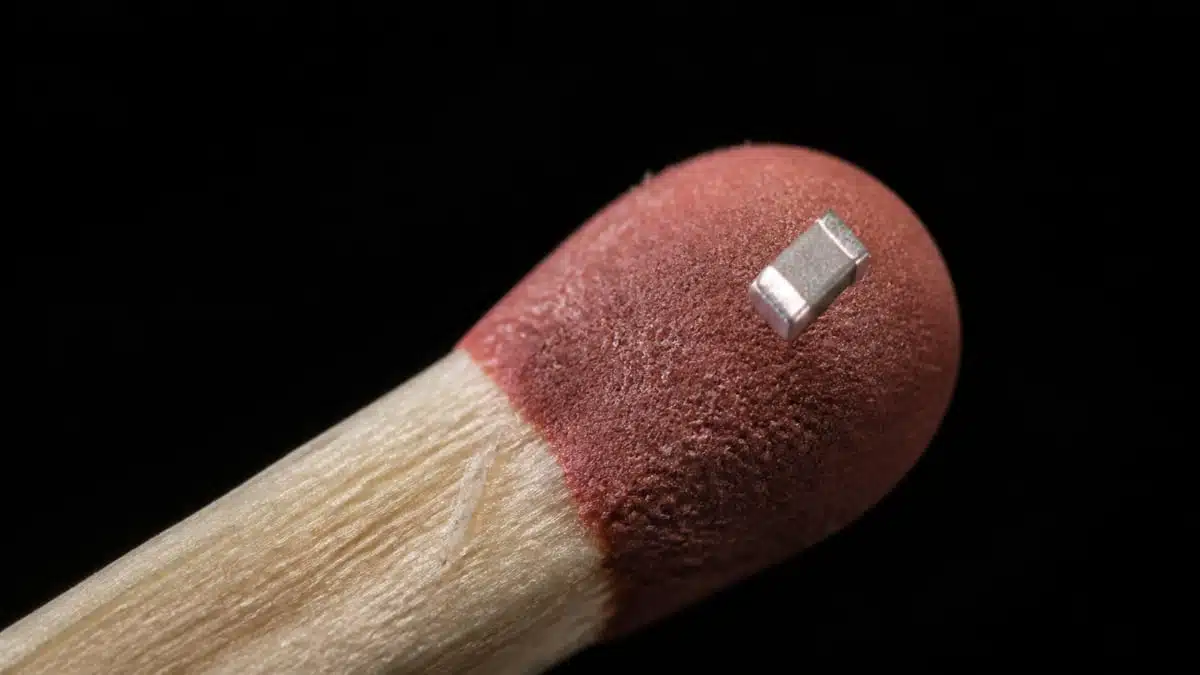
The 0402 FC Pt-RTD footprint of approximately 1.0 mm × 0.5 mm with a thickness around 280 µm allows placement in very constrained mechanical envelopes, including in between interface layers or under housings where conventional probe geometries are impractical. - Standardized platinum RTD behavior
The device is an SMD FC type according to DIN EN 60751, meaning its resistance–temperature characteristic follows the widely used platinum RTD standard curve, simplifying interface design and easing calibration and compliance. - Wide operating temperature range
The specified operating range from about −50 °C up to +170 °C (with capability up to approximately 250 °C according to manufacturer information) covers typical industrial, HVAC, and many electronics cooling scenarios, enabling use in both cold and hot measurement points without switching sensor types. - Multiple nominal resistances and tolerance classes
Nominal resistance options include 100 Ω and 1000 Ω, combined with tolerance classes F0.3 and F0.6 according to DIN EN 60751, allowing engineers to match sensor accuracy and interface impedance to the requirements of each design. Higher accuracy (F0.3) supports demanding measurement and control loops, while F0.6 offers a cost‑effective fit for less critical channels. - Fast thermal response
Low thermal mass and good thermal conductivity of the sensing structure enable rapid response to temperature changes, making this sensor suitable for dynamic thermal monitoring, quick startup diagnostics, and protection functions where delays can lead to overshoot or derating. - Robust against humidity
Compared with NTC thermistors, the Pt-RTD structure offers higher humidity resistance, improving long‑term stability in moist or condensing environments such as HVAC equipment, outdoor metering, or sealed housings with limited environmental control. - SMD‑friendly mechanical design
AgPt screen‑printed contact pads on the upper side, combined with an electrically insulated backside, support pick‑and‑place assembly and high‑volume SMT processes, while maintaining insulation to underlying PCB copper or metal structures. - Long‑term stability and low drift
The sensor is designed for high accuracy over a long lifetime with low signal drift, which is important for metering and logging applications where periodic recalibration is costly and access to the equipment is limited.
Typical applications
The YAGEO SMD 0402 FC Pt-RTD is intended for a variety of precision temperature monitoring tasks in compact electronics. Typical use cases include:
- Industrial equipment and process control
Embedded temperature feedback in control boards, actuators, and compact sensor modules, where the 0402 footprint allows integration close to heat sources or critical mechanical interfaces. - Heat and cold meters (HVAC)
Thermal energy meters and HVAC controllers require stable, standardized temperature sensing over many years; the DIN EN 60751 behavior and high humidity resistance support reliability in piping and manifold environments. - Data loggers and monitoring units
Portable or panel‑mount data loggers benefit from the low profile and small footprint when multiple temperature channels must fit on a dense PCB, with the option of 1000 Ω elements to reduce self‑heating in continuous measurement. - Pressure sensors and transducers
Pressure transducers often need integrated temperature compensation; the 0402 sensor can be placed close to the sensing element or media interface, giving accurate local temperature data without significantly altering mechanical packaging. - Medical devices and wearables
Compact medical electronics and wearables require low mass, fast‑responding temperature sensors that can sit close to the skin or inside tight device housings; the sensor supports small probe geometries and thin interface stacks. - Solar equipment and power electronics cooling
Temperature monitoring of junction boxes, power converters, and cooling plates in solar installations benefits from small, stable sensors that can be embedded near hotspots or under thermal pads. - Robotics and AI cooling environments
High‑density compute and robotic systems often need granular thermal mapping; the 0402 FC Pt-RTD can be distributed across a PCB or between cooling interfaces to provide localized, accurate temperature data for dynamic thermal management.
Technical highlights
Below is a summary of key technical parameters as presented in the manufacturer information and product brief.
Portfolio overview
| Parameter | Value / options |
|---|---|
| Sensor type | SMD FC Pt-RTD according to DIN EN 60751 |
| Size options | 0402, 0805 |
| Typical 0402 dimensions | ~1.0 mm × 0.5 mm, thickness ~280 µm |
| Nominal resistance (R₀) | 100 Ω, 1000 Ω |
| Tolerance classes | F0.3, F0.6 |
| Temperature range | −50 °C to +170 °C (up to ~250 °C per datasheet) |
| Contacts | AgPt screen‑printed pads on upper side |
| Backside | Electrically insulated |
For design work, exact ratings, curves, and mechanical drawings should be taken directly from the manufacturer datasheet rather than inferred from summary values.
Electrical and thermal behavior
- Linear signal for simple electronics
Pt-RTD elements provide an approximately linear resistance change with temperature over their operating range, which simplifies signal conditioning compared with strongly nonlinear NTC thermistors and supports ratiometric measurement with basic bridge or constant‑current circuits. - Interface options for 100 Ω vs. 1000 Ω
A 100 Ω nominal element is common in industrial and instrumentation systems, compatible with standard Pt100 measurement front ends. The 1000 Ω variant (Pt1000‑like behavior) can reduce current requirements and self‑heating in low‑power or battery‑driven devices and improve resolution for certain ADC input ranges. Exact scaling follows the manufacturer’s specified R–T curve. - Tolerance classes and system accuracy
DIN EN 60751 tolerance classes (F0.3, F0.6) define maximum deviation from the ideal curve over temperature. F0.3 devices offer tighter accuracy, at the expense of tighter calibration and potentially higher cost, while F0.6 is adequate for many control and monitoring functions where a small absolute error is acceptable.
Design‑in notes for engineers
- Placement near thermal interface layers
The very low thickness (around 280 µm) and small footprint enable placement between thermal interface materials, under shields, or directly adjacent to components with minimal mechanical impact. Care should be taken to maintain adequate electrical insulation according to the datasheet and PCB stackup. - Land pattern and soldering considerations
As an SMD component with AgPt pads on the upper side and an insulated backside, the sensor is suitable for standard SMT pick‑and‑place operations. Follow the land pattern and reflow profile recommended by the manufacturer to avoid mechanical stress or drift due to soldering conditions. - Self‑heating and measurement current
As with any RTD, measurement current must be chosen to limit self‑heating. Using the 1000 Ω variant in low‑power applications can reduce current levels while maintaining adequate signal amplitude, especially in continuous monitoring or battery‑powered devices. Reference the manufacturer’s guidance for recommended excitation currents. - Shielding and EMC
Although the sensor is primarily a low‑frequency device, routing and layout around the measurement traces should consider EMC practices: short differential leads to the front‑end, appropriate filtering, and shielding if the signal lines run near high dV/dt or high dI/dt nodes in power converters or motor drives. - Calibration and system accuracy budgeting
For metering and instrumentation, error budgeting should include sensor tolerance (F0.3 or F0.6), front‑end linearization, ADC resolution, and any offset introduced by mechanical installation. Where regulatory compliance is required (e.g., energy metering), use datasheet limits and standardized calibration procedures. - Mechanical reliability in harsh environments
In industrial and HVAC deployments with vibration, humidity, and temperature cycling, PCB mounting, encapsulation, and conformal coating practices should follow manufacturer recommendations. The sensor’s humidity resistance compared to NTCs is advantageous, but mechanical and chemical exposure must still stay within datasheet limits. - Migration from NTC and other sensors
Engineers moving from NTC thermistors to Pt-RTD elements gain more linear behavior and standardized characteristics, at the cost of a more resistive element and different signal conditioning. Existing designs may reuse PCB real estate with minor changes if they can accommodate the SMD 0402 footprint and RTD front‑end circuitry.
Source
The information in this article is based on the manufacturer’s official press release and associated product brief for the SMD 0402 FC Pt-RTD sensor portfolio, combined with general engineering interpretation of RTD behavior. For detailed numerical specifications and tolerances, consult the original datasheet and documentation provided by YAGEO Group.