







A team at the Hefei Institutes of Physical Science, Chinese Academy of Sciences, led by Zhenyang Wang, reported a monolithic, functionally graded thick cathode for aqueous zinc-ion hybrid capacitors.
The work was published in the peer-reviewed journal Composites Part B: Engineering in 2026; it is not a preprint. The paper evaluates a laser-engineered zinc-ion cathode that combines conductive porous graphene, a manganese-oxide storage region and an oxygen-functionalized outer surface in one continuous electrode architecture.
Key takeaways
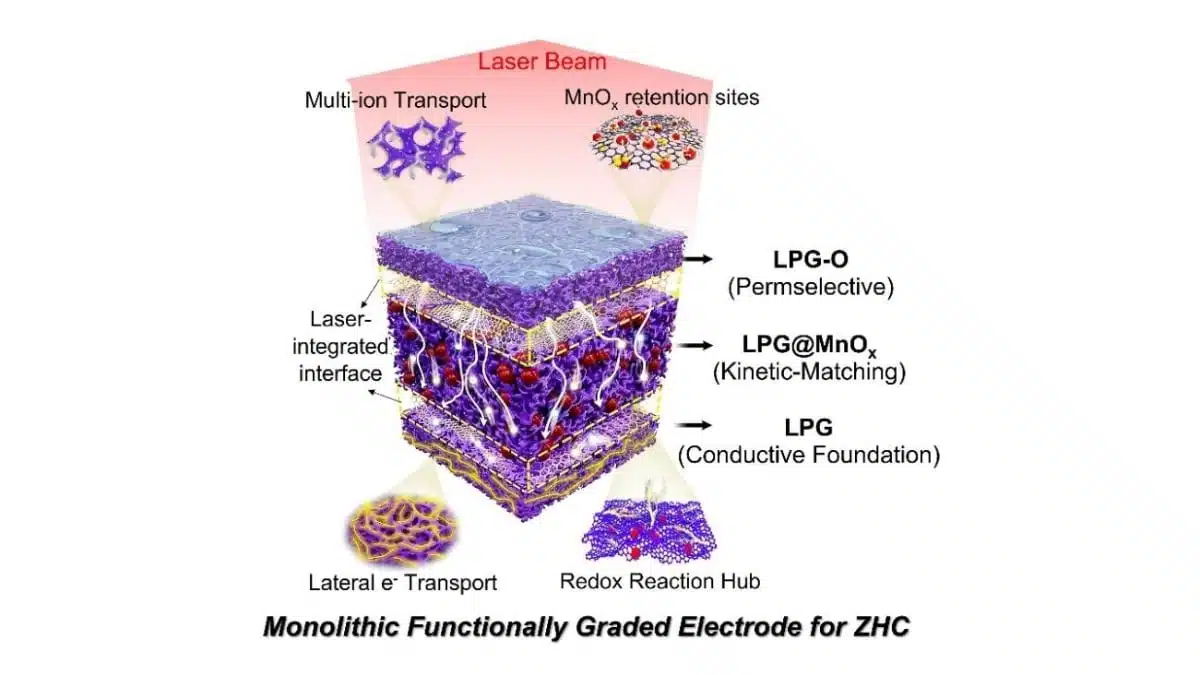
- The cathode uses three laser-defined functional regions: a conductive laser-patterned graphene core, a MnOx-containing charge-storage region and an oxygen-rich outer graphene surface.
- The monolithic architecture is intended to maintain simultaneous electron transport and electrolyte/ion access as electrode thickness and active-material loading increase.
- The reported thick electrode retained 93.6% capacitance after 12,000 charge–discharge cycles; the available press material does not state the current density, voltage window, areal loading or temperature for this figure.
- The work combines electrochemical testing, simulations and post-cycling structural analysis. The proposed oxygen-rich surface is associated with improved electrolyte wetting/access and reduced manganese loss during cycling.
- This is an electrode-architecture demonstration rather than a qualified commercial capacitor technology. Its most direct relevance is to high-areal-capacitance aqueous zinc-ion hybrid capacitors, including flexible or form-factor-constrained energy-storage devices.
Background
Zinc-ion hybrid capacitors sit between conventional electrical double-layer capacitors and rechargeable zinc batteries. A zinc-metal negative electrode supplies a battery-type zinc plating/stripping process, while the positive electrode commonly relies on porous carbon, redox-active oxides, or a combination of capacitive and faradaic storage. The architecture aims to combine the aqueous-electrolyte safety and potentially low material cost of zinc systems with faster power delivery than many battery-only chemistries.
For practical devices, increasing the mass of active material per unit area is essential. A thin laboratory electrode can produce attractive gravimetric figures while storing little energy per square centimetre. Raising thickness or loading, however, normally lengthens ionic diffusion paths, raises through-plane electronic resistance and worsens wetting of internal pore volume. The result is familiar to capacitor engineers: lower rate capability, incomplete use of active material, increased polarization and, often, accelerated cycling damage.
The central challenge is therefore not simply obtaining a porous carbon structure. It is maintaining an electrically continuous current-collection network while ensuring that electrolyte can penetrate and refresh the active region across the entire electrode thickness. That concern overlaps with the thick-electrode problem in battery electrodes, pseudocapacitors and high-loading supercapacitor electrodes.
The present concept uses laser processing to introduce a spatial division of functions within a single porous graphene-based electrode. This differs from a separately laminated multilayer stack, where interfaces between layers can introduce contact resistance, delamination risk or discontinuous pore pathways. Related context is covered in Zinc-ion Hybrid Capacitors with Ideal Anions in the Electrolyte Show Low Self-Discharge and Extra-Long Performance, which illustrates how electrolyte composition and electrode-interface chemistry can influence zinc-ion capacitor behavior.
What the researchers found
The reported electrode is described as a step-wise functionally graded LPG/LPG@MnOx/LPG-O structure. In the naming used by the research team, LPG denotes laser-processed porous graphene. The three zones are integrated into one continuous structure:
| Electrode region | Intended function | Engineering implication |
|---|---|---|
| Inner LPG region | Electronic conduction pathway | Supports through-thickness current transport in a thick porous electrode |
| Middle LPG@MnOx region | Redox-active charge storage | Adds manganese-oxide faradaic storage to the graphene scaffold |
| Outer LPG-O region | Oxygen-functionalized electrolyte-facing surface | Improves wetting and electrolyte entry into the porous cathode |
The sequential laser-engineering process forms these regions without presenting them as separately stacked electrode layers. This matters because a monolithic porous scaffold can, in principle, avoid some interfacial discontinuities inherent in multilayer coating and assembly.
The available institute release reports 93.6% capacitance retention after 12,000 cycles for the thick electrode. It also states that a zinc-ion hybrid-capacitor device assembled using the graded cathode exhibited stable energy-storage behavior. However, the accessible press-release material does not disclose enough of the underlying paper’s experimental detail to publish further values responsibly: electrode thickness, MnOx mass loading, electrolyte composition and concentration, voltage limits, current density, reference electrode configuration, initial capacitance, coulombic efficiency, areal capacitance, energy density and power density all need to be taken directly from the full publisher text and supplementary information before final publication.
Post-cycling analysis and simulations were used to interpret the role of the oxygen-rich outer region. The proposed mechanism has two linked elements: improved electrolyte access to the porous electrode interior, and mitigation of Mn dissolution or loss during repeated cycling. Manganese dissolution is a consequential failure mechanism in MnOx based aqueous electrodes because it can progressively reduce active mass and alter the electrode/electrolyte interface.
Why the laser-engineered zinc-ion cathode matters
For passive-component engineers, the interest is in the route to higher areal energy storage without accepting the rate penalty that normally accompanies thicker electrodes. In an energy-storage component, gravimetric capacitance alone does not determine system value. Electrode thickness, active loading, current-collector fraction, packaging, electrolyte volume and separator all affect usable device-level energy density.
The graded structure targets three limiting parameters at once:
- Electronic resistance: the internal graphene region is designed as a continuous low-resistance pathway. This could reduce voltage loss under higher current compared with a poorly percolated high-loading composite.
- Ionic transport and wetting: oxygen-containing surface groups can increase affinity for an aqueous electrolyte, helping the electrolyte penetrate rather than only wet the electrode exterior.
- Active-material retention: confining or stabilizing MnOx may slow loss of the redox-active phase, which is particularly relevant to long-cycle aqueous zinc systems.
The expected effect is not a direct substitute for an MLCC, aluminum electrolytic capacitor or EDLC. Zinc-ion hybrid capacitors remain electrochemical energy-storage devices with substantially different voltage ranges, leakage behavior, frequency response, operating-temperature constraints and lifetime qualification requirements. Their likely application space is therefore low-voltage energy buffering, pulse-power support, energy harvesting, flexible electronics and potentially distributed storage where aqueous chemistry is valued.
The paper is also relevant to the broader design rule that transport pathways should be engineered at the same scale as active-material loading. The same principle appears in 2D Porous Carbon Nanosheets for Zinc‑Ion Hybrid Supercapacitors, where accessible pore structure is a central factor in obtaining usable rate capability and cycling stability.
From lab to component
This should be treated as a lab-scale electrode and device prototype, not as a near-term replacement for established capacitor technologies. An appropriate editorial estimate is TRL 3–4: the team has demonstrated an experimentally fabricated electrode architecture and device-level cycling behavior, but not yet manufacturing-scale reproducibility, standardized reliability qualification or integration into commercial packages.
Laser patterning offers an attractive path to localized processing and potentially maskless pattern definition. Yet its production case depends on several unresolved factors:
- Laser throughput, yield and energy consumption for larger electrode areas.
- Uniformity of the graded chemistry through the full electrode thickness and over roll-to-roll-scale area.
- Repeatability of MnOx deposition or formation, including active-mass control between batches.
- Mechanical robustness during winding, stacking, calendering, pouch encapsulation and thermal cycling.
- Compatibility of the porous graphene architecture with zinc-anode behavior, separator selection, electrolyte management and self-discharge control.
- Validation at practical areal loadings and under device-relevant current, storage and temperature conditions.
The cathode’s oxygen-rich surface is useful only if it provides stable wetting without creating excessive parasitic reactivity, uncontrolled surface oxidation, gas evolution or increased self-discharge. Likewise, manganese retention needs to be assessed not only after constant-current cycling but after calendar storage, voltage hold, temperature exposure and realistic duty cycles.
What engineers should watch
- Areal metrics: Look for electrode thickness, mass loading, areal capacitance and device-level areal energy density, not only values normalized by active-material mass.
- Rate-test conditions: Confirm current density, voltage window, electrolyte composition, temperature and whether capacitance retention is reported for the electrode or the complete zinc-ion hybrid cell.
- MnO
_xstability: Quantitative post-mortem analysis of dissolved manganese, retained active mass and changes in oxidation state would clarify whether the surface treatment materially improves lifetime. - Zinc-anode reliability: Dendrite formation, hydrogen evolution, corrosion, zinc-utilization efficiency and separator robustness can dominate practical life in aqueous zinc devices.
- Self-discharge and leakage: High-capacitance retention under cycling does not by itself establish acceptable stored-energy retention during open-circuit storage.
- Manufacturability: Demonstrations on larger-area substrates, statistical batch variation, laser-process speed and mechanical endurance will determine whether the monolithic graded architecture can move beyond laboratory fabrication.
Summary
The research demonstrates a laser-engineered zinc-ion cathode in which porous graphene, MnOx storage material and an oxygen-rich electrolyte-facing surface are organized as a continuous, functionally graded thick electrode. The reported 93.6% capacitance retention after 12,000 cycles indicates that the architecture can remain electrochemically active over extended laboratory cycling.
Its importance lies in addressing the thick-electrode transport problem: active material must be loaded densely enough to provide useful areal storage while retaining accessible ion pathways and a continuous electronic network. For designers, the key point is that any future performance claim should be assessed first against practical areal loading, electrolyte and voltage conditions, self-discharge and full-device reliability—not capacitance retention alone.
Further reading
- Zn-Ion Supercapacitors: Merging Batteries and Capacitors
- Researchers Developed Ti/Si/C Composite Zinc-ion Hybrid Supercapacitor
- MXene Zinc-Ion Supercapacitor with Anti-Self-Discharge
Source
This article is based on a peer-reviewed paper published in Composites Part B: Engineering and the accompanying release from the Hefei Institutes of Physical Science, Chinese Academy of Sciences. The publisher page and accessible institutional release did not provide a verifiable open-access licence in the material reviewed. These are research results rather than qualified commercial components; engineers should await manufacturer datasheets, independent replication and applicable standard qualification before making a design decision.
References
- Wang, Zhenyang, et al., “Laser-engineered monolithic thick functionally graded cathodes for high-rate zinc-ion hybrid capacitors,” Composites Part B: Engineering, article 114171, 2026, https://doi.org/10.1016/j.compositesb.2026.114171. Licence not verified from the accessible publisher record.
- Hefei Institutes of Physical Science, Chinese Academy of Sciences, “Laser-Engineered Cathode Improves Zinc-Ion Hybrid Capacitors,” 17 September 2026, https://english.hf.cas.cn/nr/bth/202609/t20260917_1200783.html.
- Chinese Academy of Sciences, “Laser-engineered Cathode Improves Zinc-ion Hybrid Capacitors,” 21 September 2026, https://english.cas.cn/newsroom/research-news/202609/t20260920_1200887.shtml.