






YAGEO Group has expanded its high-reliability polymer tantalum capacitor portfolio for aerospace, defence and other mission-oriented electronics.
The YAGEO announcement brings together several established high-reliability tantalum capacitor series—T540, T541, T543, T550 and T581—covering moulded SMD, multi-anode SMD, up-screened SMD and hermetically sealed constructions.
Key features and benefits
- The portfolio covers polymer tantalum capacitors from 2 V to 180 V and 1.5 µF to 8,200 µF at portfolio level.
- Published series include T540 and T541 high-reliability moulded polymer tantalum capacitors, T543 up-screened devices, T550 hermetically sealed axial capacitors, and T581 parts qualified to MIL-PRF-32700/2.
- T540 and T541 components operate from −55 °C to +125 °C, with rated voltage specified at +105 °C and derated voltage values published for +125 °C operation.
- The T541 is a multiple-anode polymer tantalum series. Multiple-anode construction can reduce ESR in high-capacitance, low-voltage positions when compared on a part-specific basis.
- The T550 axial family combines polymer cathode technology with a hermetic enclosure and is specified for operation from −55 °C to +105 °C.
- YAGEO positions the portfolio for filtering and decoupling in fast-switching DC/DC converters, as well as aerospace, defence, communications and radar-related hardware. The applicable qualification level and exact screening option must be selected at part-number level.
Technical highlights
The portfolio announcement names five series and one surface-mount companion family:
| Series | Package / format | Published distinction |
|---|---|---|
| T540 | Moulded SMD | High-reliability polymer tantalum |
| T541 | Moulded SMD | Multiple-anode polymer tantalum |
| T543 | Moulded SMD | Up-screened high-reliability option |
| T550 | Axial leaded | Hermetically sealed polymer tantalum |
| T555 | Surface mount | Hermetically sealed polymer tantalum |
| T581 | SMD | MIL-PRF-32700/2-qualified series |
The T540 and T541 product documentation identifies a polymer tantalum dielectric system in moulded SMD packages. T541 part-number data includes 100 µF, 25 V and 30 V examples in the 2817 / 7343 case size, with a 4.3 mm height. Specific values vary substantially by ordering code and should not be transferred between variants.
| Parameter | T540 example | T541 example |
|---|---|---|
| Capacitance | 22 µF | 100 µF |
| Tolerance | ±20% | ±10% |
| Rated voltage | 25 V DC | 30 V DC |
| Voltage at +125 °C | 16.75 V DC | 20.1 V DC |
| ESR at 100 kHz | 100 mΩ | 70 mΩ |
| Ripple current | 1.50 A rms | 1.878 A rms |
| Temperature range | −55 °C to +125 °C | −55 °C to +125 °C |
The values above apply only to the published examples and illustrate why selection must be made from the current part-specific specification. For example, a 30 V T540D226M030BT8505 is specified at 22 µF, ±20%, 100 mΩ maximum ESR at 100 kHz and 1.5 A rms ripple current at 100 kHz and +45 °C. Its published endurance condition is 2,000 hours at +125 °C, while the stated humidity test condition is +85 °C, 85% RH, 1,000 hours at rated voltage.
The T550 hermetically sealed axial series includes published 100 µF, 60 V and 20 µF, 60 V variants with 200 mΩ ESR. The current T550 series document specifies a maximum operating temperature of +105 °C and includes DLA Drawing 13030-qualified options. The same document also identifies a T555 surface-mount format within the hermetically sealed polymer tantalum family.
T581 is the newest named military-performance series in the release. The announcement identifies T581 as meeting MIL-PRF-32700/2, while YAGEO’s annual-report material identifies a 35 V rated-voltage T581 series. Detailed capacitance, case-size, ESR, ripple-current and screening information should be confirmed from the current T581 specification before design release.
Typical applications
The published electrical characteristics support use in low- and medium-voltage power-distribution positions where high capacitance, low ESR and elevated-temperature operation are required.
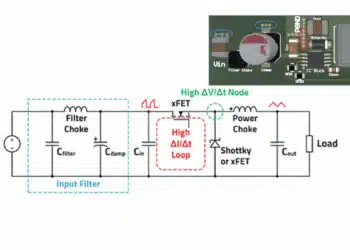
- DC/DC converter input and output capacitors: The published capacitance values, low ESR figures and ripple-current ratings support bulk decoupling and ripple-current filtering around switching regulators. See Capacitors Selection for DC/DC Converters for the wider capacitor-selection criteria in converter input and output stages.
- Point-of-load decoupling: T540, T541 and T543 SMD variants can suit local energy storage and transient-current support where the available voltage derating, ESR and ripple-current limits match the rail and load profile.
- Aerospace and defence power-management boards: The T550 hermetic series, DLA Drawing 13030 options and T581 MIL-PRF-32700/2 qualification address programmes that require controlled product documentation and defined performance specifications.
- Radar, RF, communications and flight-control power rails: The announcement identifies these end markets. The circuit position still needs to be established from the selected part’s capacitance, impedance-versus-frequency data, DC-bias condition and ripple-current limit.
- Munitions, missiles, drones and satellites: These markets are named in the portfolio announcement. AEC-Q200 qualification is a passive-component stress-test qualification and does not establish suitability for a military, airborne or space mission by itself; see MIL Spec MIL-PRF vs Automotive AEC-Q200 Explained.
Application fit
| Circuit position | Relevant published ratings | Selection check |
|---|---|---|
| DC/DC output | Capacitance, ESR, ripple current | Control-loop stability |
| Input bulk decoupling | Rated voltage, ripple current, ESR | Surge and inrush current |
| Point-of-load rail | Low ESR, SMD footprint, temperature | Transient load profile |
| Harsh-environment power | Temperature range, qualification | Programme-specific screening |
| Hermetic assembly | T550/T555 package family | Mounting and lead stress |
T541 is particularly relevant where a converter rail requires high capacitance in an SMD component while maintaining a low ESR target. The published T541X107K030AH8510 specification gives 100 µF, ±10%, 30 V DC at +105 °C, 20.1 V DC at +125 °C, 70 mΩ ESR and 1.878 A rms ripple current at 100 kHz and +45 °C. Those limits support power-rail filtering only where the actual RMS ripple, temperature rise and applied voltage remain within the specific part’s operating limits.
T550 is the relevant family where hermetic packaging, axial mounting and a +105 °C maximum operating temperature match the programme requirement. The available T550 and T555 formats should not be treated as mechanically interchangeable; board footprint, lead forming, mounting stress, solder process and vibration requirements need separate review.
The broad portfolio-level values in the announcement should not be used as design limits for any individual series. The announced 2 V to 180 V and 1.5 µF to 8,200 µF ranges span multiple series and package styles rather than defining the range of every part family.
Design-in notes for engineers
- Check the rated voltage at the actual operating temperature. Published T540 and T541 specifications include lower voltage values at +125 °C than at the +105 °C rated temperature.
- Set voltage derating from the current product specification, including normal rail tolerance, turn-on overshoot, converter fault response and repetitive transients. Refer to Tantalum and Niobium Capacitors for background on tantalum-capacitor derating and surge considerations.
- Calculate capacitor ripple current at the relevant switching frequency and load condition. Compare it with the part-specific ripple-current rating under its stated frequency and ambient-temperature conditions.
- Do not select from ESR alone. Converter stability can depend on capacitance tolerance, bias condition, temperature, ESR, ESL, layout parasitics and the control-loop compensation network.
- Confirm the current manufacturer drawing before PCB layout. Case codes such as 2817 / 7343 identify package dimensions, but height, terminal geometry, land pattern and soldering constraints remain part-number dependent.
- For aerospace and defence programmes, verify the exact qualification route: commercial, AEC-Q200, high-reliability alternative, source-controlled drawing, DLA drawing, MIL-PRF qualification or programme-specific up-screening.
- AEC-Q200 is not vehicle-level, aircraft-level, defence-system or space-system approval. Programme qualification, radiation assessment, environmental screening and lot-control requirements remain system-specific.
- The release names LEO satellite applications and automotive-grade alternatives, but no public radiation, outgassing or mission-level reliability documentation was identified in the reviewed portfolio documents for the series covered here. This should be verified under final operating and programme conditions.
- No public SPICE models, S-parameter files, impedance-versus-frequency curves, PCB land-pattern documents, product-change notices or lifecycle notices were identified in the reviewed material for the complete portfolio. Obtain the current documentation for the exact ordering code before schematic, layout and production release.
Further reading
- Capacitors Selection for DC/DC Converters
- MIL Spec MIL-PRF vs Automotive AEC-Q200 Explained
- Tantalum and Niobium Capacitors
- Tantalum Capacitors in Space Applications
Source
This article is based on the YAGEO Group portfolio announcement and official YAGEO Group product documentation for the named polymer tantalum series. Engineers should consult the latest manufacturer datasheet, applicable drawing, qualification documentation and programme-specific requirements before final qualification and design release.
References
- YAGEO Group: High-Reliability Polymer Tantalum Solutions for Aerospace & Defense
- YAGEO Group: KEMET Organic Capacitor (KO-CAP®) – High Reliability, T540 and T541
- YAGEO Group: T541X107K030AH8510 product specification
- YAGEO Group: T540D226M030BT8505 product specification
- YAGEO Group: T550 Axial & T555 Surface Mount 105°C
- YAGEO Group: T550B107M060AH4251 product specification
- YAGEO Group: T543X107M025ATE060 product specification
- YAGEO Group: T581 product-family selector entry