






Passive Components Blog
No Result
View All Result
  • Home
  • NewsFilter
    • All
    • Aerospace & Defence
    • Antenna
    • Applications
    • Automotive
    • Capacitors
    • Circuit Protection Devices
    • electro-mechanical news
    • Filters
    • Fuses
    • Inductors
    • Industrial
    • Integrated Passives
    • inter-connect news
    • Market & Supply Chain
    • Market Insights
    • Medical
    • Modelling and Simulation
    • New Materials & Supply
    • New Technologies
    • Non-linear Passives
    • Oscillators
    • Passive Sensors News
    • Resistors
    • RF & Microwave
    • Telecommunication
    • Weekly Digest

    Binder Extends NCC Circular Connectors for Harsh Environments

    Standard vs Planar LLC transformers Comparison for Battery Chargers

    Würth Elektronik and Grinn Launch Edge AI Cooperation

    Bourns Expanded Semi-Shielded Low Profile Automotive Power Inductor

    Peak Nano to Develop Fusion Grade High Energy Film Capacitors

    Murata New Vibration Sensor Targets High‑Frequency Predictive Maintenance

    Kyocera Releases 30fs Jitter Differential Clock Oscillator

    Panasonic Expands Automotive PP Film Capacitors Voltage Range

    Panasonic Extends Automotive Power Inductor Line

    Trending Tags

    • Ripple Current
    • RF
    • Leakage Current
    • Tantalum vs Ceramic
    • Snubber
    • Low ESR
    • Feedthrough
    • Derating
    • Dielectric Constant
    • New Products
    • Market Reports
  • VideoFilter
    • All
    • Antenna videos
    • Capacitor videos
    • Circuit Protection Video
    • Filter videos
    • Fuse videos
    • Inductor videos
    • Inter-Connect Video
    • Non-linear passives videos
    • Oscillator videos
    • Passive sensors videos
    • Resistor videos

    Standard vs Planar LLC transformers Comparison for Battery Chargers

    How Modern Tools Model Magnetic Components for Power Electronics

    Advanced Loss Modeling for Planar Magnetics in the Frenetic Planar Tool

    2026 Power Magnetics Design Trends: Flyback, DAB and Planar

    Enabling Software‑Defined Vehicle Architectures: Automotive Ethernet and Zonal Smart Power

    Calculating Resistance Value of a Flyback RC Snubber 

    One‑Pulse Characterization of Nonlinear Power Inductors

    Thermistor Linearization Challenges

    Coaxial Connectors and How to Connect with PCB

    Trending Tags

    • Capacitors explained
    • Inductors explained
    • Resistors explained
    • Filters explained
    • Application Video Guidelines
    • EMC
    • New Products
    • Ripple Current
    • Simulation
    • Tantalum vs Ceramic
  • Knowledge Blog
  • DossiersNew
  • Suppliers
    • Who is Who
  • PCNS
    • PCNS 2025
    • PCNS 2023
    • PCNS 2021
    • PCNS 2019
    • PCNS 2017
  • Events
  • Home
  • NewsFilter
    • All
    • Aerospace & Defence
    • Antenna
    • Applications
    • Automotive
    • Capacitors
    • Circuit Protection Devices
    • electro-mechanical news
    • Filters
    • Fuses
    • Inductors
    • Industrial
    • Integrated Passives
    • inter-connect news
    • Market & Supply Chain
    • Market Insights
    • Medical
    • Modelling and Simulation
    • New Materials & Supply
    • New Technologies
    • Non-linear Passives
    • Oscillators
    • Passive Sensors News
    • Resistors
    • RF & Microwave
    • Telecommunication
    • Weekly Digest

    Binder Extends NCC Circular Connectors for Harsh Environments

    Standard vs Planar LLC transformers Comparison for Battery Chargers

    Würth Elektronik and Grinn Launch Edge AI Cooperation

    Bourns Expanded Semi-Shielded Low Profile Automotive Power Inductor

    Peak Nano to Develop Fusion Grade High Energy Film Capacitors

    Murata New Vibration Sensor Targets High‑Frequency Predictive Maintenance

    Kyocera Releases 30fs Jitter Differential Clock Oscillator

    Panasonic Expands Automotive PP Film Capacitors Voltage Range

    Panasonic Extends Automotive Power Inductor Line

    Trending Tags

    • Ripple Current
    • RF
    • Leakage Current
    • Tantalum vs Ceramic
    • Snubber
    • Low ESR
    • Feedthrough
    • Derating
    • Dielectric Constant
    • New Products
    • Market Reports
  • VideoFilter
    • All
    • Antenna videos
    • Capacitor videos
    • Circuit Protection Video
    • Filter videos
    • Fuse videos
    • Inductor videos
    • Inter-Connect Video
    • Non-linear passives videos
    • Oscillator videos
    • Passive sensors videos
    • Resistor videos

    Standard vs Planar LLC transformers Comparison for Battery Chargers

    How Modern Tools Model Magnetic Components for Power Electronics

    Advanced Loss Modeling for Planar Magnetics in the Frenetic Planar Tool

    2026 Power Magnetics Design Trends: Flyback, DAB and Planar

    Enabling Software‑Defined Vehicle Architectures: Automotive Ethernet and Zonal Smart Power

    Calculating Resistance Value of a Flyback RC Snubber 

    One‑Pulse Characterization of Nonlinear Power Inductors

    Thermistor Linearization Challenges

    Coaxial Connectors and How to Connect with PCB

    Trending Tags

    • Capacitors explained
    • Inductors explained
    • Resistors explained
    • Filters explained
    • Application Video Guidelines
    • EMC
    • New Products
    • Ripple Current
    • Simulation
    • Tantalum vs Ceramic
  • Knowledge Blog
  • DossiersNew
  • Suppliers
    • Who is Who
  • PCNS
    • PCNS 2025
    • PCNS 2023
    • PCNS 2021
    • PCNS 2019
    • PCNS 2017
  • Events
No Result
View All Result
Passive Components Blog
No Result
View All Result

Automotive Safety Functionality ISO 26262, Second Edition, Calls for Semiconductor Development Requirements

15.5.2018
Reading Time: 4 mins read
A A

Source: TTI Market Eye article

05/14/2018 // Murray Slovick for TTI Market Eye
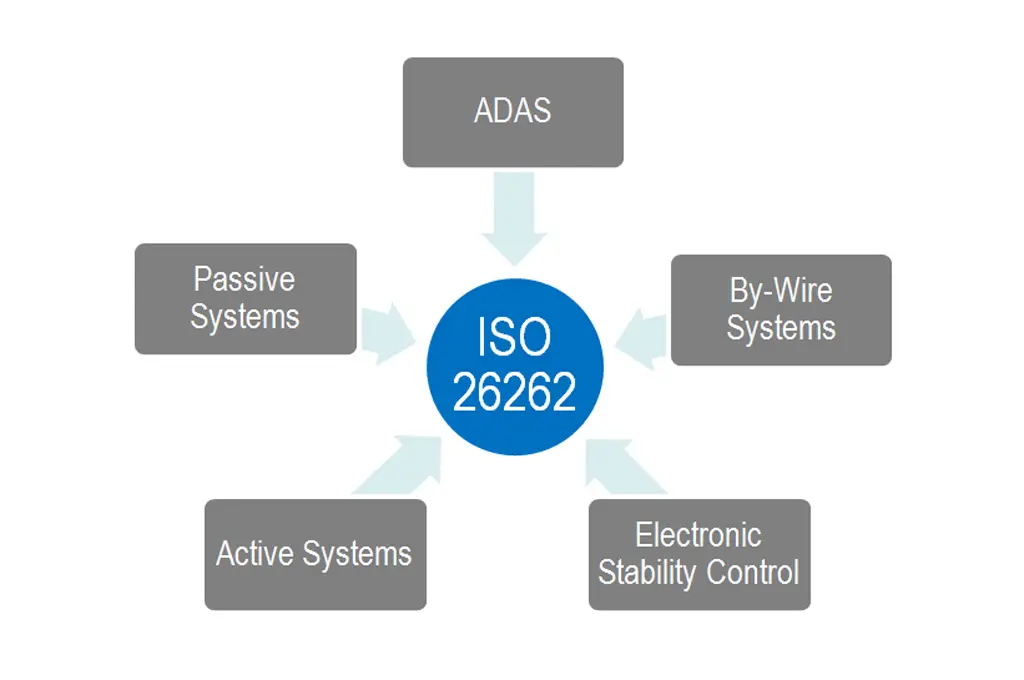
Functional safety is an immutable requirement for critical automotive systems. As such, in November 2011 the ISO 26262 standard was introduced defining the safety aspects for development of electric and electronic automotive systems. ISO 26262 describes all requirements to achieve functional safety. As an example: compliant systems must be able to identify their malfunctions and mitigate the effects such that passenger safety is preserved. Compliance with the standard is achieved between vehicle manufacturers, Tier 1 automotive suppliers, semiconductor suppliers and IP providers.

RelatedPosts

Binder Extends NCC Circular Connectors for Harsh Environments

Standard vs Planar LLC transformers Comparison for Battery Chargers

Würth Elektronik and Grinn Launch Edge AI Cooperation

The standard describes four automotive safety integrity levels (ASILs) ranging from level A, for the lowest integrity requirements and steps up through levels B and C to D, for the highest integrity requirements – which in turn define the various processes that automotive development teams must use to meet the standard. An ISO 26262 development flow sits alongside the main design flow and ensures that the SoC or associated IP meets the required functional safety level. Design teams working to meet ISO 26262 standards must systematically analyze the status of any component or system throughout the supply chain.

ISO 26262 quickly became the guiding standard for functional safety for the automotive development process. But in the seven years since 26262 was published much has changed: intensified use of car sharing services, development of Advanced Driver Assistance Systems (ADAS) and the emergence of self-driving vehicles, to name just three key technology drivers.

With automotive progress has come greater need for absolute certainty that electronic systems are going to perform as intended without malfunctioning. Autonomous vehicles, for example, bring the challenge of not just functional safety but fail-operational functionality, sometimes also referred to as fault-tolerance, where a failure in one component does not stop the whole system from working correctly – the system is expected to reconfigure itself as necessary to ensure that it does so.

Rapid progress in the development of ADAS and autonomous driving technology is now challenging the semiconductor industry to bring the rigorous safety standards used in the automotive industry to its design process.

The problem is that while ISO 26262 included a section on hardware development, the standard previously had no specific guidelines for semiconductors themselves.

Until now. A new second edition will be released this year and perhaps not long after you read this. Designated ISO 26262:2018 it will add two additional parts to the original standard. Importantly, in Part 11 this second edition will lay out guidelines for the application of ISO 26262 requirements to semiconductor development. Part 11 also addresses intellectual property (IP), specifically for ISO 26262-related silicon IP suppliers. Part 11 has been written to ensure that the 20662 standard remains relevant when applied to systems commonly used in ADAS and fully autonomous driving architectures. In this way it could help to close any safety gaps now appearing during on autonomous driving tests.

Part 11 guideline provides detailed information to help semiconductor manufacturers develop ISO 26262 compliant parts. The section has tips, recommendations, and examples for creating ISO 26262 compliant ICs and IP, and includes information on failure rates and transient faults, as well as specifying diagnostic coverage.

The update has numerous other changes, including sections on improving cybersecurity functional safety. Part 12 of the second edition adds specific content for motorcycles, trucks, buses, trailers and semi-trailers.

This forthcoming release will bring significantly more information to support semiconductor suppliers In the areas of digital and analog components, programmable logic devices (PLDs), multi-core processors and sensors and as well as silicon IP.

Let’s look at these one at a time:

  • The sub-section on digital components provides detailed definitions and guidance on fault models of components such as memories, discusses failure modes of common digital blocks, and shows how to estimate diagnostic coverage. It describes digital blocks, helps to determine failure rates, explains qualitative and quantitative analysis techniques and talks about use of verification via fault injection simulation.
  • In Analog and Mixed Signal Part 11 covers how to divide up an analog device to aid safety analysis and discusses potential failure modes, discusses Analog Single Event Transients (ASET) and under and overvoltage diagnostics Guidance is provided on the level of safety analysis required and examples of failure modes for common analog blocks given.
  • Functional safety must be considered both while developing and using a configurable component. Part 11 offers information on types of PLDs, shows the hardware assumptions generated by the PLD manufacturer that must be validated by the PLD user and highlights key failure modes and associated safety mechanisms. It also discusses avoidance of systematic faults and verification techniques.
  • In the sub-section on multicore Part 11 provides an introduction to the topic of multi-core components. It goes over the safety requirements previously allocated to separate hardware components, now allocated to a single multi-core component. Particular attention is paid to freedom from interference in multi-core components.
  • Sensors and transducers, covered in detail in ISO 26262 for the first time, starts with a general overview of sensors, failure modes, and production processes. It addresses Micro Electro Mechanical System (MEMS) functional safety evaluation and strives to clarify sensor failure modes and transducer failure modes and gives examples of root causes.
  • Since ICs typically contain intellectual property (IP) from suppliers (flash memory, standard cells, microcontrollers) Part 11 addresses IP, in particular with regard to any ISO 26262-related IP with one or more allocated safety requirements. It describes know how to handle all variations of IP and issues guidance for integrating in-context IP and pre-existing Safety Element out of Context (SEooC) IP. The section describes safety analysis content for different IP types and speaks to how other sections of ISO 26262 have been adapted to support IP.

Of course any automotive application also must meet the automotive reliability requirements defined by the Automotive Electronics Council’s AEC-Q100 “Stress Test Qualification for Packaged Integrated Circuits,” AEC Q101 for discrete parts, AEC-Q102 for Discrete Optoelectronics, AEC-Q104 for Multichip Modules and AEC-Q200 for passive components.
 

Related

Recent Posts

Bourns Expanded Semi-Shielded Low Profile Automotive Power Inductor

12.3.2026
9

Panasonic Expands Automotive PP Film Capacitors Voltage Range

9.3.2026
22

Panasonic Extends Automotive Power Inductor Line

9.3.2026
24

YAGEO Presents 3.6 kW LLC Transformer Platform

6.3.2026
46

Resistor Technology Dossier

4.3.2026
41

Mastering Galvanic Isolation in Power Electronics: Methods, Standards, and Implementation

2.3.2026
65

Bourns Releases Compact Automotive Isolation Power Transformer

2.3.2026
20

VINATech Targets AI Data Center Supercapacitor Boom

26.2.2026
70

TDK Introduces 350V Safety Film Capacitors for Compact EMI Suppression

26.2.2026
42

Upcoming Events

Mar 19
13:00 - 14:00 CDT

Smart Consideration of Inductor Thermal Performance

Mar 21
All day

PSMA Capacitor Workshop 2026

Apr 21
16:00 - 17:00 CEST

Heatsink Solutions: Thermal Management in electronic devices

View Calendar

Popular Posts

  • Buck Converter Design and Calculation

    0 shares
    Share 0 Tweet 0
  • Boost Converter Design and Calculation

    0 shares
    Share 0 Tweet 0
  • Flyback Converter Design and Calculation

    0 shares
    Share 0 Tweet 0
  • LLC Resonant Converter Design and Calculation

    0 shares
    Share 0 Tweet 0
  • MLCC Manufacturers Consider Price Increase as AI Demand Outpaces Supply

    0 shares
    Share 0 Tweet 0
  • Dual Active Bridge (DAB) Topology

    0 shares
    Share 0 Tweet 0
  • Ripple Current and its Effects on the Performance of Capacitors

    3 shares
    Share 3 Tweet 0
  • MLCC and Ceramic Capacitors

    0 shares
    Share 0 Tweet 0
  • MLCC Case Sizes Standards Explained

    0 shares
    Share 0 Tweet 0
  • 3-Phase EMI Filter Design, Simulation, Calculation and Test

    0 shares
    Share 0 Tweet 0

Newsletter Subscription


Passive Components Blog

© EPCI - Leading Passive Components Educational and Information Site

  • Home
  • Privacy Policy
  • EPCI Membership & Advertisement
  • About

No Result
View All Result
  • Home
  • Knowledge Blog
  • PCNS

© EPCI - Leading Passive Components Educational and Information Site

This website uses cookies. By continuing to use this website you are giving consent to cookies being used. Visit our Privacy and Cookie Policy.
Go to mobile version