

















Passive Components Blog
No Result
View All Result
  • Home
  • NewsFilter
    • All
    • Aerospace & Defence
    • Antenna
    • Applications
    • Automotive
    • Capacitors
    • Circuit Protection Devices
    • electro-mechanical news
    • Filters
    • Fuses
    • Inductors
    • Industrial
    • Integrated Passives
    • inter-connect news
    • Market & Supply Chain
    • Market Insights
    • Medical
    • Modelling and Simulation
    • New Materials & Supply
    • New Technologies
    • Non-linear Passives
    • Oscillators
    • Passive Sensors News
    • Resistors
    • RF & Microwave
    • Telecommunication
    • Weekly Digest

    Panasonic High Precision Chip Resistors Bridge Gap Between Thin and Thick Technology

    Wk 13 Electronics Supply Chain Digest

    Samsung Introduces 35V MLCCs Flying Capacitors for USB PD Fast Charging

    New J‑STD‑075B Standard Elevates Process Sensitivity Classification for Passive and Solid-State Components

    Modelithics Expands COMPLETE+3D Library for Ansys HFSS

    DigiKey Launches “Engineering Unlocked” Video Series

    Equivalent Circuit Constants of Crystal Units Explained

    Vishay Releases Compact High‑Accuracy Hall Effect Linear Position Sensor

    Nanocrystalline Cores for Low‑Loss MHz Chip Inductors

    Trending Tags

    • Ripple Current
    • RF
    • Leakage Current
    • Tantalum vs Ceramic
    • Snubber
    • Low ESR
    • Feedthrough
    • Derating
    • Dielectric Constant
    • New Products
    • Market Reports
  • VideoFilter
    • All
    • Antenna videos
    • Capacitor videos
    • Circuit Protection Video
    • Filter videos
    • Fuse videos
    • Inductor videos
    • Inter-Connect Video
    • Non-linear passives videos
    • Oscillator videos
    • Passive sensors videos
    • Resistor videos

    Transformer-Based Power-Line Harvester Magnetic Design

    Thermal Modeling of Magnetics

    Standard vs Planar LLC transformers Comparison for Battery Chargers

    How Modern Tools Model Magnetic Components for Power Electronics

    Advanced Loss Modeling for Planar Magnetics in the Frenetic Planar Tool

    2026 Power Magnetics Design Trends: Flyback, DAB and Planar

    Enabling Software‑Defined Vehicle Architectures: Automotive Ethernet and Zonal Smart Power

    Calculating Resistance Value of a Flyback RC Snubber 

    One‑Pulse Characterization of Nonlinear Power Inductors

    Trending Tags

    • Capacitors explained
    • Inductors explained
    • Resistors explained
    • Filters explained
    • Application Video Guidelines
    • EMC
    • New Products
    • Ripple Current
    • Simulation
    • Tantalum vs Ceramic
  • Knowledge Blog
  • DossiersNew
  • Suppliers
    • Who is Who
  • PCNS
    • PCNS 2025
    • PCNS 2023
    • PCNS 2021
    • PCNS 2019
    • PCNS 2017
  • Events
  • Home
  • NewsFilter
    • All
    • Aerospace & Defence
    • Antenna
    • Applications
    • Automotive
    • Capacitors
    • Circuit Protection Devices
    • electro-mechanical news
    • Filters
    • Fuses
    • Inductors
    • Industrial
    • Integrated Passives
    • inter-connect news
    • Market & Supply Chain
    • Market Insights
    • Medical
    • Modelling and Simulation
    • New Materials & Supply
    • New Technologies
    • Non-linear Passives
    • Oscillators
    • Passive Sensors News
    • Resistors
    • RF & Microwave
    • Telecommunication
    • Weekly Digest

    Panasonic High Precision Chip Resistors Bridge Gap Between Thin and Thick Technology

    Wk 13 Electronics Supply Chain Digest

    Samsung Introduces 35V MLCCs Flying Capacitors for USB PD Fast Charging

    New J‑STD‑075B Standard Elevates Process Sensitivity Classification for Passive and Solid-State Components

    Modelithics Expands COMPLETE+3D Library for Ansys HFSS

    DigiKey Launches “Engineering Unlocked” Video Series

    Equivalent Circuit Constants of Crystal Units Explained

    Vishay Releases Compact High‑Accuracy Hall Effect Linear Position Sensor

    Nanocrystalline Cores for Low‑Loss MHz Chip Inductors

    Trending Tags

    • Ripple Current
    • RF
    • Leakage Current
    • Tantalum vs Ceramic
    • Snubber
    • Low ESR
    • Feedthrough
    • Derating
    • Dielectric Constant
    • New Products
    • Market Reports
  • VideoFilter
    • All
    • Antenna videos
    • Capacitor videos
    • Circuit Protection Video
    • Filter videos
    • Fuse videos
    • Inductor videos
    • Inter-Connect Video
    • Non-linear passives videos
    • Oscillator videos
    • Passive sensors videos
    • Resistor videos

    Transformer-Based Power-Line Harvester Magnetic Design

    Thermal Modeling of Magnetics

    Standard vs Planar LLC transformers Comparison for Battery Chargers

    How Modern Tools Model Magnetic Components for Power Electronics

    Advanced Loss Modeling for Planar Magnetics in the Frenetic Planar Tool

    2026 Power Magnetics Design Trends: Flyback, DAB and Planar

    Enabling Software‑Defined Vehicle Architectures: Automotive Ethernet and Zonal Smart Power

    Calculating Resistance Value of a Flyback RC Snubber 

    One‑Pulse Characterization of Nonlinear Power Inductors

    Trending Tags

    • Capacitors explained
    • Inductors explained
    • Resistors explained
    • Filters explained
    • Application Video Guidelines
    • EMC
    • New Products
    • Ripple Current
    • Simulation
    • Tantalum vs Ceramic
  • Knowledge Blog
  • DossiersNew
  • Suppliers
    • Who is Who
  • PCNS
    • PCNS 2025
    • PCNS 2023
    • PCNS 2021
    • PCNS 2019
    • PCNS 2017
  • Events
No Result
View All Result
Passive Components Blog
No Result
View All Result

CAD-to-FAB Capability to Produce Planar RF Passive Structures

29.4.2025
Reading Time: 4 mins read
A A

This paper CAD-to-FAB: an introduction to the recent and ongoing investment in the capability to produce, at scale a variety of planar RF passive structures was presented by Alan Mc Neill, Smith Interconnect, UK during the 5th Space Passive Component Days (SPCD), an International Symposium held from October 15th to 18th, 2024, at ESA/ESTEC in Noordwijk, the Netherlands. Published under permission from ESA SPCD organizers.

Introduction

RelatedPosts

ESA SPCD 26 Call for Papers Extended to 30th March

High-Density PCB Assemblies For Space Applications

Solid State Polymer Multilayer Capacitors For High Temperature Application

The development of Radio Frequency (RF) passive components is undergoing a transformative shift driven by the need for more integrated, cost-effective, and scalable manufacturing processes.

Traditional RF component production methods, typically reliant on automated workflows, are not ideal for environments demanding a high mix of products with low volumes. This has led to prolonged development cycles, high prototyping costs, and extended production lead times.

Addressing these challenges, Smiths Interconnect has introduced an innovative manufacturing approach known as CAD-to-FAB. This process leverages both additive (like 3D printing) and subtractive (such as computer-controlled machining) techniques to achieve flexible, scalable, and cost-efficient production of planar RF passive structures.

Key Points:

  1. Introduction of CAD-to-FAB: Combines additive and subtractive manufacturing techniques for RF passive components.
  2. Investment Motivation: Focuses on SWaP-C (Size, Weight, Power, Cost) optimization to integrate passive functions into compact assemblies.
  3. Prototype & Scaling: Prototype system operational; full-scale system scheduled for commissioning in early 2025 at Dundee, Scotland.
  4. Product Applications: Development of SMT components from C to Ka-bands, including isolators, circulators, couplers, and RF filters.
  5. Roadmap & Future Plans: Expansion to Ka-band and potential applications in space-qualified environments.

Extended Summary:

Smiths Interconnect has pioneered a new digital manufacturing paradigm through its CAD-to-FAB process, specifically designed to overcome the limitations of traditional RF passive component production. The CAD-to-FAB approach integrates direct, computer-controlled manufacturing techniques, including both additive and subtractive methods. Unlike traditional production methods, which are cost-prohibitive at low volumes, CAD-to-FAB offers a flat cost-to-volume curve, making it economically viable for both low and high production runs.
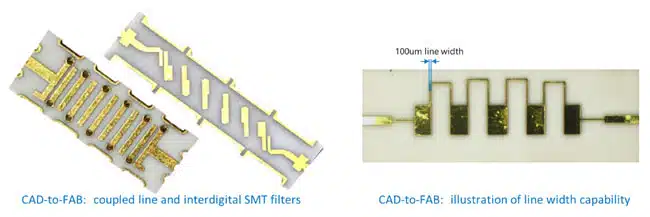
The motivation behind this investment is driven by the SWaP-C criteria—optimizing Size, Weight, Power, and Cost—critical for modern RF applications. The CAD-to-FAB process supports the development of complex multi-function assemblies by integrating passive functions such as ferrite isolators, circulators, RF filters, and couplers into compact, high-performance modules. The initial prototypes, including a C-band high-power isolator, have shown remarkable consistency and performance, highlighting the potential of this technology.

The CAD-to-FAB system presently focuses on Surface-Mount Technology (SMT) components ranging from C to Ka-bands. Its capabilities extend to producing microstrip and SMT non-reciprocal devices, RF filters, couplers, and power combiners. The process ensures high precision, with computer-controlled patterning achieving accuracies within +/- 5 micrometers. The automated assembly integrates advanced machine vision for quality assurance, reducing the need for exhaustive RF testing.

Looking forward, Smiths Interconnect’s roadmap includes the development of X-band circulators and K-band isolators, with plans to expand into Ka-band applications by early 2025. Although traditional space qualification processes are not yet planned, the materials used are already space-qualified, and efforts will focus on adapting SMT component mounting for space applications.

Conclusion:

The CAD-to-FAB initiative represents a significant leap in RF passive component manufacturing, offering flexibility, scalability, and cost efficiency. By investing in digital manufacturing technologies, Smiths Interconnect aims to reduce lead times, lower production costs, and enhance product customization. Supported by substantial funding from the UK Space Agency and Smiths Group, the CAD-to-FAB facility in Dundee is set to become a cornerstone in the production of advanced RF components, positioning Smiths Interconnect at the forefront of RF technology innovation.

Read the full paper:

SPCD24_SINT_Dundee_Abstract_AMNDownload

Related

Source: ES SPCD

Recent Posts

New J‑STD‑075B Standard Elevates Process Sensitivity Classification for Passive and Solid-State Components

27.3.2026
21

Modelithics Expands COMPLETE+3D Library for Ansys HFSS

27.3.2026
6

Exxelia Miniaturized 400 MHz Inverted‑F Antenna

24.3.2026
12

Samsung Electro-Mechanics Enters LEO Satellite Market With High‑Reliability MLCCs

19.3.2026
43

Vishay Introduced Space-Grade SMT Common Mode Choke

19.3.2026
21

Exxelia to Exhibit at APEC 2026 in San Antonio, Texas

17.3.2026
36

ESA SPCD 26 Call for Papers Extended to 30th March

16.3.2026
96

Binder Extends NCC Circular Connectors for Harsh Environments

13.3.2026
5

Peak Nano to Develop Fusion Grade High Energy Film Capacitors

11.3.2026
38

Upcoming Events

Apr 21
16:00 - 17:00 CEST

Heatsink Solutions: Thermal Management in electronic devices

May 5
16:00 - 17:00 CEST

Understanding and Selecting Capacitors – Fundamentals, Technologies and Latest Trends

May 19
16:00 - 17:00 CEST

Designing Qi2 Wireless Power Systems: Practical Development and EMC Optimization

View Calendar

Popular Posts

  • Buck Converter Design and Calculation

    0 shares
    Share 0 Tweet 0
  • Boost Converter Design and Calculation

    0 shares
    Share 0 Tweet 0
  • Flyback Converter Design and Calculation

    0 shares
    Share 0 Tweet 0
  • LLC Resonant Converter Design and Calculation

    0 shares
    Share 0 Tweet 0
  • Dual Active Bridge (DAB) Topology

    0 shares
    Share 0 Tweet 0
  • MLCC and Ceramic Capacitors

    0 shares
    Share 0 Tweet 0
  • Ripple Current and its Effects on the Performance of Capacitors

    3 shares
    Share 3 Tweet 0
  • MLCC Case Sizes Standards Explained

    0 shares
    Share 0 Tweet 0
  • Capacitor Charging and Discharging

    0 shares
    Share 0 Tweet 0
  • Plastic Materials Dielectric Constant and DF

    4 shares
    Share 4 Tweet 0

Newsletter Subscription


Passive Components Blog

© EPCI - Leading Passive Components Educational and Information Site

  • Home
  • Privacy Policy
  • EPCI Membership & Advertisement
  • About

No Result
View All Result
  • Home
  • Knowledge Blog
  • PCNS

© EPCI - Leading Passive Components Educational and Information Site

This website uses cookies. By continuing to use this website you are giving consent to cookies being used. Visit our Privacy and Cookie Policy.
Go to mobile version