









Passive Components Blog
No Result
View All Result
  • Home
  • NewsFilter
    • All
    • Aerospace & Defence
    • Antenna
    • Applications
    • Automotive
    • Capacitors
    • Circuit Protection Devices
    • electro-mechanical news
    • Filters
    • Fuses
    • Inductors
    • Industrial
    • Integrated Passives
    • inter-connect news
    • Market & Supply Chain
    • Market Insights
    • Medical
    • Modelling and Simulation
    • New Materials & Supply
    • New Technologies
    • Non-linear Passives
    • Oscillators
    • Passive Sensors News
    • Resistors
    • RF & Microwave
    • Telecommunication
    • Weekly Digest

    Würth Elektronik Expands Nanocrystalline Cable Cores for Broadband EMI Suppression

    High‑Speed Supercapacitor Balancing for AI Data Center Power Systems

    Bourns Introduced Automotive TVS Diodes for Compact ESD Protection

    EMC‑Compliant PCB and Connector Design Guidelines

    Practical Value of Structural Diagnostics for Tantalum Capacitor Anodes

    Hall-Effect Sensing for Harsh Environments: TT Electronics Selected in NASA’s Dragonfly Fan

    Bourns Releases Automotive Gate Driver Transformer for Isolated Power

    Stackpole Releases High-Frequency Thin Film Chip Resistors for RF up to 50 GHz

    Knowles Expands High‑Q Ceramic Core Inductors for RF designs

    Trending Tags

    • Ripple Current
    • RF
    • Leakage Current
    • Tantalum vs Ceramic
    • Snubber
    • Low ESR
    • Feedthrough
    • Derating
    • Dielectric Constant
    • New Products
    • Market Reports
  • VideoFilter
    • All
    • Antenna videos
    • Capacitor videos
    • Circuit Protection Video
    • Filter videos
    • Fuse videos
    • Inductor videos
    • Inter-Connect Video
    • Non-linear passives videos
    • Oscillator videos
    • Passive sensors videos
    • Resistor videos

    EMC‑Compliant PCB and Connector Design Guidelines

    Why Isolated DC/DC Power Supplies Fail Late, Würth Elektronik Podcast

    Designing 800 V DC EMC Filters: Calculation, Simulation and Measurement

    Current Sense Transformer Datasheet and Design‑in Guide

    Designing a USB Type‑C Flyback Planar Transformer with Frenetic’s Planar Tool

    Magnetics Design in High‑Frequency GaN Converters

    Qi2 Wireless Charging: Inductors, Capacitors and EMC Filters

    Two‑capacitor paradox explained for engineers

    Capacitances of Nonlinear MLCCs: What Datasheets Don’t Tell You

    Trending Tags

    • Capacitors explained
    • Inductors explained
    • Resistors explained
    • Filters explained
    • Application Video Guidelines
    • EMC
    • New Products
    • Ripple Current
    • Simulation
    • Tantalum vs Ceramic
  • Knowledge Blog
  • DossiersNew
  • Suppliers
    • Who is Who
  • PCNS
    • PCNS 2025
    • PCNS 2023
    • PCNS 2021
    • PCNS 2019
    • PCNS 2017
  • Events
  • Home
  • NewsFilter
    • All
    • Aerospace & Defence
    • Antenna
    • Applications
    • Automotive
    • Capacitors
    • Circuit Protection Devices
    • electro-mechanical news
    • Filters
    • Fuses
    • Inductors
    • Industrial
    • Integrated Passives
    • inter-connect news
    • Market & Supply Chain
    • Market Insights
    • Medical
    • Modelling and Simulation
    • New Materials & Supply
    • New Technologies
    • Non-linear Passives
    • Oscillators
    • Passive Sensors News
    • Resistors
    • RF & Microwave
    • Telecommunication
    • Weekly Digest

    Würth Elektronik Expands Nanocrystalline Cable Cores for Broadband EMI Suppression

    High‑Speed Supercapacitor Balancing for AI Data Center Power Systems

    Bourns Introduced Automotive TVS Diodes for Compact ESD Protection

    EMC‑Compliant PCB and Connector Design Guidelines

    Practical Value of Structural Diagnostics for Tantalum Capacitor Anodes

    Hall-Effect Sensing for Harsh Environments: TT Electronics Selected in NASA’s Dragonfly Fan

    Bourns Releases Automotive Gate Driver Transformer for Isolated Power

    Stackpole Releases High-Frequency Thin Film Chip Resistors for RF up to 50 GHz

    Knowles Expands High‑Q Ceramic Core Inductors for RF designs

    Trending Tags

    • Ripple Current
    • RF
    • Leakage Current
    • Tantalum vs Ceramic
    • Snubber
    • Low ESR
    • Feedthrough
    • Derating
    • Dielectric Constant
    • New Products
    • Market Reports
  • VideoFilter
    • All
    • Antenna videos
    • Capacitor videos
    • Circuit Protection Video
    • Filter videos
    • Fuse videos
    • Inductor videos
    • Inter-Connect Video
    • Non-linear passives videos
    • Oscillator videos
    • Passive sensors videos
    • Resistor videos

    EMC‑Compliant PCB and Connector Design Guidelines

    Why Isolated DC/DC Power Supplies Fail Late, Würth Elektronik Podcast

    Designing 800 V DC EMC Filters: Calculation, Simulation and Measurement

    Current Sense Transformer Datasheet and Design‑in Guide

    Designing a USB Type‑C Flyback Planar Transformer with Frenetic’s Planar Tool

    Magnetics Design in High‑Frequency GaN Converters

    Qi2 Wireless Charging: Inductors, Capacitors and EMC Filters

    Two‑capacitor paradox explained for engineers

    Capacitances of Nonlinear MLCCs: What Datasheets Don’t Tell You

    Trending Tags

    • Capacitors explained
    • Inductors explained
    • Resistors explained
    • Filters explained
    • Application Video Guidelines
    • EMC
    • New Products
    • Ripple Current
    • Simulation
    • Tantalum vs Ceramic
  • Knowledge Blog
  • DossiersNew
  • Suppliers
    • Who is Who
  • PCNS
    • PCNS 2025
    • PCNS 2023
    • PCNS 2021
    • PCNS 2019
    • PCNS 2017
  • Events
No Result
View All Result
Passive Components Blog
No Result
View All Result

Can Millennials Cope With a Component Shortage?

12.10.2017
Reading Time: 5 mins read
A A
Free supply chain and logistics training

Free supply chain and logistics training

source: TTI Market Eye article

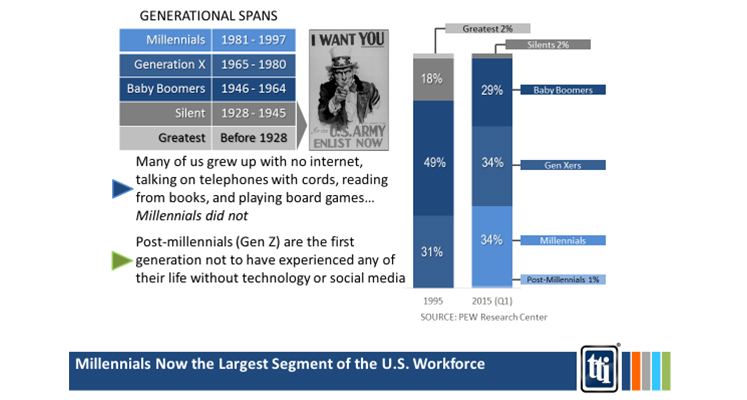
As Baby Boomers make way for Millennials in the high-tech workforce, a new generation gap is yawning. The population reared in the digital age is engaging with colleagues whose golden rule is face-to-face communication. The current electronics market will test the skills of both generations.

RelatedPosts

Würth Elektronik Expands Nanocrystalline Cable Cores for Broadband EMI Suppression

High‑Speed Supercapacitor Balancing for AI Data Center Power Systems

Bourns Introduced Automotive TVS Diodes for Compact ESD Protection


The electronics supply chain hasn’t faced a severe components shortage in more than a decade. In the interim, the people and processes in procurement have drastically changed. E-commerce has finally hit its stride and Millennials have joined the ranks of component buyers. But with many components currently in short supply, expertise in digital communications isn’t necessarily seen as an asset.

“Millennials operate a little different than the historical way where it was more of a face-to-face relationship-building atmosphere,” said a distributor executive. “I think when it comes to crunch time, there will be some scrambling because there are some things you can’t do by clicking a button on a computer.”

“Crunch time” is here. IP&E component suppliers AVX, Kemet, Murata and Vishay are quoting lead times out to the first quarter of 2018 for many of their products. DRAM is expected to be in short supply through the first half of 2018. Inventories at the industry’s two largest distributors – Arrow Electronics Inc. and Avnet Inc. — were described as “lean” in one recent market update. The Institute for Supply Management’s August report on business found shortages of capacitors, integrated circuits and memory.

Get in line

Customers join a hierarchy when components are scarce: big and strategic customers move to the head of the line. For everyone else, a good relationship with a supplier or distributor counts for a lot.

Supply chain managers acknowledge relationships take a lot of work. “We have heard with some of our power supply engineers and field sales reps that it has been challenging over the past six to eight months — in some cases — to get appointments with customers,” said one distributor executive. Other distributors and manufacturers reps share that experience.

An extended period of adequate supply and the ease of e-commerce has reduced the need for person-to-person communication in the electronics supply chain. But some industry veterans believe Millennials are ill-equipped to deal with a prolonged component shortage.

“You got a bunch of 30-year old [supply chain] advocates and people at big companies — at the GEs, Schneiders and Siemens — that have never seen a market where they didn’t have extreme buying power,” said one supplier executive. “They beat suppliers up; and one of the reasons why is a profitability problem and because suppliers will do anything to maintain their business. These 30-year-old kids who think they can demand anything and haven’t focused on relationships and only focused on their power, when lead times go out, they will find out how hard and ugly a market can be.”
Speaking “Millennial”

However, businesses acknowledge Millennials are the workforce of the future. Electronics companies are accepting the notion that business communications and relationship-building must change.

“It’s starting to move from people talking about Millennials as if they were an alien invasion to recognizing they are ‘us,’” said Michael Knight, senior vice president, Americas, for distributor TTI Inc. “However, their ideas about communication – text, e-mail or online forums — are very different than what we grew up with.”

At the ERA Executive Conference 2017, a panel of engineers discussed how they prefer to seek help. “They said ‘I don’t want to talk to anybody but in a pinch, I’ll talk to whoever gets to me the fastest,’” Knight said. “They prefer text messaging or e-mail. They don’t want these contacts to be intrusive and they prefer to talk to someone that works for a component manufacturer. We need to pay attention to that.”

There’s no foregone conclusion that only one method will be the way customer relationships are managed, Knight said.

“Regardless of the age of our customers — this might mean someone younger adapting to how an older customer wishes to communicate — we must always adapt to how they want to engage. After all, they are the customer,” said Carla Mahrt, president of electronics industry executive recruiting firm JJM Search. “I also think the more often veterans of the industry interface with the younger generation, as long as they keep an open mind, the more they will determine there are more commonalities than differences.”

One of those commonalities is instant gratification. “I think due to the fast pace of the world today, where answers are right at your fingertips on the internet, we have all grown impatient waiting for answers,” said Mahrt. “One of the key questions I ask new clients and hiring managers is what their preferred method of communication is – phone, e-mail, texts etc. The answer varies by the hiring manager and isn’t always due to their age. Several Millennials I have spoken with said that rarely have they worked with someone that is so inept at digital communication that it became a problem.”

Strained Relationships

In fact, the industry has begun to turn away from “Millennial bashing” and associations are educating their members on how to attract younger talent. Managers have shared positive experiences in hiring Millennials. The generation gap alone is not straining supply chain relationships.

“I think the whole nature of [supplier-customer] relationships have changed,” TTI’s Knight said. “The whole business has gotten progressively more mercenary. But I don’t want to say relationships don’t matter anymore because they do, they just don’t seem to matter as much as they once did.”

Customers can be fickle, even when it comes to contractual obligations. Buyers continually price shop — it’s their job to get the best value for their company – and play vendors against one another for the lowest price. Some may book business outside of contractual arrangements. But when components are scarce, contracts are viewed as a guarantee of supply. For many vendors, that leads to a difficult conversation with their customers.

“Many common, widely used parts are hard to come by right now, so there is a rebirth of customer interest in the relationship aspect of their supply chain,” Knight said. “But the timing is bad. What we are all up against on constrained parts is suppliers start allocating them to distributors and distributors start allocating them to their customers. What is typical is that you are allocated a quantity of parts equivalent to some prior year’s consumption [orders] to prevent companies from hedging and overbuying. That’s the cause of the historical cliff the component supply chain has gone over on the backside of these cycles. This doesn’t leave a lot of room for new, or even renewed, relationships.”

“It’s not just interpersonal relationships that aren’t what they once were,” Knight concludes. “We have all become conditioned to a more transactional, mercenary approach to our supply chain engagements. This is in part due to the business pace and globalization, in part due to generational differences, and in part due to technology changing the way we interact with each other. It is what it is and for the most part works fine… until a production line goes down, or a production target goes up, and you are told it will be six months or more before you can get the parts you need.”

This article appeared in Electronics Purchasing Strategies, www.epsnews.com September 28, 2017 by Michael Knight


Related

Recent Posts

TrendForce: CSP in‑house AI ASIC Boom Reshapes Capacitor Demand

18.6.2026
104

DMASS: European Components Distribution Returns To Growth In Q1 2026

16.6.2026
58

German Component Distribution Market Rebounds in Q1 2026 According to FBDi

16.6.2026
39

Bourns Completes Rakon Acquisition, Enters Timing Market

12.6.2026
65

CapXon Earns EcoVadis Bronze Medal for Sustainability Performance

10.6.2026
32

Power Converter Dossier: Passive Components Design and Selection Guide 2026

5.6.2026
75

Evans Group Unifies Four High-Rel Capacitor Leaders

5.6.2026
54

Murata and Xona Partner on LEO Satellite Navigation for Industrial Applications

3.6.2026
49

Nvidia Vera Rubin: Why One AI Rack Needs So Many More MLCC Capacitors

15.6.2026
491

Upcoming Events

Jun 30
17:00 - 18:00 CEST

PSMA Capacitor Committee Webinar: High Voltage Pulse Capacitors

Jul 14
16:00 - 17:00 CEST

EMC Design Essentials: Mastering Varistors and Common Mode Chokes

Jul 21
16:00 - 17:00 CEST

Safety by design: X and Y Interference suppression capacitors for power line filters

View Calendar

Popular Posts

  • Boost Converter Design and Calculation

    0 shares
    Share 0 Tweet 0
  • Buck Converter Design and Calculation

    0 shares
    Share 0 Tweet 0
  • LLC Resonant Converter Design and Calculation

    0 shares
    Share 0 Tweet 0
  • Flyback Converter Design and Calculation

    0 shares
    Share 0 Tweet 0
  • MLCC and Ceramic Capacitors

    0 shares
    Share 0 Tweet 0
  • Earthing Systems and IEC Classification Explained

    0 shares
    Share 0 Tweet 0
  • Nvidia Vera Rubin: Why One AI Rack Needs So Many More MLCC Capacitors

    0 shares
    Share 0 Tweet 0
  • Dual Active Bridge (DAB) Topology

    0 shares
    Share 0 Tweet 0
  • SEPIC Converter Design and Calculation

    0 shares
    Share 0 Tweet 0
  • MLCC Case Sizes Standards Explained

    0 shares
    Share 0 Tweet 0

Newsletter Subscription


Passive Components Blog

© EPCI - Leading Passive Components Educational and Information Site

  • Home
  • Privacy Policy
  • EPCI Membership & Advertisement
  • About

No Result
View All Result
  • Home
  • Knowledge Blog
  • Dossiers
  • PCNS

© EPCI - Leading Passive Components Educational and Information Site

This website uses cookies. By continuing to use this website you are giving consent to cookies being used. Visit our Privacy and Cookie Policy.
Go to mobile version