












Passive Components Blog
No Result
View All Result
  • Home
  • NewsFilter
    • All
    • Aerospace & Defence
    • Antenna
    • Applications
    • Automotive
    • Capacitors
    • Circuit Protection Devices
    • electro-mechanical news
    • Filters
    • Fuses
    • Inductors
    • Industrial
    • Integrated Passives
    • inter-connect news
    • Market & Supply Chain
    • Market Insights
    • Medical
    • Modelling and Simulation
    • New Materials & Supply
    • New Technologies
    • Non-linear Passives
    • Oscillators
    • Passive Sensors News
    • Resistors
    • RF & Microwave
    • Telecommunication
    • Weekly Digest

    Modeling Planar Magnetics Temperature: Practical Guidelines for Power Electronics Engineers

    YAGEO Releases Ferrite Shielded Power Inductors for High‑Density Designs

    Samsung Presents MLCC Selection Guide for Humanoids and Robotic Applications

    AI-Assisted Structural Diagnostics and Physics-Based Reliability Interpretation of Tantalum Capacitor Anodes

    YAGEO Introduces EMI Suppression High‑Current 3‑phase Common Mode Chokes

    KYOCERA AVX MIL-PRF-32535 BME NP0 MLCCs Approved to the DLA QPD

    ECIA March 2026 Industry Pulse Points to Best Sales Climate in Five Years

    Vishay Releases 2-Way Wilkinson Divider / Combiner for 15–20 GHz RF Front Ends

    Wk 15 Electronics Supply Chain Digest

    Trending Tags

    • Ripple Current
    • RF
    • Leakage Current
    • Tantalum vs Ceramic
    • Snubber
    • Low ESR
    • Feedthrough
    • Derating
    • Dielectric Constant
    • New Products
    • Market Reports
  • VideoFilter
    • All
    • Antenna videos
    • Capacitor videos
    • Circuit Protection Video
    • Filter videos
    • Fuse videos
    • Inductor videos
    • Inter-Connect Video
    • Non-linear passives videos
    • Oscillator videos
    • Passive sensors videos
    • Resistor videos

    Transformer-Based Power-Line Harvester Magnetic Design

    Thermal Modeling of Magnetics

    Standard vs Planar LLC transformers Comparison for Battery Chargers

    How Modern Tools Model Magnetic Components for Power Electronics

    Advanced Loss Modeling for Planar Magnetics in the Frenetic Planar Tool

    2026 Power Magnetics Design Trends: Flyback, DAB and Planar

    Enabling Software‑Defined Vehicle Architectures: Automotive Ethernet and Zonal Smart Power

    Calculating Resistance Value of a Flyback RC Snubber 

    One‑Pulse Characterization of Nonlinear Power Inductors

    Trending Tags

    • Capacitors explained
    • Inductors explained
    • Resistors explained
    • Filters explained
    • Application Video Guidelines
    • EMC
    • New Products
    • Ripple Current
    • Simulation
    • Tantalum vs Ceramic
  • Knowledge Blog
  • DossiersNew
  • Suppliers
    • Who is Who
  • PCNS
    • PCNS 2025
    • PCNS 2023
    • PCNS 2021
    • PCNS 2019
    • PCNS 2017
  • Events
  • Home
  • NewsFilter
    • All
    • Aerospace & Defence
    • Antenna
    • Applications
    • Automotive
    • Capacitors
    • Circuit Protection Devices
    • electro-mechanical news
    • Filters
    • Fuses
    • Inductors
    • Industrial
    • Integrated Passives
    • inter-connect news
    • Market & Supply Chain
    • Market Insights
    • Medical
    • Modelling and Simulation
    • New Materials & Supply
    • New Technologies
    • Non-linear Passives
    • Oscillators
    • Passive Sensors News
    • Resistors
    • RF & Microwave
    • Telecommunication
    • Weekly Digest

    Modeling Planar Magnetics Temperature: Practical Guidelines for Power Electronics Engineers

    YAGEO Releases Ferrite Shielded Power Inductors for High‑Density Designs

    Samsung Presents MLCC Selection Guide for Humanoids and Robotic Applications

    AI-Assisted Structural Diagnostics and Physics-Based Reliability Interpretation of Tantalum Capacitor Anodes

    YAGEO Introduces EMI Suppression High‑Current 3‑phase Common Mode Chokes

    KYOCERA AVX MIL-PRF-32535 BME NP0 MLCCs Approved to the DLA QPD

    ECIA March 2026 Industry Pulse Points to Best Sales Climate in Five Years

    Vishay Releases 2-Way Wilkinson Divider / Combiner for 15–20 GHz RF Front Ends

    Wk 15 Electronics Supply Chain Digest

    Trending Tags

    • Ripple Current
    • RF
    • Leakage Current
    • Tantalum vs Ceramic
    • Snubber
    • Low ESR
    • Feedthrough
    • Derating
    • Dielectric Constant
    • New Products
    • Market Reports
  • VideoFilter
    • All
    • Antenna videos
    • Capacitor videos
    • Circuit Protection Video
    • Filter videos
    • Fuse videos
    • Inductor videos
    • Inter-Connect Video
    • Non-linear passives videos
    • Oscillator videos
    • Passive sensors videos
    • Resistor videos

    Transformer-Based Power-Line Harvester Magnetic Design

    Thermal Modeling of Magnetics

    Standard vs Planar LLC transformers Comparison for Battery Chargers

    How Modern Tools Model Magnetic Components for Power Electronics

    Advanced Loss Modeling for Planar Magnetics in the Frenetic Planar Tool

    2026 Power Magnetics Design Trends: Flyback, DAB and Planar

    Enabling Software‑Defined Vehicle Architectures: Automotive Ethernet and Zonal Smart Power

    Calculating Resistance Value of a Flyback RC Snubber 

    One‑Pulse Characterization of Nonlinear Power Inductors

    Trending Tags

    • Capacitors explained
    • Inductors explained
    • Resistors explained
    • Filters explained
    • Application Video Guidelines
    • EMC
    • New Products
    • Ripple Current
    • Simulation
    • Tantalum vs Ceramic
  • Knowledge Blog
  • DossiersNew
  • Suppliers
    • Who is Who
  • PCNS
    • PCNS 2025
    • PCNS 2023
    • PCNS 2021
    • PCNS 2019
    • PCNS 2017
  • Events
No Result
View All Result
Passive Components Blog
No Result
View All Result

Choosing High-Frequency Capacitors; Role of Dielectric Material

12.7.2024
Reading Time: 3 mins read
A A

This article based on Knowles Precision Devices blog explains role of dielectric material when choosing high-frequency capacitors.

Radio frequency (RF) and microwave applications involve the transmission and receipt of high-frequency electromagnetic signals. RF refers to alternating current (AC) signals at 3 kHz to 300 GHz, and microwave refers to a higher range, closer to 300 MHz to 300 GHz. 

RelatedPosts

Knowles Doubles Capacitance of its Class I Ceramic C0G Capacitors

Knowles Releases High Q Non-Magnetic X7R MLCCs for Medical Imaging

Knowles Unveils High-Performance Safety-Certified MLCC Capacitors

Capacitance, and by extension impedance, varies with frequency, so capacitors play a variety of critical roles in these RF and microwave circuits. With many options for configuration, they function in energy storage and voltage regulation, DC blocking, impedance matching, filtering and more. 

When choosing high-frequency ceramic capacitors for radio frequency (RF) and microwave applications, several factors come into play. Let’s explore some key considerations:

  1. Dielectric Material:
    • The type of dielectric material significantly impacts the capacitance achievable in a given area.
    • For AC coupling/DC blocking applications with more forgiving requirements, consider Class II dielectrics.
    • For tighter tolerances, such as LC filters, Class I dielectrics are preferable due to their excellent stability and low-loss characteristics.
  2. Additional Factors:
    • Low Loss Tangent: Opt for materials with a low loss tangent to reduce dielectric loss.
    • Uniform, Isotropic Dielectric Constant: Minimize inconsistencies like impedance changes within the circuit.
    • Batch-to-Batch Repeatability: Ensures consistent manufacturing.
    • Smooth Surface Finish: Reduces conductor ohmic losses.
    • High Thermal Conductivity: Important for power electronics circuits.
    • Thermal Expansion: Comply with component and package requirements.

Understanding the capacitance achievable in a given area is an important factor in choosing capacitors for your application. This is ultimately determined by the type of dielectric material that can meet your application requirements for space and capacitance, see Figure 1.  
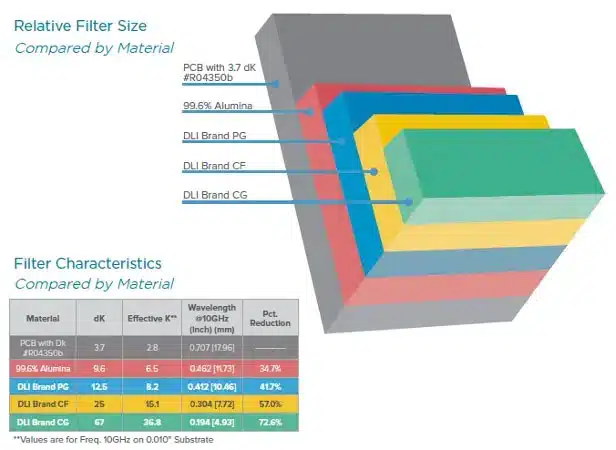
Figure 1: Comparing dielectric materials by relative filter size and characteristics 

For AC coupling/DC blocking applications where capacitance tolerance and temperature stability requirements are more forgiving, consider Class II dielectrics. In applications with tighter tolerances, like LC filters, Class I dielectrics are a better choice because of their excellent stability and low-loss characteristics.  

A majority of Knowles Precision Devices’ single-layer capacitors (SLCs) are 0.02” x 0.02” (20 mil sq) to 0.03” x 0.03” (30 mil sq). That said, we’ve seen growing demand to lower case sizes to 0.010” x 0.010” (10 mil sq). To meet this demand, Knowles Precision Devices has a range of offerings from a dielectric constant (K) of 9 through 45000. See Figure 2 for Knowles Precision Devices Class I and Class II dielectric materials and relevant specifications.  
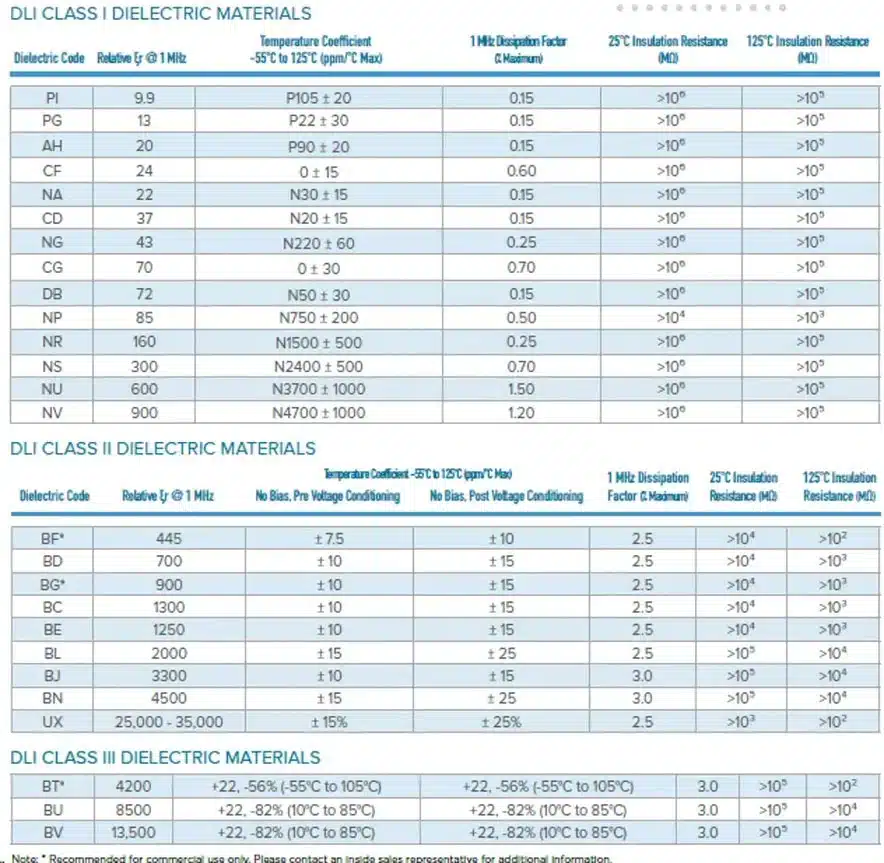
Figure 2: Knowles Precision Devices Class I, II and III dielectric material offerings and key specifications to consider 

There are additional factors at play when selecting components for high-frequency, high-performance applications. Substrate properties, like surface finish, and fabrication processes, like metallization, impact the accuracy of line width and gap width. Both of these parameters impact overall circuit performance.


Related

Source: Knowles Precision Devices

Recent Posts

Samsung Presents MLCC Selection Guide for Humanoids and Robotic Applications

15.4.2026
6

AI-Assisted Structural Diagnostics and Physics-Based Reliability Interpretation of Tantalum Capacitor Anodes

14.4.2026
13

KYOCERA AVX MIL-PRF-32535 BME NP0 MLCCs Approved to the DLA QPD

14.4.2026
18

ECIA March 2026 Industry Pulse Points to Best Sales Climate in Five Years

13.4.2026
27

Vishay Releases 2-Way Wilkinson Divider / Combiner for 15–20 GHz RF Front Ends

13.4.2026
11

Exxelia Releases Updated Microwave Materials and Frequency Tuning Catalogues

8.4.2026
18

Murata Automotive MLCCs Push Capacitance Limits for ADAS and Power Lines

8.4.2026
40

TDK and Nippon Chemical Launch Joint Venture for MLCC Materials

7.4.2026
42

March 2026 Interconnect, Passives and Electromechanical Components Market Insights

2.4.2026
95

Upcoming Events

Apr 21
16:00 - 17:00 CEST

Heatsink Solutions: Thermal Management in electronic devices

Apr 29
10:00 - 11:00 CDT

SEPIC Design Done Right

May 5
16:00 - 17:00 CEST

Understanding and Selecting Capacitors – Fundamentals, Technologies and Latest Trends

View Calendar

Popular Posts

  • Buck Converter Design and Calculation

    0 shares
    Share 0 Tweet 0
  • Boost Converter Design and Calculation

    0 shares
    Share 0 Tweet 0
  • Flyback Converter Design and Calculation

    0 shares
    Share 0 Tweet 0
  • LLC Resonant Converter Design and Calculation

    0 shares
    Share 0 Tweet 0
  • MLCC and Ceramic Capacitors

    0 shares
    Share 0 Tweet 0
  • Dual Active Bridge (DAB) Topology

    0 shares
    Share 0 Tweet 0
  • Capacitor Charging and Discharging

    0 shares
    Share 0 Tweet 0
  • Plastic Materials Dielectric Constant and DF

    4 shares
    Share 4 Tweet 0
  • MLCC Case Sizes Standards Explained

    0 shares
    Share 0 Tweet 0
  • Ripple Current and its Effects on the Performance of Capacitors

    3 shares
    Share 3 Tweet 0

Newsletter Subscription


Passive Components Blog

© EPCI - Leading Passive Components Educational and Information Site

  • Home
  • Privacy Policy
  • EPCI Membership & Advertisement
  • About

No Result
View All Result
  • Home
  • Knowledge Blog
  • PCNS

© EPCI - Leading Passive Components Educational and Information Site

This website uses cookies. By continuing to use this website you are giving consent to cookies being used. Visit our Privacy and Cookie Policy.
Go to mobile version