






Passive Components Blog
No Result
View All Result
  • Home
  • NewsFilter
    • All
    • Aerospace & Defence
    • Antenna
    • Applications
    • Automotive
    • Capacitors
    • Circuit Protection Devices
    • electro-mechanical news
    • Filters
    • Fuses
    • Inductors
    • Industrial
    • Integrated Passives
    • inter-connect news
    • Market & Supply Chain
    • Market Insights
    • Medical
    • Modelling and Simulation
    • New Materials & Supply
    • New Technologies
    • Non-linear Passives
    • Oscillators
    • Passive Sensors News
    • Resistors
    • RF & Microwave
    • Telecommunication
    • Weekly Digest

    VINATech Targets AI Data Center Supercapacitor Boom

    Littelfuse NANO2 415 SMD Fuse Wins 2025 Product of the Year

    TDK Introduces 350V Safety Film Capacitors for Compact EMI Suppression

    Molex Extends Cardinal Multi‑Port Coax Assemblies to 145 GHz for AI and 6G Test

    Samsung Launches Worlds First Automotive 47uF 4V MLCC in 0805 Size

    Würth Elektronik Present in IEEE APEC

    Samsung Three Pillars MLCC Strategy for AI Hardware Topology

    Bourns Releases High Clearance Transformer for Isolated DC/DC Supplies

    KYOCERA AVX Extends Ultra‑Broadband RF Capacitor Series

    Trending Tags

    • Ripple Current
    • RF
    • Leakage Current
    • Tantalum vs Ceramic
    • Snubber
    • Low ESR
    • Feedthrough
    • Derating
    • Dielectric Constant
    • New Products
    • Market Reports
  • VideoFilter
    • All
    • Antenna videos
    • Capacitor videos
    • Circuit Protection Video
    • Filter videos
    • Fuse videos
    • Inductor videos
    • Inter-Connect Video
    • Non-linear passives videos
    • Oscillator videos
    • Passive sensors videos
    • Resistor videos

    2026 Power Magnetics Design Trends: Flyback, DAB and Planar

    Enabling Software‑Defined Vehicle Architectures: Automotive Ethernet and Zonal Smart Power

    Calculating Resistance Value of a Flyback RC Snubber 

    One‑Pulse Characterization of Nonlinear Power Inductors

    Thermistor Linearization Challenges

    Coaxial Connectors and How to Connect with PCB

    PCB Manufacturing, Test Methods, Quality and Reliability

    Transformer Behavior – Current Transfer and Hidden Feedback

    Choosing the Right Capacitor: The Importance of Accurate Measurements

    Trending Tags

    • Capacitors explained
    • Inductors explained
    • Resistors explained
    • Filters explained
    • Application Video Guidelines
    • EMC
    • New Products
    • Ripple Current
    • Simulation
    • Tantalum vs Ceramic
  • Knowledge Blog
  • DossiersNew
  • Suppliers
    • Who is Who
  • PCNS
    • PCNS 2025
    • PCNS 2023
    • PCNS 2021
    • PCNS 2019
    • PCNS 2017
  • Events
  • Home
  • NewsFilter
    • All
    • Aerospace & Defence
    • Antenna
    • Applications
    • Automotive
    • Capacitors
    • Circuit Protection Devices
    • electro-mechanical news
    • Filters
    • Fuses
    • Inductors
    • Industrial
    • Integrated Passives
    • inter-connect news
    • Market & Supply Chain
    • Market Insights
    • Medical
    • Modelling and Simulation
    • New Materials & Supply
    • New Technologies
    • Non-linear Passives
    • Oscillators
    • Passive Sensors News
    • Resistors
    • RF & Microwave
    • Telecommunication
    • Weekly Digest

    VINATech Targets AI Data Center Supercapacitor Boom

    Littelfuse NANO2 415 SMD Fuse Wins 2025 Product of the Year

    TDK Introduces 350V Safety Film Capacitors for Compact EMI Suppression

    Molex Extends Cardinal Multi‑Port Coax Assemblies to 145 GHz for AI and 6G Test

    Samsung Launches Worlds First Automotive 47uF 4V MLCC in 0805 Size

    Würth Elektronik Present in IEEE APEC

    Samsung Three Pillars MLCC Strategy for AI Hardware Topology

    Bourns Releases High Clearance Transformer for Isolated DC/DC Supplies

    KYOCERA AVX Extends Ultra‑Broadband RF Capacitor Series

    Trending Tags

    • Ripple Current
    • RF
    • Leakage Current
    • Tantalum vs Ceramic
    • Snubber
    • Low ESR
    • Feedthrough
    • Derating
    • Dielectric Constant
    • New Products
    • Market Reports
  • VideoFilter
    • All
    • Antenna videos
    • Capacitor videos
    • Circuit Protection Video
    • Filter videos
    • Fuse videos
    • Inductor videos
    • Inter-Connect Video
    • Non-linear passives videos
    • Oscillator videos
    • Passive sensors videos
    • Resistor videos

    2026 Power Magnetics Design Trends: Flyback, DAB and Planar

    Enabling Software‑Defined Vehicle Architectures: Automotive Ethernet and Zonal Smart Power

    Calculating Resistance Value of a Flyback RC Snubber 

    One‑Pulse Characterization of Nonlinear Power Inductors

    Thermistor Linearization Challenges

    Coaxial Connectors and How to Connect with PCB

    PCB Manufacturing, Test Methods, Quality and Reliability

    Transformer Behavior – Current Transfer and Hidden Feedback

    Choosing the Right Capacitor: The Importance of Accurate Measurements

    Trending Tags

    • Capacitors explained
    • Inductors explained
    • Resistors explained
    • Filters explained
    • Application Video Guidelines
    • EMC
    • New Products
    • Ripple Current
    • Simulation
    • Tantalum vs Ceramic
  • Knowledge Blog
  • DossiersNew
  • Suppliers
    • Who is Who
  • PCNS
    • PCNS 2025
    • PCNS 2023
    • PCNS 2021
    • PCNS 2019
    • PCNS 2017
  • Events
No Result
View All Result
Passive Components Blog
No Result
View All Result

Components Thermal and Frequency Challenges in 6G Base Stations

30.9.2025
Reading Time: 4 mins read
A A

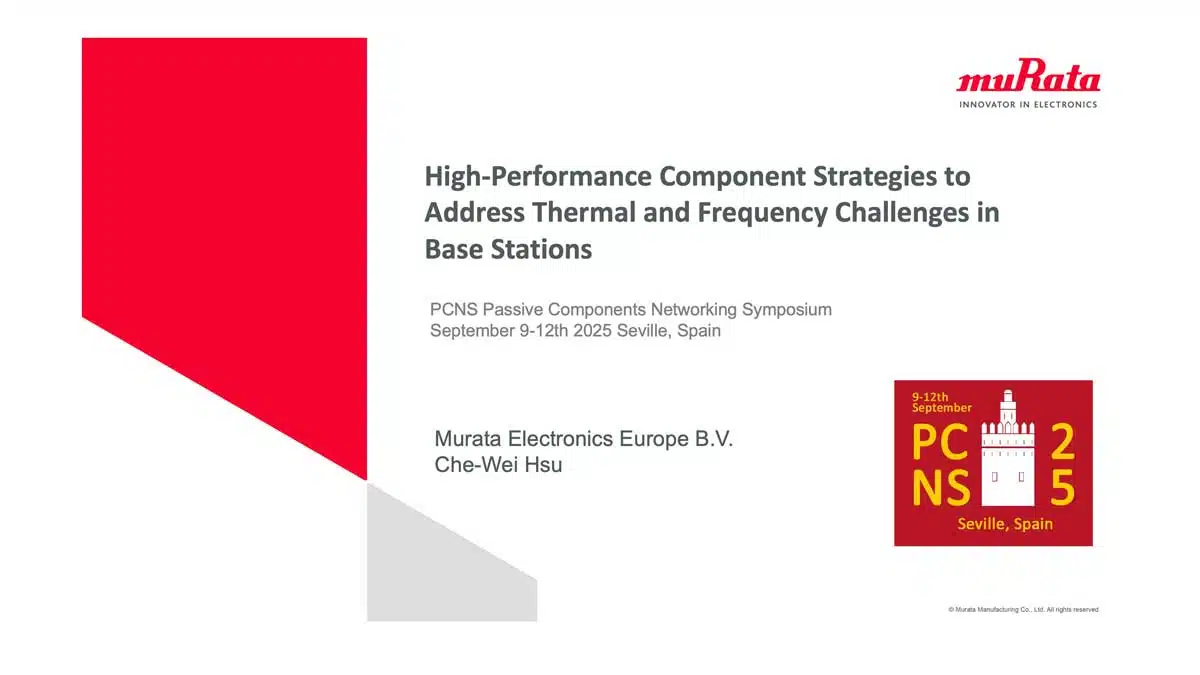
The paper “High-Performance Component Strategies to Address Thermal and Frequency Challenges in Base Stations” was presented by Che-Wei Hsu, Murata Electronics Europe B.V., Hoofddorp, The Netherlands at the 5th PCNS Passive Components Networking Symposium 9-12th September 2025, Seville, Spain as paper No. 5.1.

Introduction

The transition from 4G to 5G and the future implementation of 6G networks has significantly increased the performance demands placed on base station power amplifiers (PAs).

RelatedPosts

MLCC Manufacturers Consider Price Increase as AI Demand Outpaces Supply

Murata Opens New Ceramic Capacitor Manufacturing and R&D Center in Japan

Murata Publishes Power Delivery Guide for AI Servers

These systems now require enhanced thermal management and superior high-frequency performance to support wide bandwidths and higher power efficiency.

The integration of active antenna units (AAUs), which combine power supply units (PSUs) with remote radio units (RRUs), has created shared thermal environments that intensify heat management challenges. This evolution necessitates innovative component selection strategies to ensure reliability, efficiency, and signal integrity in next-generation telecommunication infrastructure.

Key Points

  • Base station PAs face extreme thermal conditions, often exceeding 125–150°C, and require robust components to withstand temperature cycling and material stress.
  • Higher frequencies in 5G and 6G (up to terahertz bands) demand capacitors with high Q values, low ESR/ESL, and precise tolerances to maintain signal integrity.
  • Advanced multilayer ceramic capacitors (MLCCs) offer solutions with thermal resilience, compact size, and superior high-frequency performance.
  • Design strategies must balance thermal management, frequency response optimization, space constraints, and reliable current handling.
  • Component selection increasingly relies on low-inductance designs, high-capacitance MLCCs, and temperature-stable dielectric formulations.

Extended Summary

Modern base station power amplifiers operate in environments with temperature peaks up to 150°C and frequent thermal cycling from -70°C to +180°C. These conditions can lead to component failures such as solder joint cracking, dielectric degradation, and metal migration. The move toward integrated AAU architectures exacerbates thermal stress by increasing PSU temperatures, impacting mean time between failures and overall system reliability. To address these issues, designers must select capacitors capable of sustaining performance under severe thermal conditions, including products rated for 150°C with appropriate voltage derating.

In parallel, the expansion of wireless technology into millimeter-wave and terahertz frequencies requires components optimized for high-frequency operation. Capacitors used in matching networks and DC-blocking applications must maintain high Q factors, low parasitic effects, and stable capacitance across temperature ranges. High-frequency performance is closely linked to package size, with smaller components offering higher self-resonant frequencies but reduced power handling. Advanced MLCC ceramic capacitor designs such as the GJM and GQM series leverage copper electrodes and low ESR/ESL structures to achieve the necessary performance for next-generation base stations.

Space and thermal constraints drive the need for miniaturization and efficient designs. Modern MLCCs address these challenges by offering high capacitance in compact packages, low-inductance configurations, and three-terminal designs that reduce radiation noise and improve decoupling efficiency. Such designs not only enable higher circuit density but also reduce self-heating, contributing to improved thermal management in tightly packed base station modules.

Effective component selection involves comprehensive evaluation of thermal, electrical, and mechanical requirements. Designers must consider real operating conditions around PAs, ensuring proper current handling, ESR/ESL optimization, and frequency response. High-Q capacitors in miniature packages and large-capacitance MLCCs allow for component count reduction, space savings, and improved system reliability.

Conclusion

The evolution toward 5G and 6G base stations requires advanced thermal and frequency management strategies supported by high-performance MLCC technologies. Capacitors featuring high thermal resilience, low ESR/ESL, and precise tolerances enable reliable operation in extreme environments while maintaining signal integrity. As wireless infrastructure continues to expand into higher frequencies and denser configurations, future capacitor development will focus on enhanced miniaturization, improved temperature capabilities, and optimized materials for emerging frequency bands. Selecting the right capacitors is essential to achieving performance, efficiency, and reliability in next-generation global connectivity infrastructure.

5_1_Murata_High-Performance Component Strategies in Base Stations-Che Wei HsuDownload

Related

Source: PCNS

Recent Posts

VINATech Targets AI Data Center Supercapacitor Boom

26.2.2026
22

Littelfuse NANO2 415 SMD Fuse Wins 2025 Product of the Year

26.2.2026
10

TDK Introduces 350V Safety Film Capacitors for Compact EMI Suppression

26.2.2026
15

Samsung Launches Worlds First Automotive 47uF 4V MLCC in 0805 Size

24.2.2026
23

Würth Elektronik Present in IEEE APEC

24.2.2026
16

Samsung Three Pillars MLCC Strategy for AI Hardware Topology

24.2.2026
52

Bourns Releases High Clearance Transformer for Isolated DC/DC Supplies

24.2.2026
16

KYOCERA AVX Extends Ultra‑Broadband RF Capacitor Series

24.2.2026
25

Bourns Unveils High Volt GDT for High‑Energy Surge Protection

23.2.2026
6

Upcoming Events

Mar 3
16:00 - 17:00 CET

Cybersecurity at the Eleventh Hour – from RED to CRA – Information and Discussion

Mar 21
All day

PSMA Capacitor Workshop 2026

Apr 21
16:00 - 17:00 CEST

Heatsink Solutions: Thermal Management in electronic devices

View Calendar

Popular Posts

  • Buck Converter Design and Calculation

    0 shares
    Share 0 Tweet 0
  • Boost Converter Design and Calculation

    0 shares
    Share 0 Tweet 0
  • Flyback Converter Design and Calculation

    0 shares
    Share 0 Tweet 0
  • LLC Resonant Converter Design and Calculation

    0 shares
    Share 0 Tweet 0
  • MLCC Manufacturers Consider Price Increase as AI Demand Outpaces Supply

    0 shares
    Share 0 Tweet 0
  • Dual Active Bridge (DAB) Topology

    0 shares
    Share 0 Tweet 0
  • Ripple Current and its Effects on the Performance of Capacitors

    3 shares
    Share 3 Tweet 0
  • What is a Dielectric Constant and DF of Plastic Materials?

    4 shares
    Share 4 Tweet 0
  • MLCC and Ceramic Capacitors

    0 shares
    Share 0 Tweet 0
  • MLCC Case Sizes Standards Explained

    0 shares
    Share 0 Tweet 0

Newsletter Subscription


Passive Components Blog

© EPCI - Leading Passive Components Educational and Information Site

  • Home
  • Privacy Policy
  • EPCI Membership & Advertisement
  • About

No Result
View All Result
  • Home
  • Knowledge Blog
  • PCNS

© EPCI - Leading Passive Components Educational and Information Site

This website uses cookies. By continuing to use this website you are giving consent to cookies being used. Visit our Privacy and Cookie Policy.
Go to mobile version