




Passive Components Blog
No Result
View All Result
  • Home
  • NewsFilter
    • All
    • Aerospace & Defence
    • Antenna
    • Applications
    • Automotive
    • Capacitors
    • Circuit Protection Devices
    • electro-mechanical news
    • Filters
    • Fuses
    • Inductors
    • Industrial
    • Integrated Passives
    • inter-connect news
    • Market & Supply Chain
    • Market Insights
    • Medical
    • Modelling and Simulation
    • New Materials & Supply
    • New Technologies
    • Non-linear Passives
    • Oscillators
    • Passive Sensors News
    • Resistors
    • RF & Microwave
    • Telecommunication
    • Weekly Digest

    YAGEO Introduces C0G Flexible Termination Automotive MLCCs

    SCHURTER Releases SMT Micro Switch for Compact HMIs

    binder Releases Tool‑Tightenable M12 Connectors for Improved Reliability

    Vishay Introduced Thin Film Submount Platform for Optical and RF Modules

    Murata Introduces Crystal and NTC Set for Automotive UWB Timing

    Kyocera Developed Multilayer Ceramic Core Substrate for AI Packages

    Modeling Fringing Field Losses in Inductors & Transformers

    YMIN Introduces Polymer Tantalum Capacitors for AI Server SSDs

    Littelfuse Expands High-Voltage TVS Diodes

    Trending Tags

    • Ripple Current
    • RF
    • Leakage Current
    • Tantalum vs Ceramic
    • Snubber
    • Low ESR
    • Feedthrough
    • Derating
    • Dielectric Constant
    • New Products
    • Market Reports
  • VideoFilter
    • All
    • Antenna videos
    • Capacitor videos
    • Circuit Protection Video
    • Filter videos
    • Fuse videos
    • Inductor videos
    • Inter-Connect Video
    • Non-linear passives videos
    • Oscillator videos
    • Passive sensors videos
    • Resistor videos

    Modeling Fringing Field Losses in Inductors & Transformers

    Why Power Inductors Use a Ferrite Core With an Air Gap

    Transformer-Based Power-Line Harvester Magnetic Design

    Thermal Modeling of Magnetics

    Standard vs Planar LLC transformers Comparison for Battery Chargers

    How Modern Tools Model Magnetic Components for Power Electronics

    Advanced Loss Modeling for Planar Magnetics in the Frenetic Planar Tool

    2026 Power Magnetics Design Trends: Flyback, DAB and Planar

    Enabling Software‑Defined Vehicle Architectures: Automotive Ethernet and Zonal Smart Power

    Trending Tags

    • Capacitors explained
    • Inductors explained
    • Resistors explained
    • Filters explained
    • Application Video Guidelines
    • EMC
    • New Products
    • Ripple Current
    • Simulation
    • Tantalum vs Ceramic
  • Knowledge Blog
  • DossiersNew
  • Suppliers
    • Who is Who
  • PCNS
    • PCNS 2025
    • PCNS 2023
    • PCNS 2021
    • PCNS 2019
    • PCNS 2017
  • Events
  • Home
  • NewsFilter
    • All
    • Aerospace & Defence
    • Antenna
    • Applications
    • Automotive
    • Capacitors
    • Circuit Protection Devices
    • electro-mechanical news
    • Filters
    • Fuses
    • Inductors
    • Industrial
    • Integrated Passives
    • inter-connect news
    • Market & Supply Chain
    • Market Insights
    • Medical
    • Modelling and Simulation
    • New Materials & Supply
    • New Technologies
    • Non-linear Passives
    • Oscillators
    • Passive Sensors News
    • Resistors
    • RF & Microwave
    • Telecommunication
    • Weekly Digest

    YAGEO Introduces C0G Flexible Termination Automotive MLCCs

    SCHURTER Releases SMT Micro Switch for Compact HMIs

    binder Releases Tool‑Tightenable M12 Connectors for Improved Reliability

    Vishay Introduced Thin Film Submount Platform for Optical and RF Modules

    Murata Introduces Crystal and NTC Set for Automotive UWB Timing

    Kyocera Developed Multilayer Ceramic Core Substrate for AI Packages

    Modeling Fringing Field Losses in Inductors & Transformers

    YMIN Introduces Polymer Tantalum Capacitors for AI Server SSDs

    Littelfuse Expands High-Voltage TVS Diodes

    Trending Tags

    • Ripple Current
    • RF
    • Leakage Current
    • Tantalum vs Ceramic
    • Snubber
    • Low ESR
    • Feedthrough
    • Derating
    • Dielectric Constant
    • New Products
    • Market Reports
  • VideoFilter
    • All
    • Antenna videos
    • Capacitor videos
    • Circuit Protection Video
    • Filter videos
    • Fuse videos
    • Inductor videos
    • Inter-Connect Video
    • Non-linear passives videos
    • Oscillator videos
    • Passive sensors videos
    • Resistor videos

    Modeling Fringing Field Losses in Inductors & Transformers

    Why Power Inductors Use a Ferrite Core With an Air Gap

    Transformer-Based Power-Line Harvester Magnetic Design

    Thermal Modeling of Magnetics

    Standard vs Planar LLC transformers Comparison for Battery Chargers

    How Modern Tools Model Magnetic Components for Power Electronics

    Advanced Loss Modeling for Planar Magnetics in the Frenetic Planar Tool

    2026 Power Magnetics Design Trends: Flyback, DAB and Planar

    Enabling Software‑Defined Vehicle Architectures: Automotive Ethernet and Zonal Smart Power

    Trending Tags

    • Capacitors explained
    • Inductors explained
    • Resistors explained
    • Filters explained
    • Application Video Guidelines
    • EMC
    • New Products
    • Ripple Current
    • Simulation
    • Tantalum vs Ceramic
  • Knowledge Blog
  • DossiersNew
  • Suppliers
    • Who is Who
  • PCNS
    • PCNS 2025
    • PCNS 2023
    • PCNS 2021
    • PCNS 2019
    • PCNS 2017
  • Events
No Result
View All Result
Passive Components Blog
No Result
View All Result

Electrolyte Selection and Performance in Supercapacitors

3.10.2025
Reading Time: 6 mins read
A A

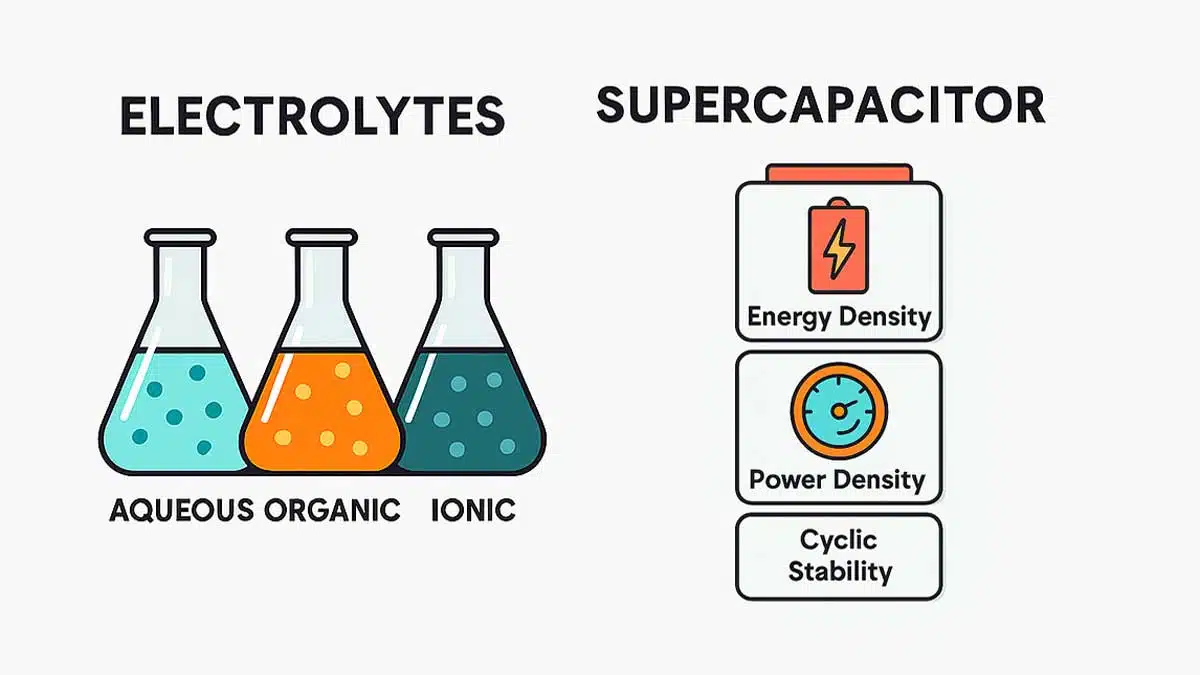
This article provides a comprehensive technical framework overview for electrolyte selection in supercapacitor design.

Introduction

Supercapacitors are at the forefront of next-generation energy storage, offering rapid charge–discharge cycles, high power density, and long operational lifetimes. While electrode materials often receive the spotlight, the electrolyte is equally decisive. It not only defines the electrochemical stability window (ESW) but also governs ion transport, interfacial dynamics, and long-term reliability.

Key Points

  • Electrolyte choice dictates both energy density and power density through its ESW and ionic conductivity.
  • Ion size, solvation, and mobility determine pore accessibility and capacitance efficiency.
  • Electrolyte–electrode compatibility influences degradation, self-discharge, and cycle life.
  • Hybrid and redox-active electrolytes represent a frontier for enhancing performance beyond traditional limits.

Electrolyte Fundamentals and Governing Equations

The energy density of a supercapacitor is expressed as:

$$ E = \frac{1}{2} C V^2 $$

where C is the capacitance and V is the maximum operating voltage. Since V is capped by the electrolyte’s ESW, extending this window is a direct route to higher energy density. The power density is approximated by:

$$ P = \frac{V^2}{4R} $$

where R is the equivalent series resistance (ESR), heavily influenced by electrolyte conductivity and viscosity. Thus, the electrolyte simultaneously governs both energy and power performance.

RelatedPosts

YAGEO Introduces C0G Flexible Termination Automotive MLCCs

SCHURTER Releases SMT Micro Switch for Compact HMIs

binder Releases Tool‑Tightenable M12 Connectors for Improved Reliability

Aqueous Electrolytes: High Conductivity, Narrow Window

Aqueous electrolytes excel in ionic conductivity (10–100 mS/cm), enabling ultrafast charge–discharge. However, water decomposition limits the ESW to ~1.23 V. Recent strategies to extend this include:

  • “Water-in-salt” electrolytes: Highly concentrated LiTFSI solutions suppress water activity, extending ESW to ~3 V.
  • pH-neutral electrolytes: Safer and less corrosive, though with reduced ionic mobility.
  • Hybrid aqueous systems: Combining salts with additives to stabilize electrode interfaces.

Organic Electrolytes: Expanding Voltage

Organic solvents such as acetonitrile (AN) and propylene carbonate (PC) allow ESWs up to 2.7–3 V, significantly boosting energy density. However, their ionic conductivity is typically one order of magnitude lower than aqueous systems. Key challenges include:

  • High flammability and toxicity (especially AN).
  • Viscosity and ion pairing effects reducing mobility.
  • Electrode passivation and SEI (solid electrolyte interphase) formation, which can both stabilize and hinder performance.

Ionic Liquids: Stability at a Cost

Ionic liquids (ILs) offer ESWs up to 4 V, thermal stability, and negligible vapor pressure. Their drawbacks are high viscosity and cost, which limit ion mobility and scalability. Recent advances include:

  • Binary IL mixtures: Reducing viscosity while retaining wide ESW.
  • Functionalized ILs: Tailoring cation/anion structures for specific electrode compatibility.
  • IL–organic hybrids: Balancing conductivity and voltage stability.

Solid and Quasi-Solid Electrolytes

Solid-state electrolytes, including polymer gels (e.g., PVA-KOH, PEO-LiClO4), provide mechanical stability, safety, and flexibility. They are particularly attractive for wearable and flexible electronics. However, their ionic conductivity (10-4–10-3 S/cm) is significantly lower than liquid systems. Nanofiller incorporation (e.g., SiO2, TiO2) and ionic liquid doping are promising strategies to enhance conductivity.

Electrode–Electrolyte Interactions

The electrolyte’s role extends beyond bulk transport to interfacial phenomena:

  • Ion size vs. pore size: Micropores (<1 nm) require desolvation of ions, which can limit kinetics but increase capacitance.
  • Solvation dynamics: Strongly solvated ions (e.g., Li+ in water) face higher desolvation barriers.
  • Specific adsorption: Certain ions (e.g., SO42-) interact strongly with carbon surfaces, altering double-layer structure.
  • Electrochemical stability: Side reactions at the interface can lead to gas evolution, electrode degradation, or SEI formation.

Comparative Performance Table

Electrolyte TypeConductivity (S/cm)ESW (V)AdvantagesLimitations
Aqueous0.1–1.01.0–2.0High conductivity, low costNarrow voltage window
Organic0.01–0.12.5–3.0Wide voltage, higher energy densityFlammable, toxic, lower conductivity
Ionic Liquids0.001–0.013.5–4.0Stable, non-volatileViscous, expensive
Solid/Quasi-Solid10-4–10-31.5–3.0Safe, flexible, stableLow conductivity

Emerging Directions

The frontier of electrolyte research is moving toward multifunctional and hybrid systems:

  • Redox-active electrolytes: Incorporating redox couples (e.g., I–/I3–, quinones) to add pseudocapacitance and boost energy density.
  • Deep eutectic solvents (DES): Low-cost, tunable alternatives to ILs with wide ESWs.
  • Hybrid aqueous–organic systems: Combining safety and conductivity of water with voltage stability of organics.
  • Interface engineering: Surface functionalization of electrodes to optimize ion adsorption and suppress side reactions.

Conclusion

Electrolytes are not passive media but active enablers of supercapacitor performance. From aqueous to organic, ionic liquid, and solid-state systems, each class offers unique trade-offs between conductivity, voltage, safety, and cost. Future breakthroughs will likely emerge from hybrid systems and interface engineering, where electrolyte chemistry is co-designed with electrode architecture. By integrating these deeper insights, researchers and engineers can push supercapacitors toward higher voltages, safer operation, and broader application in the global energy transition.

Further references:

  • Electrolyte selection for supercapacitive devices: a critical review, https://doi.org/10.1039/C9NA00374F
  • A review on electrolytes for supercapacitor devices, https://doi.org/10.1007/s43939-023-00065-3

Related

Recent Posts

YAGEO Introduces C0G Flexible Termination Automotive MLCCs

30.4.2026
7

Modeling Fringing Field Losses in Inductors & Transformers

30.4.2026
14

YMIN Introduces Polymer Tantalum Capacitors for AI Server SSDs

29.4.2026
37

Miniaturization of Tantalum Capacitors: Structural Limit Under Constant Rating

27.4.2026
32

Heatsink Design and Thermal Interface Materials for Reliable Electronics

27.4.2026
12

Murata New MLCC Bulk Case Packaging Cuts Packaging Material by 99%

27.4.2026
48

Exxelia Introduces SMD High‑Voltage Mica Capacitors

28.4.2026
23

Modelithics Releases COMPLETE v26.1 for Keysight ADS

23.4.2026
13

April 2026 Interconnect, Passives and Electromechanical Components Market Insights

22.4.2026
81

Upcoming Events

May 5
16:00 - 17:00 CEST

Understanding and Selecting Capacitors – Fundamentals, Technologies and Latest Trends

May 7
17:00 - 18:00 CEST

From Grid to Motion: How Industrial Electrification is Redefining Power System Design

May 12
8:00 - 15:00 CEST

ESCC Space Splice connectors

View Calendar

Popular Posts

  • Buck Converter Design and Calculation

    0 shares
    Share 0 Tweet 0
  • Boost Converter Design and Calculation

    0 shares
    Share 0 Tweet 0
  • Flyback Converter Design and Calculation

    0 shares
    Share 0 Tweet 0
  • LLC Resonant Converter Design and Calculation

    0 shares
    Share 0 Tweet 0
  • MLCC and Ceramic Capacitors

    0 shares
    Share 0 Tweet 0
  • Dual Active Bridge (DAB) Topology

    0 shares
    Share 0 Tweet 0
  • Capacitor Charging and Discharging

    0 shares
    Share 0 Tweet 0
  • What Electronics Engineer Needs to Know About Passive Low Pass Filters

    0 shares
    Share 0 Tweet 0
  • Ripple Current and its Effects on the Performance of Capacitors

    3 shares
    Share 3 Tweet 0
  • MLCC Case Sizes Standards Explained

    0 shares
    Share 0 Tweet 0

Newsletter Subscription


Passive Components Blog

© EPCI - Leading Passive Components Educational and Information Site

  • Home
  • Privacy Policy
  • EPCI Membership & Advertisement
  • About

No Result
View All Result
  • Home
  • Knowledge Blog
  • PCNS

© EPCI - Leading Passive Components Educational and Information Site

This website uses cookies. By continuing to use this website you are giving consent to cookies being used. Visit our Privacy and Cookie Policy.
Go to mobile version