




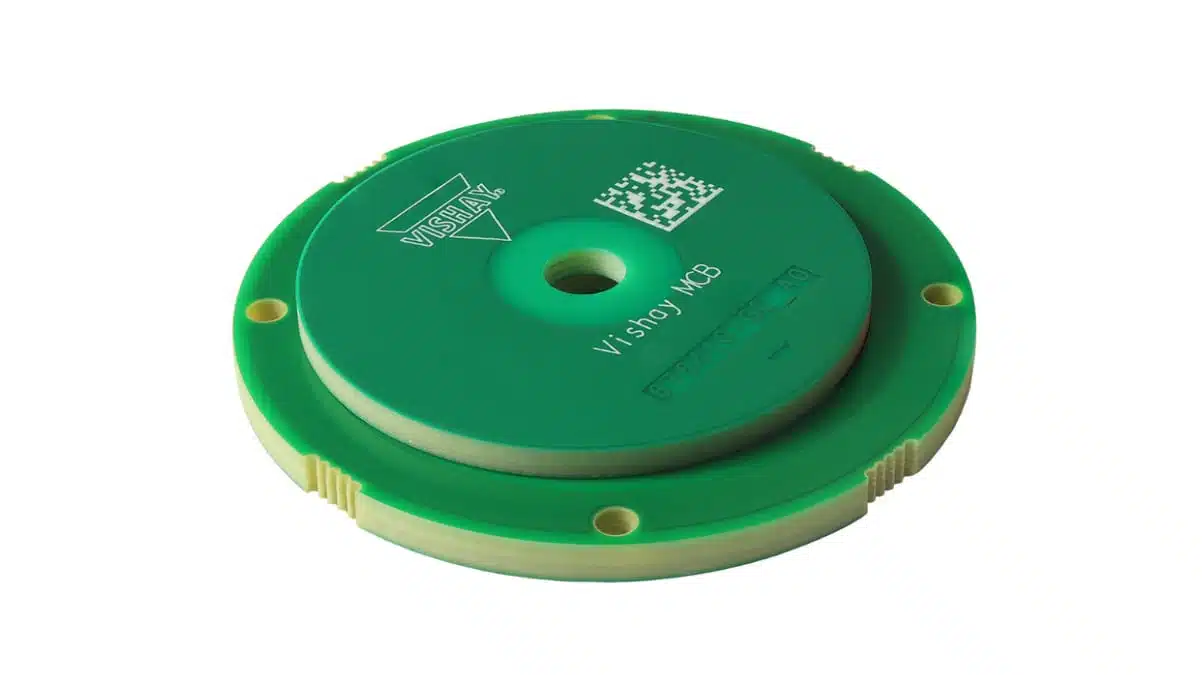
Vishay Intertechnology has introduced the RAIK045I MP, a single-turn, off-axis inductive rotary position sensor encoder with 16-bit resolution, ≥ 14-bit repeatability, and an SPI output, targeted at industrial motion-control applications operating near electric motors.
Vishay states the inductive rotary position sensor encoder is immune to external magnetic fields, which distinguishes it from Hall-effect-based encoders used in similar duty. It is positioned as a cost-effective alternative to higher-performance encoder solutions for robotics, motor drives, and conveyor systems.
What changed
- Vishay has released a new medium-precision (MP) variant within the RAIK045I inductive kit encoder family, document number 32647, revision dated 23-Apr-2026.
- The manufacturer states the sensor uses inductive rather than magnetic (Hall-effect) sensing, which it says makes it insensitive to external magnetic fields, moisture, and airborne pollution.
- Key confirmed ratings: 16-bit resolution, ≥ 14-bit repeatability, absolute accuracy ≥ 10 bits (0.35°), and rotation speeds up to 10,000 rpm.
- Samples and production quantities are stated as available now, with a lead time of 16 weeks.
Key technical data
| Parameter | Manufacturer-stated value | Engineering relevance |
|---|---|---|
| Sensor type | Off-axis rotational absolute inductive encoder, single-turn | Determines mounting geometry (hollow-shaft, off-axis) rather than through-shaft placement |
| Resolution | 16 bits (65,536 points, ≈ 0.0055°) | Sets the finest digital angle increment; not the same as accuracy |
| Repeatability | ≥ 14 bits | Indicates how consistently the sensor returns the same reading at a fixed angle |
| Absolute accuracy at 25°C | ≥ 10 bits (0.35°), typical value 0.22°C | This is the confirmed positioning error at room temperature; derating over temperature is stated separately |
| Temperature derating | ± 0.16° additional error over -40°C to +105°C | Accuracy budget must add this derating term to the 25°C figure for worst-case system error |
| Standard operating temperature range | -40°C to +125°C | Note: the connector variant is rated to 105°C for this derating spec; 125°C storage/operating applies per the pads variant per the datasheet notes |
| Maximum rotation speed | 10,000 rpm (higher on request) | Governs usable range in high-speed motor and spindle applications |
| Output | SPI (Mode 0, CPOL0/CPHA0), Sin/Cos available on request | SPI clock range is specified as 100 kHz to 1.4 MHz; system timing must respect the stated inactive and processing time windows |
| Supply | 5 VDC ± 0.5 VDC, ≤ 12 mA | Straightforward low-power budget for embedded controllers |
| Diameter / thickness | 45 mm / 6.6 mm (max) | Confirms compact envelope for the stator/rotor pair |
| Rotor / stator weight | ≤ 4.3 g / < 9.0 g | Low rotor mass is relevant to rotational inertia in fast-spinning applications |
| ESD immunity | EN IEC 61000-4-2:2008, Level 1 (2 kV), contact discharge, connector interface only | This is a component-level EMC test result, not a system-level EMC qualification |
Engineering implications
The datasheet distinguishes accuracy at 25°C (≥ 10 bits, 0.35°, typical 0.22°) from the additional ±0.16° temperature derating specified across -40°C to +105°C. For design engineers, this means the worst-case positioning error budget over the full temperature range must combine both figures rather than relying on the room-temperature accuracy number alone. Resolution (16 bits) and repeatability (≥ 14 bits) are also separate parameters: resolution defines the smallest reportable angle step, while repeatability describes how consistently the sensor reproduces a reading at the same physical position — accuracy is a distinct, generally coarser, specification.
The manufacturer notes the sensor does not integrate protection against surge-type overvoltages from switching or lightning transients per IEC 61000-4-5, and recommends external protection along with cable-length limits (power cable ≤ 3 m, data line ≤ 30 m) if that standard applies. This should be verified against the actual system wiring topology and any co-located switching converters, since inductive sensors of this type are sensitive to loop layout and EMI coupling in motor-adjacent installations. The stated ESD rating (2 kV contact discharge, connector interface only, per EN 61000-4-2:2008 Level 1) is a component-level stress test result and does not by itself establish system-level EMC compliance; this does not replace system-level validation.
Mechanical mounting tolerances are explicit in the datasheet: rotor shaft diameter Ø5 g6, stator centering diameter Ø45 H7, air-gap 0.4 mm ± 0.15 mm, and total beat/runout limits under 0.2 mm. In a typical off-axis hollow-shaft installation, meeting these mechanical tolerances is necessary to achieve the specified accuracy and repeatability figures; the manufacturer recommends a cone centering tool during assembly to help meet these limits.
Application fit
| Application or design requirement | Why the product may fit | What to verify |
|---|---|---|
| Position sensing near electric motors | Manufacturer states immunity to external magnetic fields | Confirm actual field strength and proximity in the target installation against Vishay’s test conditions |
| High-speed rotational tracking (up to 10,000 rpm) | Rated rotation speed and low rotor inertia (≤ 4.3 g) support fast spinning shafts | Validate SPI refresh rate (4.6 kHz) and sample rate (≤ 30 kHz at 1.4 MHz clock) against required control-loop update rate |
| Robotics, conveyor, AGV, and actuator position control | Listed by the manufacturer as target market applications | Confirm mechanical mounting tolerances and environmental exposure (vibration, contaminants) match the datasheet’s assumptions |
| Windmill pitch/yaw and off-road/agricultural equipment | Listed by the manufacturer among market applications | Verify outdoor humidity, vibration, and temperature exposure against the coating/potting options offered on request |
Applications such as hospital beds, surgical tables, drones, and missile launchers are listed by the manufacturer as market applications, but the source provides no application-specific qualification data (e.g., medical or aerospace certification) beyond the general industrial ratings; engineers in regulated markets should confirm whether additional qualification is required.
Verification checklist
- Confirm absolute accuracy budget by combining the 25°C figure (≥ 10 bits, 0.35°) with the ± 0.16° temperature derating across the intended operating range.
- Verify whether the 125°C or 105°C upper temperature limit applies, since the datasheet differentiates pads-variant and connector-variant maximum temperatures.
- Check SPI timing margins (clock frequency 100 kHz–1.4 MHz, inactive time ≥ 500 ns, processing time ≥ 400 ns) against the host controller’s SPI interface configuration.
- Assess whether external surge protection (IEC 61000-4-5) is needed, and confirm power/data cable length limits (3 m / 30 m) against the installation’s actual wiring.
- Validate mechanical mounting tolerances (rotor Ø5 g6, stator Ø45 H7, air-gap 0.4 mm ± 0.15 mm, beat < 0.2 mm) using the recommended cone centering tool or the alternative external-diameter centering method.
- Confirm environmental protection needs (conformal coating or potting) if the application involves metallic particles, oils, greases, salt spray, or corrosion, since these are offered only on request.
- Verify current sample/production availability and the stated 16-week lead time directly with Vishay or an authorized distributor before committing to a design timeline.
Availability and configuration status
The press release states that samples and production quantities of the RAIK045I MP are available now, with lead times of 16 weeks. Options such as pad connection, analog output, and Sin/Cos output are noted in the datasheet as available “on request,” indicating these are not standard off-the-shelf configurations. Engineers should confirm current part-specific ordering status and configuration options through Vishay’s product finder or an authorized distributor before design release.
Source
This article is based on Vishay Intertechnology’s official press release for the RAIK045I MP and the associated manufacturer datasheet (document number 32647). Engineers should consult the current Vishay datasheet, mounting drawings, and application information directly from Vishay for final component selection, validation, and design release.
References
- Vishay Intertechnology, “Single-Turn 45 mm Inductive Position Sensor Encoder” press release