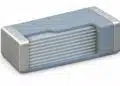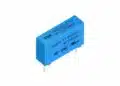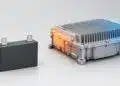
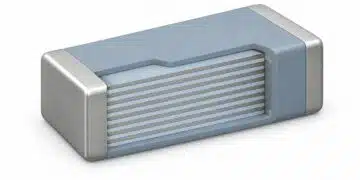



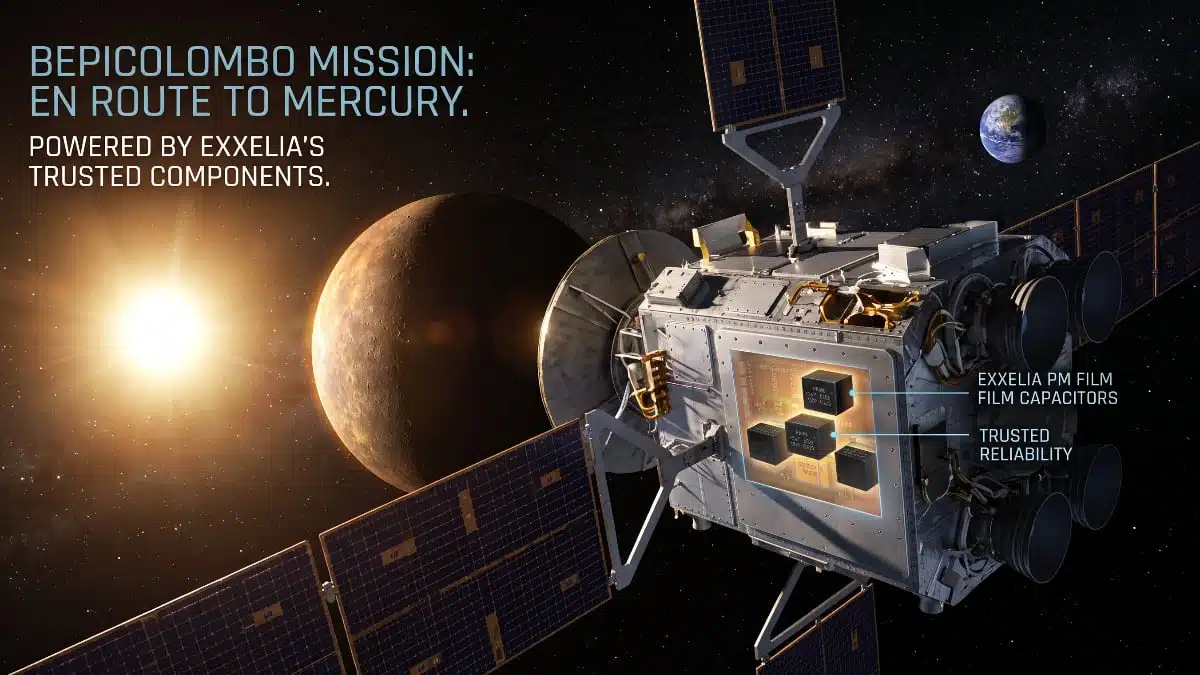
Exxelia has announced that PM film capacitors, CMC common-mode chokes and SESI power inductors are used on the ESA/JAXA BepiColombo mission to Mercury.
The Exxelia announcement links its established passive-component families with a long-duration space programme.
Key features and benefits
- The announcement names the PM90X / PM90 / PM907 capacitor family, CMC common-mode chokes and SESI power inductors.
- The PM90X family is a self-healing, non-inductive polyester film capacitor range in a thermoplastic, epoxy-resin-sealed case.
- CMC and SESI ranges are available as surface-mount magnetic components for power conversion and filtering functions.
- The announcement associates these components with spacecraft power management, filtering and electromagnetic compatibility. Specific BepiColombo part numbers, case sizes and screening levels are not published.
Technical highlights
| Component family | Published selection data |
|---|---|
| PM90X / PM90 / PM907 | 50 V to 1250 V DC; −55 °C to +125 °C; ±10% or ±20%; PET dielectric |
| CMC | 50 µH to 4.9 mH; −55 °C to +125 °C; up to 14.3 A |
| SESI | 1 µH to 6.8 mH; −55 °C to +125 °C; up to 24 A rated and 27.6 A peak |
The PM90X product page identifies high-frequency switch-mode power supplies as a typical application. Its published data differ from the announcement’s broad emphasis on extreme space conditions: the accessible product page gives the electrical range above but does not publicly provide a family-specific radiation, vibration or thermal-cycling qualification report.
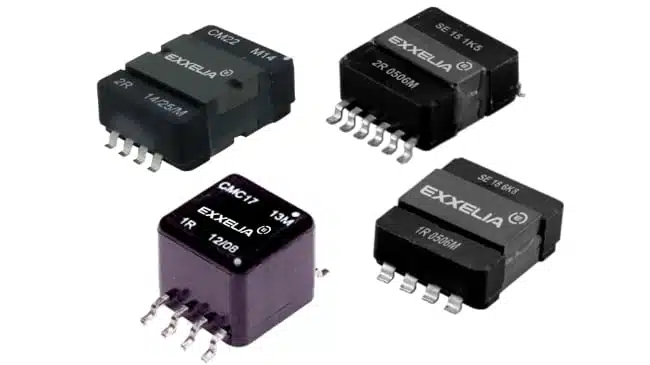
The CMC documentation covers several package platforms, including CMC14, CMC15, CMC17, CMC18 and CMC22. Published CMC15, CMC18 and CMC22 variants use an eight-terminal low-profile SMD format, specify 500 V rms dielectric-strength testing for one minute at 50 Hz, and provide attenuation plots referenced to a 50 Ω test configuration. EMI filters must still be evaluated with the converter’s actual source and load impedances, cable harness and layout.
The CMC15, CMC18 and CMC22 series are documented against MIL-STD-202, ECSS-Q-70-02 and DO-160, with ESCC 3201/010 versions available on request. The qualification information describes ESA ESCC 3201 generic and 3201/010 detail-specification procurement for CMC15/18/22 WR versions, including defined production and qualification test charts; this is not a blanket statement that every catalogue version is QPL-qualified.
| CMC platform | Inductance range | RMS current at 40 °C rise | Maximum dimensions |
|---|---|---|---|
| CMC15 2WR | 0.05 mH to 4.0 mH | 0.55 A to 6.7 A | 22 mm × 16.5 mm × 7.9 mm |
| CMC18 2WR | 0.06 mH to 4.9 mH | 0.9 A to 9.9 A | 26 mm × 22 mm × 8.9 mm |
| CMC22 2WR | 0.06 mH to 3.3 mH | 1.9 A to 14.3 A | 35.3 mm × 30.8 mm × 12.2 mm |
The SESI documentation covers 9.1, 14, 15, 18, 22 and 32 size platforms, with SMD and, for SESI32, through-hole variants. Inductance is specified at 0.25 V and 100 kHz, while the stated rated current is permanent DC current and the stated peak current is a maximum at the specified temperature where inductance is not guaranteed.
Typical applications
The CMC range is specified for EMI filtering and noise attenuation on signal lines and switch-mode power supplies. Its operating-temperature range, current ratings, dielectric-strength test and impedance or attenuation curves support common-mode filtering in embedded DC/DC converter interfaces and associated harness paths.
SESI inductors are specified for energy storage, smoothing and filtering at frequencies up to 1 MHz. The published −55 °C to +125 °C operating range, DC-current data and inductance-under-load data support their use in converter energy-storage and output-smoothing positions, subject to the selected size and value.
The PM90X family is listed for high-frequency switch-mode power supplies. Its voltage, capacitance, temperature and tolerance limits must be checked at individual part-number level before assigning it to a DC-link, snubber or resonant position; the documentation opened does not establish those circuit positions across the complete family.
Application fit
| Circuit function | Suitable family | Published basis |
|---|---|---|
| Common-mode EMI stage | CMC | 50 Ω attenuation data; 500 V rms test; SMD construction |
| Energy storage or smoothing | SESI | 1 µH to 6.8 mH; rated and peak-current data; up to 1 MHz |
| HF SMPS capacitance | PM90X | 50 V to 1250 V DC; PET film; −55 °C to +125 °C |
For CMC parts, the maximum RMS-current figures correspond to a 40 °C temperature rise above a 25 °C ambient condition. The datasheet’s derating plots show that permitted current decreases with ambient temperature and permissible temperature rise; thermal assessment must include the actual PCB copper area, enclosure temperature and cooling conditions.
For SESI parts, the loaded inductance can be materially below the no-load value. For example, the SESI 22 7K0 2WR is listed at 7 µH with no load and 3.8 µH at its 18.9 A rated current, while its maximum peak current is 24 A. This distinction matters when selecting the inductor from ripple-current and control-loop requirements rather than nominal inductance alone.
Design-in notes for engineers
- Select the exact CMC sub-family and part number from the attenuation curve, inductance, DC resistance, RMS current and mechanical drawing rather than from the family headline values.
- Treat the published CMC attenuation figures as 50 Ω laboratory data. Validate conducted emissions and susceptibility in the final converter, harness and enclosure arrangement.
- Use the CMC thermal derating curves at the real maximum ambient temperature; the published measurements use a 1 dm² PCB without a cooling device.
- Confirm the SESI inductor’s inductance at rated current, not only its no-load inductance, before finalising ripple-current and transient calculations.
- Keep peak-current operation distinct from guaranteed-inductance operation. The SESI documentation explicitly states that inductance is not guaranteed at the listed peak-current condition.
- Verify reflow profile, pad geometry, terminal finish, procurement quality level, traceability and screening requirements with the current controlled documentation before layout or production release.
- The public material identifies ESCC options as available on request for selected CMC and SESI variants. Mission-specific qualification, lot acceptance and radiation requirements should therefore be confirmed for the actual ordered part number.
Further reading
Source
This information is based on the Exxelia BepiColombo press release and official PM90X, CMC and SESI product documentation. Engineers should consult the current manufacturer datasheet, controlled drawings and procurement documentation for final qualification and design release.