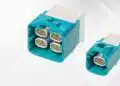











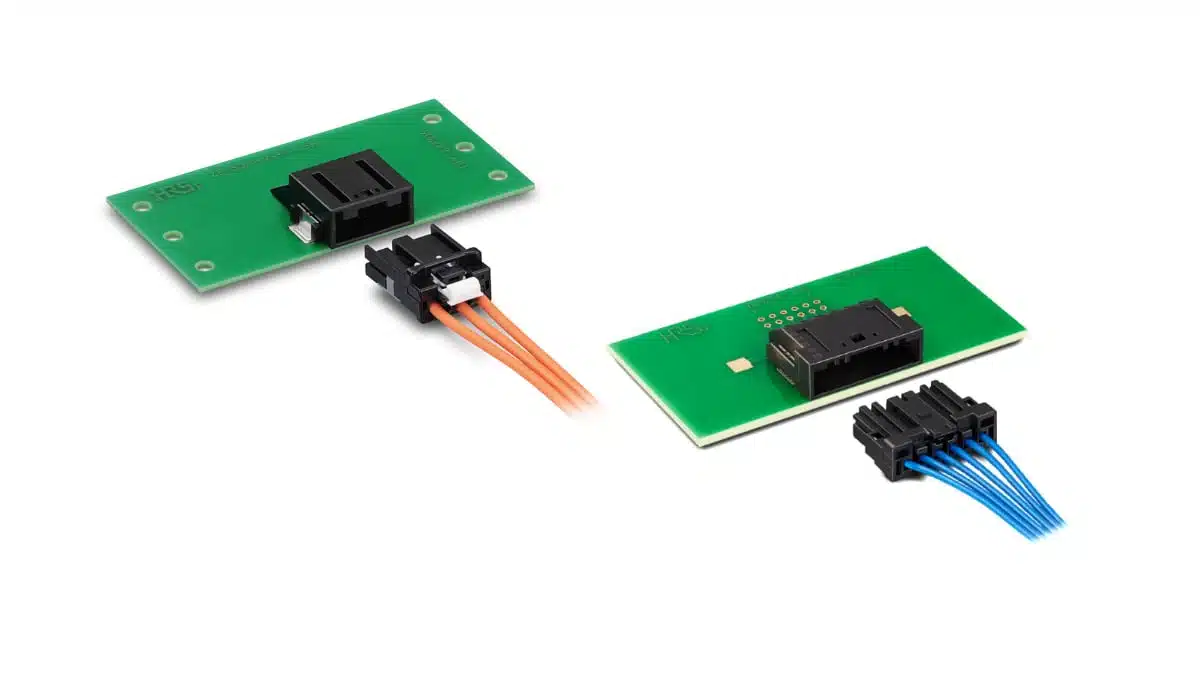
Hirose’s ZE150HV and ZG05HV connector families are compact wire‑to‑board solutions for high‑voltage circuits in electric and hybrid vehicles as well as industrial battery systems.
They are designed for up to 1,000 V operation with enhanced creepage/clearance, robust vibration performance, and options tailored to both high‑current and signal/low‑power lines. This makes them attractive for engineers who need to route high‑voltage wiring safely into PCBs in constrained EV/HEV powertrain and stationary storage designs.
Key features and benefits
- High‑voltage rating for modern EV architectures
Both ZE150HV and ZG05HV are rated for operation up to 1,000 V AC/DC with a 3,000 V AC withstand level for one minute, according to IEC 60664 (pollution degree 2, up to 6,000 m altitude). - Wide automotive operating temperature range
The connectors are specified from −40 °C to +125 °C, covering typical automotive under‑hood and battery enclosure environments. - Compact footprints with optimized creepage and clearance
A proprietary ribbed housing design increases the effective surface path between contacts, allowing high‑voltage ratings in comparatively small connector sizes. - Vibration‑robust contact system
Dual‑spring, three‑point contacts are used to increase contact force and maintain continuity under vehicle vibration and dynamic loading. - Connector Position Assurance (CPA) option for safety
The ZE150HV version integrates a CPA mechanism that helps prevent incomplete mating and reduces the risk of arcing or intermittent connection at high voltage. - Wire gauges adapted to power vs. signal needs
ZE150HV supports thicker automotive wires for higher current, while ZG05HV targets smaller gauges suitable for low‑current or sensing lines. - Surface‑mount and THR mounting options
ZE150HV is offered as an SMT connector, whereas ZG05HV uses through‑hole reflow (THR), giving layout flexibility for designers balancing assembly flow and mechanical robustness.
Typical applications
The ZE150HV and ZG05HV series target high‑voltage subsystems where wiring harnesses must interface reliably with power electronics and battery modules.
- EV and HEV traction inverters and converters in the powertrain
- On‑board chargers and DC/DC converters for high‑voltage battery systems
- Battery packs and storage modules in electric vehicles and industrial systems
- Stationary energy storage such as industrial storage batteries and smart‑grid battery modules
- Other high‑voltage automotive subsystems where compact, vibration‑resistant wire‑to‑board connections are needed
In many of these systems, the connectors provide a defined, removable interface between a cable harness and a high‑voltage PCB, simplifying assembly, serviceability, and modular system design.
Technical highlights
For quick comparison of the two series, the table below summarizes the key electrical and mechanical parameters.
ZE150HV vs. ZG05HV series overview
| Parameter | ZE150HV series | ZG05HV series |
|---|---|---|
| Nominal contact size / pitch | 1.5 size, 4.5 mm pitch | 0.5 size, 3.3 mm pitch |
| Rated current (all pins powered) | 10 A per pin | 1 A per pin |
| Rated voltage | 1,000 V AC/DC (per IEC 60664 conditions) | 1,000 V AC/DC (per IEC 60664 conditions) |
| Withstand voltage | 3,000 V AC for 1 minute | 3,000 V AC for 1 minute |
| Insulation resistance | Minimum 100 MΩ at 1,000 V DC | Minimum 100 MΩ at 1,000 V DC |
| Operating temperature | −40 °C to +125 °C | −40 °C to +125 °C |
| Mating durability | 30 mating cycles | 30 mating cycles |
| PCB mounting | Surface‑mount technology (SMT) | Through‑hole reflow (THR) |
| Applicable wire size | 16–18 AWG (0.75–1.25 mm²) | 22 and 24 AWG (0.22–0.35 mm²) |
The combination of 1,000 V rating and 3,000 V withstand voltage addresses the insulation requirements of many 400 V and 800 V class EV platforms, under the specified pollution degree and altitude. In practice, designers still need to verify that the creepage and clearance distances on the associated PCB and in the surrounding system meet the overall insulation coordination requirements for their target standard.
High‑voltage housing design
Hirose optimizes creepage and clearance by adding ribs and shaping the plastic housing to increase the effective path between adjacent contacts and between contacts and external conductive parts. This approach is particularly relevant at 1,000 V, where required creepage distances can otherwise force large connector footprints. For engineers, this means the ZE150HV and ZG05HV can be placed in tighter spaces while still meeting insulation targets when used according to the datasheet and applicable standards.
Vibration‑resistant contact geometry
The dual‑spring, three‑point contact system provides both higher contact normal force and multiple contact points per terminal. In vehicle applications subject to continuous vibration and shock, this helps maintain low and stable contact resistance over life. It also reduces the risk of momentary interruptions that could disturb high‑voltage control or sensing circuits, which is especially important in safety‑related power electronics.
CPA mechanism on ZE150HV
The Connector Position Assurance mechanism used on the ZE150HV series is designed to detect and prevent incomplete mating. Once fully engaged, the CPA locks or verifies the position so that the connector cannot remain in a “half‑mated” state. In high‑voltage systems this is critical: partial insertion can lead to arcing, heating, or intermittent faults under load. The ZG05HV focuses on compactness for smaller conductors and does not include the CPA feature, so designers should evaluate where CPA is mandatory in the system and select the series appropriately.
Design‑in notes for engineers
Series selection and partitioning
- Use ZE150HV where higher current is needed; the 10 A per pin capability and 16–18 AWG support suit power lines between battery modules, inverters, and DC/DC converters.
- Use ZG05HV where only small currents or signals are present; its 1 A per pin rating and 22–24 AWG support make it suitable for sensing, control, and monitoring lines within the same high‑voltage environment.
- Consider mixed usage in a system: ZE150HV for main power paths, ZG05HV for auxiliary or sensing harnesses, keeping voltage class consistent but optimizing size and copper usage.
Layout and insulation coordination
- Respect the manufacturer’s creepage/clearance recommendations and IEC 60664 assumptions (pollution degree 2, up to 6,000 m altitude) when defining the PCB land pattern and keep‑out areas.
- Ensure that PCB traces, copper pours, and mechanical structures around the connector do not compromise the effective creepage path provided by the ribbed housing design.
- For SMT ZE150HV, verify solder joint fillet and mechanical support in vibration‑heavy locations; additional mechanical fixing or potting may be beneficial in some designs.
Vibration and mechanical robustness
- The dual‑spring, three‑point contacts help, but system‑level vibration testing is still necessary for critical automotive use cases; consider where to place connectors to minimize exposure to extreme mechanical stress.
- Confirm that harness routing supports the connector and avoids heavy cable loads acting as a lever on the PCB, particularly for SMT versions on thinner boards.
Thermal considerations
- Current ratings are specified under defined conditions; for continuous high‑current operation in hot environments close to +125 °C, evaluate temperature rise in your specific layout and cooling conditions.
- Combine the connector’s operating temperature range with the expected ambient and self‑heating of adjacent power components (IGBTs, SiC MOSFETs, inductors, etc.) to ensure sufficient margin.
Assembly and quality
- In designs using ZE150HV, make sure manufacturing and service procedures explicitly include the CPA operation and verification, so incomplete mating is avoided on the line and in the field.
- For ZG05HV THR mounting, coordinate reflow profiles so that connector plastics and wire terminations remain within their specified temperature limits while achieving reliable solder joints.
- Plan for the 30‑cycle mating durability by avoiding unnecessary disconnects during testing and service; for frequently reconnected interfaces, consider whether additional protection or an alternative interconnect strategy is needed.
Source
This article is based on information from Hirose Electric’s official product information for the ZE150HV and ZG05HV high‑voltage automotive connector series and related manufacturer documentation, interpreted and summarized for design engineers and component purchasers.