




Passive Components Blog
No Result
View All Result
  • Home
  • News
    • All
    • Aerospace & Defence
    • Antenna
    • Applications
    • Automotive
    • Capacitors
    • Circuit Protection Devices
    • electro-mechanical news
    • Filters
    • Fuses
    • Inductors
    • Industrial
    • Integrated Passives
    • inter-connect news
    • Market & Supply Chain
    • Market Insights
    • Medical
    • Modelling and Simulation
    • New Materials & Supply
    • New Technologies
    • Non-linear Passives
    • Oscillators
    • Passive Sensors News
    • Resistors
    • RF & Microwave
    • Telecommunication
    • Weekly Digest
    Overview of fabricated ferroelectric capacitors improving hyperdimensional computing task learning accuracy. a The experimental work reported in this study comprises ferroelectric capacitor (FeCAP) device fabrication, structural and electrical characterization, analog state identification and their reliability study. b The computational part of the work explores the benefits of using characteristics from the fabricated devices in a hyperdimensional computing scheme; source: authors

    High-Precision Hyperdimensional Computing with Multi-Level Ferroelectric HZO Capacitors

    Coilcraft Introduces Automotive Common Mode Chokes Target CISPR 25 Class 5 EMC Compliance

    Murata Expands Automotive Metal Power Inductor Range

    Modelithics Qorvo GaN Library v26.5.11 Adds 200 W RF Transistor Model

    Bourns Releases Low-Profile Incremental Ring Encoder Targets Compact Industrial HMIs

    Wk 34 Electronics Supply Chain Digest

    August 2026 Interconnect, Passives and Electromechanical Components Market Insights

    AEM Introduced High-Power Fuses for Compact Automotive and Industrial Overcurrent Protection

    Knowles Cornell Dubilier 105C Flatpack Aluminum Electrolytic Capacitors Target Low-Profile High-Density Power Designs

    Trending Tags

    • Ripple Current
    • RF
    • Leakage Current
    • Tantalum vs Ceramic
    • Snubber
    • Low ESR
    • Feedthrough
    • Derating
    • Dielectric Constant
    • New Products
    • Market Reports
  • Knowledge Blog
  • Dossiers
    • AI Hardware Dossier
    • Automotive Dossier
    • Industrial Robotics Dossier
    • Power Converter Dossier
    • Capacitor Dossier
    • Resistor Dossier
    • Inductor Dossier
    • Circuit Protection Dossier
  • Suppliers
    • Who is Who
  • PCNS
    • PCNS 2025
    • PCNS 2023
    • PCNS 2021
    • PCNS 2019
    • PCNS 2017
  • Events
  • Home
  • News
    • All
    • Aerospace & Defence
    • Antenna
    • Applications
    • Automotive
    • Capacitors
    • Circuit Protection Devices
    • electro-mechanical news
    • Filters
    • Fuses
    • Inductors
    • Industrial
    • Integrated Passives
    • inter-connect news
    • Market & Supply Chain
    • Market Insights
    • Medical
    • Modelling and Simulation
    • New Materials & Supply
    • New Technologies
    • Non-linear Passives
    • Oscillators
    • Passive Sensors News
    • Resistors
    • RF & Microwave
    • Telecommunication
    • Weekly Digest
    Overview of fabricated ferroelectric capacitors improving hyperdimensional computing task learning accuracy. a The experimental work reported in this study comprises ferroelectric capacitor (FeCAP) device fabrication, structural and electrical characterization, analog state identification and their reliability study. b The computational part of the work explores the benefits of using characteristics from the fabricated devices in a hyperdimensional computing scheme; source: authors

    High-Precision Hyperdimensional Computing with Multi-Level Ferroelectric HZO Capacitors

    Coilcraft Introduces Automotive Common Mode Chokes Target CISPR 25 Class 5 EMC Compliance

    Murata Expands Automotive Metal Power Inductor Range

    Modelithics Qorvo GaN Library v26.5.11 Adds 200 W RF Transistor Model

    Bourns Releases Low-Profile Incremental Ring Encoder Targets Compact Industrial HMIs

    Wk 34 Electronics Supply Chain Digest

    August 2026 Interconnect, Passives and Electromechanical Components Market Insights

    AEM Introduced High-Power Fuses for Compact Automotive and Industrial Overcurrent Protection

    Knowles Cornell Dubilier 105C Flatpack Aluminum Electrolytic Capacitors Target Low-Profile High-Density Power Designs

    Trending Tags

    • Ripple Current
    • RF
    • Leakage Current
    • Tantalum vs Ceramic
    • Snubber
    • Low ESR
    • Feedthrough
    • Derating
    • Dielectric Constant
    • New Products
    • Market Reports
  • Knowledge Blog
  • Dossiers
    • AI Hardware Dossier
    • Automotive Dossier
    • Industrial Robotics Dossier
    • Power Converter Dossier
    • Capacitor Dossier
    • Resistor Dossier
    • Inductor Dossier
    • Circuit Protection Dossier
  • Suppliers
    • Who is Who
  • PCNS
    • PCNS 2025
    • PCNS 2023
    • PCNS 2021
    • PCNS 2019
    • PCNS 2017
  • Events
No Result
View All Result
Passive Components Blog
No Result
View All Result

Coilcraft Introduces Automotive Common Mode Chokes Target CISPR 25 Class 5 EMC Compliance

7.9.2026
Reading Time: 5 mins read
A A

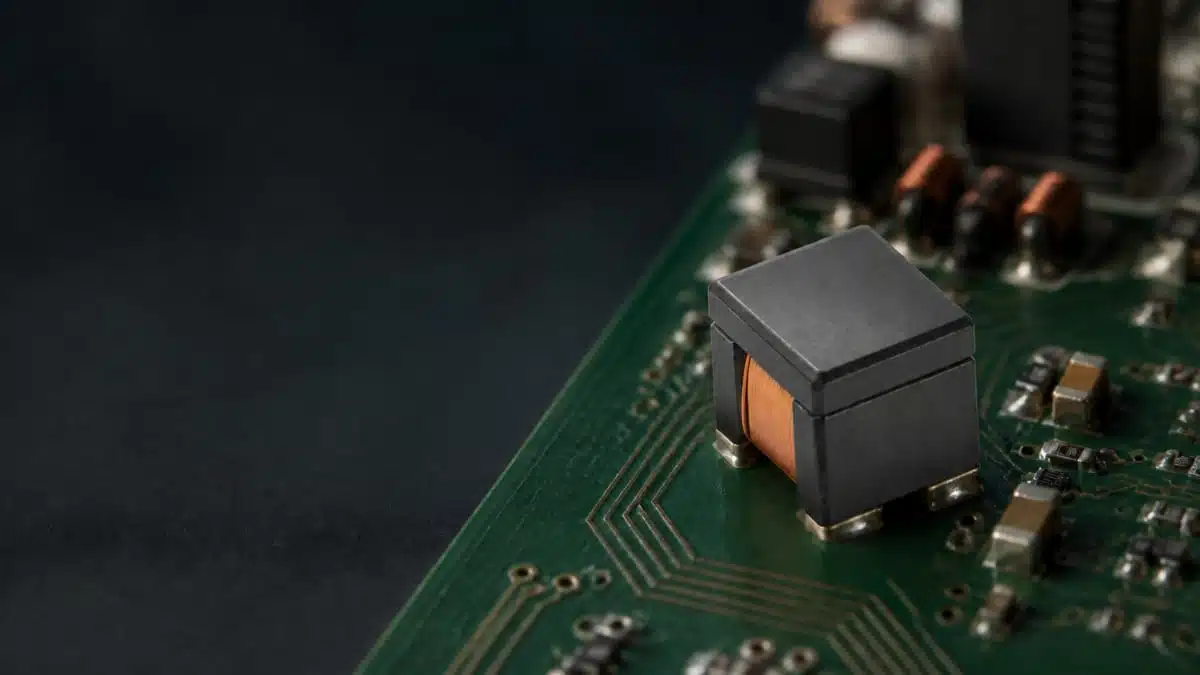
Coilcraft has introduced the DFC1210 series, a family of automotive-grade common mode chokes designed for high-frequency noise suppression on power lines in a compact chip-style footprint.

The series targets designers who need to meet CISPR 25 Class 5 EMC requirements while keeping board space and component count under control in modern vehicle electronics.

RelatedPosts

Coilcraft Releases High-Current Ferrite Beads for CISPR 25 EMC compliance

Coilcraft Releases 0402 Ferrite-Core Wirewound Chip Inductors for RF and EMI Control

Coilcraft Introduces SMT Current Sense Transformers for High‑Performance Power Electronics

Key features and benefits

  • Compact 1210 footprint: 3.25 x 2.67 x 2.8 mm, suited to dense automotive ECU and power-line filter layouts
  • CISPR 25 Class 5 optimization: engineered for high-frequency common mode noise suppression across the 30 MHz to 3 GHz range referenced in the manufacturer announcement
  • Wirewound surface mount construction: gives broadband impedance behavior that stays consistent across frequency, DC bias current, and temperature
  • AEC-Q200 qualified: passed the automotive stress-test qualification, indicating the component has been validated for the temperature cycling, vibration, and humidity conditions typical of automotive electronics
  • High current capability: rms current ratings up to 1.7 A at 25°C depending on part number, according to the manufacturer datasheet
  • Wide operating range: -40°C to +125°C ambient temperature range with rated Irms current

Technical highlights

The DFC1210 series is available in three standard inductance values, each with two lines (differential pair configuration). Electrical specifications are measured at 25°C according to the manufacturer datasheet.

Part numberCommon mode impedance (typ, @ 100 MHz)InductanceIrms @ 25°CDCR maxIsolation voltage
DFC1210-681150 Ω0.68 µH1.7 A75 mΩ250 Vrms
DFC1210-122275 Ω1.2 µH1.7 A90 mΩ250 Vrms
DFC1210-182425 Ω1.8 µH1.5 A105 mΩ250 Vrms

Inductance is measured at 100 kHz, 0.1 Vrms, 0 A DC, with a tolerance of -30%/+50% per the manufacturer datasheet. Isolation voltage is rated at 353 VDC / 250 Vrms for one minute (hipot) between primary and secondary windings. The core material is ferrite, and the termination finish is RoHS-compliant matte tin over nickel over silver-palladium-glass frit, a construction intended to support reliable solder joints through multiple reflow cycles. Moisture Sensitivity Level is rated 1, meaning the parts have unlimited floor life below 30°C and 85% relative humidity before mounting — a practical consideration for EMI filter assembly lines that batch-stage automotive boards.

Typical applications

Common mode chokes of this type are used wherever a power line needs high-frequency noise suppression without adding bulk to the board. Based on the manufacturer’s stated qualification and performance profile, suitable use cases include automotive ECUs, sensor modules, and power distribution lines subject to CISPR 25 testing.

  • Automotive electronic control units (ECUs) and body control modules
  • DC power-line filtering in infotainment and driver-assistance subsystems
  • Sensor and actuator interface lines requiring EMC compliance
  • Compact automotive power converters where board area is constrained

Application fit

CISPR 25 defines conducted and radiated emission limits for automotive electrical and electronic components, and Class 5 represents one of the tighter limit classes in that standard. A common mode choke optimized for this class is intended to attenuate noise currents that flow in the same direction on both conductors of a power line pair — a noise mode that ordinary inductors alone do not effectively suppress, since it requires a component wound to present high impedance to common mode currents while allowing differential (signal or power) current to pass largely unaffected.

Design-in notes for engineers

  • Confirm the required CISPR 25 subclass and frequency range for the target vehicle platform before selecting a specific DFC1210 part number, since impedance and attenuation vary by inductance value
  • Check DC bias current against the application’s actual line current; Irms ratings decrease at 85°C and 125°C ambient, so thermal margin should be verified against the manufacturer datasheet
  • Use the DCR-at-temperature relationship to estimate power dissipation and resulting temperature rise in the final enclosure, rather than relying solely on the 25°C DCR value
  • AEC-Q200 qualification supports automotive reliability requirements, but final qualification and design release should still follow the OEM’s own component approval process
  • Reflow and washing limits (three 40-second reflows at +260°C, aqueous-wash compatibility per MIL-STD-202 Method 215) should be checked against the actual assembly process
  • For layouts with tight EMC margins, pair choke selection with board-level voltage derating practices on nearby capacitors to avoid re-introducing noise coupling paths

Further reading

  • What Is an Inductor?
  • What Is EMI Filter?
  • Voltage Derating Guidelines for Capacitors

Source

This article is based on a manufacturer press release and product page from Coilcraft describing the DFC1210 series of automotive-grade common mode chokes. Design engineers should consult the current manufacturer datasheet and documentation before finalizing component selection or design release, as specifications may be updated over time.

References

  1. Coilcraft press release: New Automotive-grade Common Mode Chokes optimized for CISPR 25 EMC compliance
  2. Coilcraft DFC1210 Series product page
  3. Coilcraft DFC1210 datasheet (PDF)

Related

Recent Posts

Murata Expands Automotive Metal Power Inductor Range

7.9.2026
3

August 2026 Interconnect, Passives and Electromechanical Components Market Insights

4.9.2026
24

AEM Introduced High-Power Fuses for Compact Automotive and Industrial Overcurrent Protection

4.9.2026
7

Vishay Extends High-Current Common-Mode Chokes with 30 A EMI Filtering up to 150 °C

3.9.2026
20

B–H Curve-Based Inductor Modelling in LTspice: A Current-Dependent Magnetic Model

31.8.2026
43

Filter Capacitors in Electric Vehicles: Knowles Safety MLCCs for BMS and Isolated DC/DC Converters

28.8.2026
44

YAGEO Expands Aluminum Polymer Capacitors for High-Temperature AI Server Power Rails

28.8.2026
62

Vishay IFBT SMT Flyback Transformers Target PoE and Isolated DC/DC Designs up to 30 W

28.8.2026
22

Bourns Automotive BMS Signal Transformer Combines Reinforced Isolation and Common-Mode Noise Rejection

27.8.2026
27

Upcoming Events

Sep 10
11:00 - 12:00 CEST

Equipment models and model strategies for Space Missions

Sep 16
17:00 - 18:00 CEST

Designing a 5 kW, 800 V-to-50 V PSFB Converter for Next-Generation Data Centers

Sep 29
16:00 - 17:00 CEST

Cybersecurity 2026

View Calendar

Popular Posts

  • Buck Converter Design and Calculation

    0 shares
    Share 0 Tweet 0
  • LLC Resonant Converter Design and Calculation

    0 shares
    Share 0 Tweet 0
  • Boost Converter Design and Calculation

    0 shares
    Share 0 Tweet 0
  • Earthing Systems and IEC Classification Explained

    0 shares
    Share 0 Tweet 0
  • Flyback Converter Design and Calculation

    0 shares
    Share 0 Tweet 0
  • MLCC and Ceramic Capacitors

    0 shares
    Share 0 Tweet 0
  • Capacitor Charging and Discharging

    0 shares
    Share 0 Tweet 0
  • Audio Capacitors: Choosing Capacitors for Crossover Circuits

    0 shares
    Share 0 Tweet 0
  • Resistor Symbols

    0 shares
    Share 0 Tweet 0
  • Thermistors Basics, NTC and PTC Thermistors

    0 shares
    Share 0 Tweet 0

Newsletter Subscription


Passive Components Blog

© 2015–2026
All rights reserved

  • Home
  • Privacy Policy
  • EPCI Membership & Advertisement
  • About

No Result
View All Result
  • Home
  • Knowledge Blog
  • Dossiers
  • PCNS

© 2015–2026
All rights reserved