










Passive Components Blog
No Result
View All Result
  • Home
  • News
    • All
    • Aerospace & Defence
    • Antenna
    • Applications
    • Automotive
    • Capacitors
    • Circuit Protection Devices
    • electro-mechanical news
    • Filters
    • Fuses
    • Inductors
    • Industrial
    • Integrated Passives
    • inter-connect news
    • Market & Supply Chain
    • Market Insights
    • Medical
    • Modelling and Simulation
    • New Materials & Supply
    • New Technologies
    • Non-linear Passives
    • Oscillators
    • Passive Sensors News
    • Resistors
    • RF & Microwave
    • Telecommunication
    • Weekly Digest
    Overview of fabricated ferroelectric capacitors improving hyperdimensional computing task learning accuracy. a The experimental work reported in this study comprises ferroelectric capacitor (FeCAP) device fabrication, structural and electrical characterization, analog state identification and their reliability study. b The computational part of the work explores the benefits of using characteristics from the fabricated devices in a hyperdimensional computing scheme; source: authors

    High-Precision Hyperdimensional Computing with Multi-Level Ferroelectric HZO Capacitors

    Coilcraft Introduces Automotive Common Mode Chokes Target CISPR 25 Class 5 EMC Compliance

    Murata Expands Automotive Metal Power Inductor Range

    Modelithics Qorvo GaN Library v26.5.11 Adds 200 W RF Transistor Model

    Bourns Releases Low-Profile Incremental Ring Encoder Targets Compact Industrial HMIs

    Wk 34 Electronics Supply Chain Digest

    August 2026 Interconnect, Passives and Electromechanical Components Market Insights

    AEM Introduced High-Power Fuses for Compact Automotive and Industrial Overcurrent Protection

    Knowles Cornell Dubilier 105C Flatpack Aluminum Electrolytic Capacitors Target Low-Profile High-Density Power Designs

    Trending Tags

    • Ripple Current
    • RF
    • Leakage Current
    • Tantalum vs Ceramic
    • Snubber
    • Low ESR
    • Feedthrough
    • Derating
    • Dielectric Constant
    • New Products
    • Market Reports
  • Knowledge Blog
  • Dossiers
    • AI Hardware Dossier
    • Automotive Dossier
    • Industrial Robotics Dossier
    • Power Converter Dossier
    • Capacitor Dossier
    • Resistor Dossier
    • Inductor Dossier
    • Circuit Protection Dossier
  • Suppliers
    • Who is Who
  • PCNS
    • PCNS 2025
    • PCNS 2023
    • PCNS 2021
    • PCNS 2019
    • PCNS 2017
  • Events
  • Home
  • News
    • All
    • Aerospace & Defence
    • Antenna
    • Applications
    • Automotive
    • Capacitors
    • Circuit Protection Devices
    • electro-mechanical news
    • Filters
    • Fuses
    • Inductors
    • Industrial
    • Integrated Passives
    • inter-connect news
    • Market & Supply Chain
    • Market Insights
    • Medical
    • Modelling and Simulation
    • New Materials & Supply
    • New Technologies
    • Non-linear Passives
    • Oscillators
    • Passive Sensors News
    • Resistors
    • RF & Microwave
    • Telecommunication
    • Weekly Digest
    Overview of fabricated ferroelectric capacitors improving hyperdimensional computing task learning accuracy. a The experimental work reported in this study comprises ferroelectric capacitor (FeCAP) device fabrication, structural and electrical characterization, analog state identification and their reliability study. b The computational part of the work explores the benefits of using characteristics from the fabricated devices in a hyperdimensional computing scheme; source: authors

    High-Precision Hyperdimensional Computing with Multi-Level Ferroelectric HZO Capacitors

    Coilcraft Introduces Automotive Common Mode Chokes Target CISPR 25 Class 5 EMC Compliance

    Murata Expands Automotive Metal Power Inductor Range

    Modelithics Qorvo GaN Library v26.5.11 Adds 200 W RF Transistor Model

    Bourns Releases Low-Profile Incremental Ring Encoder Targets Compact Industrial HMIs

    Wk 34 Electronics Supply Chain Digest

    August 2026 Interconnect, Passives and Electromechanical Components Market Insights

    AEM Introduced High-Power Fuses for Compact Automotive and Industrial Overcurrent Protection

    Knowles Cornell Dubilier 105C Flatpack Aluminum Electrolytic Capacitors Target Low-Profile High-Density Power Designs

    Trending Tags

    • Ripple Current
    • RF
    • Leakage Current
    • Tantalum vs Ceramic
    • Snubber
    • Low ESR
    • Feedthrough
    • Derating
    • Dielectric Constant
    • New Products
    • Market Reports
  • Knowledge Blog
  • Dossiers
    • AI Hardware Dossier
    • Automotive Dossier
    • Industrial Robotics Dossier
    • Power Converter Dossier
    • Capacitor Dossier
    • Resistor Dossier
    • Inductor Dossier
    • Circuit Protection Dossier
  • Suppliers
    • Who is Who
  • PCNS
    • PCNS 2025
    • PCNS 2023
    • PCNS 2021
    • PCNS 2019
    • PCNS 2017
  • Events
No Result
View All Result
Passive Components Blog
No Result
View All Result

Modular Jacks (MJ)/Registered Jacks (RJ)

20.9.2021
Reading Time: 4 mins read
A A

Modular Connector is the name given to a family of electrical connectors originally used in telephone and Ethernet wiring. Due to the fast development of this connector family, its use is not only limited to telecommunication anymore; it is now used for many other purposes.

Historically, Modular connectors were patented by Bell Telephone Laboratory and they replaced hard wiring in the mid-seventies.

RelatedPosts

Polymer Materials and Processing

What is RF Connector

Connector Materials and Processes

Gender
Modular connectors are available in a male version named Plugs and in a female version named Jacks. The plug is used for the cable termination while the jack is used on fixed locations such as Electronic boards (PCB).

Latching
They are designed to latch securely plug and jacks together thanks to a “tab” which snaps into the jack when connected, so that the plug cannot be pulled out. To be able to unplug, the tab must be pushed down/up while pulling on the plug.

The most common way to install a jack, is to do it with the tab down; this makes it easier to operate (with thumb on top & index on tab). It’s also better because dust will tend to fall down instead of stacking on the contact area (tab down means contact up!)

Pinning
With the tab down in front of you, you can count 1 to … from left to right (see Figure 2.147). A tab up configuration implies an opposite way of counting (from right to left)
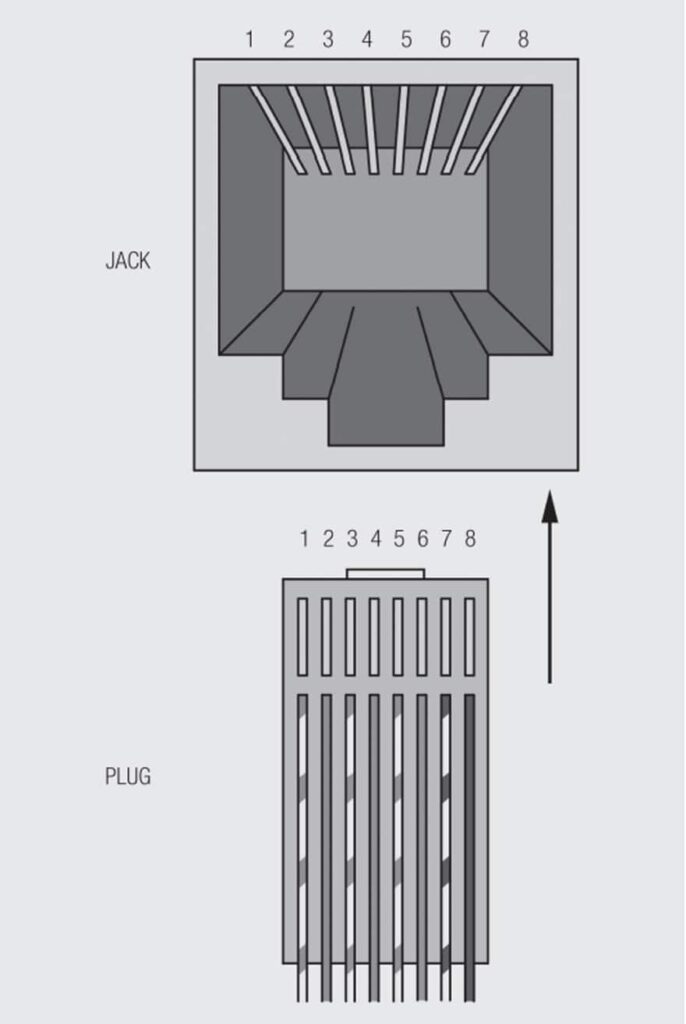
Fig. 2.147: Pinning

Size and Contacts
4P and 6P plugs share the same plastic body while 8P and 10P share a larger one. There are different combinations in terms of number of positions and number of contacts. They can be described in 2 ways, the first one being xPxC.

Number of possible positions: 4, 6, 8, 10. It defines the number of possible locations for a contact.
Number of possible contacts: 2, 4, 6, 8,10. This figure stands for the number of possible electrical contacts.
For instance 8P8C stands for 8 positions, filled with 8 contacts (no empty pole).

The other option to describe these connectors is to use a Registered Jack (RJ) number. It is a standard to name network interface wiring and jacks. A few examples are RJ-11, RJ45, RJ21, RJ28 …

Let’s review the most popular configurations:

4P4C
The 4P4C connector is popularly but incorrectly called RJ9. This is not correct because this connector is not an official connector/jack since registered connectors only classify the connection between different phones, or a phone and a network, and not between 2 parts of a phone as it is often the case here. Indeed, this connector is also called the handset connector since its most common use is to plug the telephone handset to the receiver. See Figure 2.148.
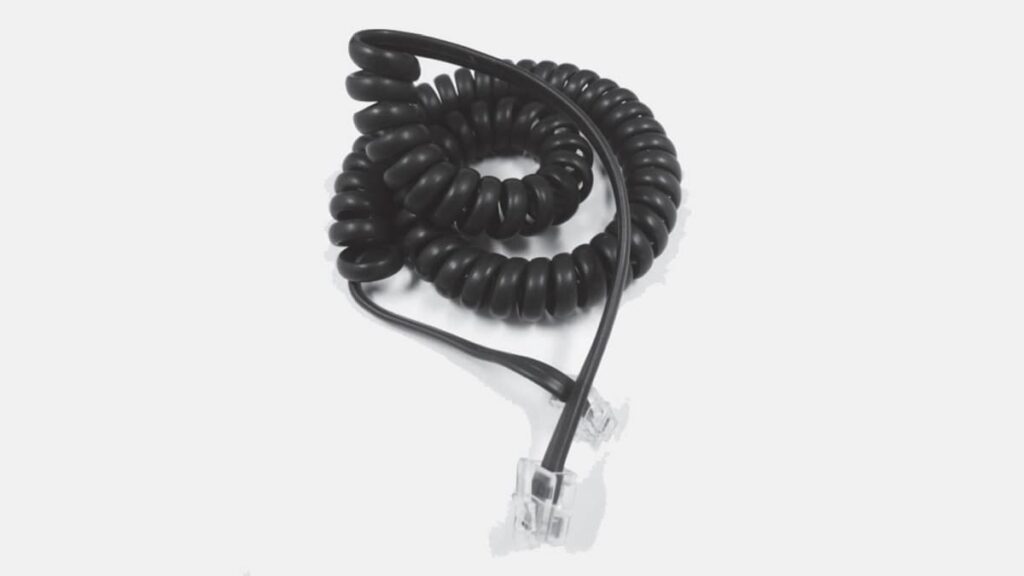
Fig. 2.148: Telephone cable cord

6PxC
6P2C = RJ11 is certainly the most familiar registered jack since it is used for single line telephone jacks in most homes across the world.

6P4C = RJ14 is similar but for 2 lines and 6P6C is for 3.

The most common configuration of Jacks is 6P4C but often only connected to a 6P2C cable (RJ11 cable).

8P8C
8P8C connectors are generally used for Ethernet applications.

Even if they are popularly called RJ45 in the context of Ethernet and cat5 cables, it’s not correct to identify 8P8C connectors as RJ45. In telephone systems, a standard RJ45S socket has a key which excludes insertion of a standard 8P8C plug. However, the unkeyed 8P8C version has spread so widely thanks to the computer market that the name RJ45 often designates the 8P8C without keying (which is not its original/official definition).

8P8C jacks support a physical connection with RJ11/RJ14 & RJ25 plugs but only RJ11 and RJ14 have full electrical compatibility. Ethernet compatible pinout split the third pair of RJ25 into two separate cable pairs making it unusable by similar phones (it was necessary to preserve the signal integrity for Ethernet which operates at much higher frequencies than telephone lines).

10P10C
The 10P10C connector is commonly referred to as the RJ50 connector although it’s not a standard registered jack. It has 10 positions fitted with 10 contacts. It is mainly used in proprietary data transfer systems; therefore, we do not find it quite often, except in special applications.

Termination IDC Technology
One of the main reasons for the success of modular jacks/plugs is the easy way to perform a cable assembly. Wires are presented into the plug as shown below and then pressed with a crimping tool. The sharp edge of the contact will perform a so called IDC termination (insulation displacement).

This can either be performed with a cheap hand tool or with an efficient automatic tool for higher volumes.
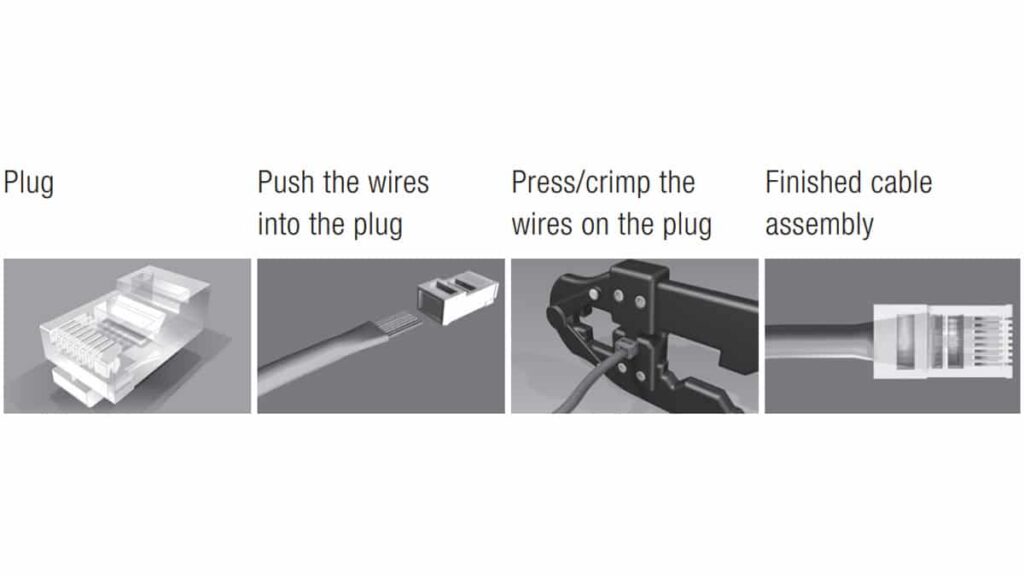
Fig. 2.149: Examples of modular plug wiring

Related

Source: Wurth elektronik

Recent Posts

Circular Connectors Coding

26.11.2025
243

Connector PCB Design Challenges

3.10.2025
135

Non-Magnetic Interconnects

23.4.2025
67

10 Tips for Ensuring Reliability of Discrete Wire Assemblies

20.2.2025
98

Polymer Materials and Processing

11.8.2025
258

Basic PCB Technology Overview

1.7.2025
64

What is RF Connector

17.12.2024
95

Creepage and Clearance of Connector

25.7.2025
134

RF Connector Types: How To Choose the Right One

24.4.2026
798

Upcoming Events

Sep 10
11:00 - 12:00 CEST

Equipment models and model strategies for Space Missions

Sep 16
17:00 - 18:00 CEST

Designing a 5 kW, 800 V-to-50 V PSFB Converter for Next-Generation Data Centers

Sep 29
16:00 - 17:00 CEST

Cybersecurity 2026

View Calendar

Popular Posts

  • Buck Converter Design and Calculation

    0 shares
    Share 0 Tweet 0
  • LLC Resonant Converter Design and Calculation

    0 shares
    Share 0 Tweet 0
  • Boost Converter Design and Calculation

    0 shares
    Share 0 Tweet 0
  • Flyback Converter Design and Calculation

    0 shares
    Share 0 Tweet 0
  • Earthing Systems and IEC Classification Explained

    0 shares
    Share 0 Tweet 0
  • MLCC and Ceramic Capacitors

    0 shares
    Share 0 Tweet 0
  • Capacitor Charging and Discharging

    0 shares
    Share 0 Tweet 0
  • Resistor Symbols

    0 shares
    Share 0 Tweet 0
  • Audio Capacitors: Choosing Capacitors for Crossover Circuits

    0 shares
    Share 0 Tweet 0
  • Thermistors Basics, NTC and PTC Thermistors

    0 shares
    Share 0 Tweet 0

Newsletter Subscription


Passive Components Blog

© 2015–2026
All rights reserved

  • Home
  • Privacy Policy
  • EPCI Membership & Advertisement
  • About

No Result
View All Result
  • Home
  • Knowledge Blog
  • Dossiers
  • PCNS

© 2015–2026
All rights reserved