









Passive Components Blog
No Result
View All Result
  • Home
  • NewsFilter
    • All
    • Aerospace & Defence
    • Antenna
    • Applications
    • Automotive
    • Capacitors
    • Circuit Protection Devices
    • electro-mechanical news
    • Filters
    • Fuses
    • Inductors
    • Industrial
    • Integrated Passives
    • inter-connect news
    • Market & Supply Chain
    • Market Insights
    • Medical
    • Modelling and Simulation
    • New Materials & Supply
    • New Technologies
    • Non-linear Passives
    • Oscillators
    • Passive Sensors News
    • Resistors
    • RF & Microwave
    • Telecommunication
    • Weekly Digest

    Nvidia Vera Rubin: Why One AI Rack Needs So Many More MLCC Capacitors

    Stackpole Introduces 1400A Busbar Shunt Resistors

    Tecate Unveils High‑temp 105C Supercapacitors for Harsh‑Environment Designs

    Bourns Expands 1000V High‑Power Fuses for Semiconductor and Battery Protection

    Passive Components in 2026: From Invisible Commodity to Design Parameter

    Bourns Introduces High Current Chip Ferrite Beads for Dense Power Rails

    Wk 22 Electronics Supply Chain Digest

    Vishay Releases High‑Current Radial Inductors up to 209 A

    May 2026 Interconnect, Passives and Electromechanical Components Market Insights

    Trending Tags

    • Ripple Current
    • RF
    • Leakage Current
    • Tantalum vs Ceramic
    • Snubber
    • Low ESR
    • Feedthrough
    • Derating
    • Dielectric Constant
    • New Products
    • Market Reports
  • VideoFilter
    • All
    • Antenna videos
    • Capacitor videos
    • Circuit Protection Video
    • Filter videos
    • Fuse videos
    • Inductor videos
    • Inter-Connect Video
    • Non-linear passives videos
    • Oscillator videos
    • Passive sensors videos
    • Resistor videos

    Current Sense Transformer Datasheet and Design‑in Guide

    Designing a USB Type‑C Flyback Planar Transformer with Frenetic’s Planar Tool

    Magnetics Design in High‑Frequency GaN Converters

    Qi2 Wireless Charging: Inductors, Capacitors and EMC Filters

    Two‑capacitor paradox explained for engineers

    Capacitances of Nonlinear MLCCs: What Datasheets Don’t Tell You

    Tapped Inductor Buck Converter Fundamentals

    Planar vs Conventional Transformer: When it Make Sense

    Modeling Fringing Field Losses in Inductors & Transformers

    Trending Tags

    • Capacitors explained
    • Inductors explained
    • Resistors explained
    • Filters explained
    • Application Video Guidelines
    • EMC
    • New Products
    • Ripple Current
    • Simulation
    • Tantalum vs Ceramic
  • Knowledge Blog
  • DossiersNew
  • Suppliers
    • Who is Who
  • PCNS
    • PCNS 2025
    • PCNS 2023
    • PCNS 2021
    • PCNS 2019
    • PCNS 2017
  • Events
  • Home
  • NewsFilter
    • All
    • Aerospace & Defence
    • Antenna
    • Applications
    • Automotive
    • Capacitors
    • Circuit Protection Devices
    • electro-mechanical news
    • Filters
    • Fuses
    • Inductors
    • Industrial
    • Integrated Passives
    • inter-connect news
    • Market & Supply Chain
    • Market Insights
    • Medical
    • Modelling and Simulation
    • New Materials & Supply
    • New Technologies
    • Non-linear Passives
    • Oscillators
    • Passive Sensors News
    • Resistors
    • RF & Microwave
    • Telecommunication
    • Weekly Digest

    Nvidia Vera Rubin: Why One AI Rack Needs So Many More MLCC Capacitors

    Stackpole Introduces 1400A Busbar Shunt Resistors

    Tecate Unveils High‑temp 105C Supercapacitors for Harsh‑Environment Designs

    Bourns Expands 1000V High‑Power Fuses for Semiconductor and Battery Protection

    Passive Components in 2026: From Invisible Commodity to Design Parameter

    Bourns Introduces High Current Chip Ferrite Beads for Dense Power Rails

    Wk 22 Electronics Supply Chain Digest

    Vishay Releases High‑Current Radial Inductors up to 209 A

    May 2026 Interconnect, Passives and Electromechanical Components Market Insights

    Trending Tags

    • Ripple Current
    • RF
    • Leakage Current
    • Tantalum vs Ceramic
    • Snubber
    • Low ESR
    • Feedthrough
    • Derating
    • Dielectric Constant
    • New Products
    • Market Reports
  • VideoFilter
    • All
    • Antenna videos
    • Capacitor videos
    • Circuit Protection Video
    • Filter videos
    • Fuse videos
    • Inductor videos
    • Inter-Connect Video
    • Non-linear passives videos
    • Oscillator videos
    • Passive sensors videos
    • Resistor videos

    Current Sense Transformer Datasheet and Design‑in Guide

    Designing a USB Type‑C Flyback Planar Transformer with Frenetic’s Planar Tool

    Magnetics Design in High‑Frequency GaN Converters

    Qi2 Wireless Charging: Inductors, Capacitors and EMC Filters

    Two‑capacitor paradox explained for engineers

    Capacitances of Nonlinear MLCCs: What Datasheets Don’t Tell You

    Tapped Inductor Buck Converter Fundamentals

    Planar vs Conventional Transformer: When it Make Sense

    Modeling Fringing Field Losses in Inductors & Transformers

    Trending Tags

    • Capacitors explained
    • Inductors explained
    • Resistors explained
    • Filters explained
    • Application Video Guidelines
    • EMC
    • New Products
    • Ripple Current
    • Simulation
    • Tantalum vs Ceramic
  • Knowledge Blog
  • DossiersNew
  • Suppliers
    • Who is Who
  • PCNS
    • PCNS 2025
    • PCNS 2023
    • PCNS 2021
    • PCNS 2019
    • PCNS 2017
  • Events
No Result
View All Result
Passive Components Blog
No Result
View All Result

October 25 Electronics Production: U.S. vs. Global Changes

30.10.2025
Reading Time: 4 mins read
A A
Source: Semiconductor Intelligence

Source: Semiconductor Intelligence

U.S. electronics production has grown significantly, driven by a shift in manufacturing from other countries, particularly due to tariff policies according to Semiconductor Intelligence report.

However, this growth hasn’t translated into increased employment, with the sector experiencing a slight decline in jobs. While China’s electronics production remains steady, other Asian countries like South Korea and Vietnam have seen a moderation in growth add the Semiconductor Intelligence report.

RelatedPosts

Nvidia Vera Rubin: Why One AI Rack Needs So Many More MLCC Capacitors

Stackpole Introduces 1400A Busbar Shunt Resistors

Tecate Unveils High‑temp 105C Supercapacitors for Harsh‑Environment Designs

KeyPoints

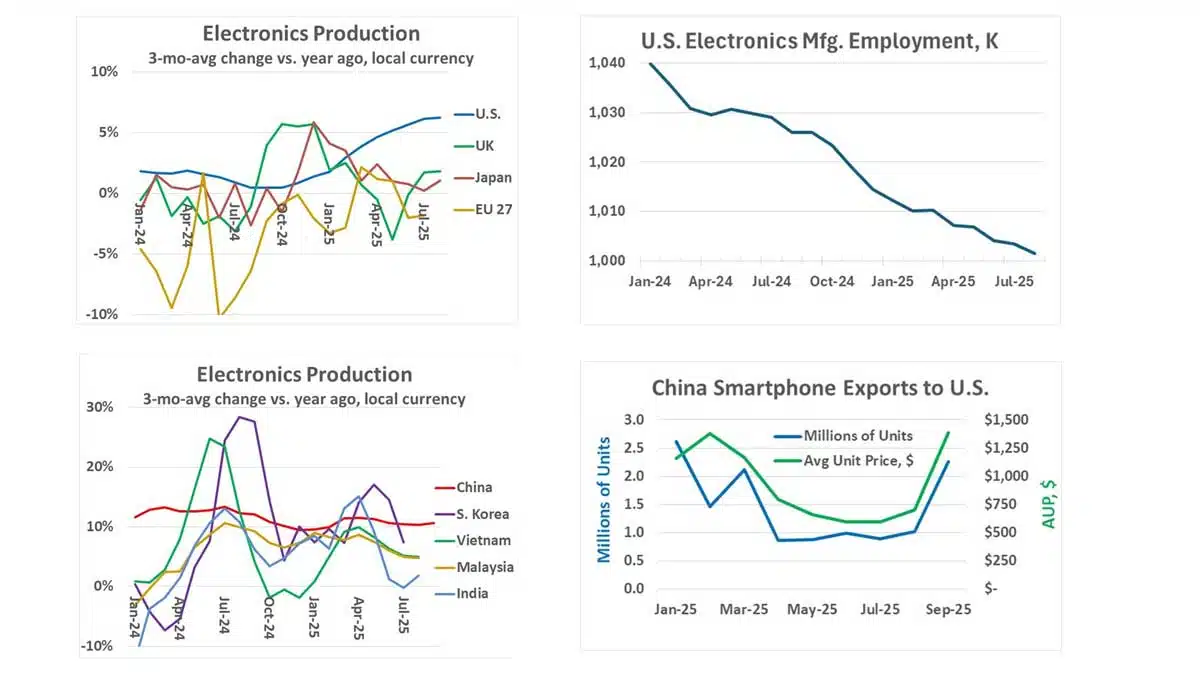
  • U.S. Electronics Production Growth: U.S. electronics production has been growing rapidly, with a 3/12 change increasing from 0.4% in October 2024 to 6.2% in August 2025.
  • Global Electronics Production Trends: Japan’s production has been growing but decelerating, while the EU has mostly experienced negative growth, and the UK has seen positive growth.
  • U.S. Electronics Manufacturing Employment: Despite the growth in production, U.S. employment in electronics manufacturing has declined slightly from January 2024 to August 2025.
  • China’s Electronics Production: Steady growth with a 3/12 change ranging from 10% to 13% since January 2024.
  • South Korea’s Electronics Production: 3/12 change moderated to 7.4% in July 2025 from 17% in May.
  • India’s Electronics Production: Volatile 3/12 change, peaking at 15% in April 2025 and dropping to zero in July.
  • Smartphone Imports Trend: U.S. smartphone imports declined significantly from April 2025, likely due to anticipated tariffs.
  • China’s Smartphone Export to U.S.: China’s smartphone exports to the U.S. surged in September 2025, coinciding with the release of Apple’s iPhone 17 models.
  • Tariff Policy Impact: While the tariff policy may have increased U.S. electronics production, it hasn’t led to job creation in the industry.

U.S. electronics production has been experiencing a rapid growth trend over the past ten months. The three-month average change compared to the same period last year (3/12 change) has increased significantly, rising from 0.4% in October 2024 to 6.2% in August 2025. Japan’s 3/12 change has been positive since November 2024 but has been decelerating throughout 2025, reaching 1.1% in August. The European Union (EU 27) comprises 27 countries, and most of them have mostly experienced negative 3/12 changes, with July 2025 recording a -1.8% change. In contrast, the United Kingdom (UK) saw a positive 3/12 change in July and reached 1.8% in August.

The accelerating growth in U.S. electronics production can be partially attributed to the shift of manufacturing from other countries to the United States by both U.S. and foreign companies. This shift is primarily driven by the Trump administration’s tariffs, both implemented and threatened. However, this manufacturing shift has not resulted in increased employment in the electronics manufacturing sector. According to the U.S. Bureau of Labor Statistics, U.S. employment in electronics manufacturing has declined from 1.04 million jobs in January 2024 to 1.001 million jobs in August 2025. August is the latest available month due to the government shutdown. Over the past decade, employment in this sector has remained relatively stable, fluctuating between 1.001 million and 1.062 million jobs.

Electronics production in key Asian countries has been volatile but generally growing over the past two years. The shift of electronics manufacturing to the U.S. has not significantly impacted China. China’s electronics production has shown steady growth, with a 3/12 change ranging from 10% to 13% since January 2024. In September 2025, China’s 3/12 change was 10.7%. South Korea’s 3/12 change moderated to 7.4% in July 2025 from 17% in May. Malaysia and Vietnam experienced similar trends in the last six months, with their 3/12 change moderating from the 8% to 10% range in March through May 2025 to the 5% to 6% range in June through August. India’s electronics production has been volatile, with a 3/12 change peaking at 15% in April 2025 and dropping to zero in July. India’s 3/12 change in August was 1.9%.

As mentioned in our June 2025 newsletter, U.S. imports of smartphones have significantly declined starting in April 2025. In April 2025, the Trump administration announced that smartphones were currently exempt from tariffs but would be subject to tariffs within a month or two. However, six months later, no smartphone tariffs have been announced. Imports remained low based on the latest data available through July. Due to the U.S. government shutdown, data for August is not available. Nevertheless, China’s export data is available through September 2025. Apparently, China has a functioning government. In September, China’s exports of smartphones to the U.S. surged sharply to 2.26 million units from 1.02 million units in August, marking a remarkable 121% increase. The average unit price (AUP) of these smartphones almost doubled from $702 in August to $1,387 in September. These increases coincide with Apple’s introduction of its iPhone 17 models in September 2025. Apple and other smartphone companies have apparently been limiting imports to the U.S. due to the tariff threat. However, they increased imports in September to support the release of new models.

While the Trump administration’s tariff policy may have contributed to increased U.S. electronics production, it has not resulted in new job creation in the industry. The ongoing tariffs and potential tariffs continue to create uncertainty in the U.S. and global electronics industry.

Related

Source: Semiconductor Intelligence

Recent Posts

Nvidia Vera Rubin: Why One AI Rack Needs So Many More MLCC Capacitors

2.6.2026
4

Passive Components in 2026: From Invisible Commodity to Design Parameter

2.6.2026
10

May 2026 Interconnect, Passives and Electromechanical Components Market Insights

29.5.2026
83

ECIA Industry Pulse April 2026: Sentiment Cools but Stays Strong

21.5.2026
66

Industrial Passive Components Markets and Technologies 2026

21.5.2026
149

Automotive Passive Components Technology Dossier

21.5.2026
84

Samsung Electro-Mechanics Signs 1.5T KRW Silicon Capacitor AI Contract

21.5.2026
119

Murata Expands Thermistor Production Capacity at Yokaichi Plant

21.5.2026
48

Circuit Protection Technology Annual Dossier

15.5.2026
64

Upcoming Events

Jun 2
16:00 - 17:00 CEST

Calculation, Simulation and Measurement of 800V EMC Filters

Jun 16
16:00 - 17:00 CEST

EMC with EMC – EMC‑compliant design with electromechanical connectors

View Calendar

Popular Posts

  • Buck Converter Design and Calculation

    0 shares
    Share 0 Tweet 0
  • Boost Converter Design and Calculation

    0 shares
    Share 0 Tweet 0
  • Flyback Converter Design and Calculation

    0 shares
    Share 0 Tweet 0
  • MLCC and Ceramic Capacitors

    0 shares
    Share 0 Tweet 0
  • LLC Resonant Converter Design and Calculation

    0 shares
    Share 0 Tweet 0
  • Capacitor Charging and Discharging

    0 shares
    Share 0 Tweet 0
  • What Electronics Engineer Needs to Know About Passive Low Pass Filters

    0 shares
    Share 0 Tweet 0
  • Dual Active Bridge (DAB) Topology

    0 shares
    Share 0 Tweet 0
  • Ripple Current and its Effects on the Performance of Capacitors

    3 shares
    Share 3 Tweet 0
  • SEPIC Converter Design and Calculation

    0 shares
    Share 0 Tweet 0

Newsletter Subscription


Passive Components Blog

© EPCI - Leading Passive Components Educational and Information Site

  • Home
  • Privacy Policy
  • EPCI Membership & Advertisement
  • About

No Result
View All Result
  • Home
  • Knowledge Blog
  • Dossiers
  • PCNS

© EPCI - Leading Passive Components Educational and Information Site

This website uses cookies. By continuing to use this website you are giving consent to cookies being used. Visit our Privacy and Cookie Policy.
Go to mobile version