




Passive Components Blog
No Result
View All Result
  • Home
  • NewsFilter
    • All
    • Aerospace & Defence
    • Antenna
    • Applications
    • Automotive
    • Capacitors
    • Circuit Protection Devices
    • electro-mechanical news
    • Filters
    • Fuses
    • Inductors
    • Industrial
    • Integrated Passives
    • inter-connect news
    • Market & Supply Chain
    • Market Insights
    • Medical
    • Modelling and Simulation
    • New Materials & Supply
    • New Technologies
    • Non-linear Passives
    • Oscillators
    • Passive Sensors News
    • Resistors
    • RF & Microwave
    • Telecommunication
    • Weekly Digest

    Advanced Electronics Markets Reshape Capacitor Demand for 2026/2027

    Panasonic Introduces Metallized Polypropylene Film Capacitors for Industrial and Automotive DC Applications

    Zowie Targets Embedded AI/HPC PDNs With Ultra-Thin Double-Sided MLPC Capacitors

    Modelithics CapV MVP Library: Measurement-Based Models for Varactor Chip Simulation

    Single Pair Ethernet for Humanoid Robot In-Robot Networks

    Panasonic Thick-Film Current Sense Resistors: Cost-Effective Alternatives to Metal Shunts

    Wk 31 Electronics Supply Chain Digest

    Bourns Transformer and Inductor Target 600 W GaN Cycloconverters

    Littelfuse Releases TVS Diodes for ISO 7637-2 Pulse 5b Load-Dump Protection

    Trending Tags

    • Ripple Current
    • RF
    • Leakage Current
    • Tantalum vs Ceramic
    • Snubber
    • Low ESR
    • Feedthrough
    • Derating
    • Dielectric Constant
    • New Products
    • Market Reports
  • VideoFilter
    • All
    • Antenna videos
    • Capacitor videos
    • Circuit Protection Video
    • Filter videos
    • Fuse videos
    • Inductor videos
    • Inter-Connect Video
    • Non-linear passives videos
    • Oscillator videos
    • Passive sensors videos
    • Resistor videos

    Current Sense Transformers: Ferrite vs Nanocrystalline Cores for Accurate Current Measurement

    EMC Design Fundamentals: Safe Use of Varistors and Common Mode Chokes in Mains and Data-Line Filters

    Ferrite versus Nanocrystalline Power Inductor Cores: Turns, Gap and Size

    KYOCERA AVX Presents Antenna Integrator Studio Tutorial for Antenna Placement and RF Design

    Power Design Simulation Tools for Faster Inductor Selection and Loss Optimization

    EMC‑Compliant PCB and Connector Design Guidelines

    Why Isolated DC/DC Power Supplies Fail Late, Würth Elektronik Podcast

    Designing 800 V DC EMC Filters: Calculation, Simulation and Measurement

    Current Sense Transformer Datasheet and Design‑in Guide

    Trending Tags

    • Capacitors explained
    • Inductors explained
    • Resistors explained
    • Filters explained
    • Application Video Guidelines
    • EMC
    • New Products
    • Ripple Current
    • Simulation
    • Tantalum vs Ceramic
  • Knowledge Blog
  • Dossiers
    • AI Hardware Dossier
    • Power Converter Dossier
    • Automotive Dossier
    • Capacitor Dossier
    • Resistor Dossier
    • Inductor Dossier
    • Circuit Protection Dossier
  • Suppliers
    • Who is Who
  • PCNS
    • PCNS 2025
    • PCNS 2023
    • PCNS 2021
    • PCNS 2019
    • PCNS 2017
  • Events
  • Home
  • NewsFilter
    • All
    • Aerospace & Defence
    • Antenna
    • Applications
    • Automotive
    • Capacitors
    • Circuit Protection Devices
    • electro-mechanical news
    • Filters
    • Fuses
    • Inductors
    • Industrial
    • Integrated Passives
    • inter-connect news
    • Market & Supply Chain
    • Market Insights
    • Medical
    • Modelling and Simulation
    • New Materials & Supply
    • New Technologies
    • Non-linear Passives
    • Oscillators
    • Passive Sensors News
    • Resistors
    • RF & Microwave
    • Telecommunication
    • Weekly Digest

    Advanced Electronics Markets Reshape Capacitor Demand for 2026/2027

    Panasonic Introduces Metallized Polypropylene Film Capacitors for Industrial and Automotive DC Applications

    Zowie Targets Embedded AI/HPC PDNs With Ultra-Thin Double-Sided MLPC Capacitors

    Modelithics CapV MVP Library: Measurement-Based Models for Varactor Chip Simulation

    Single Pair Ethernet for Humanoid Robot In-Robot Networks

    Panasonic Thick-Film Current Sense Resistors: Cost-Effective Alternatives to Metal Shunts

    Wk 31 Electronics Supply Chain Digest

    Bourns Transformer and Inductor Target 600 W GaN Cycloconverters

    Littelfuse Releases TVS Diodes for ISO 7637-2 Pulse 5b Load-Dump Protection

    Trending Tags

    • Ripple Current
    • RF
    • Leakage Current
    • Tantalum vs Ceramic
    • Snubber
    • Low ESR
    • Feedthrough
    • Derating
    • Dielectric Constant
    • New Products
    • Market Reports
  • VideoFilter
    • All
    • Antenna videos
    • Capacitor videos
    • Circuit Protection Video
    • Filter videos
    • Fuse videos
    • Inductor videos
    • Inter-Connect Video
    • Non-linear passives videos
    • Oscillator videos
    • Passive sensors videos
    • Resistor videos

    Current Sense Transformers: Ferrite vs Nanocrystalline Cores for Accurate Current Measurement

    EMC Design Fundamentals: Safe Use of Varistors and Common Mode Chokes in Mains and Data-Line Filters

    Ferrite versus Nanocrystalline Power Inductor Cores: Turns, Gap and Size

    KYOCERA AVX Presents Antenna Integrator Studio Tutorial for Antenna Placement and RF Design

    Power Design Simulation Tools for Faster Inductor Selection and Loss Optimization

    EMC‑Compliant PCB and Connector Design Guidelines

    Why Isolated DC/DC Power Supplies Fail Late, Würth Elektronik Podcast

    Designing 800 V DC EMC Filters: Calculation, Simulation and Measurement

    Current Sense Transformer Datasheet and Design‑in Guide

    Trending Tags

    • Capacitors explained
    • Inductors explained
    • Resistors explained
    • Filters explained
    • Application Video Guidelines
    • EMC
    • New Products
    • Ripple Current
    • Simulation
    • Tantalum vs Ceramic
  • Knowledge Blog
  • Dossiers
    • AI Hardware Dossier
    • Power Converter Dossier
    • Automotive Dossier
    • Capacitor Dossier
    • Resistor Dossier
    • Inductor Dossier
    • Circuit Protection Dossier
  • Suppliers
    • Who is Who
  • PCNS
    • PCNS 2025
    • PCNS 2023
    • PCNS 2021
    • PCNS 2019
    • PCNS 2017
  • Events
No Result
View All Result
Passive Components Blog
No Result
View All Result

Advanced Electronics Markets Reshape Capacitor Demand for 2026/2027

20.8.2026
Reading Time: 6 mins read
A A

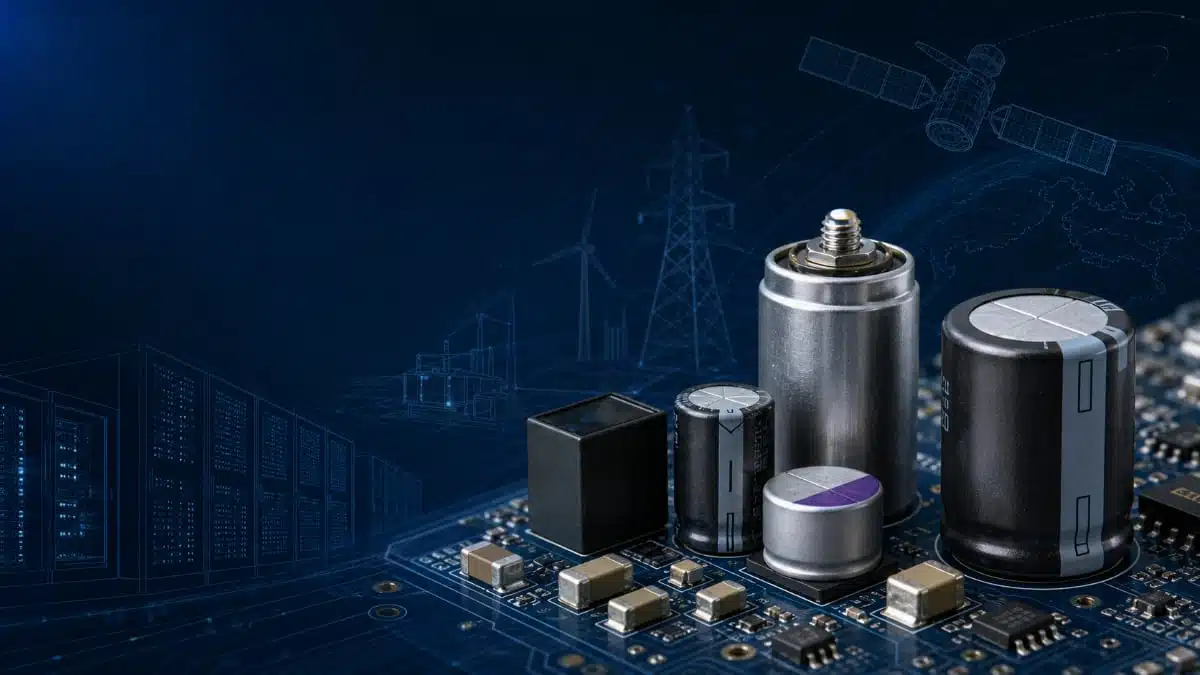
Advanced electronics markets are creating differentiated demand for capacitors across power conversion, grid infrastructure, aerospace, medical technology, industrial equipment and emerging compute platforms.

A new TTI MarketEYE analysis by Dennis Zogbi, Paumanok Inc. identifies ten end-market clusters in which requirements for bypass, decoupling, filtering, DC-link energy storage and pulsed-power capability are driving demand for specialized capacitor technologies.

RelatedPosts

Industrial Passive Components Markets and Technologies 2026

Rutheniums Critical Role in Passive Component Supply Chains

Capacitor Lead Times: October 2025

Grid infrastructure, AI power and harsh-environment systems create new opportunities for advanced capacitor technologies. Nevertheless, the opportunity is not defined solely by component volume. Many of the highlighted applications require high-reliability, high-voltage, high-temperature, low-ESR or precision-stable solutions, increasing the value of capacitor content and the importance of technology selection at the design stage.

Power Electronics Remain the Common Driver

DC-link, filtering and decoupling requirements connect nearly all growth markets

Power conversion is the shared enabling technology across the markets reviewed, from renewable-energy installations and EV charging infrastructure to AI data centers, spacecraft and medical systems. Grid modernization, HVDC expansion and renewable-energy interconnection are increasing demand for high-power DC-link and filtering capacitors in inverter and converter architectures.

Polypropylene film capacitors are particularly relevant where AC voltage, high ripple current and low dielectric loss must be handled simultaneously. Their self-healing behavior makes them well suited to grid-tie inverters, power-factor-correction banks, AC filters and snubber circuits exposed to switching transients.

Large-can aluminum electrolytic capacitors continue to provide cost-effective bulk energy storage and DC-bus smoothing at high capacitance values. In many systems, they complement film capacitors: film devices address ripple-current and fast-transient duty, while electrolytics support bulk energy buffering.

AI infrastructure raises performance expectations

AI data-center power infrastructure is accelerating demand for low-ESR polymer tantalum capacitors and polymer aluminum capacitors in high-current power-delivery and point-of-load conversion stages. At the same time, wider adoption of GaN and SiC semiconductors is increasing switching frequencies, tightening performance tolerances and supporting the use of compact, high-capacitance MLCCs in power-management and decoupling functions.

For capacitor suppliers, this shift reinforces the importance of ESR, ripple-current capability, thermal endurance, voltage derating and impedance behavior across the operating-frequency range. For equipment designers, it highlights the need to evaluate capacitor selection together with switching-device technology, layout parasitics and the control-loop requirements of the converter.

Space and Harsh Environments

Reliability becomes the primary design parameter

Commercial low-Earth-orbit constellations, growing launch activity and government investment are expanding demand for space-qualified passive components. Satellite power and telemetry systems require a broad mix of capacitors and resistors that can meet radiation, vibration, thermal-cycling and long-life requirements.

Film, ceramic and tantalum capacitors are all relevant in spacecraft electronics, with application-specific dielectric and packaging choices determined by electrical stress and environmental exposure. High-frequency ceramic capacitors support RF payloads and communication systems, while high-voltage ceramic parts are needed in elevated-voltage subsystems such as traveling-wave-tube amplifiers and ion-propulsion equipment.

Oil and gas logging tools represent another specialized market. Downhole electronics can face sustained temperatures above 175–200°C, along with extreme shock and vibration. Such operating conditions favor high-temperature ceramic and tantalum capacitors, ruggedized resistor packaging and specialty dielectric materials.

Marine systems face a different but equally demanding set of constraints: saltwater exposure, humidity, corrosion and vibration. The expansion of autonomous surface and underwater platforms is adding more complex sensor, navigation, communication and power-electronics content to this market.

Medical, Test and Precision Systems

Stable electrical performance supports measurement and patient-critical functions

Laboratory and test equipment, including oscilloscopes, calibration references and data-acquisition systems, remains a major application for ultra-precision, low-noise capacitor technologies. Tight capacitance tolerance, low temperature coefficient and predictable behavior over time are essential in timing, reference and sensitive analog signal paths.

Medical imaging systems, including MRI, CT and ultrasound platforms, combine precision analog electronics with high-voltage power subsystems. These designs use ultra-stable ceramic and tantalum capacitors in measurement circuits, while polypropylene film capacitors serve high-voltage and energy-handling functions in imaging power supplies.

Implantable medical devices place still higher emphasis on long-term reliability, miniaturization and low leakage current. Pacemakers, neurostimulators and implantable drug-delivery systems depend on capacitor technologies capable of delivering stable operation throughout multi-year service life in a non-serviceable environment.

Emerging Technology Markets

Fusion and quantum computing favor specialized solutions

Nuclear-fusion development is creating a focused opportunity for pulsed-power capacitor banks, high-voltage energy-storage capacitors and precision current-sensing resistors. Plasma initiation, heating systems and superconducting-magnet power supplies require components able to withstand repeated high-energy discharge cycles and demanding electrical stress.

Quantum-computing systems are still low-volume compared with mainstream electronics, but their technical requirements are exceptionally demanding. Superconducting-qubit architectures operating at cryogenic temperatures require filtering capacitors and thin-film resistors with predictable electrical properties when standard dielectric and resistive materials can change behavior significantly.

These markets may remain specialized, but they can support premium component demand because performance, qualification and reliability often matter more than unit cost.

Capacitor Technology Fit

Matching technology to electrical and environmental stress

Capacitor technologyTypical role in emerging markets
Polypropylene film capacitorsDC-link, AC filtering, snubber and pulsed-power duties requiring low loss, high ripple-current capability and self-healing behavior
Large-can aluminum electrolytic capacitorsBulk DC energy storage and DC-bus smoothing in HVDC converters, substations and large power-electronic systems
Snap-in aluminum electrolytic capacitorsBoard-level bulk capacitance and output filtering in auxiliary and control sections of converters
High-capacitance BME MLCCsCompact decoupling and bulk capacitance for digital and power-management circuits
Precision PGM ceramic capacitorsTight-tolerance, temperature-stable timing, reference and signal-integrity applications
Polymer tantalum and aluminum capacitorsLow-ESR power management and point-of-load conversion, including space and high-reliability electronics
High-frequency and high-voltage ceramic capacitorsRF circuits, elevated-voltage power rails and specialized power-electronic subsystems

Design Implications

Reliability, qualification and application fit will determine value

The strongest capacitor opportunities are concentrated in applications where failure is difficult, dangerous or impossible to address after deployment. Spacecraft, medical implants, fusion systems and downhole tools all demand a component strategy centered on reliability under defined mission conditions rather than minimum purchase price.

High-voltage capacitor demand also spans multiple otherwise unrelated markets, including spacecraft, medical imaging, fusion equipment and marine electronics. This makes voltage endurance, dielectric selection, insulation coordination and transient capability important cross-market engineering considerations.

Meanwhile, the growing use of wide-bandgap semiconductors will continue to influence capacitor requirements. Higher switching frequencies can reduce passive size but may increase sensitivity to parasitic inductance, AC losses, temperature rise and impedance characteristics. Designers should therefore assess capacitors at the system level, including layout, busbar design, switching waveform and expected mission profile.

Source

This article is based on a MarketEYE analysis published by TTI and authored by Dennis M. Zogbi of Paumanok Publications. The original analysis examines ten emerging and adjacent end markets shaping capacitor demand in 2026 and 2027.


References

  1. TTI MarketEYE: Advanced Electronics Markets Are Reshaping Capacitor Demand in 2026/2027

Related

Recent Posts

Panasonic Introduces Metallized Polypropylene Film Capacitors for Industrial and Automotive DC Applications

19.8.2026
17

Zowie Targets Embedded AI/HPC PDNs With Ultra-Thin Double-Sided MLPC Capacitors

19.8.2026
15

Modelithics CapV MVP Library: Measurement-Based Models for Varactor Chip Simulation

18.8.2026
18

Single Pair Ethernet for Humanoid Robot In-Robot Networks

17.8.2026
42

Panasonic Thick-Film Current Sense Resistors: Cost-Effective Alternatives to Metal Shunts

17.8.2026
17

Bourns Transformer and Inductor Target 600 W GaN Cycloconverters

13.8.2026
54

Littelfuse Releases TVS Diodes for ISO 7637-2 Pulse 5b Load-Dump Protection

12.8.2026
58

Vishay Introduces Y1 SMD Ceramic Disc Safety Capacitors to Reduce EMI Filter Board Space

12.8.2026
55

ECIA Industry Pulse Index Cools After Five-Year High

10.8.2026
85

Upcoming Events

Sep 10
11:00 - 12:00 CEST

Equipment models and model strategies for Space Missions

Sep 29
16:00 - 17:00 CEST

Cybersecurity 2026

Nov 24
16:00 - 17:00 CET

Component selection with the WE REDEXPERT® DC-DC Converter Designer Tool

View Calendar

Popular Posts

  • Buck Converter Design and Calculation

    0 shares
    Share 0 Tweet 0
  • Boost Converter Design and Calculation

    0 shares
    Share 0 Tweet 0
  • LLC Resonant Converter Design and Calculation

    0 shares
    Share 0 Tweet 0
  • MLCC and Ceramic Capacitors

    0 shares
    Share 0 Tweet 0
  • Flyback Converter Design and Calculation

    0 shares
    Share 0 Tweet 0
  • Earthing Systems and IEC Classification Explained

    0 shares
    Share 0 Tweet 0
  • MLCCs in the Age of AI: Q2 2026 Market Tightness

    0 shares
    Share 0 Tweet 0
  • Capacitor Charging and Discharging

    0 shares
    Share 0 Tweet 0
  • Audio Capacitors: Choosing Capacitors for Crossover Circuits

    0 shares
    Share 0 Tweet 0
  • Ripple Current and its Effects on the Performance of Capacitors

    3 shares
    Share 3 Tweet 0

Newsletter Subscription


Passive Components Blog

© EPCI - Leading Passive Components Educational and Information Site

  • Home
  • Privacy Policy
  • EPCI Membership & Advertisement
  • About

No Result
View All Result
  • Home
  • Knowledge Blog
  • Dossiers
  • PCNS

© EPCI - Leading Passive Components Educational and Information Site