




Passive Components Blog
No Result
View All Result
  • Home
  • NewsFilter
    • All
    • Aerospace & Defence
    • Antenna
    • Applications
    • Automotive
    • Capacitors
    • Circuit Protection Devices
    • electro-mechanical news
    • Filters
    • Fuses
    • Inductors
    • Industrial
    • Integrated Passives
    • inter-connect news
    • Market & Supply Chain
    • Market Insights
    • Medical
    • Modelling and Simulation
    • New Materials & Supply
    • New Technologies
    • Non-linear Passives
    • Oscillators
    • Passive Sensors News
    • Resistors
    • RF & Microwave
    • Telecommunication
    • Weekly Digest

    Knowles Introduces PP Film Capacitors for High‑Stress Power Electronics

    High‑Power Current Sensing with YAGEO PK Metal Current Sensors

    AI Data Centers Push Aluminium Capacitor Prices Higher

    Murata Releases 1210 Metal Terminal Common Mode Choke for 10Base‑T1S In‑Vehicle Ethernet

    DigiKey Ads 27,000 New In-Stock Parts and 104 Additional Suppliers in Q2 2026

    Würth Elektronik Coupled Inductors Harnessing Leakage Inductance in SEPIC, ZETA and Ćuk Converters

    Samsung Introduces Ultra‑compact, High‑Capacitance MLCCs for AI Edge and Wearable designs

    Knowles Presents Pulse Power Capacitors for Demanding MedTech, Industrial and Defense Applications

    Bourns Introduces LTCC Band Pass Filters for 5G C‑Band RF Front‑End Designs

    Trending Tags

    • Ripple Current
    • RF
    • Leakage Current
    • Tantalum vs Ceramic
    • Snubber
    • Low ESR
    • Feedthrough
    • Derating
    • Dielectric Constant
    • New Products
    • Market Reports
  • VideoFilter
    • All
    • Antenna videos
    • Capacitor videos
    • Circuit Protection Video
    • Filter videos
    • Fuse videos
    • Inductor videos
    • Inter-Connect Video
    • Non-linear passives videos
    • Oscillator videos
    • Passive sensors videos
    • Resistor videos

    EMC Design Fundamentals: Safe Use of Varistors and Common Mode Chokes in Mains and Data-Line Filters

    Ferrite versus Nanocrystalline Power Inductor Cores: Turns, Gap and Size

    KYOCERA AVX Presents Antenna Integrator Studio Tutorial for Antenna Placement and RF Design

    Power Design Simulation Tools for Faster Inductor Selection and Loss Optimization

    EMC‑Compliant PCB and Connector Design Guidelines

    Why Isolated DC/DC Power Supplies Fail Late, Würth Elektronik Podcast

    Designing 800 V DC EMC Filters: Calculation, Simulation and Measurement

    Current Sense Transformer Datasheet and Design‑in Guide

    Designing a USB Type‑C Flyback Planar Transformer with Frenetic’s Planar Tool

    Trending Tags

    • Capacitors explained
    • Inductors explained
    • Resistors explained
    • Filters explained
    • Application Video Guidelines
    • EMC
    • New Products
    • Ripple Current
    • Simulation
    • Tantalum vs Ceramic
  • Knowledge Blog
  • Dossiers
    • AI Hardware Dossier
    • Power Converter Dossier
    • Automotive Dossier
    • Capacitor Dossier
    • Resistor Dossier
    • Inductor Dossier
    • Circuit Protection Dossier
  • Suppliers
    • Who is Who
  • PCNS
    • PCNS 2025
    • PCNS 2023
    • PCNS 2021
    • PCNS 2019
    • PCNS 2017
  • Events
  • Home
  • NewsFilter
    • All
    • Aerospace & Defence
    • Antenna
    • Applications
    • Automotive
    • Capacitors
    • Circuit Protection Devices
    • electro-mechanical news
    • Filters
    • Fuses
    • Inductors
    • Industrial
    • Integrated Passives
    • inter-connect news
    • Market & Supply Chain
    • Market Insights
    • Medical
    • Modelling and Simulation
    • New Materials & Supply
    • New Technologies
    • Non-linear Passives
    • Oscillators
    • Passive Sensors News
    • Resistors
    • RF & Microwave
    • Telecommunication
    • Weekly Digest

    Knowles Introduces PP Film Capacitors for High‑Stress Power Electronics

    High‑Power Current Sensing with YAGEO PK Metal Current Sensors

    AI Data Centers Push Aluminium Capacitor Prices Higher

    Murata Releases 1210 Metal Terminal Common Mode Choke for 10Base‑T1S In‑Vehicle Ethernet

    DigiKey Ads 27,000 New In-Stock Parts and 104 Additional Suppliers in Q2 2026

    Würth Elektronik Coupled Inductors Harnessing Leakage Inductance in SEPIC, ZETA and Ćuk Converters

    Samsung Introduces Ultra‑compact, High‑Capacitance MLCCs for AI Edge and Wearable designs

    Knowles Presents Pulse Power Capacitors for Demanding MedTech, Industrial and Defense Applications

    Bourns Introduces LTCC Band Pass Filters for 5G C‑Band RF Front‑End Designs

    Trending Tags

    • Ripple Current
    • RF
    • Leakage Current
    • Tantalum vs Ceramic
    • Snubber
    • Low ESR
    • Feedthrough
    • Derating
    • Dielectric Constant
    • New Products
    • Market Reports
  • VideoFilter
    • All
    • Antenna videos
    • Capacitor videos
    • Circuit Protection Video
    • Filter videos
    • Fuse videos
    • Inductor videos
    • Inter-Connect Video
    • Non-linear passives videos
    • Oscillator videos
    • Passive sensors videos
    • Resistor videos

    EMC Design Fundamentals: Safe Use of Varistors and Common Mode Chokes in Mains and Data-Line Filters

    Ferrite versus Nanocrystalline Power Inductor Cores: Turns, Gap and Size

    KYOCERA AVX Presents Antenna Integrator Studio Tutorial for Antenna Placement and RF Design

    Power Design Simulation Tools for Faster Inductor Selection and Loss Optimization

    EMC‑Compliant PCB and Connector Design Guidelines

    Why Isolated DC/DC Power Supplies Fail Late, Würth Elektronik Podcast

    Designing 800 V DC EMC Filters: Calculation, Simulation and Measurement

    Current Sense Transformer Datasheet and Design‑in Guide

    Designing a USB Type‑C Flyback Planar Transformer with Frenetic’s Planar Tool

    Trending Tags

    • Capacitors explained
    • Inductors explained
    • Resistors explained
    • Filters explained
    • Application Video Guidelines
    • EMC
    • New Products
    • Ripple Current
    • Simulation
    • Tantalum vs Ceramic
  • Knowledge Blog
  • Dossiers
    • AI Hardware Dossier
    • Power Converter Dossier
    • Automotive Dossier
    • Capacitor Dossier
    • Resistor Dossier
    • Inductor Dossier
    • Circuit Protection Dossier
  • Suppliers
    • Who is Who
  • PCNS
    • PCNS 2025
    • PCNS 2023
    • PCNS 2021
    • PCNS 2019
    • PCNS 2017
  • Events
No Result
View All Result
Passive Components Blog
No Result
View All Result

AI Data Centers Push Aluminium Capacitor Prices Higher

30.7.2026
Reading Time: 5 mins read
A A

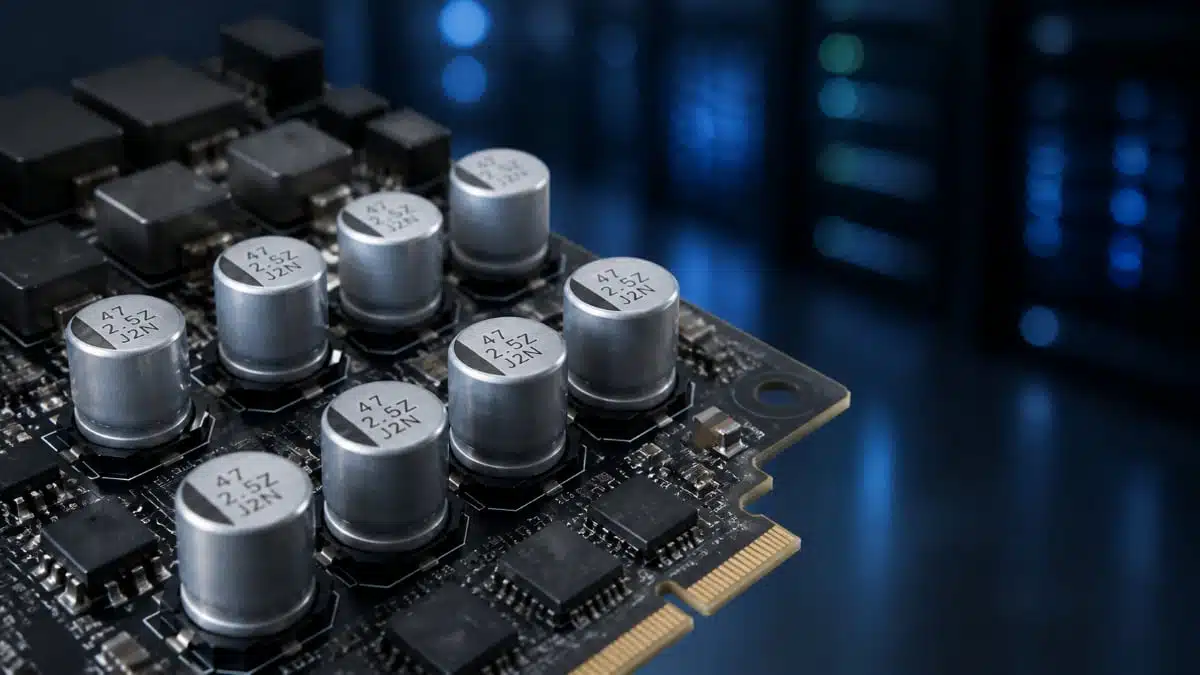
Aluminium electrolytic capacitor prices are entering a rare up‑cycle in 2026 as AI data‑center demand collides with rising aluminium foil and chemical costs across Japan, China and Taiwan.

For power‑electronics designers and buyers, this shift is starting to show up in quotation updates, double‑digit price adjustments and tighter availability for high‑end series used in AI power supplies.

RelatedPosts

Nichicon Presents Self-Charging LTO Board for Maintenance-Free IoT Nodes

Nichicon Extends Rechargeable Batteries Temperature to Rival Supercapacitors

Nichicon ADN Automotive Hybrid Aluminum Capacitors Now Available in EMEA

AI servers as a new demand driver

The most important change behind the current price moves is the rapid build‑out of AI server capacity. Global cloud service providers and GPU vendors are ramping new accelerator platforms, which in turn increases the number and rating of power supplies per rack, and the share of high‑ripple, long‑life aluminium electrolytic capacitors in those designs.

Recent industry research points to AI servers, high‑performance computing systems and data‑center power infrastructure as key demand drivers for high‑end aluminium electrolytic capacitors in 2026. A significant share of Japanese passive‑component capacity is now exposed to AI power‑supply applications, so AI ramps directly translate to higher capacitor consumption and reduced flexibility to support other end‑markets.

Aluminium foil and input‑cost inflation

On the supply side, manufacturers report that capacitor‑grade aluminium foil and associated chemical materials have seen notable price increases. Trend data for foil used in electrolytic capacitors indicates high‑purity foil costs and related processing expenses have risen, amplified by tariffs and energy costs in several regions.

Industry sources mention roughly 30–40% higher chemical‑material costs and around 10% higher metal prices feeding into production budgets for aluminium electrolytic capacitors in 2026. This input‑cost inflation, combined with strong AI‑sector demand, gives suppliers a clear rationale to pass through price increases rather than absorbing them in margins.

Price hikes at Japanese and Taiwanese suppliers

Japan’s leading aluminium electrolytic capacitor makers, including Nichicon and Nippon Chemi‑Con, have notified customers of across‑the‑board price hikes on aluminium electrolytic capacitor products. Initial plans for 9–12% adjustments have reportedly shifted toward increases in the 10–15% range, especially for series used in AI server and power‑system applications.

Reports also indicate that Taiwanese aluminium‑capacitor vendors are following with their own price increases during mid‑2026, responding both to higher raw‑material costs and to tighter supply‑demand conditions. This matches commentary that demand remains strongest in AI‑related segments, even as some traditional consumer‑electronics markets are softer.

Supply tightening and lead‑time risk

Capacity utilization for major aluminium electrolytic capacitor lines in Japan, China and Taiwan has been high since at least early 2026, and for some suppliers since the previous AI and 5G deployment wave. As AI server ramps accelerate into the second half of 2026, research houses warn of structural tightening for high‑end capacitor series similar to what is already visible in MLCCs and tantalum capacitors.

For design and purchasing teams, the practical implication is that selected aluminium electrolytic series—especially those optimized for high ripple current, long lifetime and elevated temperatures—may see extended lead times and more frequent price revisions. Local distributors and EMS partners are already reporting closer coordination on AI‑related power‑supply BOMs to secure allocation.

Design and sourcing implications for power electronics

In high‑power DC‑DC and AC‑DC stages, aluminium electrolytic capacitors still play a central role in bulk energy storage, bus smoothing and hold‑up, particularly in PFC front ends and intermediate bus converters. Potential price and lead‑time increases in these components can affect total PSU cost, design margins and qualification strategies.

From an engineering perspective, teams may consider:

  • Reviewing lifetime and ripple‑current margins to avoid forced series changes later when allocation tightens.
  • Evaluating polymer aluminium and hybrid capacitor options as partial substitutes, where suitable, especially on lower‑voltage rails.
  • Ensuring second‑source qualification for critical can sizes and voltage ratings used in AI server and data‑center designs.

On the purchasing side, this environment favors longer‑term agreements, earlier volume planning for AI‑adjacent projects and closer communication with distributors regarding capacity and allocation windows in Japan, China and Taiwan.

Outlook for 2026–2027

Market outlooks for aluminium electrolytic capacitors and capacitor‑grade aluminium foil point to continued growth through the rest of 2026 and into 2027, supported by AI, data‑center and industrial‑power investments. As new AI platforms from major cloud providers ramp in the second half of 2026, industry analysts expect the current price‑upcycle and supply‑tightening pattern in high‑end aluminium electrolytic capacitors to persist.

For design houses and OEMs, the next 12–18 months are likely to remain characterized by selective shortages, premium pricing for high‑performance series and a stronger need to align power‑supply roadmaps with passive‑component capacity planning.

Sources

  • DIGITIMES – AI demand, aluminium foil costs trigger rare capacitor price rises across China, Japan and Taiwan
  • TrendForce – MLCC and aluminium electrolytic capacitor industry research, 2026 (AI CSP ASICs and looming high‑end MLCC shortages, plus aluminium capacitor price upcycle)
  • Liberty Times / Economic Daily News summaries – price increases at Japanese aluminium electrolytic capacitor makers (Nichicon, Nippon Chemi‑Con)
  • Taiwan industry coverage – aluminium foil costs push capacitor prices higher in Taiwan and Japan

Related

Recent Posts

Knowles Introduces PP Film Capacitors for High‑Stress Power Electronics

30.7.2026
1

DigiKey Ads 27,000 New In-Stock Parts and 104 Additional Suppliers in Q2 2026

30.7.2026
3

Samsung Introduces Ultra‑compact, High‑Capacitance MLCCs for AI Edge and Wearable designs

29.7.2026
21

Knowles Presents Pulse Power Capacitors for Demanding MedTech, Industrial and Defense Applications

29.7.2026
19

YAGEO Extends its Supercapacitor Series Line-Up

28.7.2026
46

June 2026: AI Demand Pushes Japanese and Korean MLCC Makers to Five‑Year Shipment High

28.7.2026
56

July 2026 Interconnect, Passives and Electromechanical Components Market Insights

27.7.2026
59

Samsung Introduces 1000V C0G and X7 MLCCs for 800V DC Systems

27.7.2026
57

Exxelia Offers 1200V Capacitors and Magnetics for 800V Aerospace Platforms

22.7.2026
62

Upcoming Events

Sep 29
16:00 - 17:00 CEST

Cybersecurity 2026

View Calendar

Popular Posts

  • Buck Converter Design and Calculation

    0 shares
    Share 0 Tweet 0
  • YAGEO Announces July 2026 Capacitor Price Increase

    0 shares
    Share 0 Tweet 0
  • Boost Converter Design and Calculation

    0 shares
    Share 0 Tweet 0
  • LLC Resonant Converter Design and Calculation

    0 shares
    Share 0 Tweet 0
  • Flyback Converter Design and Calculation

    0 shares
    Share 0 Tweet 0
  • MLCCs in the Age of AI: Q2 2026 Market Tightness

    0 shares
    Share 0 Tweet 0
  • MLCC and Ceramic Capacitors

    0 shares
    Share 0 Tweet 0
  • Earthing Systems and IEC Classification Explained

    0 shares
    Share 0 Tweet 0
  • Dual Active Bridge (DAB) Topology

    0 shares
    Share 0 Tweet 0
  • Nvidia Vera Rubin: Why One AI Rack Needs So Many More MLCC Capacitors

    0 shares
    Share 0 Tweet 0

Newsletter Subscription


Passive Components Blog

© EPCI - Leading Passive Components Educational and Information Site

  • Home
  • Privacy Policy
  • EPCI Membership & Advertisement
  • About

No Result
View All Result
  • Home
  • Knowledge Blog
  • Dossiers
  • PCNS

© EPCI - Leading Passive Components Educational and Information Site

This website uses cookies. By continuing to use this website you are giving consent to cookies being used. Visit our Privacy and Cookie Policy.