Passive Components Blog
No Result
View All Result
  • Home
  • NewsFilter
    • All
    • Aerospace & Defence
    • Antenna
    • Applications
    • Automotive
    • Capacitors
    • Circuit Protection Devices
    • electro-mechanical news
    • Filters
    • Fuses
    • Inductors
    • Industrial
    • Integrated Passives
    • inter-connect news
    • Market & Supply Chain
    • Market Insights
    • Medical
    • Modelling and Simulation
    • New Materials & Supply
    • New Technologies
    • Non-linear Passives
    • Oscillators
    • Passive Sensors News
    • Resistors
    • RF & Microwave
    • Telecommunication
    • Weekly Digest

    YAGEO Introduces High‑Current Y2/X1 Film Capacitors for Wide-bandgap Power Systems

    Amphenol Explanded Liquid Cooling Connectors for AI, ESS and EV Systems

    Hirose Introduced BGA connector for PCIe Gen6 for AI and Edge Computing

    YAGEO Introduces High Rel MLCCs Beyond MIL-Spec Limits

    Würth Elektronik Expanded Capacity for Validation and Services in Asia

    Samsung Introduces Ultra-High-Voltage 1500 V MLCCs for xEV Powertrains

    YAGEO Q1 2026 Results: AI Servers and Pricing Power Behind a Moderate Q2 Outlook

    TDK Introduces High‑Voltage Common‑Mode Chokes for Compact 1250 V DC Converters

    Vishay Extends Power Inductors for DC/DC with 1212 Compact Case

    Trending Tags

    • Ripple Current
    • RF
    • Leakage Current
    • Tantalum vs Ceramic
    • Snubber
    • Low ESR
    • Feedthrough
    • Derating
    • Dielectric Constant
    • New Products
    • Market Reports
  • VideoFilter
    • All
    • Antenna videos
    • Capacitor videos
    • Circuit Protection Video
    • Filter videos
    • Fuse videos
    • Inductor videos
    • Inter-Connect Video
    • Non-linear passives videos
    • Oscillator videos
    • Passive sensors videos
    • Resistor videos

    Transformer-Based Power-Line Harvester Magnetic Design

    Thermal Modeling of Magnetics

    Standard vs Planar LLC transformers Comparison for Battery Chargers

    How Modern Tools Model Magnetic Components for Power Electronics

    Advanced Loss Modeling for Planar Magnetics in the Frenetic Planar Tool

    2026 Power Magnetics Design Trends: Flyback, DAB and Planar

    Enabling Software‑Defined Vehicle Architectures: Automotive Ethernet and Zonal Smart Power

    Calculating Resistance Value of a Flyback RC Snubber 

    One‑Pulse Characterization of Nonlinear Power Inductors

    Trending Tags

    • Capacitors explained
    • Inductors explained
    • Resistors explained
    • Filters explained
    • Application Video Guidelines
    • EMC
    • New Products
    • Ripple Current
    • Simulation
    • Tantalum vs Ceramic
  • Knowledge Blog
  • DossiersNew
  • Suppliers
    • Who is Who
  • PCNS
    • PCNS 2025
    • PCNS 2023
    • PCNS 2021
    • PCNS 2019
    • PCNS 2017
  • Events
  • Home
  • NewsFilter
    • All
    • Aerospace & Defence
    • Antenna
    • Applications
    • Automotive
    • Capacitors
    • Circuit Protection Devices
    • electro-mechanical news
    • Filters
    • Fuses
    • Inductors
    • Industrial
    • Integrated Passives
    • inter-connect news
    • Market & Supply Chain
    • Market Insights
    • Medical
    • Modelling and Simulation
    • New Materials & Supply
    • New Technologies
    • Non-linear Passives
    • Oscillators
    • Passive Sensors News
    • Resistors
    • RF & Microwave
    • Telecommunication
    • Weekly Digest

    YAGEO Introduces High‑Current Y2/X1 Film Capacitors for Wide-bandgap Power Systems

    Amphenol Explanded Liquid Cooling Connectors for AI, ESS and EV Systems

    Hirose Introduced BGA connector for PCIe Gen6 for AI and Edge Computing

    YAGEO Introduces High Rel MLCCs Beyond MIL-Spec Limits

    Würth Elektronik Expanded Capacity for Validation and Services in Asia

    Samsung Introduces Ultra-High-Voltage 1500 V MLCCs for xEV Powertrains

    YAGEO Q1 2026 Results: AI Servers and Pricing Power Behind a Moderate Q2 Outlook

    TDK Introduces High‑Voltage Common‑Mode Chokes for Compact 1250 V DC Converters

    Vishay Extends Power Inductors for DC/DC with 1212 Compact Case

    Trending Tags

    • Ripple Current
    • RF
    • Leakage Current
    • Tantalum vs Ceramic
    • Snubber
    • Low ESR
    • Feedthrough
    • Derating
    • Dielectric Constant
    • New Products
    • Market Reports
  • VideoFilter
    • All
    • Antenna videos
    • Capacitor videos
    • Circuit Protection Video
    • Filter videos
    • Fuse videos
    • Inductor videos
    • Inter-Connect Video
    • Non-linear passives videos
    • Oscillator videos
    • Passive sensors videos
    • Resistor videos

    Transformer-Based Power-Line Harvester Magnetic Design

    Thermal Modeling of Magnetics

    Standard vs Planar LLC transformers Comparison for Battery Chargers

    How Modern Tools Model Magnetic Components for Power Electronics

    Advanced Loss Modeling for Planar Magnetics in the Frenetic Planar Tool

    2026 Power Magnetics Design Trends: Flyback, DAB and Planar

    Enabling Software‑Defined Vehicle Architectures: Automotive Ethernet and Zonal Smart Power

    Calculating Resistance Value of a Flyback RC Snubber 

    One‑Pulse Characterization of Nonlinear Power Inductors

    Trending Tags

    • Capacitors explained
    • Inductors explained
    • Resistors explained
    • Filters explained
    • Application Video Guidelines
    • EMC
    • New Products
    • Ripple Current
    • Simulation
    • Tantalum vs Ceramic
  • Knowledge Blog
  • DossiersNew
  • Suppliers
    • Who is Who
  • PCNS
    • PCNS 2025
    • PCNS 2023
    • PCNS 2021
    • PCNS 2019
    • PCNS 2017
  • Events
No Result
View All Result
Passive Components Blog
No Result
View All Result

Optimization of IoT for GEO NB-NTN Hybrid Connectivity

19.6.2025
Reading Time: 5 mins read
A A

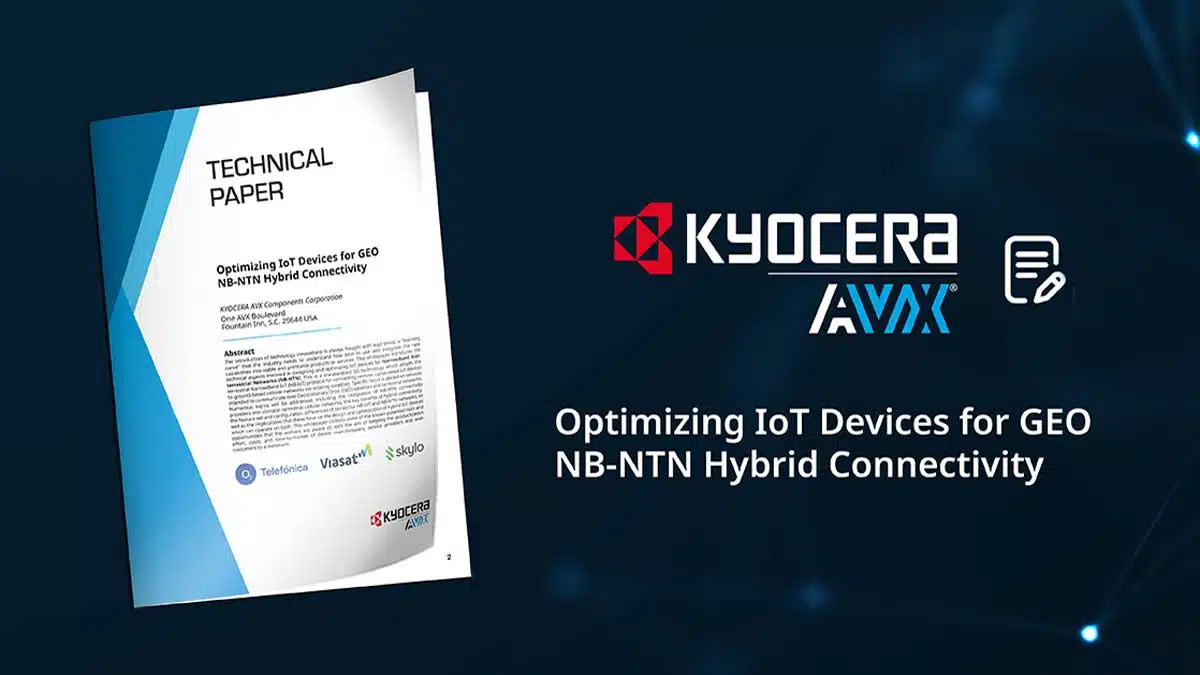
KYOCERA AVX has released white paper Optimizing IoT Devices for GEO NB-NTN Hybrid Connectivity written in collaboration with Telefonica, Viasat, & Skylo.

Abstract

The introduction of technology innovations inevitably involves lead times and a “learning curve” that the industry must comprehend to effectively utilize and integrate new capabilities into viable and profitable products or services. This whitepaper delves into the technical aspects of designing and optimizing IoT devices for Narrow-Band Non-terrestrial Networks (NB-NTN). NB-NTN is a standardized 5G technology that adapts the terrestrial Narrow-Band IoT (NB-IoT) protocol to connect remote, constrained IoT devices to ground-based cellular networks via orbiting satellites.

RelatedPosts

KYOCERA AVX MIL-PRF-32535 BME NP0 MLCCs Approved to the DLA QPD

Kyocera Releases 30fs Jitter Differential Clock Oscillator

KYOCERA AVX Extends Ultra‑Broadband RF Capacitor Series

The paper focuses on services intended to communicate over Geostationary Orbit (GEO) satellites and terrestrial networks. It covers various topics, including the integration of NB-NTN connectivity providers into classical terrestrial cellular networks, the key benefits of hybrid connectivity, the feature set and configuration differences between terrestrial NB-IoT and NB-NTN networks, and the implications these have on the design and optimization of hybrid IoT devices that can operate on both.

The whitepaper also acknowledges known potential risks and opportunities, aiming to minimize the productization effort, costs, and time-to-market for device manufacturers, service providers, and end-customers. Special focus is placed on antenna design, modem selection, power architecture, and regulatory compliance.

1. Introduction

Traditional NB-IoT networks fall short in reaching maritime, rural, and infrastructure-poor regions. GEO-based NB-NTN offers a solution by enabling narrowband communication from orbit. Defined in 3GPP Release 17, NB-NTN enhances coverage while maintaining compatibility with NB-IoT device ecosystems. This hybrid model merges terrestrial fallback with satellite resilience.

2. System Architecture Overview

2.1 GEO Satellite Connectivity

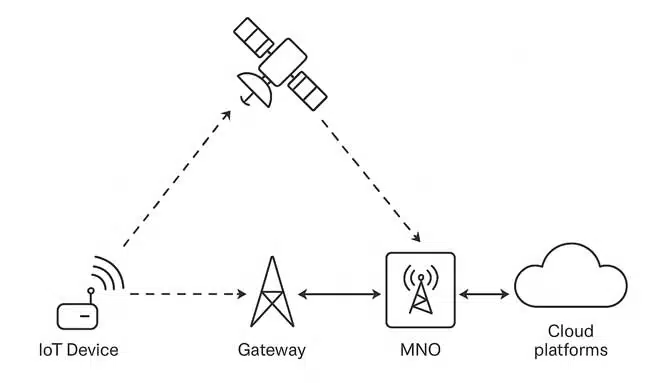
GEO NB-NTN involves a bent-pipe satellite relay system interfacing with mobile network operators (MNOs):

  • Fixed satellite position enables simplified tracking
  • Round-trip latency ~250 ms
  • Uplink budget limited to 23 dBm for Power Class 3 devices
  • Integration via standard S1 and S8 interfaces at MNO edge
Diagram 1: GEO NB-NTN architecture showing device ↔ satellite ↔ gateway ↔ MNO ↔ cloud platforms

3. Antenna Engineering for Hybrid Operation

3.1. Performance Role in System Link Budget

The antenna subsystem critically influences the NB-NTN link performance, particularly due to high free-space path loss (~190+ dB) and atmospheric impairments. Unlike multipath-rich terrestrial NB-IoT, GEO satellites rely on line-of-sight propagation, minimizing angular spread but demanding stricter elevation and polarization control.

3.2. Selection and Design Guidelines

Key selection factors for antenna systems in hybrid NB-NTN/NB-IoT devices:

  • Multiband operation: Support for both terrestrial (e.g., B20) and satellite (e.g., L-/S-Band)
  • Efficiency > 60% in satellite bands under ground-level orientation
  • VSWR ≤ 2:1 across bands to minimize mismatch losses
  • Radiation pattern: Omnidirectional for GNSS and terrestrial fallback; more directive for satellite reception

External antennas are recommended where form factor allows, as internal PCB-integrated solutions often underperform under low-elevation GEO link constraints. When space or design demands internalization, high-Q multiband ceramic elements may be used with proper ground plane tuning.

3.3. Integration Best Practices

  • Use short RF feedlines (<10 cm) to reduce insertion loss
  • Apply matching networks with π or T topologies customized per band
  • Isolate GNSS and NB-NTN paths if operating concurrently

4. Hardware Considerations in IoT NB-NTN Device Design

4.1. Battery Technologies

NB-NTN imposes periodic current bursts (up to 23 dBm TRP) which constrain battery selection. Two chemistries are suited for harsh outdoor and long-lifetime deployments:

  • Li-SOCl₂: High energy density, low self-discharge, robust pulse support with capacitive buffer
  • Li-MnO₂: High discharge current capability, compact form factors

Spiral-wound cells are preferred for pulse tolerance, while bobbin cells offer higher energy density but require pulse-support components (e.g., EDLCs).

4.2. Modem & Certification

Use of Skylo or Viasat-certified NB-NTN modules ensures compliance. Multimode modules (NB-NTN + NB-IoT) reduce SKU complexity and optimize BOM costs. Certification processes may vary by MNO, with Telefónica Germany offering integrated NB-NTN SIM solutions through its Kite platform.

5. Network and Regulatory Integration

5.1. Roaming Framework

NB-NTN networks integrate into MNO infrastructure via 3GPP roaming agreements, allowing devices to use a single SIM for terrestrial and satellite domains. Control and data planes remain consistent, with traffic securely home-routed through standard interfaces like S8-C.

5.2. Spectrum Licensing

Although the satellite spectrum (e.g., L-band) is allocated globally, country-specific landing rights are required. Service providers must negotiate access with national regulators. Coverage in polar/high-latitude regions may be limited due to GEO satellite visibility.

6. Conclusion

Designing IoT devices for NB-NTN hybrid connectivity requires a system-level engineering approach that balances link budget constraints, hardware integration, spectrum compliance, and network interoperability. Antenna architecture is the central determinant of NB-NTN feasibility, especially for devices with compact form factors or diverse deployment environments. Proper pairing with power supply technologies, certified modules, and regulatory-aware deployments ensures the long-term viability of NB-NTN in real-world IoT scenarios.


Read the full white paper here: https://www.kyocera-avx.com/docs/techinfo/Antennas/Optimizing-IoT-Devices-GEO-NB-NTN-Hybrid-Connectivity.pdf

Related

Source: KYOCERA AVX

Recent Posts

Würth Elektronik Expanded Capacity for Validation and Services in Asia

16.4.2026
10

KYOCERA AVX MIL-PRF-32535 BME NP0 MLCCs Approved to the DLA QPD

16.4.2026
25

Murata Automotive MLCCs Push Capacitance Limits for ADAS and Power Lines

16.4.2026
45

Würth Elektronik Releases Heat Sinks for TO and IC packages

31.3.2026
27

Exxelia Miniaturized 400 MHz Inverted‑F Antenna

24.3.2026
16

Würth Elektronik Unveils High-Current Automotive Power Inductor

16.4.2026
41

Würth Elektronik Presents Differential Pressure Sensor for HVAC and Medical

17.3.2026
21

Würth Elektronik and Grinn Launch Edge AI Cooperation

13.3.2026
30

Murata New Vibration Sensor Targets High‑Frequency Predictive Maintenance

10.3.2026
60

Upcoming Events

Apr 21
16:00 - 17:00 CEST

Heatsink Solutions: Thermal Management in electronic devices

Apr 22
17:00 - 17:30 CEST

Magnetics in a high frequency GaN era

Apr 22
17:00 - 18:00 CEST

Derating Tantalum, Film, and Ceramic Capacitors

View Calendar

Popular Posts

  • Buck Converter Design and Calculation

    0 shares
    Share 0 Tweet 0
  • Boost Converter Design and Calculation

    0 shares
    Share 0 Tweet 0
  • Flyback Converter Design and Calculation

    0 shares
    Share 0 Tweet 0
  • LLC Resonant Converter Design and Calculation

    0 shares
    Share 0 Tweet 0
  • MLCC and Ceramic Capacitors

    0 shares
    Share 0 Tweet 0
  • Dual Active Bridge (DAB) Topology

    0 shares
    Share 0 Tweet 0
  • Capacitor Charging and Discharging

    0 shares
    Share 0 Tweet 0
  • Plastic Materials Dielectric Constant and DF

    4 shares
    Share 4 Tweet 0
  • MLCC Case Sizes Standards Explained

    0 shares
    Share 0 Tweet 0
  • Ripple Current and its Effects on the Performance of Capacitors

    3 shares
    Share 3 Tweet 0

Newsletter Subscription


Passive Components Blog

© EPCI - Leading Passive Components Educational and Information Site

  • Home
  • Privacy Policy
  • EPCI Membership & Advertisement
  • About

No Result
View All Result
  • Home
  • Knowledge Blog
  • PCNS

© EPCI - Leading Passive Components Educational and Information Site

This website uses cookies. By continuing to use this website you are giving consent to cookies being used. Visit our Privacy and Cookie Policy.
Go to mobile version