


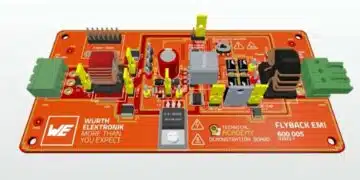
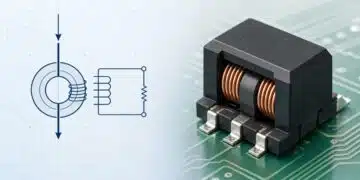

Qi2 wireless power is pushing classic power‑electronics issues—EMC, magnetics and filter design—into very compact, consumer‑grade hardware. This Würth Elektronik webinar walks through a complete Qi2 transmitter design, from system architecture to conducted and radiated EMC optimization, and offers several concrete lessons for selecting and applying passive components in modern wireless chargers.
Introduction
The Würth Elektronik webinar presented design implementation of a Qi2 magnetic power profile (MPP) transmitter based on a USB‑C input, buck‑boost stage, full‑bridge resonant inverter and a standardized Qi2 transmitter coil with integrated magnetics. The focus of the webinar is not only on achieving functional power transfer but also on meeting CISPR 32‑class EMC limits through systematic LC filter design on all interface lines. Along the way, the speakers highlight why inductors, capacitors, ferrites and PCB layout decisions make the difference between a clean, compliant design and a complete EMC failure.
System overview and key building blocks
The transmitter system follows the Qi2 standard functional diagram: a variable DC supply, resonant inverter and primary coil, plus ASK/FSK communication and an authentication path. In the Würth Elektronik demo, these blocks are implemented around Infineon’s WLC1115 wireless charging controller (now obsolete) and a dedicated Qi2 transmitter coil module.
Main functional blocks
- Input supply: USB Type‑C or DC adapter, typically 5, 9, 15 or 20 V feeding the entire system.
- EMC input filter: placed directly behind the connector, implemented as LC filters and, optionally, ferrites to contain conducted emissions before they reach the outside world.
- Buck‑boost converter: integrated in the WLC1115, converting the input range into an adjustable 3–24 V supply for the inverter.
- Full‑bridge inverter and resonant tank: MOSFET bridge driving the Qi2 coil via resonant capacitors CR1 and CR2, plus snubber capacitors to limit switching voltage stress.
- Qi2 transmitter coil module: standardized coil with ferrite plate, magnet ring and permeable shunt, forming the magnetic power profile required by Qi2 MPP.
- Control and security: wireless power controller, security IC (Optiga Trust Charge), ASK demodulator and communication interfaces (I²C/UART) for configuration and monitoring.
- Sensing and protection: current, voltage and temperature sensors plus foreign‑object detection for safe operation.
Obsolescence caveat
After the design work, Infineon discontinued all of its wireless charging ICs and exited the wireless power business, so the exact controller and originally planned reference layout are no longer available from the manufacturer. For practical design‑in, engineers should treat this as a case study in architecture and EMC/filter design rather than a drop‑in reference and select a currently supported Qi2/Qi1 controller from vendors such as NXP, Microchip, Texas Instruments or Analog Devices according to their datasheets.
Qi2 transmitter coil and magnetic design
The Qi2 transmitter coil module is the centerpiece of the system and is strongly defined by the Qi2 magnetic power profile. In the Würth module, the coil is integrated with several magnetic and mechanical elements that directly impact coupling, efficiency and EMC.
Coil module construction
- Planar transmitter coil: defines the main inductance and field shape for power transfer.
- Ferrite plate: focuses the magnetic field towards the receiver, reduces stray fields into the PCB and improves efficiency.
- Magnet ring: provides position feedback and helps localize the receiver (for example a smartphone) over the transmitter area.
- Permeable magnetic shunt: mechanically holds the magnet and influences the field distribution.
- Top and bottom enclosure: define mechanical integration and can also influence shielding and thermal paths.
These elements are standardized in Qi2, so the coil vendor’s module can be integrated without redesigning the magnetic stack‑up, provided the mechanical constraints are respected.
Resonant tank and power profiles
The WLC1115 and Qi2 system use a switchable resonant capacitance to support both Qi2 MPP and backward compatibility with Qi1 baseline devices.
- Qi2 MPP (e.g. iPhone 15): uses a resonant capacitance of approximately 33 nF, tuned to the Qi2 operating frequency and power profile.
- Qi1 baseline devices: switch to a significantly higher resonant capacitance around 400 nF to match the older standard.
In practice, this means the design must maintain the LC resonant frequency within allowed tolerances despite capacitor tolerance and coil inductance variation. According to the presenters, the Qi2 standard’s allowed frequency range and the standardized coil definition absorb the typical component spreads, provided quality capacitors and coils are used.
Key features and benefits of the passive component choices
Buck‑boost converter passives
The integrated buck‑boost stage has to cover a wide input range and regulate a similarly wide output window, which drives the selection of inductors and capacitors around it.
- Inductor: must handle peak currents at the lowest input voltage and highest output power while maintaining acceptable ripple and saturation margins. The webinar does not specify the exact inductance value, so engineers should size it “according to manufacturer datasheet” based on the chosen controller and power level.
- Output capacitors: must provide low ESR to limit ripple at the switching frequency and its harmonics; dielectric and temperature class selection will impact stability under load and temperature swings in a sealed consumer enclosure.
The presenters do not go deep into the buck‑boost inductor and capacitor selection, but the EMC results clearly show that residual switching ripple at around 360 kHz propagates along the supply cables if not filtered properly.
Resonant tank and snubber capacitors
The full‑bridge inverter drives the resonant tank and the Qi2 coil, with two main capacitor groups:
- Resonant capacitors , : together with the coil inductance, they define the main operating frequency. Tight capacitance tolerance and low loss (low dissipation factor) are crucial to maintain Q‑factor and efficiency.
- Snubber capacitors , : limit MOSFET voltage overshoot and reduce high‑frequency ringing, directly impacting radiated and conducted emissions in the tens of MHz range.
Qi2 places implicit limits on frequency deviation; the webinar confirms that standard tolerances and Qi2’s allowed range make the design robust to realistic spreads, but this is only true if high‑quality capacitors and a well‑controlled coil are used.
ASK demodulation path passives
The ASK demodulator uses three possible measurement paths: current at the buck‑boost output, coil voltage via a peak‑hold circuit, or a phase‑demodulation path, followed by low‑pass filtering, AC amplification and a final comparator.
- Low‑pass filters: sets the demodulation bandwidth and noise rejection; capacitor value and tolerance directly affect signal integrity.
- AC coupling and gain‑setting components: resistors and capacitors define the demodulator’s sensitivity to small amplitude changes in the received signal.
The presenters highlight that the demodulated signal has very small amplitude and needs careful amplification and filtering to reconstruct a clean digital bit stream for the controller. For design engineers, this is a reminder that “non‑power” capacitors and resistors in the communication path are just as critical as the high‑power tank components.
EMC measurements: conducted emissions and line filters
The EMC part of the webinar takes place directly in Würth’s EMC lab and uses CISPR 16 measurement setups with CISPR 32 limit lines for commercial environments. This provides a concrete example of how unfiltered converter noise couples onto cables and how systematic LC filtering improves the situation.
Baseline conducted emissions
- Empty load: with no phone on the transmitter, conducted noise between 150 kHz and 30 MHz is relatively low; measurements are taken from 9 kHz upwards to anticipate future extensions of the standard.
- With smartphone load: placing a “more or less empty” mobile phone on the Qi2 pad raises the noise floor and exposes a strong peak at approximately 360 kHz (the converter operating frequency), plus multiple harmonics.
The 360 kHz fundamental and its harmonics approach or exceed the CISPR 32 limit lines, showing that the initial design would not pass conducted EMC once loaded.
LC filter design on VCC and CC lines
To mitigate the 360 kHz differential‑mode noise, the engineer adds LC filters directly at the transmitter side:
- First step: LC filter only in the VCC line, using and , dimensioned to give about 40 dB attenuation at 360 kHz.
- Practical result: surprisingly little improvement; the 360 kHz peak and its harmonics remain high.
From this, they infer that a significant portion of the noise is escaping on the unfiltered CC (configuration/control) line, which presents a lower impedance path than the filtered VCC line.
Adding a second LC filter with the same component values to the CC line yields much better results:
- The 360 kHz peak moves clearly away from the limit line.
- Harmonics are also reduced, though not yet sufficient for radiated emissions.
Finally, they add a 2.2 µH inductor in the ground line as well, close to the transmitter:
- With LC filters on VCC and CC and an inductor in ground, the conducted emission results show a comfortable margin below the limit lines, and this filtering strategy also helps the radiated emission performance.
Lessons for passive component selection
- Use wound inductors, not ferrite beads, for low‑frequency (hundreds of kHz) differential‑mode filtering; ferrites are designed for tens to hundreds of MHz and are ineffective at 360 kHz.
- Size inductors for hot‑plug inrush; classic wire‑wound filter inductors tolerate short inrush pulses much better than printed ferrite structures and typically survive USB‑C hot‑plug events without issues.
- Use sufficiently large, low‑ESR capacitors in the LC filters to ensure real attenuation at the converter frequency, not just at much higher frequencies.
- Place the filters physically close to the connector and route carefully so that noise cannot “jump over” the filter via parallel copper planes or unintended coupling paths.
The presenters explicitly warn that filter effectiveness is not just a question of schematic but also of layout quality and grounding.
Radiated emissions and cable/line strategies
After optimizing conducted emissions, the team moves into the absorber chamber to test radiated emissions up to 1 GHz (with additional observation up to 6 GHz), again using CISPR 16/32 setups.
Filtered vs. unfiltered radiated performance
With LC filters on VCC and CC and an inductor in ground:
- Vertical polarization: the measured field strength shows a “big gap” to the limit line across the band; the design passes comfortably.
- Horizontal polarization: slightly higher levels in some bands, but still below limits—overall, the radiated test is passed.
Without filtering:
- Vertical polarization: emissions are close or too close to the limit line.
- Horizontal polarization: several peaks exceed the limit, resulting in a clear fail; the design would not achieve a CE mark without additional filtering.
The presence of a 2.45 GHz peak from the phone’s Wi‑Fi is noted but correctly ignored for the charger EMC result, as it is not part of the EUT emissions.
Comments on cable twisting and shielding
In the Q&A, the speakers address typical mitigation ideas:
- Twisted VCC/GND pairs: helpful for common‑mode noise reduction but ineffective for the dominant differential‑mode noise at ~360 kHz in this design.
- Shielded cables with metal braiding: useful for radiated EMC by blocking coupling to the antenna, but ineffective for conducted emissions because the LISN measures directly on the conductors.
The clear message for passive‑component‑oriented readers is that common‑mode hardware (e.g., cable twisting, shields, common‑mode chokes) must be matched to the dominant noise mechanism; in this design, low‑frequency differential‑mode filtering with discrete LC sections is essential.
Design‑in notes for engineers
Although the specific WLC1115 controller is obsolete, the passive‑component and EMC lessons generalize well to other Qi2 and wireless power designs.
Selecting inductors and capacitors for line filtering
- Inductors:
- Use wire‑wound inductors with sufficient current rating and saturation margin for both continuous load and USB‑C inrush.
- Choose inductance values that target the converter’s fundamental frequency (e.g., 360 kHz); combine with appropriately sized capacitors to form strong low‑pass filters.
- Capacitors:
- Use low‑ESR capacitors with adequate ripple current rating; 10 µF was used in the example LC sections.
- Ensure voltage rating and temperature characteristics (e.g., X7R vs. Y5V) are suitable for the ambient and self‑heating conditions of a compact charger enclosure.
Integrating the Qi2 coil module
- Respect the mechanical and magnetic stack‑up (coil, ferrite, magnet, shunt, enclosure) defined by the Qi2 standard and the coil vendor.
- Keep metallic parts and return planes under the coil defined as in the reference to avoid excessive eddy currents or detuning.
- Use Q‑factor estimation circuits or measurement procedures similar to those in the webinar to detect foreign objects and changes in loading; this relies on accurate inductance and loss behavior of the coil system.
Layout and EMC best practices
- Place LC filters as close as possible to the connector side of VCC, CC and ground; avoid long copper segments that bypass the filters.
- Provide solid, low‑impedance grounding for the filter capacitors and snubbers; route noisy currents in tight loops to minimize magnetic field spread.
- Reserve space for additional filter stages or alternative components (for example, a common‑mode choke) if later EMC testing reveals new coupling paths. The presenters note that common‑mode chokes were not tried in this demo but could be an option in a follow‑up optimization.
Controller and ecosystem considerations
Given Infineon’s exit from wireless power, designers should:
- Select a currently supported Qi2 or Qi1 controller and associated development kits from vendors such as NXP, Microchip, Texas Instruments or Analog Devices, using the Qi2 demo as a conceptual guide to power path and filter placement.
- Verify that security IC, ASK demodulation components and coil modules are compatible with the chosen controller’s requirements, particularly for authentication and communication timing.
Typical applications
Qi2 transmitters with this kind of architecture and EMC profile naturally target consumer and small industrial applications, where standardized coils and strong EMC requirements intersect.
Typical use cases include:
- Smartphone and wearable charging pads for desks, nightstands and in‑car chargers.
- Integrated Qi2 transmitters in furniture (office desks, hotel furniture, public charging points).
- Accessory chargers where compactness and EMC robustness are critical, such as audio devices, handheld tools or medical accessories, assuming compliance with the relevant safety standards.
In all of these, the same combination of a wide‑range input, high‑frequency resonant inverter, Qi2‑compatible coil and carefully designed LC filters on all external lines will recur, making the passive‑component insights from this webinar broadly reusable.
Conclusion
The Würth Elektronik Qi2 transmitter demo shows that the success or failure of a wireless charger design often hinges on “ordinary” passive components: inductors and capacitors in the resonant tank, LC filters on supply and control lines, and the standardized coil and ferrite stack‑up. Even with a capable controller IC, unfiltered 360 kHz differential‑mode noise will push conducted and radiated emissions over CISPR 32 limits, while properly dimensioned and placed LC sections on VCC, CC and ground can restore comfortable EMC margins.
For designers and purchasing engineers, the key is to treat these passives as design‑critical components: specify inductors and capacitors with suitable electrical characteristics, temperature behavior and mechanical robustness, and validate their effect in the actual EMC lab setup rather than relying solely on schematic‑level estimates. While the exact controller used in the webinar is obsolete, the architecture and EMC/filtering approach provide a valuable reference for implementing Qi2 wireless power systems with a strong focus on passive‑component performance.
Source
The information in this article is based on a Würth Elektronik webinar demonstrating the design and EMC optimization of a Qi2 wireless power transmitter, including live measurements in their EMC chambers and a Q&A session with the design and field application engineers.youtube