









Passive Components Blog
No Result
View All Result
  • Home
  • NewsFilter
    • All
    • Aerospace & Defence
    • Antenna
    • Applications
    • Automotive
    • Capacitors
    • Circuit Protection Devices
    • electro-mechanical news
    • Filters
    • Fuses
    • Inductors
    • Industrial
    • Integrated Passives
    • inter-connect news
    • Market & Supply Chain
    • Market Insights
    • Medical
    • Modelling and Simulation
    • New Materials & Supply
    • New Technologies
    • Non-linear Passives
    • Oscillators
    • Passive Sensors News
    • Resistors
    • RF & Microwave
    • Telecommunication
    • Weekly Digest

    Bourns Completes Rakon Acquisition, Enters Timing Market

    Knowles Releases 3825 X1/Y2 Safety MLCCs for High‑Voltage Applications

    Knowles Expands High Q Ceramic Core Inductors

    TAIYO YUDEN Releases 220uF 1210 Automotive MLCC

    HEICO’s Exxelia Expands High-Voltage Ceramic Capacitor Portfolio with CalRamic Acquisition

    Vishay Extends Automotive Ferrite Beads for High‑Current EMC Noise Filtering

    CapXon Earns EcoVadis Bronze Medal for Sustainability Performance

    All‑Water Supercapacitor Based on 1‑nm Clay Channels and Nanoconfined Water Electrolyte

    Littelfuse Unveils High‑Current 48V SMD Fuse for AI Data Center Protection

    Trending Tags

    • Ripple Current
    • RF
    • Leakage Current
    • Tantalum vs Ceramic
    • Snubber
    • Low ESR
    • Feedthrough
    • Derating
    • Dielectric Constant
    • New Products
    • Market Reports
  • VideoFilter
    • All
    • Antenna videos
    • Capacitor videos
    • Circuit Protection Video
    • Filter videos
    • Fuse videos
    • Inductor videos
    • Inter-Connect Video
    • Non-linear passives videos
    • Oscillator videos
    • Passive sensors videos
    • Resistor videos

    Why Isolated DC/DC Power Supplies Fail Late, Würth Elektronik Podcast

    Designing 800 V DC EMC Filters: Calculation, Simulation and Measurement

    Current Sense Transformer Datasheet and Design‑in Guide

    Designing a USB Type‑C Flyback Planar Transformer with Frenetic’s Planar Tool

    Magnetics Design in High‑Frequency GaN Converters

    Qi2 Wireless Charging: Inductors, Capacitors and EMC Filters

    Two‑capacitor paradox explained for engineers

    Capacitances of Nonlinear MLCCs: What Datasheets Don’t Tell You

    Tapped Inductor Buck Converter Fundamentals

    Trending Tags

    • Capacitors explained
    • Inductors explained
    • Resistors explained
    • Filters explained
    • Application Video Guidelines
    • EMC
    • New Products
    • Ripple Current
    • Simulation
    • Tantalum vs Ceramic
  • Knowledge Blog
  • DossiersNew
  • Suppliers
    • Who is Who
  • PCNS
    • PCNS 2025
    • PCNS 2023
    • PCNS 2021
    • PCNS 2019
    • PCNS 2017
  • Events
  • Home
  • NewsFilter
    • All
    • Aerospace & Defence
    • Antenna
    • Applications
    • Automotive
    • Capacitors
    • Circuit Protection Devices
    • electro-mechanical news
    • Filters
    • Fuses
    • Inductors
    • Industrial
    • Integrated Passives
    • inter-connect news
    • Market & Supply Chain
    • Market Insights
    • Medical
    • Modelling and Simulation
    • New Materials & Supply
    • New Technologies
    • Non-linear Passives
    • Oscillators
    • Passive Sensors News
    • Resistors
    • RF & Microwave
    • Telecommunication
    • Weekly Digest

    Bourns Completes Rakon Acquisition, Enters Timing Market

    Knowles Releases 3825 X1/Y2 Safety MLCCs for High‑Voltage Applications

    Knowles Expands High Q Ceramic Core Inductors

    TAIYO YUDEN Releases 220uF 1210 Automotive MLCC

    HEICO’s Exxelia Expands High-Voltage Ceramic Capacitor Portfolio with CalRamic Acquisition

    Vishay Extends Automotive Ferrite Beads for High‑Current EMC Noise Filtering

    CapXon Earns EcoVadis Bronze Medal for Sustainability Performance

    All‑Water Supercapacitor Based on 1‑nm Clay Channels and Nanoconfined Water Electrolyte

    Littelfuse Unveils High‑Current 48V SMD Fuse for AI Data Center Protection

    Trending Tags

    • Ripple Current
    • RF
    • Leakage Current
    • Tantalum vs Ceramic
    • Snubber
    • Low ESR
    • Feedthrough
    • Derating
    • Dielectric Constant
    • New Products
    • Market Reports
  • VideoFilter
    • All
    • Antenna videos
    • Capacitor videos
    • Circuit Protection Video
    • Filter videos
    • Fuse videos
    • Inductor videos
    • Inter-Connect Video
    • Non-linear passives videos
    • Oscillator videos
    • Passive sensors videos
    • Resistor videos

    Why Isolated DC/DC Power Supplies Fail Late, Würth Elektronik Podcast

    Designing 800 V DC EMC Filters: Calculation, Simulation and Measurement

    Current Sense Transformer Datasheet and Design‑in Guide

    Designing a USB Type‑C Flyback Planar Transformer with Frenetic’s Planar Tool

    Magnetics Design in High‑Frequency GaN Converters

    Qi2 Wireless Charging: Inductors, Capacitors and EMC Filters

    Two‑capacitor paradox explained for engineers

    Capacitances of Nonlinear MLCCs: What Datasheets Don’t Tell You

    Tapped Inductor Buck Converter Fundamentals

    Trending Tags

    • Capacitors explained
    • Inductors explained
    • Resistors explained
    • Filters explained
    • Application Video Guidelines
    • EMC
    • New Products
    • Ripple Current
    • Simulation
    • Tantalum vs Ceramic
  • Knowledge Blog
  • DossiersNew
  • Suppliers
    • Who is Who
  • PCNS
    • PCNS 2025
    • PCNS 2023
    • PCNS 2021
    • PCNS 2019
    • PCNS 2017
  • Events
No Result
View All Result
Passive Components Blog
No Result
View All Result

Researchers Developed Neodymium Reduced High Performance Magnets

25.4.2022
Reading Time: 3 mins read
A A

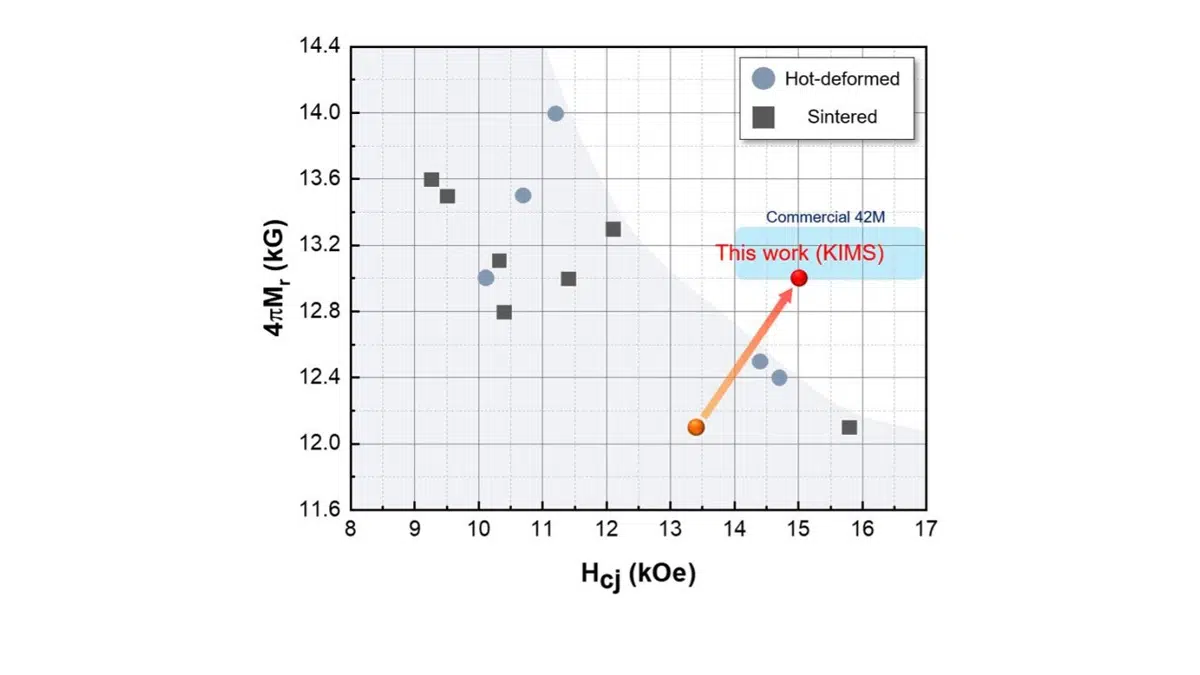
KIMS Korea Institute of Materials Science research team developed rare-earth-reduced permanent magnet that can achieve the commercial magnet (grade 42) level of performance while reducing the amount of neodymium (Nd), expensive rare earth, by about 30%.

A research team led by Dr. Lee Jeong Gu and Dr. Kim Tae Hun of the Department of Magnetic Materials in the Powder Materials Division at the Korea Institute of Materials Science, a government-funded research institute under the Ministry of Science and ICT, succeeded in developing rare-earth-reduced permanent magnet. The technology has a significant value as it achieved the commercial magnet-level of performance, which is currently used in the industry, even though it reduces the amount of high-priced rare earth.

RelatedPosts

Bourns Completes Rakon Acquisition, Enters Timing Market

Knowles Releases 3825 X1/Y2 Safety MLCCs for High‑Voltage Applications

Knowles Expands High Q Ceramic Core Inductors

Neodymium (Nd) is expensive and unstably supplied, but it has been inevitably used, as it is essential for manufacturing rare earth permanent magnets. In order to develop a neodymium (Nd) reduced permanent magnet, the content of cerium (Ce), an inexpensive element, has to be increased, instead of reducing the content of neodymium (Nd). Until now, with the increased content of cerium (Ce), it was not able to prevent the deterioration of the magnetic properties. The research team focused on clarifying the cause and mechanism of the deterioration of the magnetic properties caused by the increased cerium (Ce) content, and they successfully solve the problem of rare-earth-reduced permanent magnets by controlling atomic-scale microstructure.

The researchers discovered that unnecessary magnetic particles were formed in the existing manufacturing process, which are the cause of the deterioration of the magnet’s microstructure and magnetic properties. They improved the microstructure of magnets and enhance magnetic properties to prevent the formation of unnecessary magnetic particles by suppressing their atomic diffusion of them.

The research team applied the melt-spinning method and the hot-deformation method, which have very fast cooling velocity compared to the conventional process, to the manufacturing process of rare-earth-reduced precursors and permanent magnets, respectively. As a result, they succeeded in optimizing the microstructure of the magnet by suppressing the formation of unnecessary magnetic particles. In addition, they were able to simultaneously improve the residual magnetism and coercive force, which are the main properties of permanent magnets. As the residual magnetism and coercive force are in a trade-off relationship, the technology that improves both main properties is very useful and valuable.

The domestic market of the rare earth permanent magnets for high-efficiency motors is worth 186 billion won per year in 2021, but Korea depends on imports of the material. In the context of China’s weaponization of rare earth, Japan’s export restrictions on materials, and global carbon neutrality, localization of rare earth permanent magnet material is a must for Korea. When this technology is commercialized, it can be used in high value-added industries such as electric vehicles, drones, flying cars, and electric ships that require high-efficiency motors.

Dr. Kim Tae-hoon, a senior researcher at KIMS, who led the research team, said, “When the technology is commercialized, it will simultaneously solve the resource problems and material, parts, and equipment issues of the domestic rare earth permanent magnet material market. This is only the beginning. With further research in the future, we will spare no effort to lead the development of the domestic rare earth permanent magnet industry.”

This research was supported by the material technology development project of magnetic powder with performance modified composite magnetic structure, a fundamental research project of KIMS and funded by the Ministry of Science and ICT. In addition, on March 17th, the research outcome was published in Scripta Materialia, one of the world’s top 5 academic journals in the field of metal materials (The first author, Gayoung Kim, Ph.D. student, Title: High-performance Ce-substituted) (Nd0.7Ce0.3)-Fe-B hot-deformed magnets fabricated from amorphous melt-spun powders).

Related

Source: KIMS

Recent Posts

Knowles Expands High Q Ceramic Core Inductors

11.6.2026
19

Vishay Extends Automotive Ferrite Beads for High‑Current EMC Noise Filtering

10.6.2026
25

All‑Water Supercapacitor Based on 1‑nm Clay Channels and Nanoconfined Water Electrolyte

10.6.2026
34

Modelithics Releases COMPLETE Library v26.2 for Keysight Genesys

8.6.2026
21

Power Converter Dossier: Passive Components Design and Selection Guide 2026

5.6.2026
62

Bourns Offers Custom Magnetics for 3‑Phase Flying Capacitor Inverters

3.6.2026
34

Passive Components in 2026: From Invisible Commodity to Design Parameter

2.6.2026
90

Bourns Introduces High Current Chip Ferrite Beads for Dense Power Rails

1.6.2026
24

Vishay Releases High‑Current Radial Inductors up to 209 A

29.5.2026
35

Upcoming Events

Jun 16
16:00 - 17:00 CEST

EMC with EMC – EMC‑compliant design with electromechanical connectors

Jul 14
16:00 - 17:00 CEST

EMC Design Essentials: Mastering Varistors and Common Mode Chokes

Jul 21
16:00 - 17:00 CEST

Safety by design: X and Y Interference suppression capacitors for power line filters

View Calendar

Popular Posts

  • Buck Converter Design and Calculation

    0 shares
    Share 0 Tweet 0
  • Boost Converter Design and Calculation

    0 shares
    Share 0 Tweet 0
  • MLCC and Ceramic Capacitors

    0 shares
    Share 0 Tweet 0
  • LLC Resonant Converter Design and Calculation

    0 shares
    Share 0 Tweet 0
  • Flyback Converter Design and Calculation

    0 shares
    Share 0 Tweet 0
  • SEPIC Converter Design and Calculation

    0 shares
    Share 0 Tweet 0
  • Earthing Systems and IEC Classification Explained

    0 shares
    Share 0 Tweet 0
  • Dual Active Bridge (DAB) Topology

    0 shares
    Share 0 Tweet 0
  • What Electronics Engineer Needs to Know About Passive Low Pass Filters

    0 shares
    Share 0 Tweet 0
  • Capacitor Charging and Discharging

    0 shares
    Share 0 Tweet 0

Newsletter Subscription


Passive Components Blog

© EPCI - Leading Passive Components Educational and Information Site

  • Home
  • Privacy Policy
  • EPCI Membership & Advertisement
  • About

No Result
View All Result
  • Home
  • Knowledge Blog
  • Dossiers
  • PCNS

© EPCI - Leading Passive Components Educational and Information Site

This website uses cookies. By continuing to use this website you are giving consent to cookies being used. Visit our Privacy and Cookie Policy.
Go to mobile version