









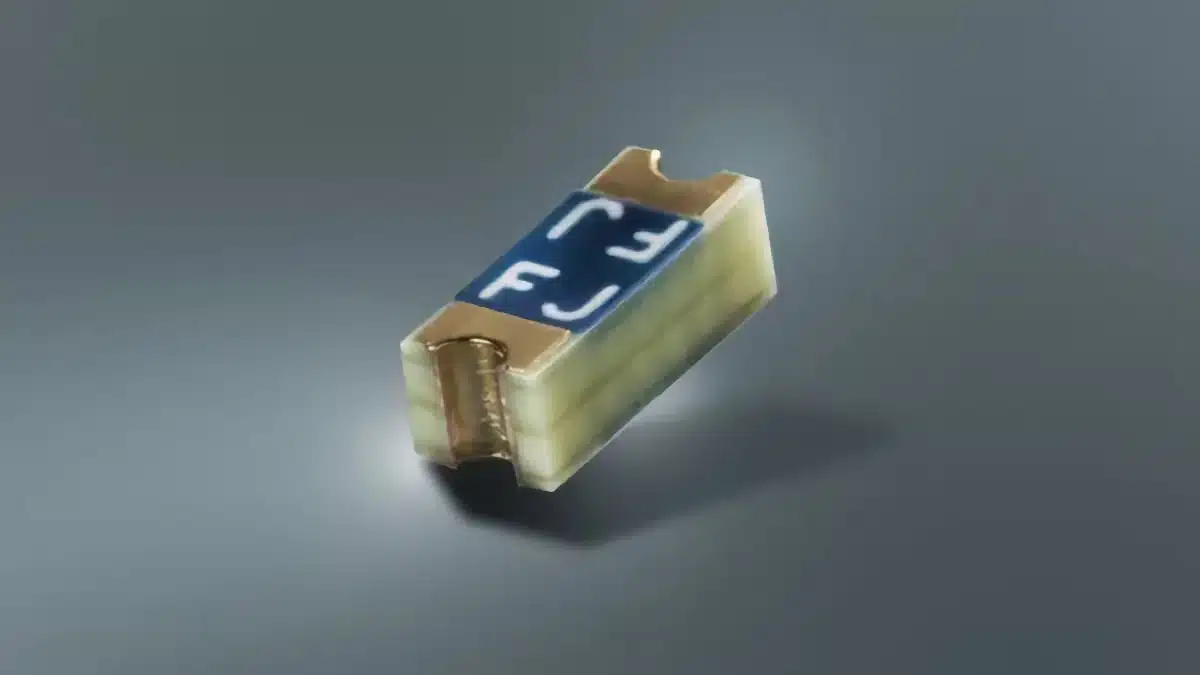
SCHURTER’s USE 2410 is a quick-acting, wire-in-air surface‑mount fuse in the compact 2410 footprint, designed for both AC and DC mains-related applications.
It combines a high breaking capacity and robust mechanical design with AEC‑Q200 testing, making it attractive for industrial, automotive and other demanding environments.
Key features and benefits
The USE 2410 fuse targets designers who need compact overcurrent protection with mains-compliant ratings and high reliability.
- Surface-mount quick‑acting F fuse in 2410 footprint
- Voltage ratings: 125–250 VAC and 86–125 VDC
- Breaking capacity up to 200 A
- Rated current range from 0.6 A to 10 A
- Temperature range from -55 °C to 125 °C
- Lead-free design, compliant with RoHS and REACH
- Tested according to AEC‑Q200, suitable for automotive‑grade designs
- UL and VDE approvals (according to manufacturer)
- Housing material UL 94V‑0 (fiber‑reinforced plastic)
- Gold‑plated copper terminals
- Sealed construction, resistant against typical potting compounds
- Reflow solderable for standard SMT assembly processes
From a practical engineering perspective, the combination of 2410 size and up to 250 VAC rating allows designers to replace larger through‑hole or cartridge fuses in space‑constrained designs. The extended operating temperature range improves reliability in harsh environments such as under‑hood automotive, industrial cabinets or tightly packed LED drivers.
Wire-in-air concept and mechanical robustness
The USE 2410 uses an innovative melting wire technology in a wire‑in‑air configuration rather than a traditional fuse link buried in bulk material. This construction:
- Supports precise, rapid opening under overload and short‑circuit conditions
- Minimizes the risk of internal solder joint fatigue, as there are no internal solder joints
- Enhances vibration resistance and robustness, especially in mobile and automotive applications
For mobile, transport and industrial equipment subject to shock and vibration, the absence of internal solder joints helps mitigate common failure modes such as cracked joints or drift in electrical characteristics over lifetime.
Typical applications
The USE 2410 is intended for a wide range of AC and DC applications where compact, fast‑acting overcurrent protection is required.
Typical use cases include:
- Battery‑operated systems (portable instruments, battery management units, DC power stages)
- LED drivers and electronic ballasts (primary and secondary side overcurrent protection)
- Medical and industrial equipment (auxiliary supplies, control boards, I/O modules)
- Switched‑mode power supplies and adapters (primary mains input and secondary DC outputs)
- White goods and household appliances (control boards, motor drives, auxiliary loads)
- Automotive electronics (ECUs, DC/DC converters, body electronics)
- Aerospace and other transport applications requiring robust, vibration‑resistant SMT fuses
In automotive designs, the AEC‑Q200 testing and the manufacturer’s IATF 16949 background mean the device can be considered for many non‑safety‑critical ECU protection roles, provided the system‑level safety and derating guidelines are respected. In industrial and medical equipment, the sealed construction and wide temperature range help when potting or conformal coating is used for increased insulation or environmental protection.
Technical highlights
From a component selection perspective, several parameters are particularly relevant.
Electrical ratings
- Voltage:
- 125–250 VAC (mains‑related AC applications)
- 86–125 VDC (DC buses and battery systems in this range)
- Current range: 0.6–10 A (according to manufacturer datasheet)
- Breaking capacity: up to 200 A
In practice, the 250 VAC rating with 200 A breaking capacity allows the fuse to safely interrupt high fault currents typical of low‑impedance mains or DC bus systems, when coordinated with upstream protection and PCB trace design. The wide current range supports both low‑power logic rails and higher‑current sections such as LED strings, DC motors or power supply outputs.
Thermal and environmental performance
- Operating temperature range: -55 °C to 125 °C
- Housing and terminals:
- Fiber‑reinforced plastic housing, UL 94V‑0 rated
- Gold‑plated copper terminals
The extended temperature range allows the fuse to be placed close to heat sources such as power semiconductors, transformers or resistors, while still maintaining predictable behavior when properly derated. Gold‑plated terminations improve solderability and long‑term contact reliability, which is valuable in high‑humidity or corrosive environments.
Construction and standards
- Wire‑in‑air melting wire technology for precise, fast tripping
- No internal solder joints for improved shock and vibration resistance
- Sealed construction resistant to common potting compounds
- Tested to AEC‑Q200 (component qualification standard widely used in automotive)
- Conformity to UL, VDE, RoHS and REACH (according to manufacturer)
For designers, the AEC‑Q200 qualification means the component has been subjected to a standardized set of environmental, mechanical and electrical tests, making it easier to justify its use in automotive and other high‑reliability applications. The UL 94V‑0 housing flammability rating is often required by safety standards and internal corporate design rules.
Design-in notes for engineers
When designing in the USE 2410, there are several practical points to consider.
Electrical coordination
- Select the fuse current rating so that it does not open under normal operating and inrush conditions, but clears reliably under fault. Use the time‑current characteristics from the datasheet rather than relying on nominal current alone.
- Check the maximum prospective short‑circuit current in the application and confirm that it is within the 200 A breaking capacity at the relevant system voltage.
- Ensure coordination with upstream protection (circuit breakers, mains fuses) and downstream copper traces so that in a fault the fuse clears before PCB damage or excessive heating occurs.
For applications with strong inrush (for example, capacitive input power supplies or LED drivers), it may be necessary to implement inrush limiting or adjust the fuse rating while still meeting safety and reliability targets.
Layout and thermal aspects
- Use PCB land patterns recommended in the manufacturer datasheet for the 2410 footprint to ensure proper solder fillets and mechanical stability.
- Place the fuse away from extreme hot spots where possible; if it must be near hot components, apply thermal derating based on the datasheet curves and the ambient inside the enclosure.
- Consider creepage and clearance distances around the fuse and associated traces when operating at mains voltages, in accordance with relevant safety standards.
In potted or conformally coated assemblies, the sealed design of the USE 2410 helps maintain performance, but it is still important to verify that the chosen compound and process do not excessively modify the thermal environment.
Reliability and qualification
- For automotive and other high‑reliability designs, the AEC‑Q200 testing background is useful, but final qualification should follow the end‑customer or OEM requirements.
- Run board‑level tests (thermal cycling, vibration, surge/overload tests) with the selected fuse rating to confirm behavior under real system conditions.
- For global products, verify that the specific catalog part number used has the required UL and VDE approvals for the target markets.
By aligning fuse selection, PCB layout and system‑level protection strategy, the USE 2410 can deliver compact, reliable overcurrent protection in a wide range of AC and DC applications.
Source
This article is based on information provided by SCHURTER in their official press release and associated product documentation for the USE 2410 surface‑mount fuse series.