





Passive Components Blog
No Result
View All Result
  • Home
  • NewsFilter
    • All
    • Aerospace & Defence
    • Antenna
    • Applications
    • Automotive
    • Capacitors
    • Circuit Protection Devices
    • electro-mechanical news
    • Filters
    • Fuses
    • Inductors
    • Industrial
    • Integrated Passives
    • inter-connect news
    • Market & Supply Chain
    • Market Insights
    • Medical
    • Modelling and Simulation
    • New Materials & Supply
    • New Technologies
    • Non-linear Passives
    • Oscillators
    • Passive Sensors News
    • Resistors
    • RF & Microwave
    • Telecommunication
    • Weekly Digest

    YAGEO Extends Automotive Tantalum Polymer Capacitors for AI and ADAS Controllers

    Knowles Introduces PP Film Capacitors for High‑Stress Power Electronics

    High‑Power Current Sensing with YAGEO PK Metal Current Sensors

    AI Data Centers Push Aluminium Capacitor Prices Higher

    Murata Releases 1210 Metal Terminal Common Mode Choke for 10Base‑T1S In‑Vehicle Ethernet

    DigiKey Ads 27,000 New In-Stock Parts and 104 Additional Suppliers in Q2 2026

    Würth Elektronik Coupled Inductors Harnessing Leakage Inductance in SEPIC, ZETA and Ćuk Converters

    Samsung Introduces Ultra‑compact, High‑Capacitance MLCCs for AI Edge and Wearable designs

    Knowles Presents Pulse Power Capacitors for Demanding MedTech, Industrial and Defense Applications

    Trending Tags

    • Ripple Current
    • RF
    • Leakage Current
    • Tantalum vs Ceramic
    • Snubber
    • Low ESR
    • Feedthrough
    • Derating
    • Dielectric Constant
    • New Products
    • Market Reports
  • VideoFilter
    • All
    • Antenna videos
    • Capacitor videos
    • Circuit Protection Video
    • Filter videos
    • Fuse videos
    • Inductor videos
    • Inter-Connect Video
    • Non-linear passives videos
    • Oscillator videos
    • Passive sensors videos
    • Resistor videos

    EMC Design Fundamentals: Safe Use of Varistors and Common Mode Chokes in Mains and Data-Line Filters

    Ferrite versus Nanocrystalline Power Inductor Cores: Turns, Gap and Size

    KYOCERA AVX Presents Antenna Integrator Studio Tutorial for Antenna Placement and RF Design

    Power Design Simulation Tools for Faster Inductor Selection and Loss Optimization

    EMC‑Compliant PCB and Connector Design Guidelines

    Why Isolated DC/DC Power Supplies Fail Late, Würth Elektronik Podcast

    Designing 800 V DC EMC Filters: Calculation, Simulation and Measurement

    Current Sense Transformer Datasheet and Design‑in Guide

    Designing a USB Type‑C Flyback Planar Transformer with Frenetic’s Planar Tool

    Trending Tags

    • Capacitors explained
    • Inductors explained
    • Resistors explained
    • Filters explained
    • Application Video Guidelines
    • EMC
    • New Products
    • Ripple Current
    • Simulation
    • Tantalum vs Ceramic
  • Knowledge Blog
  • Dossiers
    • AI Hardware Dossier
    • Power Converter Dossier
    • Automotive Dossier
    • Capacitor Dossier
    • Resistor Dossier
    • Inductor Dossier
    • Circuit Protection Dossier
  • Suppliers
    • Who is Who
  • PCNS
    • PCNS 2025
    • PCNS 2023
    • PCNS 2021
    • PCNS 2019
    • PCNS 2017
  • Events
  • Home
  • NewsFilter
    • All
    • Aerospace & Defence
    • Antenna
    • Applications
    • Automotive
    • Capacitors
    • Circuit Protection Devices
    • electro-mechanical news
    • Filters
    • Fuses
    • Inductors
    • Industrial
    • Integrated Passives
    • inter-connect news
    • Market & Supply Chain
    • Market Insights
    • Medical
    • Modelling and Simulation
    • New Materials & Supply
    • New Technologies
    • Non-linear Passives
    • Oscillators
    • Passive Sensors News
    • Resistors
    • RF & Microwave
    • Telecommunication
    • Weekly Digest

    YAGEO Extends Automotive Tantalum Polymer Capacitors for AI and ADAS Controllers

    Knowles Introduces PP Film Capacitors for High‑Stress Power Electronics

    High‑Power Current Sensing with YAGEO PK Metal Current Sensors

    AI Data Centers Push Aluminium Capacitor Prices Higher

    Murata Releases 1210 Metal Terminal Common Mode Choke for 10Base‑T1S In‑Vehicle Ethernet

    DigiKey Ads 27,000 New In-Stock Parts and 104 Additional Suppliers in Q2 2026

    Würth Elektronik Coupled Inductors Harnessing Leakage Inductance in SEPIC, ZETA and Ćuk Converters

    Samsung Introduces Ultra‑compact, High‑Capacitance MLCCs for AI Edge and Wearable designs

    Knowles Presents Pulse Power Capacitors for Demanding MedTech, Industrial and Defense Applications

    Trending Tags

    • Ripple Current
    • RF
    • Leakage Current
    • Tantalum vs Ceramic
    • Snubber
    • Low ESR
    • Feedthrough
    • Derating
    • Dielectric Constant
    • New Products
    • Market Reports
  • VideoFilter
    • All
    • Antenna videos
    • Capacitor videos
    • Circuit Protection Video
    • Filter videos
    • Fuse videos
    • Inductor videos
    • Inter-Connect Video
    • Non-linear passives videos
    • Oscillator videos
    • Passive sensors videos
    • Resistor videos

    EMC Design Fundamentals: Safe Use of Varistors and Common Mode Chokes in Mains and Data-Line Filters

    Ferrite versus Nanocrystalline Power Inductor Cores: Turns, Gap and Size

    KYOCERA AVX Presents Antenna Integrator Studio Tutorial for Antenna Placement and RF Design

    Power Design Simulation Tools for Faster Inductor Selection and Loss Optimization

    EMC‑Compliant PCB and Connector Design Guidelines

    Why Isolated DC/DC Power Supplies Fail Late, Würth Elektronik Podcast

    Designing 800 V DC EMC Filters: Calculation, Simulation and Measurement

    Current Sense Transformer Datasheet and Design‑in Guide

    Designing a USB Type‑C Flyback Planar Transformer with Frenetic’s Planar Tool

    Trending Tags

    • Capacitors explained
    • Inductors explained
    • Resistors explained
    • Filters explained
    • Application Video Guidelines
    • EMC
    • New Products
    • Ripple Current
    • Simulation
    • Tantalum vs Ceramic
  • Knowledge Blog
  • Dossiers
    • AI Hardware Dossier
    • Power Converter Dossier
    • Automotive Dossier
    • Capacitor Dossier
    • Resistor Dossier
    • Inductor Dossier
    • Circuit Protection Dossier
  • Suppliers
    • Who is Who
  • PCNS
    • PCNS 2025
    • PCNS 2023
    • PCNS 2021
    • PCNS 2019
    • PCNS 2017
  • Events
No Result
View All Result
Passive Components Blog
No Result
View All Result

SCHURTER APO Pyrofuse Brings Active Safety for High-Voltage Systems

17.12.2025
Reading Time: 4 mins read
A A

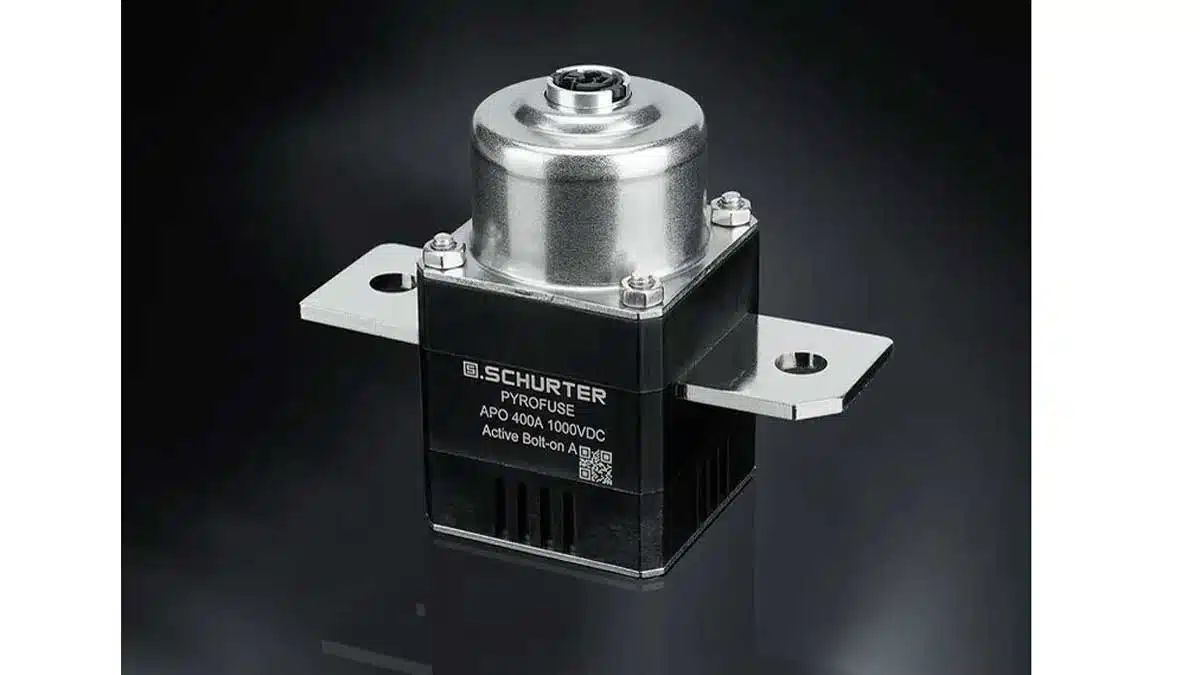
SCHURTER has introduced a new fuse technology, the Pyrofuse-APO Series, designed to meet the increasing demand for reliable protection in high-voltage systems driven by electrification in industries like EVs, aerospace, and energy storage.

Key Features and Benefits:

RelatedPosts

SCHURTER Presents EKO High‑Voltage Fuses for Global Energy Systems

SCHURTER Releases Intelligent Three‑Terminal Fuses for Safer Li‑ion Battery Systems

SCHURTER Introduces PPTC Resettable Overcurrent Protection for Compact Electronics

  • Active Operation: Unlike conventional fuses, the APO operates actively. Upon detecting a short circuit or accident, a control unit triggers a micro gas generator.
  • Rapid Response: The gas generator creates high pressure to mechanically sever a copper busbar, achieving complete galvanic isolation in less than 2 milliseconds (with measured speeds as fast as 0.9 ms).
  • High Performance:
    • Rated for operating voltages up to 1000 V.
    • Supports continuous currents up to 400 A.
    • Ultra-low internal resistance (micro-Ohms range) minimizes power loss and heat.
  • Safety & Design:
    • High breaking capacity for extreme short-circuit conditions.
    • Fully encapsulated design prevents the release of particles or gases.
    • Compact design allows for easy integration and reduces stress on downstream components like contactors.

This technology aims to set a new safety benchmark for e-mobility and energy transition applications.

Overview: A New Benchmark in High-Voltage Protection

As global industries—from automotive to aerospace—rapidly transition toward electrification, the safety requirements for high-voltage systems have intensified. Schurter’s new Pyrofuse-APO Series represents a paradigm shift from traditional passive circuit protection to active safety. Designed specifically for the rigorous demands of electric vehicles (EVs), charging infrastructure, energy storage, and fuel cells, this technology offers a level of speed and reliability that conventional fuses cannot match.

Operational Mechanism: Pyrotechnic Precision

The core innovation of the APO series lies in its “active” triggering mechanism. Unlike standard fuses that rely on melting a detailed element over time due to thermal buildup, the APO reacts instantaneously to a digital trigger:

  1. Trigger Event: In the event of a crash or short circuit, the system’s control unit sends a signal to the fuse.
  2. Gas Generation: This signal activates an integrated micro-gas generator.
  3. Mechanical Separation: Within milliseconds, the generator builds high pressure that drives a piston. This piston mechanically severs a solid copper busbar.
  4. Arc Extinguishing: The electrical arc resulting from the cut is immediately contained and suppressed within a dedicated extinguishing chamber.
  5. Result: The system achieves complete galvanic isolation in less than 2 milliseconds, with real-world performance measured as fast as 0.9 ms.

Technical Specifications & Efficiency

The APO Series is engineered to handle the high power density of modern electric architectures without compromising efficiency:

  • Voltage & Current: Rated for operating voltages up to 1000 V and continuous currents of 400 A.
  • Ultra-Low Resistance: The unit boasts an internal resistance in the range of only a few dozen micro-Ohms (µOhms).
  • Thermal Management: This exceptionally low resistance ensures that power losses are negligible and temperature rise remains minimal, addressing one of the common pain points in high-power management.

Safety, Robustness, and Design

Schurter has designed the APO to function safely even under extreme conditions:

  • Encapsulation: The unit features a fully encapsulated design, ensuring that no gases or particles are released into the surrounding environment during operation.
  • High Breaking Capacity: It is capable of safely interrupting extreme short-circuit currents that would overwhelm standard components.
  • Downstream Protection: Its rapid reaction time relieves stress on downstream components, such as contactors, potentially extending the lifespan and reducing the cost of the overall system architecture.

Applications

This technology positions Schurter as a key partner in the energy transition, offering critical protection for:

  • E-Mobility: Electric vehicles and commercial fleets.
  • Energy Storage: Stationary battery systems and renewable energy grids.
  • Aerospace: High-reliability power systems for aircraft.

Related

Source: SCHURTER

Recent Posts

SCHURTER Presents EKO High‑Voltage Fuses for Global Energy Systems

28.7.2026
21

EMC Design Fundamentals: Safe Use of Varistors and Common Mode Chokes in Mains and Data-Line Filters

16.7.2026
174

SCHURTER Releases Intelligent Three‑Terminal Fuses for Safer Li‑ion Battery Systems

14.7.2026
68

Littelfuse Announced TVS Diodes for 48 V Automotive Systems

10.7.2026
66

YAGEO Introduces Automotive MOV Surge Protection Varistor

28.7.2026
43

Vishay Introduces SMD Polymer PTC Thermistors for Fast Resettable Overcurrent Protection

30.6.2026
65

AI Hardware Demand for Passive Components Dossier

30.6.2026
206

Bourns Introduced Automotive TVS Diodes for Compact ESD Protection

23.6.2026
76

SCHURTER Introduces PPTC Resettable Overcurrent Protection for Compact Electronics

18.6.2026
73

Upcoming Events

Sep 29
16:00 - 17:00 CEST

Cybersecurity 2026

View Calendar

Popular Posts

  • Buck Converter Design and Calculation

    0 shares
    Share 0 Tweet 0
  • Boost Converter Design and Calculation

    0 shares
    Share 0 Tweet 0
  • YAGEO Announces July 2026 Capacitor Price Increase

    0 shares
    Share 0 Tweet 0
  • LLC Resonant Converter Design and Calculation

    0 shares
    Share 0 Tweet 0
  • Flyback Converter Design and Calculation

    0 shares
    Share 0 Tweet 0
  • MLCCs in the Age of AI: Q2 2026 Market Tightness

    0 shares
    Share 0 Tweet 0
  • MLCC and Ceramic Capacitors

    0 shares
    Share 0 Tweet 0
  • Earthing Systems and IEC Classification Explained

    0 shares
    Share 0 Tweet 0
  • Dual Active Bridge (DAB) Topology

    0 shares
    Share 0 Tweet 0
  • Core Materials, Permeability and Their Losses

    0 shares
    Share 0 Tweet 0

Newsletter Subscription


Passive Components Blog

© EPCI - Leading Passive Components Educational and Information Site

  • Home
  • Privacy Policy
  • EPCI Membership & Advertisement
  • About

No Result
View All Result
  • Home
  • Knowledge Blog
  • Dossiers
  • PCNS

© EPCI - Leading Passive Components Educational and Information Site