






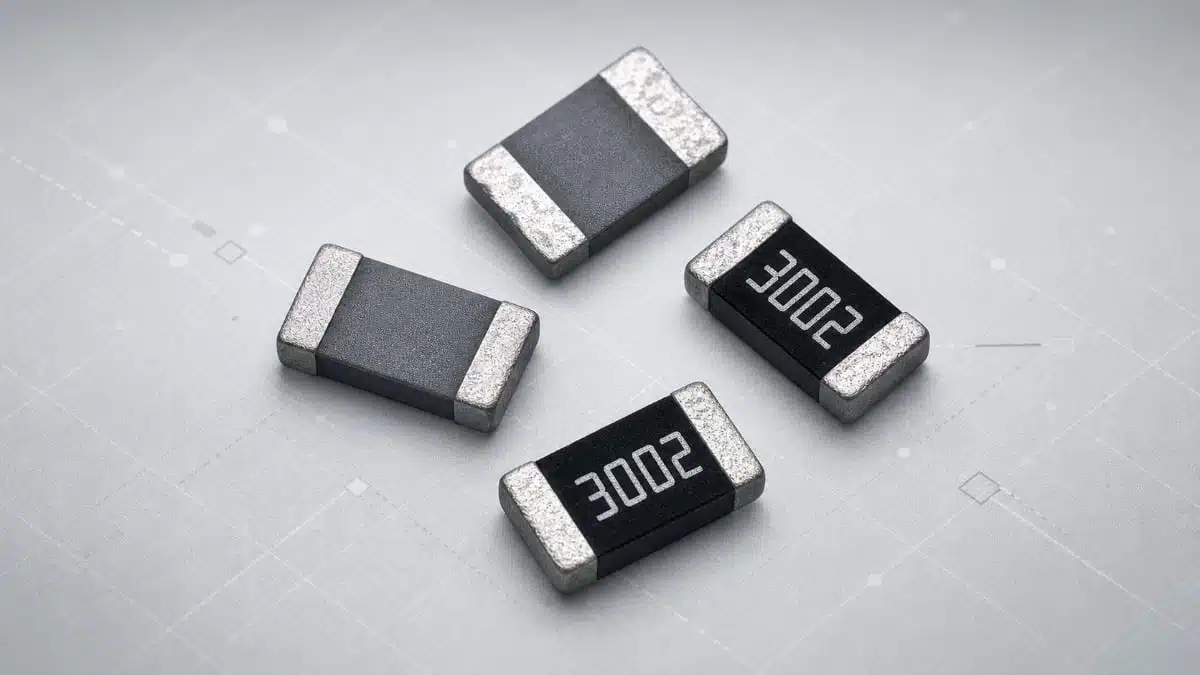
Stackpole’s RMHT series is a family of AEC-qualified thick film chip resistors designed for elevated ambient temperatures and harsh operating conditions in automotive, aerospace, and industrial electronics.
The automotive thick film chip resistors series targets applications where continuous operation, high power density, and long service life place extra demands on resistive components and PCB layout.
Key features and benefits
- High-temperature operation without early derating
The RMHT series maintains full-rated power up to 105°C ambient, whereas conventional thick film resistors typically begin derating above about 70°C according to manufacturer information. This extended full-power window simplifies thermal design in densely packed boards. - AEC-qualified thick film construction
RMHT devices are qualified to automotive-grade standards, making them suitable for safety-critical and mission-critical automotive electronics where component robustness and traceability are essential. - Anti-sulfur protection for polluted environments
The series includes anti-sulfur protection verified to EIA-977, addressing failure mechanisms in environments with sulfur-containing atmospheres (industrial plants, automotive under-hood, and certain outdoor installations). - Stable performance under thermal stress
Thick film technology optimized for high-temperature operation supports stable resistance and predictable drift over time, which is critical for sensing, feedback, and protection functions at elevated temperatures. - 100% automated optical inspection
All RMHT devices undergo 100% automated optical inspection, helping to catch assembly and process anomalies early in production and improving lot-to-lot consistency for OEMs. - Standard chip sizes for easy layout integration
Available in 0402, 0603, and 0805 packages, RMHT resistors drop into standard SMT footprints, allowing engineers to upgrade thermal performance without major PCB redesign. - Broad resistance and precision options
Resistance values from 1 Ω to 300 kΩ are offered with tolerance options of 0.5%, 1%, and 5%, as well as temperature coefficient of resistance (TCR) choices of 100 ppm/°C or 200 ppm/°C, according to the manufacturer datasheet. This range covers typical needs from current sensing and snubbers to signal-level networks.
Typical applications
RMHT thick film chip resistors are intended for demanding applications where high ambient temperature, continuous operation, and reliability under thermal stress are key design drivers.
Automotive and EV systems
- EV powertrain control, such as inverter gate drive circuitry and current sense networks near power modules.
- Battery management systems (BMS) exposed to elevated temperatures during fast charging or under-hood placement.
- Under-hood electronic control units (ECUs) where thermal cycling and proximity to engines or exhaust systems stress conventional resistors.
Aerospace and industrial automation
- Aerospace electronics with constrained cooling, where resistors must tolerate high local board temperatures and long mission profiles.
- Industrial automation, drives, and PLC modules installed in control cabinets with limited airflow and elevated ambient temperature.
- Motor drives and power conversion control boards, where thermal hotspots can occur near power devices and bus bars.
General harsh-environment electronics
- High-power-density embedded systems with localized hotspots around power stages, regulators, and DC-DC converters.
- Measurement and feedback networks in high-temperature industrial processes, where long-term resistance stability is essential for control accuracy.
Technical highlights
Package sizes and resistance range
- Chip sizes: 0402, 0603, 0805.
- Resistance range: 1 Ω to 300 kΩ, covering low-ohmic current sensing, mid-range load and snubber resistors, and higher-value signal and bias networks.
Tolerance and TCR options
- Tolerance options: 0.5%, 1%, and 5%.
- TCR options: 100 ppm/°C and 200 ppm/°C.
- In practice, 0.5% and 1% tolerance combined with 100 ppm/°C TCR are suitable for precision feedback, sensing, and gain-setting networks, while 5% tolerance and 200 ppm/°C TCR may be sufficient for general-purpose pull-ups, bleeders, and non-critical loads.
High-temperature power rating
- Full-rated power up to 105°C ambient, according to the manufacturer.
- Conventional thick film chip resistors frequently require power derating above about 70°C, leading to larger packages or additional derating in high-power-density layouts. Extending full power to 105°C gives designers more margin at elevated temperatures and can help keep footprint sizes compact.
Quality and reliability measures
- AEC-qualified thick film construction for automotive-grade reliability.
- Anti-sulfur protection verified to EIA-977 to reduce risk of sulfur-induced failure modes often seen in polluted industrial or automotive environments.
- 100% automated optical inspection for each device to improve outgoing quality and reduce assembly-related defects.
Summary table of key parameters
| Parameter | RMHT series value |
|---|---|
| Technology | Thick film, high-temperature, automotive-grade |
| Package sizes | 0402, 0603, 0805 |
| Resistance range | 1 Ω to 300 kΩ |
| Tolerance options | 0.5%, 1%, 5% |
| TCR options | 100 ppm/°C, 200 ppm/°C |
| Full-rated power ambient | Up to 105°C |
| Anti-sulfur protection standard | Verified to EIA-977 |
| Inspection | 100% automated optical inspection |
Design-in notes for engineers
- Match package size to thermal environment
When using RMHT in high-temperature zones near power semiconductors or under-hood modules, select the package size not only on nominal power rating but also on PCB copper area and local airflow. A smaller 0402 footprint may be adequate for low-power sensing, while 0805 can offer better thermal spreading for higher dissipations. - Use high-temperature capability to reduce derating complexity
The full-power rating up to 105°C ambient allows more straightforward derating policies. Designers can often avoid upsizing resistors solely due to conservative temperature assumptions in dense EV powertrain or industrial drive layouts. - Choose tolerance and TCR based on function
For precision sensing (current shunts at higher resistance, voltage dividers in feedback loops, and accurate bias networks), prioritize tighter tolerance (0.5% or 1%) and the lower 100 ppm/°C TCR. For non-critical functions like bleeder resistors or simple pull-ups, 5% tolerance and 200 ppm/°C TCR may be acceptable and more cost-effective. - Consider anti-sulfur protection for specific environments
In applications exposed to exhaust gases, industrial pollution, or sulfur-containing atmospheres (e.g., rubber manufacturing, certain petrochemical processes), the EIA-977 verified anti-sulfur protection of RMHT can mitigate long-term reliability risks relative to standard thick film resistors. - Integrate RMHT into automotive qualification flows
For automotive ECUs and EV power electronics, ensure that RMHT parts are included in the component approval and PPAP process, taking advantage of their AEC-qualified status. This can simplify documentation and reduce time-to-qualification for new designs. - Check datasheet limits for surge, voltage, and overload
While RMHT is optimized for high ambient temperature and continuous operation, engineers should confirm maximum working voltage, surge and pulse capabilities, and overload profiles from the official datasheet. For functions such as snubbers or transient protection elements, verify that the chosen value and package meet application-specific surge energy requirements.
Source
This article is based on information provided by Stackpole Electronics in their official press release and related RMHT series documentation, with additional independent commentary aimed at design engineers and purchasing professionals.