






Passive Components Blog
No Result
View All Result
  • Home
  • NewsFilter
    • All
    • Aerospace & Defence
    • Antenna
    • Applications
    • Automotive
    • Capacitors
    • Circuit Protection Devices
    • electro-mechanical news
    • Filters
    • Fuses
    • Inductors
    • Industrial
    • Integrated Passives
    • inter-connect news
    • Market & Supply Chain
    • Market Insights
    • Medical
    • Modelling and Simulation
    • New Materials & Supply
    • New Technologies
    • Non-linear Passives
    • Oscillators
    • Passive Sensors News
    • Resistors
    • RF & Microwave
    • Telecommunication
    • Weekly Digest

    Bourns Expanded Blend‑Balance Guitar Potentiometers Resistance Range

    TDK Extends Vibration‑Resistant Axial Aluminum Capacitors for Compact DC‑links

    YAGEO Releases SMD 0402 Pt Temperature Sensors for Space‑Constrained Designs

    Bourns Introduces Automotive Wide Terminal Metal Foil Current Sense Resistors for High‑Reliability Designs

    Current Sense Transformers: Ferrite vs Nanocrystalline Cores for Accurate Current Measurement

    Wk 30 Electronics Supply Chain Digest

    YAGEO Extends Automotive Tantalum Polymer Capacitors for AI and ADAS Controllers

    Knowles Introduces PP Film Capacitors for High‑Stress Power Electronics

    High‑Power Current Sensing with YAGEO PK Metal Current Sensors

    Trending Tags

    • Ripple Current
    • RF
    • Leakage Current
    • Tantalum vs Ceramic
    • Snubber
    • Low ESR
    • Feedthrough
    • Derating
    • Dielectric Constant
    • New Products
    • Market Reports
  • VideoFilter
    • All
    • Antenna videos
    • Capacitor videos
    • Circuit Protection Video
    • Filter videos
    • Fuse videos
    • Inductor videos
    • Inter-Connect Video
    • Non-linear passives videos
    • Oscillator videos
    • Passive sensors videos
    • Resistor videos

    Current Sense Transformers: Ferrite vs Nanocrystalline Cores for Accurate Current Measurement

    EMC Design Fundamentals: Safe Use of Varistors and Common Mode Chokes in Mains and Data-Line Filters

    Ferrite versus Nanocrystalline Power Inductor Cores: Turns, Gap and Size

    KYOCERA AVX Presents Antenna Integrator Studio Tutorial for Antenna Placement and RF Design

    Power Design Simulation Tools for Faster Inductor Selection and Loss Optimization

    EMC‑Compliant PCB and Connector Design Guidelines

    Why Isolated DC/DC Power Supplies Fail Late, Würth Elektronik Podcast

    Designing 800 V DC EMC Filters: Calculation, Simulation and Measurement

    Current Sense Transformer Datasheet and Design‑in Guide

    Trending Tags

    • Capacitors explained
    • Inductors explained
    • Resistors explained
    • Filters explained
    • Application Video Guidelines
    • EMC
    • New Products
    • Ripple Current
    • Simulation
    • Tantalum vs Ceramic
  • Knowledge Blog
  • Dossiers
    • AI Hardware Dossier
    • Power Converter Dossier
    • Automotive Dossier
    • Capacitor Dossier
    • Resistor Dossier
    • Inductor Dossier
    • Circuit Protection Dossier
  • Suppliers
    • Who is Who
  • PCNS
    • PCNS 2025
    • PCNS 2023
    • PCNS 2021
    • PCNS 2019
    • PCNS 2017
  • Events
  • Home
  • NewsFilter
    • All
    • Aerospace & Defence
    • Antenna
    • Applications
    • Automotive
    • Capacitors
    • Circuit Protection Devices
    • electro-mechanical news
    • Filters
    • Fuses
    • Inductors
    • Industrial
    • Integrated Passives
    • inter-connect news
    • Market & Supply Chain
    • Market Insights
    • Medical
    • Modelling and Simulation
    • New Materials & Supply
    • New Technologies
    • Non-linear Passives
    • Oscillators
    • Passive Sensors News
    • Resistors
    • RF & Microwave
    • Telecommunication
    • Weekly Digest

    Bourns Expanded Blend‑Balance Guitar Potentiometers Resistance Range

    TDK Extends Vibration‑Resistant Axial Aluminum Capacitors for Compact DC‑links

    YAGEO Releases SMD 0402 Pt Temperature Sensors for Space‑Constrained Designs

    Bourns Introduces Automotive Wide Terminal Metal Foil Current Sense Resistors for High‑Reliability Designs

    Current Sense Transformers: Ferrite vs Nanocrystalline Cores for Accurate Current Measurement

    Wk 30 Electronics Supply Chain Digest

    YAGEO Extends Automotive Tantalum Polymer Capacitors for AI and ADAS Controllers

    Knowles Introduces PP Film Capacitors for High‑Stress Power Electronics

    High‑Power Current Sensing with YAGEO PK Metal Current Sensors

    Trending Tags

    • Ripple Current
    • RF
    • Leakage Current
    • Tantalum vs Ceramic
    • Snubber
    • Low ESR
    • Feedthrough
    • Derating
    • Dielectric Constant
    • New Products
    • Market Reports
  • VideoFilter
    • All
    • Antenna videos
    • Capacitor videos
    • Circuit Protection Video
    • Filter videos
    • Fuse videos
    • Inductor videos
    • Inter-Connect Video
    • Non-linear passives videos
    • Oscillator videos
    • Passive sensors videos
    • Resistor videos

    Current Sense Transformers: Ferrite vs Nanocrystalline Cores for Accurate Current Measurement

    EMC Design Fundamentals: Safe Use of Varistors and Common Mode Chokes in Mains and Data-Line Filters

    Ferrite versus Nanocrystalline Power Inductor Cores: Turns, Gap and Size

    KYOCERA AVX Presents Antenna Integrator Studio Tutorial for Antenna Placement and RF Design

    Power Design Simulation Tools for Faster Inductor Selection and Loss Optimization

    EMC‑Compliant PCB and Connector Design Guidelines

    Why Isolated DC/DC Power Supplies Fail Late, Würth Elektronik Podcast

    Designing 800 V DC EMC Filters: Calculation, Simulation and Measurement

    Current Sense Transformer Datasheet and Design‑in Guide

    Trending Tags

    • Capacitors explained
    • Inductors explained
    • Resistors explained
    • Filters explained
    • Application Video Guidelines
    • EMC
    • New Products
    • Ripple Current
    • Simulation
    • Tantalum vs Ceramic
  • Knowledge Blog
  • Dossiers
    • AI Hardware Dossier
    • Power Converter Dossier
    • Automotive Dossier
    • Capacitor Dossier
    • Resistor Dossier
    • Inductor Dossier
    • Circuit Protection Dossier
  • Suppliers
    • Who is Who
  • PCNS
    • PCNS 2025
    • PCNS 2023
    • PCNS 2021
    • PCNS 2019
    • PCNS 2017
  • Events
No Result
View All Result
Passive Components Blog
No Result
View All Result

Bourns Expanded Blend‑Balance Guitar Potentiometers Resistance Range

5.8.2026
Reading Time: 6 mins read
A A

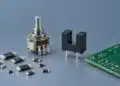
Bourns has expanded the standard resistance values of its PDB182-GTRB Series 17 mm blend‑balance guitar potentiometers, extending the range from 10 kΩ up to 1 MΩ according to the manufacturer datasheet and press release.

This gives instrument makers and audio equipment designers more tonal and signal‑routing options without changing the mechanical layout or requalifying the potentiometer footprint.

RelatedPosts

Bourns Introduces Automotive Wide Terminal Metal Foil Current Sense Resistors for High‑Reliability Designs

Bourns Introduces LTCC Band Pass Filters for 5G C‑Band RF Front‑End Designs

Bourns Introduces LTCC GNSS L‑Band Diplexer for Compact RF Front Ends

Key features and benefits

  • Broader resistance range on one platform – Standard values now span 10 kΩ to 1 MΩ on the same 17 mm mechanical platform, simplifying design reuse and giving OEMs a wider choice of tone and blend characteristics without PCB changes.
  • Blend/balance focused design – Dual‑gang construction with a center detent provides a clear mid‑position and repeatable adjustment for pickup blending, channel balance or wet/dry mixes.
  • Compact 17 mm package – The L17 mm form factor suits densely packed control cavities in guitars and basses as well as compact mixer and synth front panels.
  • Carbon resistive element – A carbon track is used for smooth, consistent wiper contact, which helps reduce scratchy noise and improves perceived feel during rotation.
  • Mechanical robustness – Metal shaft and metal bushing construction supports repeated actuation, which is important in stage instruments and pro‑audio gear that see frequent use.
  • Flexible shaft and termination options – Plain or knurled shaft variants support different knob designs, while rear solder lugs or PC pins allow either hand‑wired harnesses or PCB mounting.
  • Standard audio tapers – Availability of M and N tapers across the resistance range is suited to common audio volume, tone and blend curves without resorting to custom parts.
  • Environmental compliance – The series is RoHS compliant based on the applicable directive, which eases adoption in global designs.

Typical applications

The PDB182-GTRB Series is targeted at audio and musical‑instrument controls where a precise center position and smooth transition between two signals is required.

  • Electric and bass guitars with pickup blend controls in place of a conventional three‑way switch.
  • Guitar and bass amplifiers for channel blending, effects loop mixing or presence/contour controls.
  • Studio and live sound mixers for pan, balance or group blend functions in a compact mechanical format.
  • Synthesizers, drum machines and grooveboxes for mixing oscillators, layers or effect sends/returns.
  • Pro‑audio and broadcast equipment where front‑panel blend/balance controls require a tactile center detent.
  • Consumer audio and multimedia devices, such as powered speakers or small mixers, needing simple left/right or wet/dry balance.
  • General‑purpose audio control circuits that benefit from dual‑gang, center‑detent behavior.

Technical highlights

The most relevant electrical parameters for design‑in are:

ParameterTypical value / notes
Resistance range10 kΩ to 1 MΩ standard values
Resistance tolerance±20%
Taper optionsM and N audio tapers
Power rating (dual section)0.06 W
Operating temperature−10 °C to +50 °C
Rotational life15,000 cycles (typical for this series)
ConstructionDual‑gang, carbon element, metal shaft and bushing
Mechanical size17 mm potentiometer body length (series designation L17)

A resistance range up to 1 MΩ allows these potentiometers to interface comfortably with high‑impedance guitar pickups and line‑level audio stages without excessive loading. At the lower end, 10 kΩ values can be useful in low‑impedance or buffered stages where designers want tighter control over signal levels.

The ±20% resistance tolerance is typical for carbon‑element panel controls and is generally acceptable in audio applications where exact absolute resistance is less critical than taper consistency and tracking between gangs. The 0.06 W dual‑section power rating is adequate for control‑level signals rather than direct power handling, so the devices should not be used where significant dissipation across the track is expected.

The operating temperature range from −10 °C to +50 °C covers typical musical‑instrument and indoor pro‑audio environments; if extended industrial or automotive temperature ranges are needed, a different product line would be more appropriate.

Design‑in notes for engineers

For circuit designers and hardware engineers, the main value of this update is the ability to fine‑tune pickup or channel interactions without redesigning the mechanical interface.

  • Match resistance to source impedance – For passive guitar pickups, higher resistance values (typically 250 kΩ to 500 kΩ or 1 MΩ) help preserve high‑frequency content and sustain, whereas lower values introduce more loading and darker tone.
  • Choose taper based on user interaction – M and N tapers differ in how quickly the level changes around the center; select the taper that gives the desired perceived “sweep” during a blend from one source to the other.
  • Use the center detent intentionally – The mechanical detent should correspond to an acoustically meaningful balance point; in many designs this is the equal contribution of the two sources, but in some cases a slight offset is acceptable.
  • Check dual‑gang tracking requirements – For precise stereo balance or two‑channel control, verify in lab builds that the tracking between gangs is sufficient, especially near the center detent.
  • Confirm thermal limits in unusual use cases – While these potentiometers are intended for low‑power audio signals, verify that any DC bias or series resistance in your design does not cause excess dissipation beyond the 0.06 W dual‑section rating.
  • Account for rotational life in high‑use controls – With a specified rotational life of 15,000 cycles, these parts are well suited for typical instrument and audio controls; however, extreme high‑duty applications (for example, training or rental equipment) may warrant verification of wear margins.
  • Standardize mechanical variants – To simplify both manufacturing and field service, limit the number of shaft and bushing options used per product line and clearly document knob compatibility in the mechanical drawings.
  • Treat environmental specs as indoor‑focused – Given the −10 °C to +50 °C operating range, avoid placing these parts in enclosures with poor thermal management in outdoor or high‑temperature environments.

From a layout perspective, the ability to keep the same 17 mm footprint and panel hardware across multiple resistance options makes it practical to design one PCB and enclosure set that serves different SKUs, differentiated only by the installed potentiometer configuration.

Source

This article is based on information provided in the official Bourns press release for the PDB182-GTRB Series and the associated product documentation and datasheet, with additional independent commentary for design engineers and component buyers.

References

  1. Bourns press release: Bourns Expands Standard Resistance Values for Blend-Balance Guitar Potentiometers
  2. Bourns PDB182-GTRB Series datasheet
  3. Bourns Commercial Panel Controls overview

Related

Recent Posts

YAGEO Releases SMD 0402 Pt Temperature Sensors for Space‑Constrained Designs

3.8.2026
44

Bourns Introduces Automotive Wide Terminal Metal Foil Current Sense Resistors for High‑Reliability Designs

3.8.2026
22

High‑Power Current Sensing with YAGEO PK Metal Current Sensors

30.7.2026
23

TT Electronics: How Qualification Underpins Reliable Selection of Thick‑Film Resistors

27.7.2026
105

Stackpole Extends Resistance Range of 2512 High‑Power Current Sense Resistors

13.7.2026
58

Spectrum Controls Joins Modelithics Program to Offer High‑Fidelity RF Models for Resistors, Attenuators and Terminations

10.7.2026
30

AI Hardware Demand for Passive Components Dossier

30.6.2026
211

Stackpole Releases High-Frequency Thin Film Chip Resistors for RF up to 50 GHz

19.6.2026
66

DMASS: European Components Distribution Returns To Growth In Q1 2026

16.6.2026
113

Upcoming Events

Sep 29
16:00 - 17:00 CEST

Cybersecurity 2026

Nov 24
16:00 - 17:00 CET

Component selection with the WE REDEXPERT® DC-DC Converter Designer Tool

View Calendar

Popular Posts

  • Buck Converter Design and Calculation

    0 shares
    Share 0 Tweet 0
  • Boost Converter Design and Calculation

    0 shares
    Share 0 Tweet 0
  • YAGEO Announces July 2026 Capacitor Price Increase

    0 shares
    Share 0 Tweet 0
  • LLC Resonant Converter Design and Calculation

    0 shares
    Share 0 Tweet 0
  • Flyback Converter Design and Calculation

    0 shares
    Share 0 Tweet 0
  • MLCCs in the Age of AI: Q2 2026 Market Tightness

    0 shares
    Share 0 Tweet 0
  • MLCC and Ceramic Capacitors

    0 shares
    Share 0 Tweet 0
  • Earthing Systems and IEC Classification Explained

    0 shares
    Share 0 Tweet 0
  • Dual Active Bridge (DAB) Topology

    0 shares
    Share 0 Tweet 0
  • Ripple Current and its Effects on the Performance of Capacitors

    3 shares
    Share 3 Tweet 0

Newsletter Subscription


Passive Components Blog

© EPCI - Leading Passive Components Educational and Information Site

  • Home
  • Privacy Policy
  • EPCI Membership & Advertisement
  • About

No Result
View All Result
  • Home
  • Knowledge Blog
  • Dossiers
  • PCNS

© EPCI - Leading Passive Components Educational and Information Site

This website uses cookies. By continuing to use this website you are giving consent to cookies being used. Visit our Privacy and Cookie Policy.