



Passive Components Blog
No Result
View All Result
  • Home
  • NewsFilter
    • All
    • Aerospace & Defence
    • Antenna
    • Applications
    • Automotive
    • Capacitors
    • Circuit Protection Devices
    • electro-mechanical news
    • Filters
    • Fuses
    • Inductors
    • Industrial
    • Integrated Passives
    • inter-connect news
    • Market & Supply Chain
    • Market Insights
    • Medical
    • Modelling and Simulation
    • New Materials & Supply
    • New Technologies
    • Non-linear Passives
    • Oscillators
    • Passive Sensors News
    • Resistors
    • RF & Microwave
    • Telecommunication
    • Weekly Digest

    Binder Hybrid Connector Simplifies One Cable Automation

    Tapped Inductor Buck Converter Fundamentals

    TAIYO YUDEN Releases Mini Metal Power Inductors

    Molecular Memristor Shows Record 145 kH Emergent Inductance

    Planar vs Conventional Transformer: When it Make Sense

    Researchers Propose Next‑Gen Compact Memory Using Ultra-thin Ferroelectric Capacitors

    Nichicon ADN Automotive Hybrid Aluminum Capacitors Now Available in EMEA

    Wk 19 Electronics Supply Chain Digest

    Electrocaloric Multilayer Capacitors: Towards Quiet, Solid‑State Cooling Around Room Temperature

    Trending Tags

    • Ripple Current
    • RF
    • Leakage Current
    • Tantalum vs Ceramic
    • Snubber
    • Low ESR
    • Feedthrough
    • Derating
    • Dielectric Constant
    • New Products
    • Market Reports
  • VideoFilter
    • All
    • Antenna videos
    • Capacitor videos
    • Circuit Protection Video
    • Filter videos
    • Fuse videos
    • Inductor videos
    • Inter-Connect Video
    • Non-linear passives videos
    • Oscillator videos
    • Passive sensors videos
    • Resistor videos

    Tapped Inductor Buck Converter Fundamentals

    Planar vs Conventional Transformer: When it Make Sense

    Modeling Fringing Field Losses in Inductors & Transformers

    Why Power Inductors Use a Ferrite Core With an Air Gap

    Transformer-Based Power-Line Harvester Magnetic Design

    Thermal Modeling of Magnetics

    Standard vs Planar LLC transformers Comparison for Battery Chargers

    How Modern Tools Model Magnetic Components for Power Electronics

    Advanced Loss Modeling for Planar Magnetics in the Frenetic Planar Tool

    Trending Tags

    • Capacitors explained
    • Inductors explained
    • Resistors explained
    • Filters explained
    • Application Video Guidelines
    • EMC
    • New Products
    • Ripple Current
    • Simulation
    • Tantalum vs Ceramic
  • Knowledge Blog
  • DossiersNew
  • Suppliers
    • Who is Who
  • PCNS
    • PCNS 2025
    • PCNS 2023
    • PCNS 2021
    • PCNS 2019
    • PCNS 2017
  • Events
  • Home
  • NewsFilter
    • All
    • Aerospace & Defence
    • Antenna
    • Applications
    • Automotive
    • Capacitors
    • Circuit Protection Devices
    • electro-mechanical news
    • Filters
    • Fuses
    • Inductors
    • Industrial
    • Integrated Passives
    • inter-connect news
    • Market & Supply Chain
    • Market Insights
    • Medical
    • Modelling and Simulation
    • New Materials & Supply
    • New Technologies
    • Non-linear Passives
    • Oscillators
    • Passive Sensors News
    • Resistors
    • RF & Microwave
    • Telecommunication
    • Weekly Digest

    Binder Hybrid Connector Simplifies One Cable Automation

    Tapped Inductor Buck Converter Fundamentals

    TAIYO YUDEN Releases Mini Metal Power Inductors

    Molecular Memristor Shows Record 145 kH Emergent Inductance

    Planar vs Conventional Transformer: When it Make Sense

    Researchers Propose Next‑Gen Compact Memory Using Ultra-thin Ferroelectric Capacitors

    Nichicon ADN Automotive Hybrid Aluminum Capacitors Now Available in EMEA

    Wk 19 Electronics Supply Chain Digest

    Electrocaloric Multilayer Capacitors: Towards Quiet, Solid‑State Cooling Around Room Temperature

    Trending Tags

    • Ripple Current
    • RF
    • Leakage Current
    • Tantalum vs Ceramic
    • Snubber
    • Low ESR
    • Feedthrough
    • Derating
    • Dielectric Constant
    • New Products
    • Market Reports
  • VideoFilter
    • All
    • Antenna videos
    • Capacitor videos
    • Circuit Protection Video
    • Filter videos
    • Fuse videos
    • Inductor videos
    • Inter-Connect Video
    • Non-linear passives videos
    • Oscillator videos
    • Passive sensors videos
    • Resistor videos

    Tapped Inductor Buck Converter Fundamentals

    Planar vs Conventional Transformer: When it Make Sense

    Modeling Fringing Field Losses in Inductors & Transformers

    Why Power Inductors Use a Ferrite Core With an Air Gap

    Transformer-Based Power-Line Harvester Magnetic Design

    Thermal Modeling of Magnetics

    Standard vs Planar LLC transformers Comparison for Battery Chargers

    How Modern Tools Model Magnetic Components for Power Electronics

    Advanced Loss Modeling for Planar Magnetics in the Frenetic Planar Tool

    Trending Tags

    • Capacitors explained
    • Inductors explained
    • Resistors explained
    • Filters explained
    • Application Video Guidelines
    • EMC
    • New Products
    • Ripple Current
    • Simulation
    • Tantalum vs Ceramic
  • Knowledge Blog
  • DossiersNew
  • Suppliers
    • Who is Who
  • PCNS
    • PCNS 2025
    • PCNS 2023
    • PCNS 2021
    • PCNS 2019
    • PCNS 2017
  • Events
No Result
View All Result
Passive Components Blog
No Result
View All Result

Thermoset Polymer Dielectric Capacitors for Harsh Environment Applications 

24.9.2025
Reading Time: 4 mins read
A A

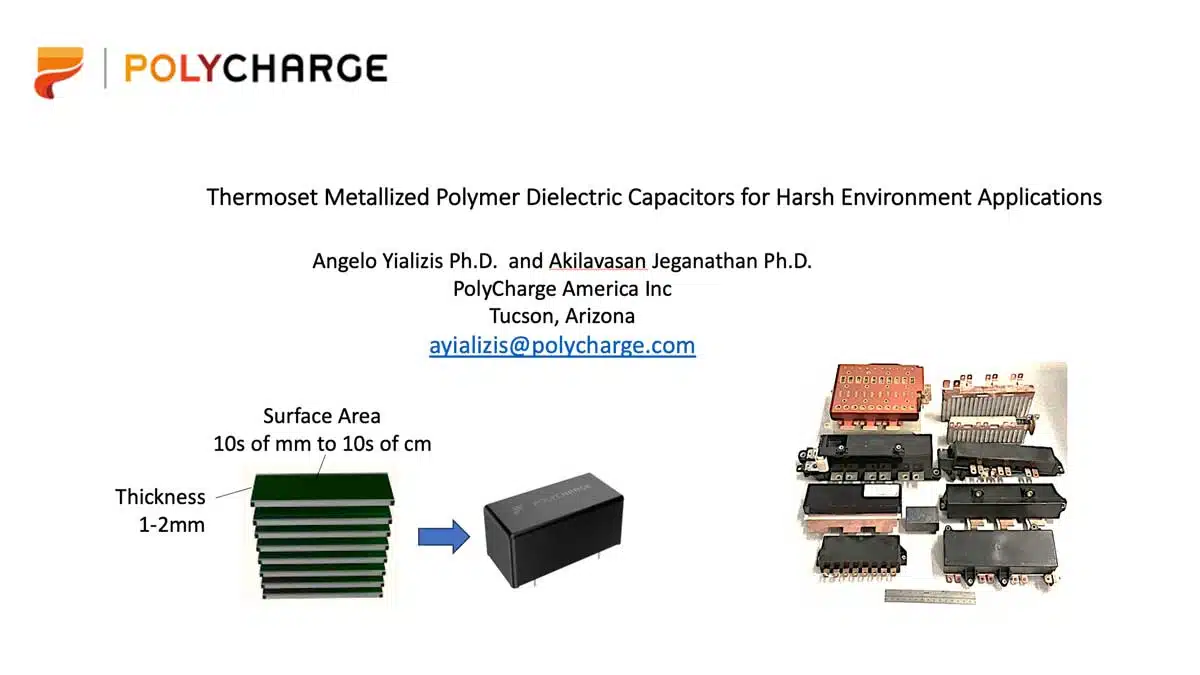
The paper “Thermoset Polymer Dielectric Capacitors for Harsh Environment Applications ” was presented by Angelo Yializis, PolyCharge America Inc. Tucson, AZ, USA at the 5th PCNS Passive Components Networking Symposium 9-12th September 2025, Seville, Spain as paper No. 1.1.

Introduction

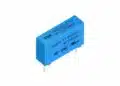
The article discusses the development and performance of NanoLam™ thermoset polymer dielectric film capacitors for applications in extreme environments.

RelatedPosts

Advances in the Environmental Performance of Polymer Capacitors

How to Manage Supercapacitors Leakage Current and Self Discharge 

Qualification of Commercial Supercapacitors for Space Applications

Electronics designed for harsh industrial, aerospace, automotive, military, and space conditions must endure extreme temperatures, high electrical stress, mechanical shock, and ionizing radiation without performance degradation. Conventional capacitor technologies—such as ceramic multilayer capacitors, electrolytic capacitors, and polymer film capacitors—face limitations that restrict their use in environments requiring both high energy density and reliability under multiple stressors.

NanoLam™ capacitors address these challenges by employing a solid-state, nanolaminate dielectric structure with highly cross-linked thermoset polymers and nanometer-thick aluminum electrodes, enabling operation from -196°C to +160°C with excellent dielectric stability, self-healing properties, and radiation resistance.

Key Points

  • NanoLam™ capacitors are designed for operation between -196°C and +160°C, maintaining high energy density and reliability.
  • Submicron cross-linked thermoset polymer dielectrics and nanometer-thick aluminum electrodes provide superior dielectric stability.
  • Capacitors exhibit self-healing behavior without requiring air gaps, suitable for vacuum and cryogenic conditions.
  • High resistance to radiation-induced degradation makes them ideal in aerospace, defense, and nuclear applications.
  • Moisture sensitivity at high temperatures and encapsulation challenges remain key considerations for long-term performance.

Extended Summary

The article begins by emphasizing the critical need for capacitors that can reliably operate under extreme environmental conditions, including high and low temperatures, strong mechanical vibrations, and ionizing radiation exposure. Traditional capacitor technologies—ceramic multilayers, electrolytics, and polymer films like polypropylene and PTFE—suffer from either limited energy density, poor radiation resilience, or thermal instability.

NanoLam™ capacitors were introduced to fill this gap, using a nanolaminate structure composed of thousands of submicron polymer dielectric layers and nanometer-scale aluminum electrodes. The dielectric is a beta-radiation-cured thermoset polymer with a glass transition temperature of 200°C, ensuring dimensional stability, low thermal expansion, and enhanced self-healing. This structure mimics multilayer ceramics but offers the mechanical and electrical benefits of a solid-state polymer system.

The article details the capacitors’ parametric stability under various conditions. Voltage and temperature effects on dielectric breakdown and leakage current were analyzed, with experimental results showing that self-healing events occur at predictable overvoltages, and leakage current behavior follows the Poole-Frenkel conduction model. Submicron dielectrics exhibited higher breakdown strength and temperature-dependent conduction, confirming their suitability for high-voltage operation.

Performance in cryogenic conditions was also evaluated. At -196°C, conventional polymer films become brittle due to glass transition effects, but NanoLam™ dielectrics remain well below their Tg, preventing fracture and minimizing thermal contraction mismatch. Their self-healing mechanism, independent of air gaps, functions effectively in vacuum or liquid nitrogen environments. Extended testing under liquid nitrogen immersion demonstrated stable capacitance, ESR, and dissipation factor over 100 hours.

High-temperature performance is equally critical. NanoLam™ capacitors withstand ambient temperatures up to 160°C, maintaining parametric stability when appropriately derated to minimize aluminum electrode corrosion and ESR growth. Tests show that these capacitors outperform larger polypropylene alternatives in high-ripple current scenarios by resisting thermal runaway, though encapsulation remains a limiting factor beyond 160°C due to epoxy Tg and moisture ingress.

Resistance to ionizing radiation is achieved through the highly cross-linked acrylate/methacrylate dielectric network. This structure resists chain scission, charge trapping, and oxidative degradation, while maintaining dielectric integrity and adhesion at nano-interfaces. Independent evaluations, including work by Sandia National Laboratories, validated their suitability for high-radiation, shock-tolerant applications in nuclear and aerospace sectors.

Conclusion

NanoLam™ thermoset polymer dielectric capacitors represent a significant technological advancement for extreme-condition electronics. Their combination of wide temperature tolerance, self-healing capability, high energy density, and radiation resistance addresses the shortcomings of traditional capacitor technologies. Remaining challenges include improving encapsulation methods to manage moisture ingress and mechanical stress in cryogenic and ultra-high-temperature scenarios. With continued development, these capacitors are poised to enable reliable, compact, and high-performance energy storage solutions for mission-critical defense, aerospace, automotive, and space applications.
1_1_Polycharge – Thermoset Polymer Dielectric Capacitors for Harsh EnvironmentsDownload

Related

Source: PCNS

Recent Posts

Binder Hybrid Connector Simplifies One Cable Automation

13.5.2026
4

Planar vs Conventional Transformer: When it Make Sense

11.5.2026
35

Researchers Propose Next‑Gen Compact Memory Using Ultra-thin Ferroelectric Capacitors

11.5.2026
28

Nichicon ADN Automotive Hybrid Aluminum Capacitors Now Available in EMEA

11.5.2026
23

Electrocaloric Multilayer Capacitors: Towards Quiet, Solid‑State Cooling Around Room Temperature

7.5.2026
186

Stackpole Expanded its AlN Thick Film Chip Resistors

6.5.2026
23

KYOCERA 10 µF 0201 MLCC Brings High‑Capacitance into Mobile Designs

6.5.2026
54

Würth Elektronik Introduces Compact Flat-wire SMT Power Inductors for Automotive

5.5.2026
50

KYOCERA AVX Extends MLV Varistors for 48V Automotive Protection

5.5.2026
27

Upcoming Events

May 19
16:00 - 17:00 CEST

Designing Qi2 Wireless Power Systems: Practical Development and EMC Optimization

Jun 2
16:00 - 17:00 CEST

Calculation, Simulation and Measurement of 800V EMC Filters

Jun 16
16:00 - 17:00 CEST

EMC with EMC – EMC‑compliant design with electromechanical connectors

View Calendar

Popular Posts

  • Buck Converter Design and Calculation

    0 shares
    Share 0 Tweet 0
  • Boost Converter Design and Calculation

    0 shares
    Share 0 Tweet 0
  • Flyback Converter Design and Calculation

    0 shares
    Share 0 Tweet 0
  • LLC Resonant Converter Design and Calculation

    0 shares
    Share 0 Tweet 0
  • MLCC and Ceramic Capacitors

    0 shares
    Share 0 Tweet 0
  • Dual Active Bridge (DAB) Topology

    0 shares
    Share 0 Tweet 0
  • Capacitor Charging and Discharging

    0 shares
    Share 0 Tweet 0
  • What Electronics Engineer Needs to Know About Passive Low Pass Filters

    0 shares
    Share 0 Tweet 0
  • Ripple Current and its Effects on the Performance of Capacitors

    3 shares
    Share 3 Tweet 0
  • MLCC Case Sizes Standards Explained

    0 shares
    Share 0 Tweet 0

Newsletter Subscription


Passive Components Blog

© EPCI - Leading Passive Components Educational and Information Site

  • Home
  • Privacy Policy
  • EPCI Membership & Advertisement
  • About

No Result
View All Result
  • Home
  • Knowledge Blog
  • PCNS

© EPCI - Leading Passive Components Educational and Information Site

This website uses cookies. By continuing to use this website you are giving consent to cookies being used. Visit our Privacy and Cookie Policy.
Go to mobile version