



Passive Components Blog
No Result
View All Result
  • Home
  • NewsFilter
    • All
    • Aerospace & Defence
    • Antenna
    • Applications
    • Automotive
    • Capacitors
    • Circuit Protection Devices
    • electro-mechanical news
    • Filters
    • Fuses
    • Inductors
    • Industrial
    • Integrated Passives
    • inter-connect news
    • Market & Supply Chain
    • Market Insights
    • Medical
    • Modelling and Simulation
    • New Materials & Supply
    • New Technologies
    • Non-linear Passives
    • Oscillators
    • Passive Sensors News
    • Resistors
    • RF & Microwave
    • Telecommunication
    • Weekly Digest

    RF Inductors: Selection and Design Challenges for High-Frequency Circuits

    Wk 45 Electronics Supply Chain Digest

    Transformer Safety IEC 61558 Standard

    ESR of Capacitors, Measurements and Applications

    Murata Christophe Pottier Appointed President of EPCIA

    3-Phase EMI Filter Design, Simulation, Calculation and Test

    YAGEO Unveils Compact 2.4 GHz SMD Antenna

    KYOCERA AVX Releases Antenna for Iridium Satellite IoT Applications

    Molex Releases Industry-First Quad-Row Board-to-Board Connectors with EMI Shields

    Trending Tags

    • Ripple Current
    • RF
    • Leakage Current
    • Tantalum vs Ceramic
    • Snubber
    • Low ESR
    • Feedthrough
    • Derating
    • Dielectric Constant
    • New Products
    • Market Reports
  • VideoFilter
    • All
    • Antenna videos
    • Capacitor videos
    • Circuit Protection Video
    • Filter videos
    • Fuse videos
    • Inductor videos
    • Inter-Connect Video
    • Non-linear passives videos
    • Oscillator videos
    • Passive sensors videos
    • Resistor videos

    RF Inductors: Selection and Design Challenges for High-Frequency Circuits

    Transformer Safety IEC 61558 Standard

    3-Phase EMI Filter Design, Simulation, Calculation and Test

    Transformer Design Optimization for Power Electronics Applications

    Common Mode Chokes Selection for RF Circuits in Next-Generation Communication Systems

    Capacitor Self-balancing in a Flying-Capacitor Buck Converter

    How to Select Ferrite Bead for Filtering in Buck Boost Converter

    Power Inductors Future: Minimal Losses and Compact Designs

    Percolation Phenomenon: Degradation of Molded Power Inductors in DC/DC Converters

    Trending Tags

    • Capacitors explained
    • Inductors explained
    • Resistors explained
    • Filters explained
    • Application Video Guidelines
    • EMC
    • New Products
    • Ripple Current
    • Simulation
    • Tantalum vs Ceramic
  • Knowledge Blog
  • Suppliers
    • Who is Who
  • PCNS
    • PCNS 2025
    • PCNS 2023
    • PCNS 2021
    • PCNS 2019
    • PCNS 2017
  • Events
  • Home
  • NewsFilter
    • All
    • Aerospace & Defence
    • Antenna
    • Applications
    • Automotive
    • Capacitors
    • Circuit Protection Devices
    • electro-mechanical news
    • Filters
    • Fuses
    • Inductors
    • Industrial
    • Integrated Passives
    • inter-connect news
    • Market & Supply Chain
    • Market Insights
    • Medical
    • Modelling and Simulation
    • New Materials & Supply
    • New Technologies
    • Non-linear Passives
    • Oscillators
    • Passive Sensors News
    • Resistors
    • RF & Microwave
    • Telecommunication
    • Weekly Digest

    RF Inductors: Selection and Design Challenges for High-Frequency Circuits

    Wk 45 Electronics Supply Chain Digest

    Transformer Safety IEC 61558 Standard

    ESR of Capacitors, Measurements and Applications

    Murata Christophe Pottier Appointed President of EPCIA

    3-Phase EMI Filter Design, Simulation, Calculation and Test

    YAGEO Unveils Compact 2.4 GHz SMD Antenna

    KYOCERA AVX Releases Antenna for Iridium Satellite IoT Applications

    Molex Releases Industry-First Quad-Row Board-to-Board Connectors with EMI Shields

    Trending Tags

    • Ripple Current
    • RF
    • Leakage Current
    • Tantalum vs Ceramic
    • Snubber
    • Low ESR
    • Feedthrough
    • Derating
    • Dielectric Constant
    • New Products
    • Market Reports
  • VideoFilter
    • All
    • Antenna videos
    • Capacitor videos
    • Circuit Protection Video
    • Filter videos
    • Fuse videos
    • Inductor videos
    • Inter-Connect Video
    • Non-linear passives videos
    • Oscillator videos
    • Passive sensors videos
    • Resistor videos

    RF Inductors: Selection and Design Challenges for High-Frequency Circuits

    Transformer Safety IEC 61558 Standard

    3-Phase EMI Filter Design, Simulation, Calculation and Test

    Transformer Design Optimization for Power Electronics Applications

    Common Mode Chokes Selection for RF Circuits in Next-Generation Communication Systems

    Capacitor Self-balancing in a Flying-Capacitor Buck Converter

    How to Select Ferrite Bead for Filtering in Buck Boost Converter

    Power Inductors Future: Minimal Losses and Compact Designs

    Percolation Phenomenon: Degradation of Molded Power Inductors in DC/DC Converters

    Trending Tags

    • Capacitors explained
    • Inductors explained
    • Resistors explained
    • Filters explained
    • Application Video Guidelines
    • EMC
    • New Products
    • Ripple Current
    • Simulation
    • Tantalum vs Ceramic
  • Knowledge Blog
  • Suppliers
    • Who is Who
  • PCNS
    • PCNS 2025
    • PCNS 2023
    • PCNS 2021
    • PCNS 2019
    • PCNS 2017
  • Events
No Result
View All Result
Passive Components Blog
No Result
View All Result

Advances in the Environmental Performance of Polymer Capacitors

8.10.2025
Reading Time: 4 mins read
A A

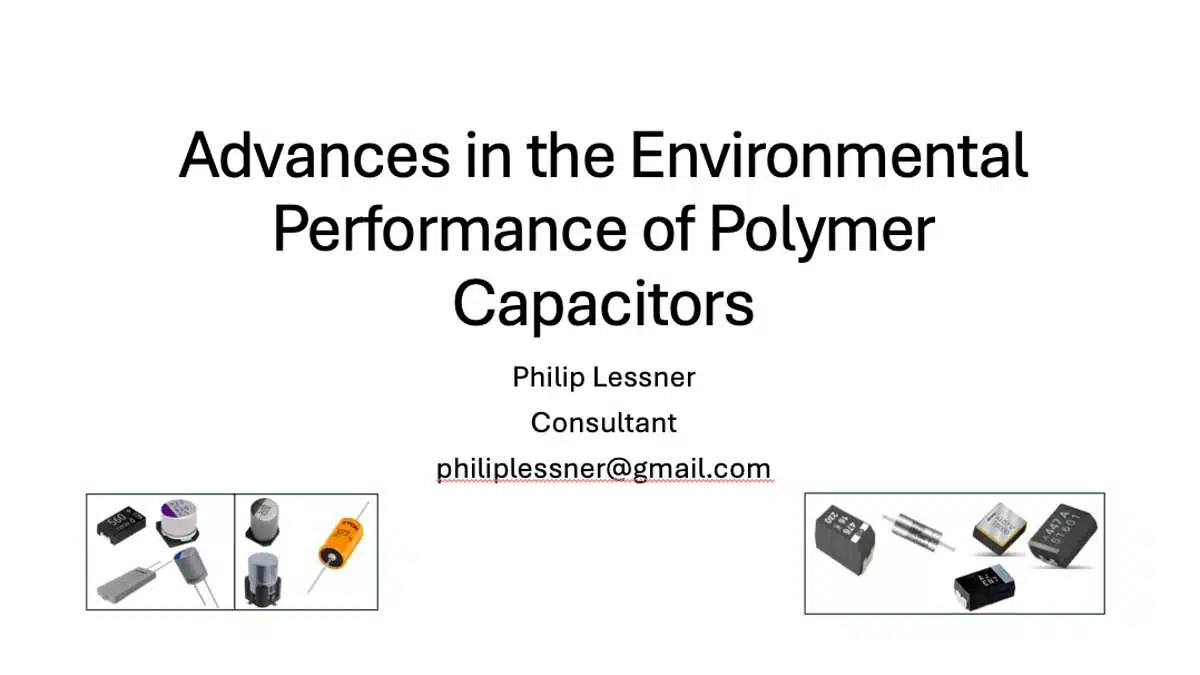
The paper “Advances in the Environmental Performance of Polymer Capacitors” was presented by Philip Lessner Consultant, South Carolina, USA at the 5th PCNS Passive Components Networking Symposium 9-12th September 2025, Seville, Spain as Keynote paper III.

Introduction

This article provides a comprehensive examination of the advances in the environmental performance of polymer capacitors, particularly aluminum capacitors and tantalum capacitors with conductive polymer cathodes.

RelatedPosts

How to Manage Supercapacitors Leakage Current and Self Discharge 

Qualification of Commercial Supercapacitors for Space Applications

Experimental Evaluation of Wear Failures in SMD Inductors

Since their introduction in the mid-1990s for consumer electronics, these capacitors have evolved to meet the stringent requirements of automotive, defense/aerospace, and high-performance data center applications.

The paper delves into the degradation mechanisms under stress conditions involving temperature, voltage, and humidity, and highlights material science innovations that have enabled higher reliability and longer lifetimes.

Key Points

  1. Evolution of Polymer Capacitors: Early capacitors were limited to 85–105°C and moderate humidity, but modern designs meet AEC-Q200 and MIL-SPEC requirements.
  2. Dielectric Reliability: Tantalum pentoxide formation, oxygen migration, and crystallization are key factors affecting lifetime.
  3. Conductive Polymer Degradation: ESR increase and capacitance loss due to thermal and humidity effects are now better understood.
  4. Environmental Performance: Humidity and high-temperature exposure mechanisms have been identified, leading to improved packaging materials and cathode polymers.
  5. Applications: Automotive, defense/aerospace, and AI data centers demand long-term reliability, up to 100,000 hours or more.

Extended Summary

The development of polymer capacitors began with applications in portable electronics, where moderate temperature and humidity tolerance was sufficient. Initial tantalum and aluminum conductive polymer capacitors reduced Equivalent Series Resistance (ESR), a critical factor as digital circuits advanced. Their limited voltage and thermal performance restricted them to low-voltage consumer devices.

Breakthroughs in polymer chemistry and capacitor design around 2008 enabled higher voltage ratings (up to 75V) and improved thermal and humidity performance. This opened opportunities in automotive electronics, where AEC-Q200 standards require 125°C operation and 85°C/85%RH humidity tolerance. Subsequent adoption in defense and aerospace led to the development of COTS and MIL-SPEC series, and hermetically sealed units for harsh environments.

Dielectric reliability is primarily governed by the quality of the tantalum pentoxide layer. Oxygen migration induces conductive pathways, while crystallization of the dielectric under high voltage and temperature can lead to breakdown. Self-healing mechanisms in conductive polymer cathodes provide some resilience, but oxidation and thermal degradation can limit life, especially in air. Pre-polymerized PEDOT:PSSA provided a key improvement in high-voltage performance, while antioxidants and optimized encapsulation further enhance stability.

Humidity introduces additional failure modes, such as silver ion migration and copper dendrite formation, which cause leakage current increases and eventual shorts. Polymer delamination and ESR rise are also critical concerns. Improved epoxies, lead frame materials, and interlayer adhesion have significantly mitigated these issues, allowing modern tantalum-polymer capacitors to meet automotive and aerospace reliability standards.

In high-reliability environments like AI data centers, the focus is on sustaining 5+ year operation under continuous high-temperature conditions. Accelerated life testing and physics-based models (e.g., McPherson’s field-modified activation energy model) predict dielectric lifetimes in the hundreds to thousands of years at 85°C and nominal voltage, but ESR and capacitance degradation become the limiting factors.

Conclusion

Polymer capacitors have matured into high-reliability components suitable for demanding automotive, defense, aerospace, and data center applications. Advances in dielectric formation, polymer chemistry, and packaging have enabled significant improvements in temperature and humidity performance. While dielectric wear-out is now largely a long-term concern, thermal and humidity-induced ESR rise and capacitance loss remain active areas for further research. Continued developments in material science, encapsulation, and predictive modeling will be key to extending lifetime performance toward the 100,000-hour expectation for next-generation applications.


KNIII LESSNER Advances in the Environmental Performance of Polymer CapacitorsDownload

Related

Source: PCNS

Recent Posts

ESR of Capacitors, Measurements and Applications

7.11.2025
29

3-Phase EMI Filter Design, Simulation, Calculation and Test

6.11.2025
43

YAGEO Unveils Compact 2.4 GHz SMD Antenna

6.11.2025
10

KYOCERA AVX Releases Antenna for Iridium Satellite IoT Applications

6.11.2025
10

Molex Releases Industry-First Quad-Row Board-to-Board Connectors with EMI Shields

6.11.2025
8

Smoltek CNF-MIM Capacitors Pass 1,000h Reliability Test

6.11.2025
11

Capacitor Lead Times: October 2025

6.11.2025
64

Paumanok Unveils Aluminum Capacitor Foils World Markets Study 2025-2030

6.11.2025
14

Coilcraft Introduces Ultra-Low Loss Shielded Power Inductors

6.11.2025
15

Upcoming Events

Nov 11
17:00 - 18:00 CET

Industrial Applications Demand More from Interconnects in Next-Gen Designs

Nov 12
11:00 - 12:00 CET

PCB Design: Impedance is for everyone!

Nov 12
November 12 @ 12:00 - November 13 @ 14:15 EST

Microelectronic Packaging Failure Modes and Analysis

View Calendar

Popular Posts

  • Buck Converter Design and Calculation

    0 shares
    Share 0 Tweet 0
  • Boost Converter Design and Calculation

    0 shares
    Share 0 Tweet 0
  • LLC Resonant Converter Design and Calculation

    0 shares
    Share 0 Tweet 0
  • Flyback Converter Design and Calculation

    0 shares
    Share 0 Tweet 0
  • Ripple Current and its Effects on the Performance of Capacitors

    3 shares
    Share 3 Tweet 0
  • MLCC and Ceramic Capacitors

    0 shares
    Share 0 Tweet 0
  • Dual Active Bridge (DAB) Topology

    0 shares
    Share 0 Tweet 0
  • SEPIC Converter Design and Calculation

    0 shares
    Share 0 Tweet 0
  • What is a Dielectric Constant and DF of Plastic Materials?

    4 shares
    Share 4 Tweet 0
  • Flying Capacitors

    0 shares
    Share 0 Tweet 0

Newsletter Subscription


Passive Components Blog

© EPCI - Leading Passive Components Educational and Information Site

  • Home
  • Privacy Policy
  • EPCI Membership & Advertisement
  • About

No Result
View All Result
  • Home
  • Knowledge Blog
  • PCNS

© EPCI - Leading Passive Components Educational and Information Site

This website uses cookies. By continuing to use this website you are giving consent to cookies being used. Visit our Privacy and Cookie Policy.
Go to mobile version