













Researchers Ji Zhang, and col., working in materials science and electronic ceramics research institutions in China and Australia published their article “Ultrahigh energy-storage in lead-free ceramic capacitors via local structure design” in Nature Communications in March 2026.
Introduction
Dielectric ceramic capacitors are key energy‑storage components in pulsed‑power and high‑power electronic systems such as inverters and converters in hybrid and electric vehicles.
Unlike batteries or electrochemical capacitors, these devices store and release electrical energy through polarization of the dielectric material under an applied electric field, which allows extremely fast charge–discharge, high power density and excellent operational reliability.
The performance of a dielectric capacitor for energy storage is usually described by its recoverable energy density and its charge–discharge efficiency . These figures of merit depend on the shape of the polarization–electric field – loop: high maximum polarization , low remanent polarization large polarization difference and high breakdown strength are all desired simultaneously, but they are usually in conflict.
Relaxor ferroelectric ceramics are promising candidates because they exhibit slim – loops and polar nanoregions, but their recoverable energy density typically remains below about 10 J/cm³, which is limiting for compact, high‑energy applications.
Existing optimization strategies focus either on increasing breakdown strength or tailoring polarization behavior, for example by compositional tuning, microstructural engineering, nanodomain design, or high‑entropy approaches. However, the intrinsic coupling between , and means that improving one parameter often degrades another, leading to a trade‑off between energy density and efficiency. The authors address this challenge by designing the local polar structure in BiFeO₃‑based ceramics so that strong local polar clusters are embedded in a weakly polar matrix, and by simultaneously improving the microstructure and insulating properties.
Key points
- The authors develop a lead‑free BiFeO₃‑SrTiO₃‑NaNbO₃‑MnO ceramic system, denoted BF‑ST‑xNN‑Mn, using local structure design to enhance energy‑storage performance.
- By incorporating NaNbO₃ into a BiFeO₃‑SrTiO₃ matrix and adding MnO as a sintering aid, they create embedded polar nanoregions within a weakly polar host while improving resistivity and suppressing leakage.
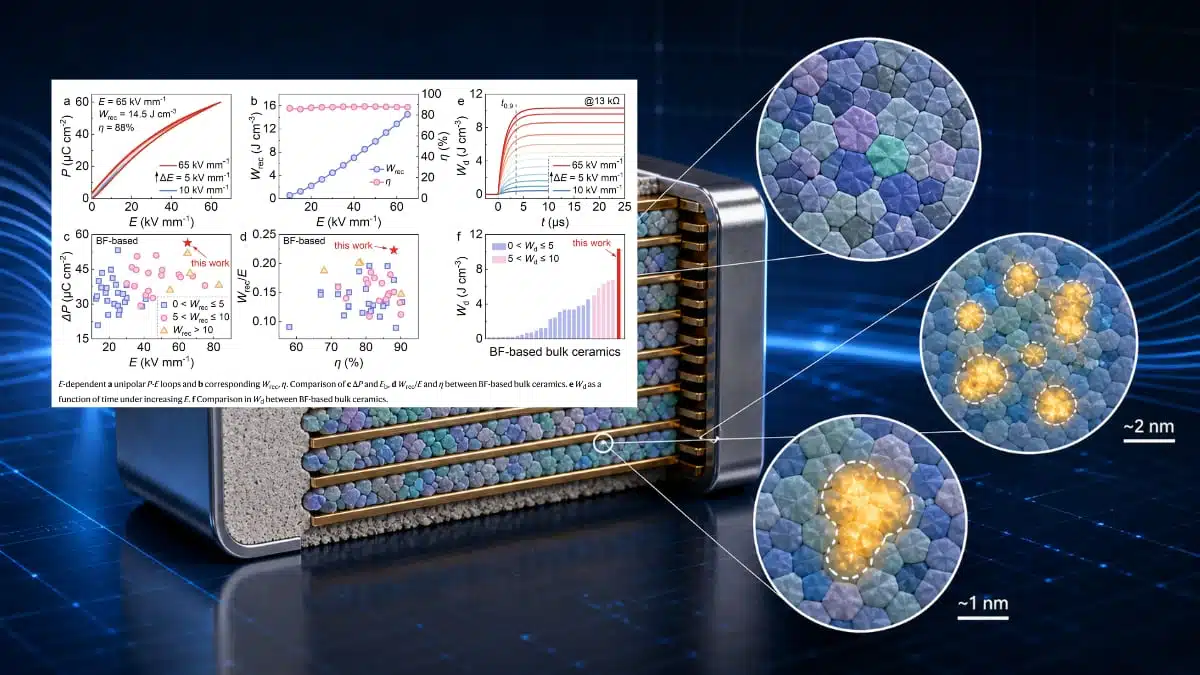
- An optimized composition 0.46BiFeO₃–0.4SrTiO₃–0.14NaNbO₃ + 0.1 wt% MnO achieves a giant polarization difference ΔP of 56.4 µC/cm², a low remanent polarization Pr of 3.6 µC/cm² and a high breakdown strength Eb of 66 kV/mm.
- This composition delivers an ultrahigh recoverable energy density Wrec of 14.5 J/cm³ and a high efficiency η of 88% at an applied field of 65 kV/mm, which is among the best values reported for BiFeO₃‑based bulk ceramics.
- Direct charge–discharge measurements confirm a discharge energy density Wd of 10.3 J/cm³ with microsecond‑scale discharge times, demonstrating both high energy and high power capability.
- The material shows excellent cycling stability over up to 106 charge–discharge cycles and maintains good energy‑storage performance between 30 °C and 120 °C.
- Transmission electron microscopy and atomic‑resolution STEM mapping reveal nanoscale polar clusters (1–4 nm) with strong local polarization embedded in a cubic average structure, indicative of relaxor behavior.
- Neutron total scattering and atomic pair distribution function analysis show that large local polar displacements, particularly of Bi³⁺ and Nb⁵⁺ ions, and local chemical clustering underpin the formation of polar nanoregions.
- Phase‑field simulations demonstrate how strong local polar fluctuations in a weak‑polar matrix delay polarization saturation, enabling high Pmax at high fields while keeping low Pr after field removal.
- Finite‑element simulations and impedance/optical measurements link the increased breakdown strength to reduced grain size, more grain boundaries, higher resistivity and enlarged band gap.
Extended summary
Problem statement and background
High‑performance dielectric capacitors require both high recoverable energy density and high efficiency under strong electric fields, especially for compact pulsed‑power and power electronics systems. In practice, this is difficult because the key parameters are coupled: increasing the maximum polarization tends to increase the remanent polarization which widens the hysteresis loop and reduces efficiency, and large often reduces the breakdown strength by increasing electrostatic forces at the electrode interfaces. The resulting “polarization–breakdown paradox” limits further improvements in energy storage, even in advanced lead‑free relaxor ferroelectric materials.
The authors focus on BiFeO₃‑based ceramics, which are attractive because Bi‑containing perovskites can sustain high intrinsic polarization due to strong hybridization of Bi 6s² lone‑pair electrons with oxygen 2p orbitals. A reference composition 0.6BiFeO₃–0.4SrTiO₃ is known to exhibit a morphotropic phase boundary and high polarization around 40 µC/cm², but it shows strong ferroelectricity, high leakage, square – loops and poor energy‑storage properties. The challenge is to transform this system into a relaxor‑like material with slim – loops and high breakdown strength while retaining strong local polarization for a large .
Methods / materials / experimental setup
To address this, the authors design a quaternary perovskite system (0.6–x)BiFeO₃–0.4SrTiO₃–xNaNbO₃ + 0.1 wt% MnO, abbreviated BF‑ST‑xNN‑Mn, prepared by conventional solid‑state reaction. The NaNbO₃ end‑member is selected to disrupt long‑range ferroelectric order in the BiFeO₃–SrTiO₃ matrix, promote relaxor behavior and form polar nanoregions, while its relatively wide band gap of about 3.4 eV helps to increase resistivity and breakdown strength. MnO is introduced as a sintering aid and defect‑control additive to compensate charge, suppress oxygen vacancies and secondary phases, and thus reduce leakage current and dielectric losses associated with Bi volatility and Fe³⁺ reduction during sintering.
Ceramic discs of BF‑ST‑xNN‑Mn with x from 0 to 0.16 are fabricated with thickness around 80 µm and electrode area about 0.79 mm², which reduces fringing field and parasitic capacitance effects in energy‑storage measurements. Polarization–electric field loops are measured under various fields up to the breakdown limit, and recoverable energy density and efficiency are obtained from the unipolar – loops. Direct charge–discharge tests with a 13 kΩ load resistor are used to determine the discharge energy density W and discharge time, based on the current–time response during capacitor discharge.
The discharge energy density is calculated using
where is the load resistance, I is the discharge current as a function of time and is the active volume of the sample.
The discharge time is defined as the time needed to reach 90% of , providing a convenient figure of merit for power capability. Electrical fatigue is evaluated by cycling the capacitor up to times, and temperature‑dependent measurements between 30 °C and 120 °C are used to assess thermal stability.
To understand the microstructure and local polar order, the authors combine several advanced characterization techniques. Transmission electron microscopy provides low‑ and high‑resolution dark‑field images to visualize domain structures, while selected‑area electron diffraction gives information on average crystal symmetry. Atomic‑resolution scanning transmission electron microscopy in high‑angle annular dark‑field (HAADF) mode, combined with 2D Gaussian fitting, is used to map atomic displacement vectors of A‑site and B‑site cations relative to oxygen octahedra, giving 2D maps of local lattice distortion and polarization.
Neutron total scattering and atomic pair distribution function (PDF) analysis are employed to probe the three‑dimensional local structure over length scales from sub‑nanometer to nanometer. Reverse Monte Carlo refinement of a large perovskite supercell simultaneously fits real‑space and reciprocal‑space data, enabling reconstruction of local atomic configurations and displacement vectors for different species such as Bi, Sr, Na, Fe, Ti and Nb. The authors also perform phase‑field simulations to model the evolution of polarization vectors in a relaxor with strong local polar fluctuations under an external electric field, and finite‑element simulations of local electric‑field distribution and breakdown paths for different grain sizes.
Impedance spectroscopy is used to extract bulk resistivity and activation energy for conduction from temperature‑dependent data using the Arrhenius relation. Optical band gap is evaluated to link electronic structure to insulating behavior and breakdown strength. Together, these experiments and simulations build a comprehensive picture of how local structure design, microstructure and electronic properties cooperate to enhance energy storage.
Main experimental results
With increasing NaNbO₃ content , the – loops of BF‑ST‑xNN‑Mn ceramics measured at 10 kV/mm evolve from square, strongly hysteretic loops to much slimmer relaxor‑like loops. Both and decrease as relaxor behavior strengthens, and the efficiency increases from about 13.2% at up to more than 90% at . When each composition is driven close to its maximum sustainable field, compositions with intermediate retain relatively high while maintaining low , indicating a favorable balance between polarization and hysteresis.
The composition emerges as optimal. Across electric fields from 10 to 65 kV/mm, its unipolar – loops remain slender, and both and increase monotonically but modestly with field. At 65 kV/mm, this composition achieves of 60 µC/cm², of only 3.6 µC/cm², and thus a very large polarization difference of 56.4 µC/cm², yielding a recoverable energy density J/cm³ with efficiency
To compare different materials fairly, the authors also consider the figure of merit , which reflects how efficiently a material converts field amplitude into energy density. For the composition, reaches 0.22 J·cm⁻³ per kV·mm⁻¹ while still maintaining high η, outperforming previously reported BiFeO₃‑based bulk ceramics where either or remains lower. Compared to reference BiFeO₃‑based compositions in the literature, this material breaks the usual trade‑off between high energy density, high field utilization and high efficiency.
Direct charge–discharge measurements confirm these excellent energy‑storage properties. The discharge energy density for increases from 0.4 J/cm³ at 10 kV/mm to 10.3 J/cm³ at 65 kV/mm, which is significantly higher than that of other BiFeO₃‑based bulk ceramics reported previously. The discharge time is about 3.3 µs, indicating that the stored energy can be released on microsecond timescales, suitable for high‑power pulsed applications.
Under repeated cycling at 25 kV/mm, the – loop of remains essentially unchanged up to cycles. The recoverable energy density stays around 3.25 J/cm³ and efficiency around 88%, demonstrating excellent fatigue resistance. With temperature increasing from 30 °C to 120 °C at 25 kV/mm, and slightly increase, leading to a modest decrease of from 3.3 to 3.1 J/cm³ and a more notable decrease of from about 88.5% to 81.5%, which still indicates satisfactory thermal stability for many applications.
Local structure and polarization mechanisms
Electron microscopy reveals how the local polar structure is engineered in the optimal composition. In dark‑field TEM, the typical lamellar ferroelectric domains seen in conventional ferroelectrics are absent, consistent with relaxor behavior inferred from the slim – loop. Selected‑area electron diffraction and X‑ray diffraction show that the average crystal structure is close to cubic symmetry, even though significant local distortions are present.
Atomic‑resolution HAADF‑STEM images along the direction show A‑site and B‑site cations with different contrasts and allow quantitative mapping of local lattice parameters.
The local ratio fluctuates between about 0.97 and 1.06, indicating strong local lattice distortion and symmetry breaking at the unit‑cell level. From the displacement of A‑ and B‑site cations relative to their surrounding polyhedra, the authors construct maps of atomic displacement vectors whose magnitude and direction correspond to local polarizations.
These maps reveal embedded polar clusters of 1–4 nm size with polar magnitudes up to about 18 pm, surrounded by a matrix with lower polar distortion. The polar orientation distribution indicates local regions with rhombohedral‑like, orthorhombic‑like, tetragonal‑like and cubic‑like symmetry, connected by low‑symmetry monoclinic transition regions, which reduces polarization anisotropy and lowers the energy barrier for switching. This complex polymorphic polar landscape is typical of relaxor ferroelectrics and is crucial for achieving a large under field while keeping low hysteresis and high efficiency.
Neutron total scattering and PDF analysis further clarify the 3D local structure.
The refined PDF data show that different A–O and B–O pairs have distinct local distance distributions, with strongly separated peaks for Bi–O, Sr–O and Na–O, evidencing significant off‑center displacements of these cations. Among all ions, Bi³⁺ shows the largest average polar displacement (about 0.38 Å), while Nb⁵⁺ displacement at the B‑site is larger than that of Fe³⁺ and Ti⁴⁺, indicating that the addition of NaNbO₃ enhances local B‑site polarization as well.
The 3D reconstruction shows nanoscale chemical clustering and positional disorder on the A‑site and in the oxygen octahedra.
Na⁺ ions are distributed randomly in the Bi/Sr matrix but tend to form nanoscale clusters, which together with variations in octahedral environment leads to nanoscale polar heterogeneity and polar clusters with local polarization up to about 50 µC/cm³. This heterogeneous local structure, driven by differences in ionic radius, electronic configuration and polarizability, underpins the strong local polar clusters embedded in a weakly polar matrix that are central to the energy‑storage mechanism.
Phase‑field simulations model a relaxor system with strong local polar fluctuations embedded in a weak‑polar background.
At zero or low field, polarization vectors are randomly oriented with moderate magnitude, matching experimental observations of relaxor‑like behavior. As the electric field increases, the matrix polarization rapidly aligns with the field, while the strong local polar clusters gradually rotate and align at higher fields, delaying polarization saturation and enabling a high under large field without excessively increasing .
When the field is removed, the polarization vectors largely relax back to a disordered, low‑magnitude state, indicating a low energy barrier for reversal and small hysteresis losses. This simulated behavior provides a mechanistic explanation of how the engineered local polar structure breaks the typical coupling between and and allows simultaneous enhancement of recoverable energy density and efficiency.
Breakdown strength and insulating behavior
The breakdown strength of BF‑ST‑N‑Mn ceramics is analyzed statistically using Weibull distribution fits of breakdown field data. For the base composition , the average breakdown strength is about 13 kV/mm, but it increases continuously with NaNbO₃ content, reaching 66 kV/mm at . This large enhancement arises from a combination of microstructural refinement and improved insulating properties.
Scanning electron microscopy shows that grain size decreases from micron‑scale at low to submicron‑scale at higher NaNbO₃ content, while the microstructure remains dense with homogeneous element distribution. Smaller grains increase grain boundary density, and grain boundaries act as barriers against crack propagation and electric tree growth during breakdown. Finite‑element simulations suggest that because the dielectric constant of the grain interior is higher than that of grain boundaries, the local electric field concentrates at grain boundaries, but a finer grain structure makes the field and potential distribution more uniform and slows the propagation of electric trees.
Impedance spectra show that the total resistivity increases with , and the activation energy for conduction reaches a maximum at , pointing to optimized insulating behavior at the optimal composition. Optical measurements indicate an increased band gap at , meaning that more energy is required to excite charge carriers, which suppresses electronic conduction and leakage. The combination of reduced grain size, increased resistivity, higher activation energy and enlarged band gap collectively yields a high breakdown strength that is essential for reaching high energy density without premature failure.
Conclusion
The authors demonstrate that carefully engineered local polar structure in a BiFeO₃‑based lead‑free ceramic can overcome the traditional trade‑offs between maximum polarization, remanent polarization and breakdown strength. By embedding strong polar nanoclusters within a weakly polar matrix and simultaneously refining the microstructure and insulating properties, they achieve ultrahigh recoverable energy density of 14.5 J/cm³ and high efficiency of 88% at 65 kV/mm in the optimized BF‑ST‑0.14NN‑Mn composition. This performance is supported by microsecond‑scale discharge times, excellent cycling stability and good thermal robustness, making the material promising for cutting‑edge capacitive energy‑storage applications.
The work highlights the power of local structure design, combining experimental probes (STEM, neutron PDF) and phase‑field simulations, to rationally tune the interplay between polar order and breakdown strength in complex perovskite ceramics. Limitations include the current focus on relatively thin bulk samples and the need to translate these findings to industrially relevant geometries such as multilayer capacitors and stacked modules. Future research directions include extending the local structure design strategy to other lead‑free perovskite systems, exploring processing routes compatible with large‑scale manufacturing and further optimizing thermal and frequency stability for real power electronics environments.
References
- Ji Zhang, Zhiqing Li, Shuhao Wang, Huajie Luo, Shujun Zhang, Yaojin Wang, “Ultrahigh energy-storage in lead-free ceramic capacitors via local structure design,” Nature Communications, 17, Article 4660 (2026). Available at: <https://www.nature.com/articles/s41467-026-71276-4>.