













Passive Components Blog
No Result
View All Result
  • Home
  • NewsFilter
    • All
    • Aerospace & Defence
    • Antenna
    • Applications
    • Automotive
    • Capacitors
    • Circuit Protection Devices
    • electro-mechanical news
    • Filters
    • Fuses
    • Inductors
    • Industrial
    • Integrated Passives
    • inter-connect news
    • Market & Supply Chain
    • Market Insights
    • Medical
    • Modelling and Simulation
    • New Materials & Supply
    • New Technologies
    • Non-linear Passives
    • Oscillators
    • Passive Sensors News
    • Resistors
    • RF & Microwave
    • Telecommunication
    • Weekly Digest

    Littelfuse Introduces Automotive Current Sensors for EV Battery, Motor, and Safety Systems

    Vishay Releases Fast Acting Thin Film Chip Fuses

    Mechanical Testing of Tantalum Anodes to Predict Tantalum Capacitor Quality

    Thermistor Linearization Challenges

    Coaxial Connectors and How to Connect with PCB

    SCHURTER APO Pyrofuse Brings Active Safety for High-Voltage Systems

    Coilcraft Releases Worlds Smallest 0402 Ferrite-Core Wirewound Chip Inductor

    Panasonic Releases Compact Tactile Switch with 3N Operation Force and 500K Cycles Life

    Modelithics Unveils Qorvo GaN Library v25.5.9

    Trending Tags

    • Ripple Current
    • RF
    • Leakage Current
    • Tantalum vs Ceramic
    • Snubber
    • Low ESR
    • Feedthrough
    • Derating
    • Dielectric Constant
    • New Products
    • Market Reports
  • VideoFilter
    • All
    • Antenna videos
    • Capacitor videos
    • Circuit Protection Video
    • Filter videos
    • Fuse videos
    • Inductor videos
    • Inter-Connect Video
    • Non-linear passives videos
    • Oscillator videos
    • Passive sensors videos
    • Resistor videos

    Thermistor Linearization Challenges

    Coaxial Connectors and How to Connect with PCB

    PCB Manufacturing, Test Methods, Quality and Reliability

    Transformer Behavior – Current Transfer and Hidden Feedback

    Choosing the Right Capacitor: The Importance of Accurate Measurements

    RF Inductors: Selection and Design Challenges for High-Frequency Circuits

    Transformer Safety IEC 61558 Standard

    3-Phase EMI Filter Design, Simulation, Calculation and Test

    Transformer Design Optimization for Power Electronics Applications

    Trending Tags

    • Capacitors explained
    • Inductors explained
    • Resistors explained
    • Filters explained
    • Application Video Guidelines
    • EMC
    • New Products
    • Ripple Current
    • Simulation
    • Tantalum vs Ceramic
  • Knowledge Blog
  • Suppliers
    • Who is Who
  • PCNS
    • PCNS 2025
    • PCNS 2023
    • PCNS 2021
    • PCNS 2019
    • PCNS 2017
  • Events
  • Home
  • NewsFilter
    • All
    • Aerospace & Defence
    • Antenna
    • Applications
    • Automotive
    • Capacitors
    • Circuit Protection Devices
    • electro-mechanical news
    • Filters
    • Fuses
    • Inductors
    • Industrial
    • Integrated Passives
    • inter-connect news
    • Market & Supply Chain
    • Market Insights
    • Medical
    • Modelling and Simulation
    • New Materials & Supply
    • New Technologies
    • Non-linear Passives
    • Oscillators
    • Passive Sensors News
    • Resistors
    • RF & Microwave
    • Telecommunication
    • Weekly Digest

    Littelfuse Introduces Automotive Current Sensors for EV Battery, Motor, and Safety Systems

    Vishay Releases Fast Acting Thin Film Chip Fuses

    Mechanical Testing of Tantalum Anodes to Predict Tantalum Capacitor Quality

    Thermistor Linearization Challenges

    Coaxial Connectors and How to Connect with PCB

    SCHURTER APO Pyrofuse Brings Active Safety for High-Voltage Systems

    Coilcraft Releases Worlds Smallest 0402 Ferrite-Core Wirewound Chip Inductor

    Panasonic Releases Compact Tactile Switch with 3N Operation Force and 500K Cycles Life

    Modelithics Unveils Qorvo GaN Library v25.5.9

    Trending Tags

    • Ripple Current
    • RF
    • Leakage Current
    • Tantalum vs Ceramic
    • Snubber
    • Low ESR
    • Feedthrough
    • Derating
    • Dielectric Constant
    • New Products
    • Market Reports
  • VideoFilter
    • All
    • Antenna videos
    • Capacitor videos
    • Circuit Protection Video
    • Filter videos
    • Fuse videos
    • Inductor videos
    • Inter-Connect Video
    • Non-linear passives videos
    • Oscillator videos
    • Passive sensors videos
    • Resistor videos

    Thermistor Linearization Challenges

    Coaxial Connectors and How to Connect with PCB

    PCB Manufacturing, Test Methods, Quality and Reliability

    Transformer Behavior – Current Transfer and Hidden Feedback

    Choosing the Right Capacitor: The Importance of Accurate Measurements

    RF Inductors: Selection and Design Challenges for High-Frequency Circuits

    Transformer Safety IEC 61558 Standard

    3-Phase EMI Filter Design, Simulation, Calculation and Test

    Transformer Design Optimization for Power Electronics Applications

    Trending Tags

    • Capacitors explained
    • Inductors explained
    • Resistors explained
    • Filters explained
    • Application Video Guidelines
    • EMC
    • New Products
    • Ripple Current
    • Simulation
    • Tantalum vs Ceramic
  • Knowledge Blog
  • Suppliers
    • Who is Who
  • PCNS
    • PCNS 2025
    • PCNS 2023
    • PCNS 2021
    • PCNS 2019
    • PCNS 2017
  • Events
No Result
View All Result
Passive Components Blog
No Result
View All Result

Understanding Ionic Transport in Porous Materials May Enhance Supercapacitor Capabilities

31.5.2024
Reading Time: 2 mins read
A A
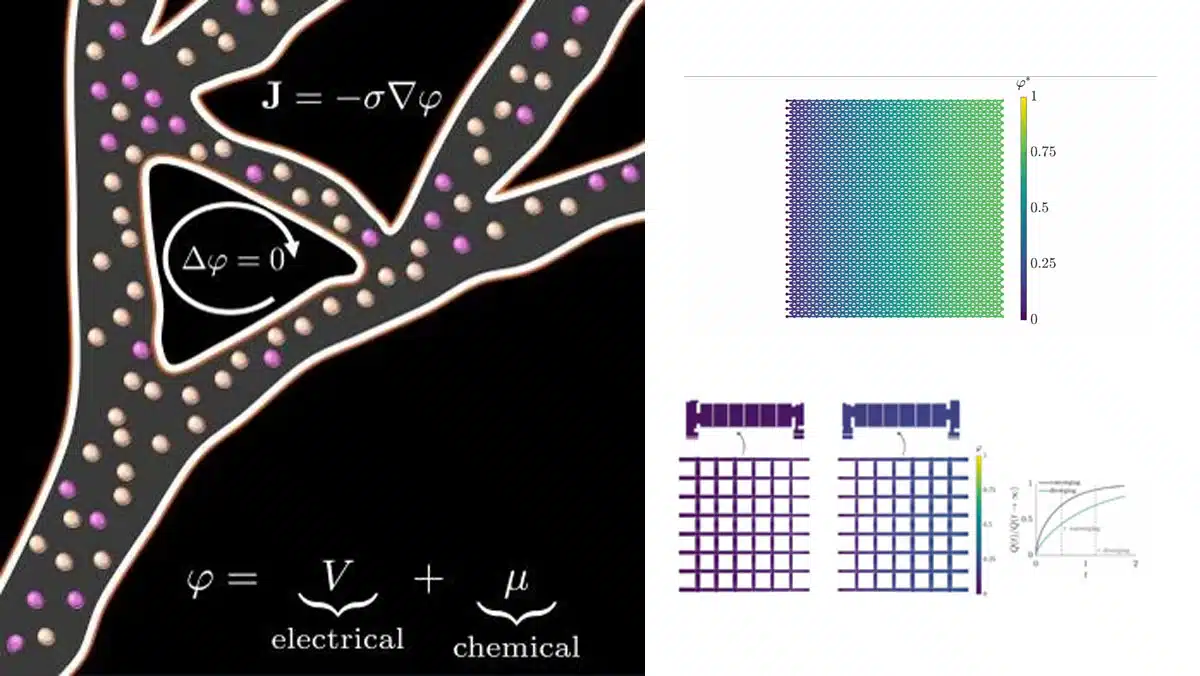
Modified Kirchhoff's law; how the rules have been changed at the intersections. Credit: University of Colorado

Modified Kirchhoff's law; how the rules have been changed at the intersections. Credit: University of Colorado

Published in the Proceedings of the National Academy of Science, Colorado University researchers in Ankur Gupta’s lab discovered how tiny charged particles, called ions, move within a complex network of minuscule pores. The breakthrough could lead to the development of more efficient energy storage devices, such as supercapacitors, said Gupta, an assistant professor of chemical and biological engineering. 

Imagine if your dead laptop or phone could charge in a minute or if an electric car could be fully powered in 10 minutes. While not possible yet, new research by a team of CU Boulder scientists could potentially lead to such advances. 

RelatedPosts

Littelfuse Introduces Automotive Current Sensors for EV Battery, Motor, and Safety Systems

Vishay Releases Fast Acting Thin Film Chip Fuses

Mechanical Testing of Tantalum Anodes to Predict Tantalum Capacitor Quality

“Given the critical role of energy in the future of the planet, I felt inspired to apply my chemical engineering knowledge to advancing energy storage devices,” Gupta said. “It felt like the topic was somewhat underexplored and as such, the perfect opportunity.”

Gupta explained that several chemical engineering techniques are used to study flow in porous materials such as oil reservoirs and water filtration, but they have not been fully utilized in some energy storage systems.

The discovery is significant not only for storing energy in vehicles and electronic devices but also for power grids, where fluctuating energy demand requires efficient storage to avoid waste during periods of low demand and to ensure rapid supply during high demand.  

Supercapacitors, energy storage devices that rely on ion accumulation in their pores, have rapid charging times and longer life spans compared to batteries. 

“The primary appeal of supercapacitors lies in their speed,” Gupta said. “So how can we make their charging and release of energy faster? By the more efficient movement of ions.”

Their findings modify Kirchhoff’s law, which has governed current flow in electrical circuits since 1845 and is a staple in high school students’ science classes. Unlike electrons, ions move due to both electric fields and diffusion, and the researchers determined that their movements at pore intersections are different from what was described in Kirchhoff’s law.

Prior to the study, ion movements were only described in the literature in one straight pore. Through this research, ion movement in a complex network of thousands of interconnected pores can be simulated and predicted in a few minutes.

“That’s the leap of the work,” Gupta said. “We found the missing link.”

Further link to the scientific paper:

A network model to predict ionic transport in porous materials;
https://doi.org/10.1073/pnas.2401656121


Related

Source: University of Colorado

Recent Posts

Mechanical Testing of Tantalum Anodes to Predict Tantalum Capacitor Quality

17.12.2025
19

Jianghai Offers Custom Bottom Cooled Screw Aluminum Capacitors

17.12.2025
27

TDK Unveils Vibration-Resistant Hybrid Polymer Aluminum Capacitors

15.12.2025
20

Samsungs Low ESL MLCCs to Power Next-Generation ADAS SoCs

10.12.2025
26

YAGEO Launches Hybrid Polymer Radial Capacitor for High-Reliability Automotive and Power Applications

10.12.2025
29

Digital Twin of a Tantalum Capacitor Anode: From Powder to Formation

8.12.2025
59

November 2025 Interconnect, Passives and Electromechanical Components Market Insights

4.12.2025
95

Skeleton Opens €220M Supercapacitor Leipzig Factory

3.12.2025
26

TAIYO YUDEN Extends Polymer Hybrid Aluminum Capacitors with Higher Ripple Current and Lower Profile

3.12.2025
35

Upcoming Events

Dec 19
12:00 - 14:00 EST

External Visual Inspection per MIL-STD-883 TM 2009

Jan 27
16:00 - 17:00 CET

Simplifying Vehicle Development with Automotive Ethernet and Zonal Smart Switch Technologies

Feb 24
16:00 - 17:00 CET

Designing Qi2 Wireless Power Systems: Practical Development and EMC Optimization

View Calendar

Popular Posts

  • Buck Converter Design and Calculation

    0 shares
    Share 0 Tweet 0
  • Boost Converter Design and Calculation

    0 shares
    Share 0 Tweet 0
  • LLC Resonant Converter Design and Calculation

    0 shares
    Share 0 Tweet 0
  • Flyback Converter Design and Calculation

    0 shares
    Share 0 Tweet 0
  • What Electronics Engineer Needs to Know About Passive Low Pass Filters

    0 shares
    Share 0 Tweet 0
  • Dual Active Bridge (DAB) Topology

    0 shares
    Share 0 Tweet 0
  • Ripple Current and its Effects on the Performance of Capacitors

    3 shares
    Share 3 Tweet 0
  • What is a Dielectric Constant and DF of Plastic Materials?

    4 shares
    Share 4 Tweet 0
  • MLCC and Ceramic Capacitors

    0 shares
    Share 0 Tweet 0
  • SEPIC Converter Design and Calculation

    0 shares
    Share 0 Tweet 0

Newsletter Subscription


Passive Components Blog

© EPCI - Leading Passive Components Educational and Information Site

  • Home
  • Privacy Policy
  • EPCI Membership & Advertisement
  • About

No Result
View All Result
  • Home
  • Knowledge Blog
  • PCNS

© EPCI - Leading Passive Components Educational and Information Site

This website uses cookies. By continuing to use this website you are giving consent to cookies being used. Visit our Privacy and Cookie Policy.
Go to mobile version