













Passive Components Blog
No Result
View All Result
  • Home
  • NewsFilter
    • All
    • Aerospace & Defence
    • Antenna
    • Applications
    • Automotive
    • Capacitors
    • Circuit Protection Devices
    • electro-mechanical news
    • Filters
    • Fuses
    • Inductors
    • Industrial
    • Integrated Passives
    • inter-connect news
    • Market & Supply Chain
    • Market Insights
    • Medical
    • Modelling and Simulation
    • New Materials & Supply
    • New Technologies
    • Non-linear Passives
    • Oscillators
    • Passive Sensors News
    • Resistors
    • RF & Microwave
    • Telecommunication
    • Weekly Digest

    binder Releases Tool‑Tightenable M12 Connectors for Improved Reliability

    Vishay Introduced Thin Film Submount Platform for Optical and RF Modules

    Murata Introduces Crystal and NTC Set for Automotive UWB Timing

    Kyocera Developed Multilayer Ceramic Core Substrate for AI Packages

    Modeling Fringing Field Losses in Inductors & Transformers

    YMIN Introduces Polymer Tantalum Capacitors for AI Server SSDs

    Littelfuse Expands High-Voltage TVS Diodes

    DigiKey Adds 31k New In‑Stock Parts in Q1 2026

    Miniaturization of Tantalum Capacitors: Structural Limit Under Constant Rating

    Trending Tags

    • Ripple Current
    • RF
    • Leakage Current
    • Tantalum vs Ceramic
    • Snubber
    • Low ESR
    • Feedthrough
    • Derating
    • Dielectric Constant
    • New Products
    • Market Reports
  • VideoFilter
    • All
    • Antenna videos
    • Capacitor videos
    • Circuit Protection Video
    • Filter videos
    • Fuse videos
    • Inductor videos
    • Inter-Connect Video
    • Non-linear passives videos
    • Oscillator videos
    • Passive sensors videos
    • Resistor videos

    Modeling Fringing Field Losses in Inductors & Transformers

    Why Power Inductors Use a Ferrite Core With an Air Gap

    Transformer-Based Power-Line Harvester Magnetic Design

    Thermal Modeling of Magnetics

    Standard vs Planar LLC transformers Comparison for Battery Chargers

    How Modern Tools Model Magnetic Components for Power Electronics

    Advanced Loss Modeling for Planar Magnetics in the Frenetic Planar Tool

    2026 Power Magnetics Design Trends: Flyback, DAB and Planar

    Enabling Software‑Defined Vehicle Architectures: Automotive Ethernet and Zonal Smart Power

    Trending Tags

    • Capacitors explained
    • Inductors explained
    • Resistors explained
    • Filters explained
    • Application Video Guidelines
    • EMC
    • New Products
    • Ripple Current
    • Simulation
    • Tantalum vs Ceramic
  • Knowledge Blog
  • DossiersNew
  • Suppliers
    • Who is Who
  • PCNS
    • PCNS 2025
    • PCNS 2023
    • PCNS 2021
    • PCNS 2019
    • PCNS 2017
  • Events
  • Home
  • NewsFilter
    • All
    • Aerospace & Defence
    • Antenna
    • Applications
    • Automotive
    • Capacitors
    • Circuit Protection Devices
    • electro-mechanical news
    • Filters
    • Fuses
    • Inductors
    • Industrial
    • Integrated Passives
    • inter-connect news
    • Market & Supply Chain
    • Market Insights
    • Medical
    • Modelling and Simulation
    • New Materials & Supply
    • New Technologies
    • Non-linear Passives
    • Oscillators
    • Passive Sensors News
    • Resistors
    • RF & Microwave
    • Telecommunication
    • Weekly Digest

    binder Releases Tool‑Tightenable M12 Connectors for Improved Reliability

    Vishay Introduced Thin Film Submount Platform for Optical and RF Modules

    Murata Introduces Crystal and NTC Set for Automotive UWB Timing

    Kyocera Developed Multilayer Ceramic Core Substrate for AI Packages

    Modeling Fringing Field Losses in Inductors & Transformers

    YMIN Introduces Polymer Tantalum Capacitors for AI Server SSDs

    Littelfuse Expands High-Voltage TVS Diodes

    DigiKey Adds 31k New In‑Stock Parts in Q1 2026

    Miniaturization of Tantalum Capacitors: Structural Limit Under Constant Rating

    Trending Tags

    • Ripple Current
    • RF
    • Leakage Current
    • Tantalum vs Ceramic
    • Snubber
    • Low ESR
    • Feedthrough
    • Derating
    • Dielectric Constant
    • New Products
    • Market Reports
  • VideoFilter
    • All
    • Antenna videos
    • Capacitor videos
    • Circuit Protection Video
    • Filter videos
    • Fuse videos
    • Inductor videos
    • Inter-Connect Video
    • Non-linear passives videos
    • Oscillator videos
    • Passive sensors videos
    • Resistor videos

    Modeling Fringing Field Losses in Inductors & Transformers

    Why Power Inductors Use a Ferrite Core With an Air Gap

    Transformer-Based Power-Line Harvester Magnetic Design

    Thermal Modeling of Magnetics

    Standard vs Planar LLC transformers Comparison for Battery Chargers

    How Modern Tools Model Magnetic Components for Power Electronics

    Advanced Loss Modeling for Planar Magnetics in the Frenetic Planar Tool

    2026 Power Magnetics Design Trends: Flyback, DAB and Planar

    Enabling Software‑Defined Vehicle Architectures: Automotive Ethernet and Zonal Smart Power

    Trending Tags

    • Capacitors explained
    • Inductors explained
    • Resistors explained
    • Filters explained
    • Application Video Guidelines
    • EMC
    • New Products
    • Ripple Current
    • Simulation
    • Tantalum vs Ceramic
  • Knowledge Blog
  • DossiersNew
  • Suppliers
    • Who is Who
  • PCNS
    • PCNS 2025
    • PCNS 2023
    • PCNS 2021
    • PCNS 2019
    • PCNS 2017
  • Events
No Result
View All Result
Passive Components Blog
No Result
View All Result

Vishay Introduced Thin Film Submount Platform for Optical and RF Modules

30.4.2026
Reading Time: 8 mins read
A A

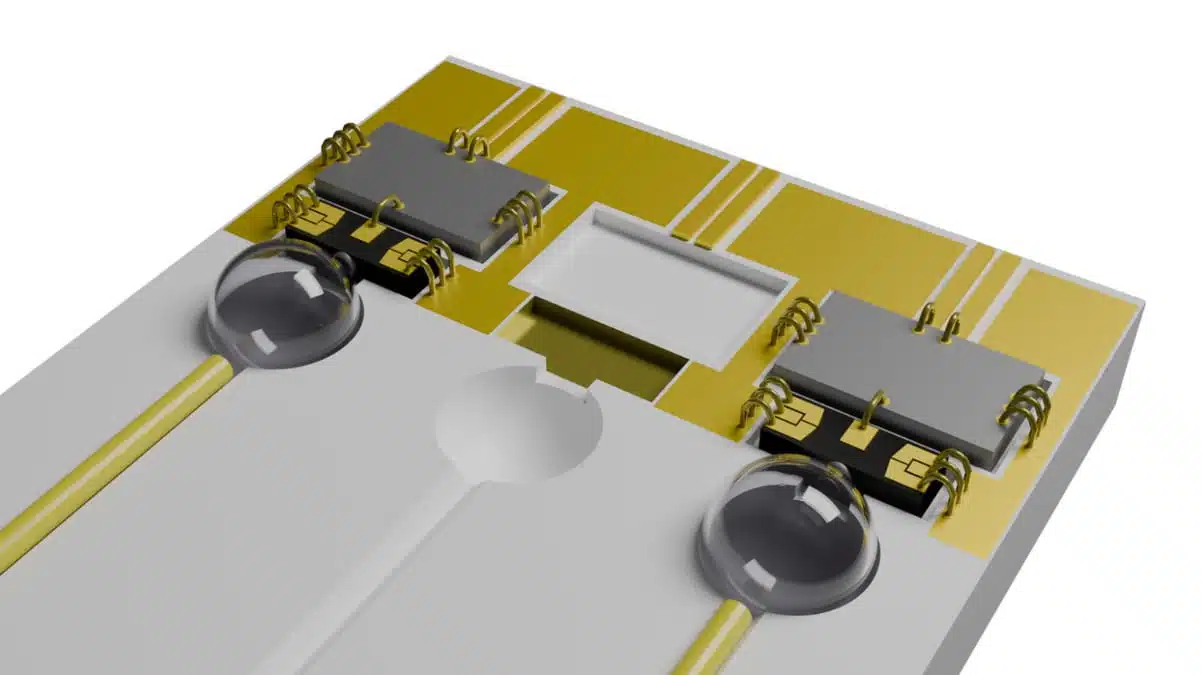
Vishay has introduced a thin film submount platform aimed at high speed optical transceivers, RF modules, and advanced electronic packaging where thermal management, alignment accuracy, and high frequency signal integrity are critical.

The new Vishay platform combines precision thin film passive structures with advanced ceramic substrates such as aluminum nitride to help engineers handle higher power densities and tighter packaging constraints in next‑generation systems.

RelatedPosts

binder Releases Tool‑Tightenable M12 Connectors for Improved Reliability

Murata Introduces Crystal and NTC Set for Automotive UWB Timing

Kyocera Developed Multilayer Ceramic Core Substrate for AI Packages

Introduction

Thin film submounts sit between active devices (for example laser diodes or RF ICs) and the main module or board, providing a mechanically stable, thermally efficient, and electrically optimized interface. Vishay’s new platform extends this concept by combining high thermal conductivity ceramics, precision thin film metallization, and customized machining to support demanding photonics and RF designs in data communications, defense, space, and high reliability industrial markets. According to Vishay, the platform is intended to ease design‑in for both quick‑turn prototyping and volume production.

Key features and benefits

Platform characteristics

  • High thermal conductivity aluminum nitride substrates for efficient heat spreading from high power die into the module structure.
  • Thin film metallization with low loss interconnects to support microwave and millimeter‑wave signal paths.
  • Precision machining of ceramic submounts for tight dimensional control and repeatable mechanical interfaces.
  • Support for integrated passive circuit elements (for example resistors or other thin film features) as part of the submount design.

Manufacturing and logistics

  • Quick‑turn prototyping capabilities combined with high volume production, allowing migration from early samples to series production on the same platform.
  • Production supported from three manufacturing locations, improving supply resilience and logistics planning for global programs.
  • Pre‑deposited AuSn or EPIG finishes available to streamline assembly flows and reduce the number of process steps at the customer side.

Benefits for system design

  • Improved thermal management at the device level, helping to keep junction temperatures under control in high power optical and RF components.
  • Enhanced high frequency performance thanks to low loss thin film interconnects and well‑controlled geometries that reduce parasitics.
  • Better precision alignment of optical elements or RF structures due to tight mechanical tolerances and custom machined features.
  • Reduced manufacturing complexity in final modules because critical interfaces and finishes are already engineered into the submount.

Typical applications

Vishay positions the thin film submount platform primarily for high speed data communications and other high performance modules that must balance power density, signal integrity, and mechanical robustness. Typical application areas include:

  • 800G, 1.6T, and 3.2T optical transceivers, where laser diodes and driver ICs must be cooled efficiently while maintaining precise optical alignment.
  • RF and microwave modules that require low loss transitions and controlled impedance routing at the package level.
  • Millimeter‑wave assemblies for high frequency communications and radar, where thin film structures help manage parasitics and line geometry.
  • Laser diode mounting in industrial, medical, and defense systems, where reliable thermal paths and stable mechanical support are critical.
  • Optical alignment structures in photonics modules, combining mechanical reference features with metallized pads for interconnect.
  • Hermetic packaging solutions and modules that combine wire bonding and SMT processes on a single submount.

Technical highlights

The press release focuses on the submount platform rather than listing fixed part numbers, emphasizing customization around a common thin film and ceramic technology stack. Key technical aspects include:

  • Use of advanced ceramic substrates such as aluminum nitride, selected for high thermal conductivity and good dimensional stability.
  • Precision deposition of passive circuit elements in thin film technology, enabling integrated resistive networks or controlled impedance features directly on the submount.
  • Thin film interconnects engineered for low loss performance at microwave and millimeter‑wave frequencies.
  • Custom geometries and metallization schemes to match specific die layouts, optical paths, or RF transitions.
  • Compatibility with pre‑deposited AuSn solder or EPIG metallization stacks to support different assembly and bonding strategies.

For specific thermal performance figures (for example thermal conductivity values, maximum power dissipation) and electrical parameters, designers should refer to the relevant manufacturer datasheets and application notes for the selected submount configuration according to the manufacturer datasheet.

Platform capabilities overview

AspectDescription
Substrate typeAdvanced ceramics, including aluminum nitride for high thermal performance
Interconnect technologyThin film metallization optimized for high frequency and low loss
Integrated functionsPassive circuit elements and custom routing on the submount
Surface finishesOptions such as pre‑deposited AuSn or EPIG for streamlined assembly
Mechanical customizationPrecision machining for tailored geometries and alignment features

Design flow snapshot

StepRole of the submount platform
Requirement definitionCapture power, frequency, alignment, and assembly constraints
Co‑design with VishayTranslate requirements into geometry, metallization, and finishes
PrototypingQuick‑turn sample builds verify electrical, thermal, and mechanical targets
QualificationTesting under application‑specific environmental conditions
Ramp to productionTransition to high volume at global manufacturing sites

Design‑in notes for engineers

Thermal management

  • Start from junction‑to‑case thermal targets for critical dies and allocate part of the thermal budget to the submount; aluminum nitride and optimized metallization can significantly lower thermal resistance compared to standard alumina structures.
  • Consider the entire thermal path from die attach through submount into the module baseplate or PCB, including solder or TIM layers, when specifying thicknesses and materials.

High frequency layout

  • For RF and millimeter‑wave designs, collaborate early on line impedance, transition geometry, and pad dimensions so that the thin film interconnect layout matches the surrounding PCB and package structures.
  • Use the submount to integrate short controlled impedance runs and critical transitions, reducing parasitics and improving repeatability versus discrete bond wire only solutions.

Opto‑mechanical alignment

  • When designing optical transceivers or laser modules, treat the submount as a key mechanical reference surface; precision machining allows slots, steps, or fiducials that define lens or fiber positions.
  • Specify tolerance requirements for coplanarity, thickness, and feature position to ensure that automated assembly and alignment processes can hit the required optical budgets.

Assembly and metallization choices

  • Select between AuSn solderable surfaces or EPIG finishes based on planned assembly processes (eutectic attach, solder reflow, wire bonding, flip‑chip, or SMT).
  • When combining wire bond and SMT on a single submount, define keep‑out regions, bond pad finishes, and solderable areas clearly to avoid process conflicts.

Reliability and qualification

  • For defense, space, and other high reliability applications, align submount material choices and finishes with the applicable standards and test regimes (temperature cycling, humidity, vibration, outgassing).
  • Validate that CTE (coefficient of thermal expansion) compatibility between die, submount, and carrier structure is sufficient to prevent stress‑related failures over lifetime.

Source

This article is based on information provided in a Vishay Intertechnology press release announcing the Specialty Thin Film thin film submount platform, complemented by related information from Vishay’s specialty thin film capability pages and landing pages.


References

  1. Vishay press release – Thin film submount platform
  2. Vishay Specialty Thin Film – main landing page
  3. Vishay STF miniaturization and precision integration
  4. Vishay STF complex assembly integration
  5. Vishay STF submount platform overview

Related

Recent Posts

binder Releases Tool‑Tightenable M12 Connectors for Improved Reliability

30.4.2026
1

Exxelia Introduces SMD High‑Voltage Mica Capacitors

28.4.2026
19

April 2026 Interconnect, Passives and Electromechanical Components Market Insights

22.4.2026
75

KYOCERA AVX Introduces Traction‑Grade DC Link Film Capacitors

21.4.2026
47

YAGEO Introduces High‑Current Y2/X1 Film Capacitors for Wide-bandgap Power Systems

17.4.2026
43

Amphenol Explanded Liquid Cooling Connectors for AI, ESS and EV Systems

17.4.2026
23

Hirose Introduced BGA connector for PCIe Gen6 for AI and Edge Computing

17.4.2026
14

YAGEO Introduces High Rel MLCCs Beyond MIL-Spec Limits

16.4.2026
58

Samsung Introduces Ultra-High-Voltage 1500 V MLCCs for xEV Powertrains

16.4.2026
30

Upcoming Events

May 5
16:00 - 17:00 CEST

Understanding and Selecting Capacitors – Fundamentals, Technologies and Latest Trends

May 7
17:00 - 18:00 CEST

From Grid to Motion: How Industrial Electrification is Redefining Power System Design

May 12
8:00 - 15:00 CEST

ESCC Space Splice connectors

View Calendar

Popular Posts

  • Buck Converter Design and Calculation

    0 shares
    Share 0 Tweet 0
  • Boost Converter Design and Calculation

    0 shares
    Share 0 Tweet 0
  • Flyback Converter Design and Calculation

    0 shares
    Share 0 Tweet 0
  • LLC Resonant Converter Design and Calculation

    0 shares
    Share 0 Tweet 0
  • MLCC and Ceramic Capacitors

    0 shares
    Share 0 Tweet 0
  • Dual Active Bridge (DAB) Topology

    0 shares
    Share 0 Tweet 0
  • What Electronics Engineer Needs to Know About Passive Low Pass Filters

    0 shares
    Share 0 Tweet 0
  • Capacitor Charging and Discharging

    0 shares
    Share 0 Tweet 0
  • MLCC Case Sizes Standards Explained

    0 shares
    Share 0 Tweet 0
  • Ripple Current and its Effects on the Performance of Capacitors

    3 shares
    Share 3 Tweet 0

Newsletter Subscription


Passive Components Blog

© EPCI - Leading Passive Components Educational and Information Site

  • Home
  • Privacy Policy
  • EPCI Membership & Advertisement
  • About

No Result
View All Result
  • Home
  • Knowledge Blog
  • PCNS

© EPCI - Leading Passive Components Educational and Information Site

This website uses cookies. By continuing to use this website you are giving consent to cookies being used. Visit our Privacy and Cookie Policy.
Go to mobile version