






Passive Components Blog
No Result
View All Result
  • Home
  • NewsFilter
    • All
    • Aerospace & Defence
    • Antenna
    • Applications
    • Automotive
    • Capacitors
    • Circuit Protection Devices
    • electro-mechanical news
    • Filters
    • Fuses
    • Inductors
    • Industrial
    • Integrated Passives
    • inter-connect news
    • Market & Supply Chain
    • Market Insights
    • Medical
    • Modelling and Simulation
    • New Materials & Supply
    • New Technologies
    • Non-linear Passives
    • Oscillators
    • Passive Sensors News
    • Resistors
    • RF & Microwave
    • Telecommunication
    • Weekly Digest

    Binder Extends NCC Circular Connectors for Harsh Environments

    Standard vs Planar LLC transformers Comparison for Battery Chargers

    Würth Elektronik and Grinn Launch Edge AI Cooperation

    Bourns Expanded Semi-Shielded Low Profile Automotive Power Inductor

    Peak Nano to Develop Fusion Grade High Energy Film Capacitors

    Murata New Vibration Sensor Targets High‑Frequency Predictive Maintenance

    Kyocera Releases 30fs Jitter Differential Clock Oscillator

    Panasonic Expands Automotive PP Film Capacitors Voltage Range

    Panasonic Extends Automotive Power Inductor Line

    Trending Tags

    • Ripple Current
    • RF
    • Leakage Current
    • Tantalum vs Ceramic
    • Snubber
    • Low ESR
    • Feedthrough
    • Derating
    • Dielectric Constant
    • New Products
    • Market Reports
  • VideoFilter
    • All
    • Antenna videos
    • Capacitor videos
    • Circuit Protection Video
    • Filter videos
    • Fuse videos
    • Inductor videos
    • Inter-Connect Video
    • Non-linear passives videos
    • Oscillator videos
    • Passive sensors videos
    • Resistor videos

    Standard vs Planar LLC transformers Comparison for Battery Chargers

    How Modern Tools Model Magnetic Components for Power Electronics

    Advanced Loss Modeling for Planar Magnetics in the Frenetic Planar Tool

    2026 Power Magnetics Design Trends: Flyback, DAB and Planar

    Enabling Software‑Defined Vehicle Architectures: Automotive Ethernet and Zonal Smart Power

    Calculating Resistance Value of a Flyback RC Snubber 

    One‑Pulse Characterization of Nonlinear Power Inductors

    Thermistor Linearization Challenges

    Coaxial Connectors and How to Connect with PCB

    Trending Tags

    • Capacitors explained
    • Inductors explained
    • Resistors explained
    • Filters explained
    • Application Video Guidelines
    • EMC
    • New Products
    • Ripple Current
    • Simulation
    • Tantalum vs Ceramic
  • Knowledge Blog
  • DossiersNew
  • Suppliers
    • Who is Who
  • PCNS
    • PCNS 2025
    • PCNS 2023
    • PCNS 2021
    • PCNS 2019
    • PCNS 2017
  • Events
  • Home
  • NewsFilter
    • All
    • Aerospace & Defence
    • Antenna
    • Applications
    • Automotive
    • Capacitors
    • Circuit Protection Devices
    • electro-mechanical news
    • Filters
    • Fuses
    • Inductors
    • Industrial
    • Integrated Passives
    • inter-connect news
    • Market & Supply Chain
    • Market Insights
    • Medical
    • Modelling and Simulation
    • New Materials & Supply
    • New Technologies
    • Non-linear Passives
    • Oscillators
    • Passive Sensors News
    • Resistors
    • RF & Microwave
    • Telecommunication
    • Weekly Digest

    Binder Extends NCC Circular Connectors for Harsh Environments

    Standard vs Planar LLC transformers Comparison for Battery Chargers

    Würth Elektronik and Grinn Launch Edge AI Cooperation

    Bourns Expanded Semi-Shielded Low Profile Automotive Power Inductor

    Peak Nano to Develop Fusion Grade High Energy Film Capacitors

    Murata New Vibration Sensor Targets High‑Frequency Predictive Maintenance

    Kyocera Releases 30fs Jitter Differential Clock Oscillator

    Panasonic Expands Automotive PP Film Capacitors Voltage Range

    Panasonic Extends Automotive Power Inductor Line

    Trending Tags

    • Ripple Current
    • RF
    • Leakage Current
    • Tantalum vs Ceramic
    • Snubber
    • Low ESR
    • Feedthrough
    • Derating
    • Dielectric Constant
    • New Products
    • Market Reports
  • VideoFilter
    • All
    • Antenna videos
    • Capacitor videos
    • Circuit Protection Video
    • Filter videos
    • Fuse videos
    • Inductor videos
    • Inter-Connect Video
    • Non-linear passives videos
    • Oscillator videos
    • Passive sensors videos
    • Resistor videos

    Standard vs Planar LLC transformers Comparison for Battery Chargers

    How Modern Tools Model Magnetic Components for Power Electronics

    Advanced Loss Modeling for Planar Magnetics in the Frenetic Planar Tool

    2026 Power Magnetics Design Trends: Flyback, DAB and Planar

    Enabling Software‑Defined Vehicle Architectures: Automotive Ethernet and Zonal Smart Power

    Calculating Resistance Value of a Flyback RC Snubber 

    One‑Pulse Characterization of Nonlinear Power Inductors

    Thermistor Linearization Challenges

    Coaxial Connectors and How to Connect with PCB

    Trending Tags

    • Capacitors explained
    • Inductors explained
    • Resistors explained
    • Filters explained
    • Application Video Guidelines
    • EMC
    • New Products
    • Ripple Current
    • Simulation
    • Tantalum vs Ceramic
  • Knowledge Blog
  • DossiersNew
  • Suppliers
    • Who is Who
  • PCNS
    • PCNS 2025
    • PCNS 2023
    • PCNS 2021
    • PCNS 2019
    • PCNS 2017
  • Events
No Result
View All Result
Passive Components Blog
No Result
View All Result

YAGEO Introduces Automotive Supercapacitors for Stable BMS in EVs

5.6.2025
Reading Time: 3 mins read
A A

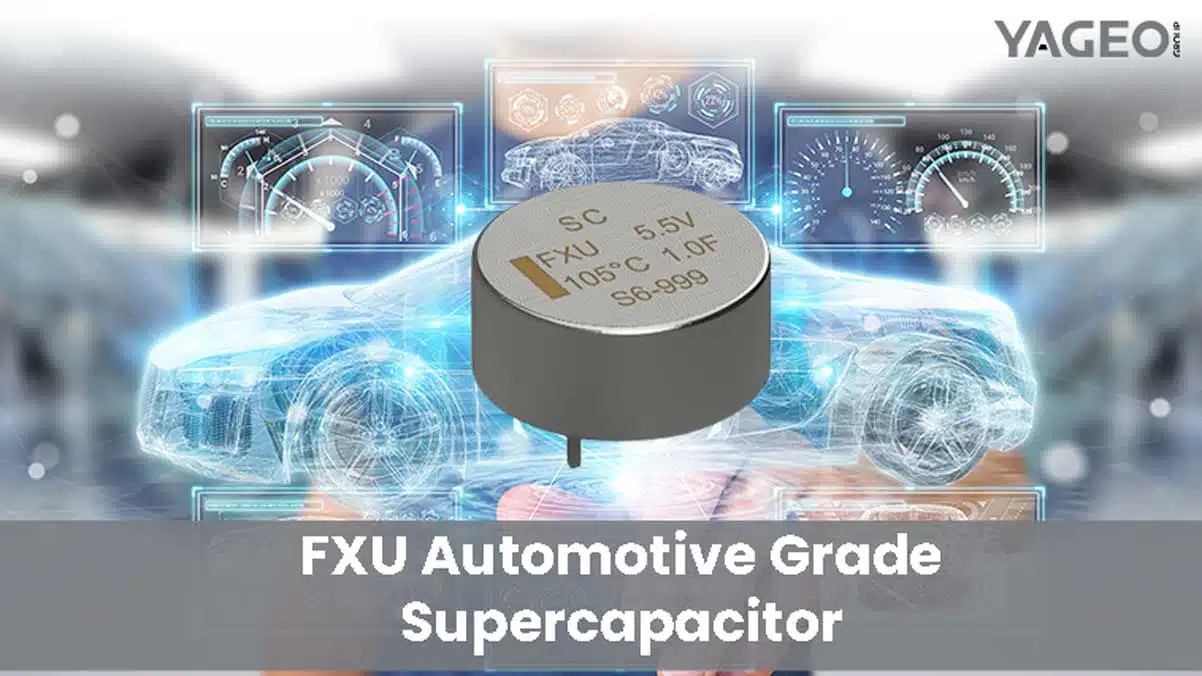
KEMET, YAGEO Group announces release of its latest advancement in energy storage technology—the FXU Series automotive supercapacitors.

Designed specifically for the rigorous demands of automotive applications, the FXU Series provides superior backup power solutions with a remarkable 1F capacitance, a rated voltage of 5.5V, and an operational lifespan of 1000 hours at temperatures up to 105ºC.

RelatedPosts

YAGEO Presents 3.6 kW LLC Transformer Platform

AI Servers Demand is Driving Tantalum Capacitor Price Hikes

YAGEO Extends Antenna Portfolio with Wi‑Fi 6E/7 and Tri‑band GNSS Solutions

Meeting the Challenges of Modern Automotive Environments

As vehicles become increasingly connected and autonomous, reliable system backup during power loss is critical. Traditional electrolytic capacitors and batteries often fail under extreme conditions due to high temperatures and humidity, leading to increased resistance and degraded performance. The FXU Series Supercapacitors address these challenges with advanced materials and design, ensuring long-term stability even in harsh environments.

Supporting the Rapid Growth of the Electric Vehicle (EV) Market

The booming EV sector demands robust energy solutions to manage complex systems like motor drives, battery management systems (BMS), and charging infrastructure. Supercapacitors play a pivotal role in maintaining system integrity, especially as backup power for Real Time Clocks (RTC) near the CPU, ensuring data preservation during power interruptions.

In automotive applications, system backup power is becoming increasingly critical during a power loss. The automotive environment, however, is extraordinarily harsh, with high temperatures, humidity, and vibration. Traditional aluminum electrolytic capacitors and batteries will dry out over time under high-temperature conditions, resulting in increased ESR series resistance and degradation of capacitance.

Specialized Supercapacitors can be used in these situations to free design engineers from the restrictions imposed by finite battery lifetimes. In addition, the supercapacitor’s benign open-circuit failure mode contrasts with typical short-circuit battery failures that may result in outgassing or ignition. 

As such, Supercapacitors are the most cost-effective alternative to small backup batteries and can store enough energy to provide backup for durations ranging from a few seconds to several days, depending on the type of load and current demand.
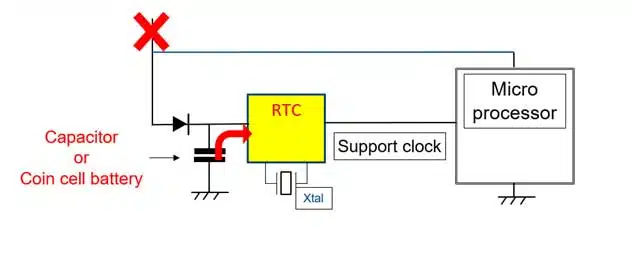
Schematic RTC backup solution with capacitor or battery

Advantages of the FXU Series Supercapacitors

  • High Temperature and Humidity Resistance: Reliable performance in extreme automotive conditions.
  • Extended Lifespan: Superior cycle life reduces maintenance costs compared to traditional batteries.
  • Safety and Reliability: Benign open-circuit failure mode minimizes risks associated with battery short circuits.
  • Cost-Effective: Eliminates the need for frequent battery replacements, offering long-term savings.

A Future-Ready Energy Solution

KEMET’s FXU Series Supercapacitors are engineered with cutting-edge aqueous electrolytes, providing the high voltage tolerance, durability, and environmental resilience necessary for next-generation vehicles and other high-reliability applications.


Related

Source: YAGEO

Recent Posts

Bourns Expanded Semi-Shielded Low Profile Automotive Power Inductor

12.3.2026
9

Peak Nano to Develop Fusion Grade High Energy Film Capacitors

11.3.2026
24

Panasonic Expands Automotive PP Film Capacitors Voltage Range

9.3.2026
22

Panasonic Extends Automotive Power Inductor Line

9.3.2026
24

February 2026 Interconnect, Passives and Electromechanical Components Market Insights

9.3.2026
47

YAGEO Presents 3.6 kW LLC Transformer Platform

6.3.2026
46

Empower Extends Embedded Silicon Capacitors for AI

6.3.2026
42

Resistor Technology Dossier

4.3.2026
41

AI Servers Demand is Driving Tantalum Capacitor Price Hikes

5.3.2026
110

Upcoming Events

Mar 19
13:00 - 14:00 CDT

Smart Consideration of Inductor Thermal Performance

Mar 21
All day

PSMA Capacitor Workshop 2026

Apr 21
16:00 - 17:00 CEST

Heatsink Solutions: Thermal Management in electronic devices

View Calendar

Popular Posts

  • Buck Converter Design and Calculation

    0 shares
    Share 0 Tweet 0
  • Boost Converter Design and Calculation

    0 shares
    Share 0 Tweet 0
  • Flyback Converter Design and Calculation

    0 shares
    Share 0 Tweet 0
  • LLC Resonant Converter Design and Calculation

    0 shares
    Share 0 Tweet 0
  • MLCC Manufacturers Consider Price Increase as AI Demand Outpaces Supply

    0 shares
    Share 0 Tweet 0
  • Dual Active Bridge (DAB) Topology

    0 shares
    Share 0 Tweet 0
  • Ripple Current and its Effects on the Performance of Capacitors

    3 shares
    Share 3 Tweet 0
  • MLCC and Ceramic Capacitors

    0 shares
    Share 0 Tweet 0
  • MLCC Case Sizes Standards Explained

    0 shares
    Share 0 Tweet 0
  • What is a Dielectric Constant and DF of Plastic Materials?

    4 shares
    Share 4 Tweet 0

Newsletter Subscription


Passive Components Blog

© EPCI - Leading Passive Components Educational and Information Site

  • Home
  • Privacy Policy
  • EPCI Membership & Advertisement
  • About

No Result
View All Result
  • Home
  • Knowledge Blog
  • PCNS

© EPCI - Leading Passive Components Educational and Information Site

This website uses cookies. By continuing to use this website you are giving consent to cookies being used. Visit our Privacy and Cookie Policy.
Go to mobile version