






Passive Components Blog
No Result
View All Result
  • Home
  • NewsFilter
    • All
    • Aerospace & Defence
    • Antenna
    • Applications
    • Automotive
    • Capacitors
    • Circuit Protection Devices
    • electro-mechanical news
    • Filters
    • Fuses
    • Inductors
    • Industrial
    • Integrated Passives
    • inter-connect news
    • Market & Supply Chain
    • Market Insights
    • Medical
    • Modelling and Simulation
    • New Materials & Supply
    • New Technologies
    • Non-linear Passives
    • Oscillators
    • Passive Sensors News
    • Resistors
    • RF & Microwave
    • Telecommunication
    • Weekly Digest

    Molex Completes Acquisition of Smiths Interconnect, Expanding Portfolio of High-Reliability Connectivity Solutions

    APEC 2026 Power Electronics Trends and Implications for Passive Components

    Hydra Enhances Film Capacitor Robustness by Novel Gel Filler

    Würth Elektronik Releases Heat Sinks for TO and IC packages

    Würth Elektronik ICS to Acquire MRS Electronic and Expand Vehicle Electronics Portfolio

    Indias ECMS Wave Brings New Capacity For Passive Components Manufacturing in India

    Binder Introduces Triangular Moulding for M16 and M12 Cable Connectors

    Panasonic High Precision Chip Resistors Bridge Gap Between Thin and Thick Technology

    Wk 13 Electronics Supply Chain Digest

    Trending Tags

    • Ripple Current
    • RF
    • Leakage Current
    • Tantalum vs Ceramic
    • Snubber
    • Low ESR
    • Feedthrough
    • Derating
    • Dielectric Constant
    • New Products
    • Market Reports
  • VideoFilter
    • All
    • Antenna videos
    • Capacitor videos
    • Circuit Protection Video
    • Filter videos
    • Fuse videos
    • Inductor videos
    • Inter-Connect Video
    • Non-linear passives videos
    • Oscillator videos
    • Passive sensors videos
    • Resistor videos

    Transformer-Based Power-Line Harvester Magnetic Design

    Thermal Modeling of Magnetics

    Standard vs Planar LLC transformers Comparison for Battery Chargers

    How Modern Tools Model Magnetic Components for Power Electronics

    Advanced Loss Modeling for Planar Magnetics in the Frenetic Planar Tool

    2026 Power Magnetics Design Trends: Flyback, DAB and Planar

    Enabling Software‑Defined Vehicle Architectures: Automotive Ethernet and Zonal Smart Power

    Calculating Resistance Value of a Flyback RC Snubber 

    One‑Pulse Characterization of Nonlinear Power Inductors

    Trending Tags

    • Capacitors explained
    • Inductors explained
    • Resistors explained
    • Filters explained
    • Application Video Guidelines
    • EMC
    • New Products
    • Ripple Current
    • Simulation
    • Tantalum vs Ceramic
  • Knowledge Blog
  • DossiersNew
  • Suppliers
    • Who is Who
  • PCNS
    • PCNS 2025
    • PCNS 2023
    • PCNS 2021
    • PCNS 2019
    • PCNS 2017
  • Events
  • Home
  • NewsFilter
    • All
    • Aerospace & Defence
    • Antenna
    • Applications
    • Automotive
    • Capacitors
    • Circuit Protection Devices
    • electro-mechanical news
    • Filters
    • Fuses
    • Inductors
    • Industrial
    • Integrated Passives
    • inter-connect news
    • Market & Supply Chain
    • Market Insights
    • Medical
    • Modelling and Simulation
    • New Materials & Supply
    • New Technologies
    • Non-linear Passives
    • Oscillators
    • Passive Sensors News
    • Resistors
    • RF & Microwave
    • Telecommunication
    • Weekly Digest

    Molex Completes Acquisition of Smiths Interconnect, Expanding Portfolio of High-Reliability Connectivity Solutions

    APEC 2026 Power Electronics Trends and Implications for Passive Components

    Hydra Enhances Film Capacitor Robustness by Novel Gel Filler

    Würth Elektronik Releases Heat Sinks for TO and IC packages

    Würth Elektronik ICS to Acquire MRS Electronic and Expand Vehicle Electronics Portfolio

    Indias ECMS Wave Brings New Capacity For Passive Components Manufacturing in India

    Binder Introduces Triangular Moulding for M16 and M12 Cable Connectors

    Panasonic High Precision Chip Resistors Bridge Gap Between Thin and Thick Technology

    Wk 13 Electronics Supply Chain Digest

    Trending Tags

    • Ripple Current
    • RF
    • Leakage Current
    • Tantalum vs Ceramic
    • Snubber
    • Low ESR
    • Feedthrough
    • Derating
    • Dielectric Constant
    • New Products
    • Market Reports
  • VideoFilter
    • All
    • Antenna videos
    • Capacitor videos
    • Circuit Protection Video
    • Filter videos
    • Fuse videos
    • Inductor videos
    • Inter-Connect Video
    • Non-linear passives videos
    • Oscillator videos
    • Passive sensors videos
    • Resistor videos

    Transformer-Based Power-Line Harvester Magnetic Design

    Thermal Modeling of Magnetics

    Standard vs Planar LLC transformers Comparison for Battery Chargers

    How Modern Tools Model Magnetic Components for Power Electronics

    Advanced Loss Modeling for Planar Magnetics in the Frenetic Planar Tool

    2026 Power Magnetics Design Trends: Flyback, DAB and Planar

    Enabling Software‑Defined Vehicle Architectures: Automotive Ethernet and Zonal Smart Power

    Calculating Resistance Value of a Flyback RC Snubber 

    One‑Pulse Characterization of Nonlinear Power Inductors

    Trending Tags

    • Capacitors explained
    • Inductors explained
    • Resistors explained
    • Filters explained
    • Application Video Guidelines
    • EMC
    • New Products
    • Ripple Current
    • Simulation
    • Tantalum vs Ceramic
  • Knowledge Blog
  • DossiersNew
  • Suppliers
    • Who is Who
  • PCNS
    • PCNS 2025
    • PCNS 2023
    • PCNS 2021
    • PCNS 2019
    • PCNS 2017
  • Events
No Result
View All Result
Passive Components Blog
No Result
View All Result

Best Practices for Cable Management in High-Speed and High-Density Systems

4.9.2025
Reading Time: 5 mins read
A A
source: Samtec

source: Samtec

This paper based on post Samtec’s Cable Management in High‑Data‑Rate Applications offering a cbrief framework for engineers, technicians, and system integrators about the best practices for cable management in high-speed and high-density systems.

In the era of high‑data‑rate (HDR) and high‑speed electronic systems, cable management has evolved from a tidy‑up exercise into a critical engineering discipline. The way cables are routed, bent, twisted, labeled, and secured can have a measurable effect on signal integrity, thermal performance, and long‑term reliability.

RelatedPosts

Samtec AcceleRate Slim ARC6 Cable Assemblies with New Signaling Options

Samtec ANSI/VITA 90 Connectors: Rugged Small Form Factor Standard

Key Interconnect Technologies for 2025

1. Introduction

As data rates climb into the tens and hundreds of gigabits per second, the physical layer becomes increasingly sensitive to mechanical handling. A poorly routed cable can introduce impedance discontinuities, skew, and crosstalk, while also restricting airflow and creating serviceability headaches. In high‑density environments such as AI accelerators, hyperscale data centers, and advanced test systems, the stakes are even higher: downtime is costly, and rework is disruptive.

Cable management, therefore, is not just about aesthetics. It is about preserving the electrical and mechanical integrity of the interconnect over the system’s operational life. This requires a disciplined approach that considers bend radius, twist control, strain relief, slack allocation, labeling, and structured routing — all while anticipating future maintenance and upgrades.

2. Bend and Twist: The Mechanics of Signal Integrity

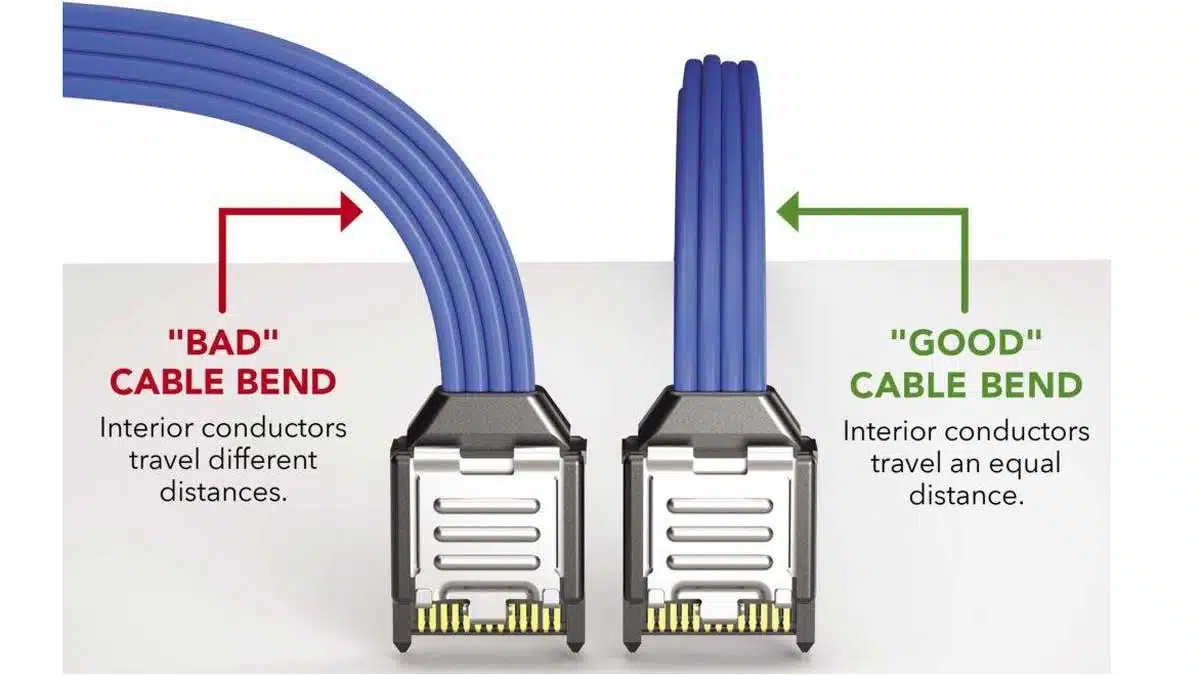
One of the most overlooked aspects of cable management is the geometry of bends and twists. Samtec’s guidance highlights a subtle but critical distinction between a “good” bend and a “bad” bend. In a good bend, the conductors inside the cable remain at consistent lengths, preserving timing alignment. In a bad bend — often caused by bending along the connector’s length — the inner and outer conductors travel different distances, introducing skew and degrading high‑speed performance.

The recommended practice is to first bend the cable in the optimal direction, then apply a controlled 90‑degree twist along the connector length. This twist should not be forced; instead, it should follow the cable’s natural lay, which is easier to achieve when cables are loosely bundled rather than tightly bound. Over‑tight bundling not only resists proper twisting but also increases mechanical stress and can deform the dielectric, altering impedance.

3. Stress Relief at Cable Exits

The point where a cable exits a connector is a mechanical weak spot. Sharp bends here can transfer stress directly to the termination, leading to intermittent faults or outright failure. Allowing cables to splay outward before routing them into a bend distributes mechanical load more evenly. This technique also enables tighter bend radii without exceeding the cable’s minimum bend specification, which is especially important for twinax and coax assemblies used in HDR applications.

4. Slack Management: Balancing Flexibility and Order

Slack is both a necessity and a liability. Too little slack, and cables may be strained during servicing or thermal expansion; too much, and they form loops that obstruct airflow and create clutter. The goal is to provide just enough slack to allow for connector mating/demating and minor re‑routing, while keeping the overall path taut and predictable. Horizontal and vertical cable managers, Velcro straps (preferred over zip ties for reusability and reduced compression), and modular routing panels can help maintain this balance.

5. Identification and Documentation

In complex systems, the time spent tracing an unmarked cable can dwarf the time spent replacing it. Industry standards such as ANSI/TIA‑606 recommend labeling both ends of every cable with durable, legible identifiers. Color coding can further speed identification, especially when differentiating between copper, fiber, and power lines. Beyond physical labels, maintaining an up‑to‑date cable map — ideally in a DCIM (Data Center Infrastructure Management) system or CAD model — ensures that changes are tracked and future work is streamlined.

6. Structured Routing and Pathways

Structured cabling principles apply equally inside a chassis as they do in a data hall. Separating power and data cables reduces electromagnetic interference (EMI) risk, while dedicated trays, raceways, and runways prevent accidental damage. For high‑density racks, it is wise to design pathways with 30–40% spare capacity to accommodate future expansion without re‑routing existing cables. Fiber optic cables, in particular, require careful routing to avoid microbending losses.

7. Thermal and Electrical Performance Considerations

Cable bundles can act as thermal insulators, trapping heat around active components. This is especially problematic in systems with high‑power GPUs, FPGAs, or CPUs, where every degree of cooling margin matters. Over‑bundling can also increase insertion loss by compressing the dielectric. Engineers should route cables to preserve airflow channels and, where possible, use perforated managers or open‑frame trays to promote convection.

From an electrical standpoint, improper bends or excessive mechanical stress can alter the characteristic impedance of high‑speed cables, leading to reflections and jitter. In HDR systems, even small impedance mismatches can cause measurable eye‑diagram closure, reducing link margin.

8. Standards and Compliance

Adhering to established standards ensures consistency and interoperability. ANSI/TIA‑606 provides a framework for labeling and administration, while TIA‑942 outlines best practices for data center cabling infrastructure. For product‑specific handling, always consult the manufacturer’s datasheets for parameters such as static and dynamic bend radius, flex life, and mating cycles.

9. Summary and Conclusion

  • Consistent conductor lengths: Good bends keep all conductors on equal-length paths; bad bends force different path lengths and add skew.
  • Bend plane vs connector plane: Good bends occur after the exit, in a single plane; bad bends “wrap” along the connector length.
  • Bend-then-twist sequencing: Bend first, then apply a controlled 90° twist along the cable’s axis—not at the exit or through the connector.
  • Stress relief at exits: Allow cable fan-out before routing; do not force tight turns immediately at the termination.
  • Minimum bend radius: Honor datasheet values; when unspecified, use conservative planning like ≥10×OD for copper and fiber-safe radii for optics.
  • Bundle pressure: Use low-compression ties (hook-and-loop), avoid over-tightening that deforms dielectric or jacket.

Cable management in high‑speed and high‑density environments is a convergence of mechanical engineering, electrical design, and operational foresight. By applying disciplined bend and twist techniques, relieving stress at exits, managing slack intelligently, labeling rigorously, and routing with structure, engineers can safeguard performance and reliability while simplifying maintenance. As data rates continue to climb, these practices will only grow in importance — transforming cable management from an afterthought into a core design consideration.

Related

Source: Samtec

Recent Posts

Molex Completes Acquisition of Smiths Interconnect, Expanding Portfolio of High-Reliability Connectivity Solutions

1.4.2026
4

Binder Introduces Triangular Moulding for M16 and M12 Cable Connectors

31.3.2026
3

Bourns Expands its Modular Contacts for Power-Dense Systems

19.3.2026
11

Samtec AcceleRate Slim ARC6 Cable Assemblies with New Signaling Options

19.3.2026
14

Hirose Electric to Establish Automotive Connector Plant in India

19.3.2026
21

Binder Extends NCC Circular Connectors for Harsh Environments

13.3.2026
7

Samtec ANSI/VITA 90 Connectors: Rugged Small Form Factor Standard

5.3.2026
18

Molex Extends Cardinal Multi‑Port Coax Assemblies to 145 GHz for AI and 6G Test

25.2.2026
19

Earthing Systems and IEC Classification Explained

25.3.2026
238

Upcoming Events

Apr 8
17:00 - 18:00 CEST

Trade Secrets of the Flyback Converter

Apr 21
16:00 - 17:00 CEST

Heatsink Solutions: Thermal Management in electronic devices

May 5
16:00 - 17:00 CEST

Understanding and Selecting Capacitors – Fundamentals, Technologies and Latest Trends

View Calendar

Popular Posts

  • Buck Converter Design and Calculation

    0 shares
    Share 0 Tweet 0
  • Boost Converter Design and Calculation

    0 shares
    Share 0 Tweet 0
  • Flyback Converter Design and Calculation

    0 shares
    Share 0 Tweet 0
  • LLC Resonant Converter Design and Calculation

    0 shares
    Share 0 Tweet 0
  • Dual Active Bridge (DAB) Topology

    0 shares
    Share 0 Tweet 0
  • MLCC and Ceramic Capacitors

    0 shares
    Share 0 Tweet 0
  • Ripple Current and its Effects on the Performance of Capacitors

    3 shares
    Share 3 Tweet 0
  • MLCC Case Sizes Standards Explained

    0 shares
    Share 0 Tweet 0
  • Capacitor Charging and Discharging

    0 shares
    Share 0 Tweet 0
  • Plastic Materials Dielectric Constant and DF

    4 shares
    Share 4 Tweet 0

Newsletter Subscription


Passive Components Blog

© EPCI - Leading Passive Components Educational and Information Site

  • Home
  • Privacy Policy
  • EPCI Membership & Advertisement
  • About

No Result
View All Result
  • Home
  • Knowledge Blog
  • PCNS

© EPCI - Leading Passive Components Educational and Information Site

This website uses cookies. By continuing to use this website you are giving consent to cookies being used. Visit our Privacy and Cookie Policy.
Go to mobile version