












Passive Components Blog
No Result
View All Result
  • Home
  • NewsFilter
    • All
    • Aerospace & Defence
    • Antenna
    • Applications
    • Automotive
    • Capacitors
    • Circuit Protection Devices
    • electro-mechanical news
    • Filters
    • Fuses
    • Inductors
    • Industrial
    • Integrated Passives
    • inter-connect news
    • Market & Supply Chain
    • Market Insights
    • Medical
    • Modelling and Simulation
    • New Materials & Supply
    • New Technologies
    • Non-linear Passives
    • Oscillators
    • Passive Sensors News
    • Resistors
    • RF & Microwave
    • Telecommunication
    • Weekly Digest

    Vishay Releases High‑Current Radial Inductors up to 209 A

    May 2026 Interconnect, Passives and Electromechanical Components Market Insights

    Passive Components Enable Safe and Reliable ADAS Architectures

    Current Sense Transformer Datasheet and Design‑in Guide

    Designing a USB Type‑C Flyback Planar Transformer with Frenetic’s Planar Tool

    YMIN Releases Square Supercapacitors for AI Server Power System

    Exxelia Extends Temperature Range of its PP Film Capacitors to 140C

    How Long-Term Storage Causes Aging in Electronic Components

    Nichicon Presents Self-Charging LTO Board for Maintenance-Free IoT Nodes

    Trending Tags

    • Ripple Current
    • RF
    • Leakage Current
    • Tantalum vs Ceramic
    • Snubber
    • Low ESR
    • Feedthrough
    • Derating
    • Dielectric Constant
    • New Products
    • Market Reports
  • VideoFilter
    • All
    • Antenna videos
    • Capacitor videos
    • Circuit Protection Video
    • Filter videos
    • Fuse videos
    • Inductor videos
    • Inter-Connect Video
    • Non-linear passives videos
    • Oscillator videos
    • Passive sensors videos
    • Resistor videos

    Current Sense Transformer Datasheet and Design‑in Guide

    Designing a USB Type‑C Flyback Planar Transformer with Frenetic’s Planar Tool

    Magnetics Design in High‑Frequency GaN Converters

    Qi2 Wireless Charging: Inductors, Capacitors and EMC Filters

    Two‑capacitor paradox explained for engineers

    Capacitances of Nonlinear MLCCs: What Datasheets Don’t Tell You

    Tapped Inductor Buck Converter Fundamentals

    Planar vs Conventional Transformer: When it Make Sense

    Modeling Fringing Field Losses in Inductors & Transformers

    Trending Tags

    • Capacitors explained
    • Inductors explained
    • Resistors explained
    • Filters explained
    • Application Video Guidelines
    • EMC
    • New Products
    • Ripple Current
    • Simulation
    • Tantalum vs Ceramic
  • Knowledge Blog
  • DossiersNew
  • Suppliers
    • Who is Who
  • PCNS
    • PCNS 2025
    • PCNS 2023
    • PCNS 2021
    • PCNS 2019
    • PCNS 2017
  • Events
  • Home
  • NewsFilter
    • All
    • Aerospace & Defence
    • Antenna
    • Applications
    • Automotive
    • Capacitors
    • Circuit Protection Devices
    • electro-mechanical news
    • Filters
    • Fuses
    • Inductors
    • Industrial
    • Integrated Passives
    • inter-connect news
    • Market & Supply Chain
    • Market Insights
    • Medical
    • Modelling and Simulation
    • New Materials & Supply
    • New Technologies
    • Non-linear Passives
    • Oscillators
    • Passive Sensors News
    • Resistors
    • RF & Microwave
    • Telecommunication
    • Weekly Digest

    Vishay Releases High‑Current Radial Inductors up to 209 A

    May 2026 Interconnect, Passives and Electromechanical Components Market Insights

    Passive Components Enable Safe and Reliable ADAS Architectures

    Current Sense Transformer Datasheet and Design‑in Guide

    Designing a USB Type‑C Flyback Planar Transformer with Frenetic’s Planar Tool

    YMIN Releases Square Supercapacitors for AI Server Power System

    Exxelia Extends Temperature Range of its PP Film Capacitors to 140C

    How Long-Term Storage Causes Aging in Electronic Components

    Nichicon Presents Self-Charging LTO Board for Maintenance-Free IoT Nodes

    Trending Tags

    • Ripple Current
    • RF
    • Leakage Current
    • Tantalum vs Ceramic
    • Snubber
    • Low ESR
    • Feedthrough
    • Derating
    • Dielectric Constant
    • New Products
    • Market Reports
  • VideoFilter
    • All
    • Antenna videos
    • Capacitor videos
    • Circuit Protection Video
    • Filter videos
    • Fuse videos
    • Inductor videos
    • Inter-Connect Video
    • Non-linear passives videos
    • Oscillator videos
    • Passive sensors videos
    • Resistor videos

    Current Sense Transformer Datasheet and Design‑in Guide

    Designing a USB Type‑C Flyback Planar Transformer with Frenetic’s Planar Tool

    Magnetics Design in High‑Frequency GaN Converters

    Qi2 Wireless Charging: Inductors, Capacitors and EMC Filters

    Two‑capacitor paradox explained for engineers

    Capacitances of Nonlinear MLCCs: What Datasheets Don’t Tell You

    Tapped Inductor Buck Converter Fundamentals

    Planar vs Conventional Transformer: When it Make Sense

    Modeling Fringing Field Losses in Inductors & Transformers

    Trending Tags

    • Capacitors explained
    • Inductors explained
    • Resistors explained
    • Filters explained
    • Application Video Guidelines
    • EMC
    • New Products
    • Ripple Current
    • Simulation
    • Tantalum vs Ceramic
  • Knowledge Blog
  • DossiersNew
  • Suppliers
    • Who is Who
  • PCNS
    • PCNS 2025
    • PCNS 2023
    • PCNS 2021
    • PCNS 2019
    • PCNS 2017
  • Events
No Result
View All Result
Passive Components Blog
No Result
View All Result

Bourns Trimming Potentiometer Supports Hearing Aids

15.5.2024
Reading Time: 3 mins read
A A

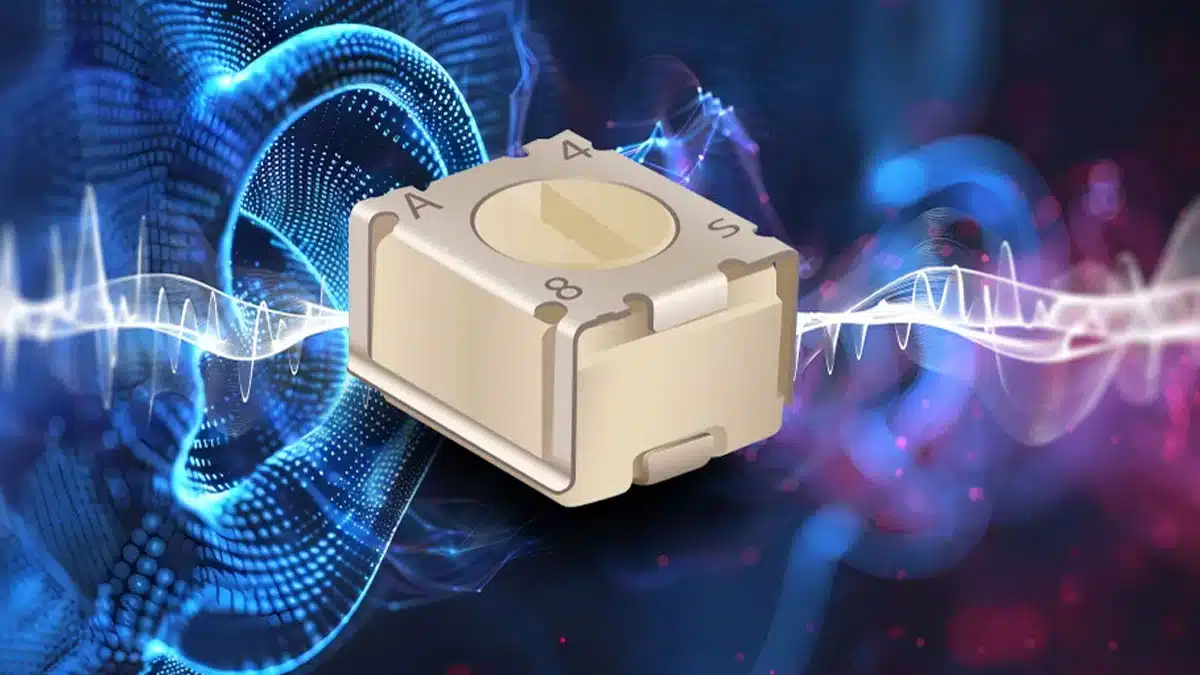
Bourns is helping developers make significant strides in this area with its Trimpot® trimming potentiometers. And, specifically for hearing aid designs, it is the Trimpot® Model 3312 which offers a unique blend of precision, durability, and flexibility that enables substantial improvements in device performance.

In the rapidly evolving landscape of non-critical medical devices, hearing aids stand out as an essential device that helps millions of people worldwide enhance their quality of life through better hearing.

RelatedPosts

Bourns Releases Compact High Current Shielded Power Inductors

Bourns Expands its Modular Contacts for Power-Dense Systems

Bourns Expanded Semi-Shielded Low Profile Automotive Power Inductor

A hearing aid works by converting acoustic energy into electrical signals, which are then amplified and sent back to the ear as acoustic energy. This process involves several key components:

  • Microphone: Converts sound to electrical energy.
  • Amplifier: Increases the strength of the electrical signal while maintaining sound quality.
  • Volume Control: Manages the overall signal strength after amplification.
  • Receiver (Earphone): Converts the amplified electrical energy back into sound.
  • Battery: Provides the necessary power for the device.

Each component must function flawlessly to ensure optimal performance, and this is where Bourns® Model 3312 comes into play.

Fine-Tuning Hearing Aid Functionality

Authentic Bourns® Model 3312 Trimpot® trimming potentiometers are engineered to fine-tune the functionality of hearing aids, providing precise control over their various operational aspects. Here’s how they contribute:

Adjustability

The very small Trimpot® device can be used within the internal controls of the hearing aid, allowing audiologists to make fine adjustments to tailor the hearing aid’s performance to individual needs. This includes adjusting the volume control as a rheostat where it is able to modify the current through the microphone and amplifier. The result is the sound output is enhanced without distortion.

Durability and Reliability

Designed to endure the rigorous assembly process of hearing aids, which includes soldering of the microphone, amplifier, and volume control followed by a wash process, the Model 3312 device is sealed to withstand these conditions. This makes it particularly suitable for smaller, intricate hearing aid designs such as Behind-The-Ear (BTE), In-The-Ear (ITE), and In-The-Canal (ITC).

The Model 3312 offers:

  • Standard Resistance Range: 10 Ω to 2 MΩ.
  • Adjustability: Features a voltage divider with ±0.4% adjustability and a rheostat with ±0.8%.
  • Environmental Resilience: Operates effectively across a temperature range of -55 °C to +125 °C and is resistant to shock and vibration, ensuring consistent performance in various conditions.

Conclusion

With the integration of Bourns® Model 3312 Trimpot trimming potentiometers in hearing aids, users can expect a significant enhancement in sound quality and device reliability. These components not only extend the functional capabilities of hearing aids but also ensure they can be finely adjusted to meet the specific needs of the user, making them an indispensable tool to further enhance modern hearing aid technology.

Related

Source: Bourns

Recent Posts

May 2026 Interconnect, Passives and Electromechanical Components Market Insights

29.5.2026
28

Passive Components Enable Safe and Reliable ADAS Architectures

28.5.2026
38

How Long-Term Storage Causes Aging in Electronic Components

26.5.2026
68

Stackpole Introduces High‑Voltage Low VCR Chip Resistors

25.5.2026
27

Industrial Passive Components Markets and Technologies 2026

21.5.2026
133

Automotive Passive Components Technology Dossier

21.5.2026
72

Using Stress–Strain Curves to Diagnose Tantalum Powders for Capacitors

20.5.2026
37

ESA SPCD 26 Registration Open

15.5.2026
34

Stackpole Releases Automotive Wide‑Termination Resistors

14.5.2026
34

Upcoming Events

Jun 2
16:00 - 17:00 CEST

Calculation, Simulation and Measurement of 800V EMC Filters

Jun 16
16:00 - 17:00 CEST

EMC with EMC – EMC‑compliant design with electromechanical connectors

View Calendar

Popular Posts

  • Buck Converter Design and Calculation

    0 shares
    Share 0 Tweet 0
  • Boost Converter Design and Calculation

    0 shares
    Share 0 Tweet 0
  • Flyback Converter Design and Calculation

    0 shares
    Share 0 Tweet 0
  • MLCC and Ceramic Capacitors

    0 shares
    Share 0 Tweet 0
  • LLC Resonant Converter Design and Calculation

    0 shares
    Share 0 Tweet 0
  • Capacitor Charging and Discharging

    0 shares
    Share 0 Tweet 0
  • What Electronics Engineer Needs to Know About Passive Low Pass Filters

    0 shares
    Share 0 Tweet 0
  • Dual Active Bridge (DAB) Topology

    0 shares
    Share 0 Tweet 0
  • Ripple Current and its Effects on the Performance of Capacitors

    3 shares
    Share 3 Tweet 0
  • Samsung Electro-Mechanics Releases High-Capacitance MLCCs for AI Server Applications

    0 shares
    Share 0 Tweet 0

Newsletter Subscription


Passive Components Blog

© EPCI - Leading Passive Components Educational and Information Site

  • Home
  • Privacy Policy
  • EPCI Membership & Advertisement
  • About

No Result
View All Result
  • Home
  • Knowledge Blog
  • Dossiers
  • PCNS

© EPCI - Leading Passive Components Educational and Information Site

This website uses cookies. By continuing to use this website you are giving consent to cookies being used. Visit our Privacy and Cookie Policy.
Go to mobile version