





Passive Components Blog
No Result
View All Result
  • Home
  • News
    • All
    • Aerospace & Defence
    • Antenna
    • Applications
    • Automotive
    • Capacitors
    • Circuit Protection Devices
    • electro-mechanical news
    • Filters
    • Fuses
    • Inductors
    • Industrial
    • Integrated Passives
    • inter-connect news
    • Market & Supply Chain
    • Market Insights
    • Medical
    • Modelling and Simulation
    • New Materials & Supply
    • New Technologies
    • Non-linear Passives
    • Oscillators
    • Passive Sensors News
    • Resistors
    • RF & Microwave
    • Telecommunication
    • Weekly Digest

    Modelithics Qorvo GaN Library v26.5.11 Adds 200 W RF Transistor Model

    Bourns Releases Low-Profile Incremental Ring Encoder Targets Compact Industrial HMIs

    Wk 34 Electronics Supply Chain Digest

    August 2026 Interconnect, Passives and Electromechanical Components Market Insights

    AEM Introduced High-Power Fuses for Compact Automotive and Industrial Overcurrent Protection

    Knowles Cornell Dubilier 105C Flatpack Aluminum Electrolytic Capacitors Target Low-Profile High-Density Power Designs

    Vishay Thin Film Chip Resistors Combine up to 50 GHz Operation with High Power Density

    Samsung Electro-Mechanics Secures KRW 1.0722 Trillion AI Server MLCC Supply Contract

    KYOCERA AVX Adds 0201 C0G RF MLCCs to KGU Ultra-Low-ESR Capacitor Series

    Trending Tags

    • Ripple Current
    • RF
    • Leakage Current
    • Tantalum vs Ceramic
    • Snubber
    • Low ESR
    • Feedthrough
    • Derating
    • Dielectric Constant
    • New Products
    • Market Reports
  • Knowledge Blog
  • Dossiers
    • AI Hardware Dossier
    • Automotive Dossier
    • Industrial Robotics Dossier
    • Power Converter Dossier
    • Capacitor Dossier
    • Resistor Dossier
    • Inductor Dossier
    • Circuit Protection Dossier
  • Suppliers
    • Who is Who
  • PCNS
    • PCNS 2025
    • PCNS 2023
    • PCNS 2021
    • PCNS 2019
    • PCNS 2017
  • Events
  • Home
  • News
    • All
    • Aerospace & Defence
    • Antenna
    • Applications
    • Automotive
    • Capacitors
    • Circuit Protection Devices
    • electro-mechanical news
    • Filters
    • Fuses
    • Inductors
    • Industrial
    • Integrated Passives
    • inter-connect news
    • Market & Supply Chain
    • Market Insights
    • Medical
    • Modelling and Simulation
    • New Materials & Supply
    • New Technologies
    • Non-linear Passives
    • Oscillators
    • Passive Sensors News
    • Resistors
    • RF & Microwave
    • Telecommunication
    • Weekly Digest

    Modelithics Qorvo GaN Library v26.5.11 Adds 200 W RF Transistor Model

    Bourns Releases Low-Profile Incremental Ring Encoder Targets Compact Industrial HMIs

    Wk 34 Electronics Supply Chain Digest

    August 2026 Interconnect, Passives and Electromechanical Components Market Insights

    AEM Introduced High-Power Fuses for Compact Automotive and Industrial Overcurrent Protection

    Knowles Cornell Dubilier 105C Flatpack Aluminum Electrolytic Capacitors Target Low-Profile High-Density Power Designs

    Vishay Thin Film Chip Resistors Combine up to 50 GHz Operation with High Power Density

    Samsung Electro-Mechanics Secures KRW 1.0722 Trillion AI Server MLCC Supply Contract

    KYOCERA AVX Adds 0201 C0G RF MLCCs to KGU Ultra-Low-ESR Capacitor Series

    Trending Tags

    • Ripple Current
    • RF
    • Leakage Current
    • Tantalum vs Ceramic
    • Snubber
    • Low ESR
    • Feedthrough
    • Derating
    • Dielectric Constant
    • New Products
    • Market Reports
  • Knowledge Blog
  • Dossiers
    • AI Hardware Dossier
    • Automotive Dossier
    • Industrial Robotics Dossier
    • Power Converter Dossier
    • Capacitor Dossier
    • Resistor Dossier
    • Inductor Dossier
    • Circuit Protection Dossier
  • Suppliers
    • Who is Who
  • PCNS
    • PCNS 2025
    • PCNS 2023
    • PCNS 2021
    • PCNS 2019
    • PCNS 2017
  • Events
No Result
View All Result
Passive Components Blog
No Result
View All Result

Bourns Releases Low-Profile Incremental Ring Encoder Targets Compact Industrial HMIs

7.9.2026
Reading Time: 6 mins read
A A

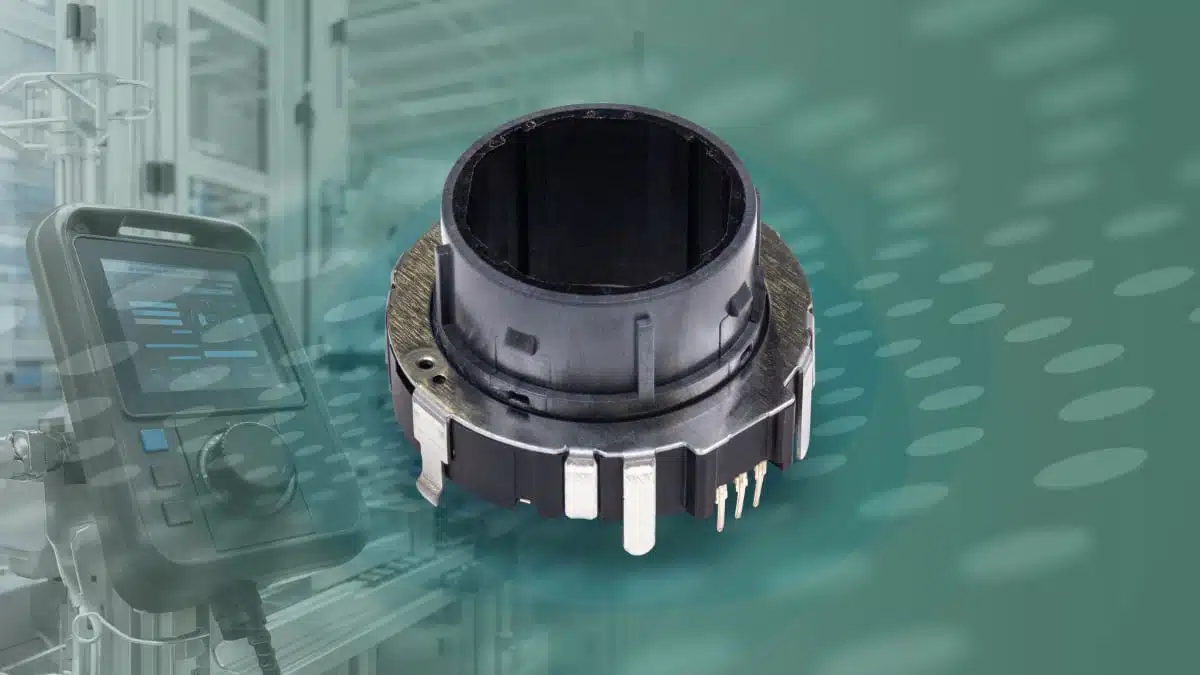
Bourns has introduced the Model PER40, a 22 mm low-profile incremental ring encoder for human-machine interfaces where panel depth, tactile control and reliable digital position sensing must be balanced.

The mechanical encoder combines continuous rotation, detent feedback and a 2-phase quadrature output for industrial controls, instruments and compact appliance interfaces.

RelatedPosts

Bourns Copper-Electrode MOV Series Targets High-Energy Line Surge Protection

Bourns Expands 12 mm SMD Incremental Encoder with Shaft-Length Options for Compact HMI Controls

Bourns UT-A Wirewound Power Resistors Target High-Temperature and Pulse-Load Applications

Key features and benefits

  • 22 mm ring-style, low-profile construction supports compact front-panel and control-interface designs where available installation height is limited.
  • 2-phase quadrature output enables a microcontroller or embedded controller to determine incremental movement and rotation direction from the phase relationship of the two output signals.
  • 15 pulses per revolution provide incremental control resolution, while 30 detents per revolution give the operator a tactile step approximately every 12 degrees of rotation.
  • Continuous 360-degree electrical and mechanical travel allows knob-like adjustment without an end stop, which is useful for menu navigation, parameter selection and repeated setpoint changes.
  • 3.3 VDC to 5 VDC operation supports direct integration with common low-voltage digital-control platforms.
  • 30,000-cycle rotational life is specified for equipment subject to frequent operator interaction.
  • RoHS compliance supports use in products designed around applicable environmental material restrictions.

Technical highlights

ParameterBourns Model PER40 specification
Encoder typeIncremental mechanical ring encoder
Ring diameter22 mm
Output2-phase quadrature code
Rated voltage3.3 VDC to 5 VDC
Contact rating0.3 mA to 1 mA
Resolution15 pulses per 360-degree rotation
Tactile feedback30 detents per revolution
Electrical travelContinuous
Mechanical angleContinuous 360 degrees
Sliding bounce3 ms maximum
Operating and storage temperature-40 °C to +85 °C
Insulation resistance100 Mohm minimum at 250 VDC
Dielectric strength300 VAC for 1 minute at sea level
Ingress-protection ratingIP40
Rotational life30,000 cycles

The PER40 is a contacting encoder, so its output is intended for low-level control signalling rather than for switching load current. The specified sliding bounce of up to 3 ms means firmware should apply suitable debouncing before accepting a change of state as a valid incremental movement.

Typical applications

Bourns identifies the PER40 for the following interface applications:

  • Industrial automation control panels
  • Industrial tools
  • Test and measurement equipment
  • Home-appliance instrumentation

The combination of ring geometry and continuous rotation can suit compact operator panels where a conventional protruding shaft control would add unwanted depth or mechanical exposure. Its tactile detents provide immediate operator feedback without requiring the user to look continuously at a display.

Application fit

Design requirementHow the PER40 fits
Compact front panelThe 22 mm low-profile ring format is intended to help reduce panel height and mechanical depth
Menu navigation or setpoint adjustmentQuadrature output enables directional incremental input to a digital controller
Tactile operator controlThirty detents per revolution provide distinct mechanical indexing points
Repeated manual adjustmentContinuous rotation avoids mechanical end stops during repetitive navigation
Industrial ambient conditionsThe specified -40 °C to +85 °C operating range supports a broad industrial temperature envelope
Protected-enclosure useIP40 indicates protection against solid objects larger than 1 mm, but not against water ingress

Design-in notes for engineers

  • Decode both quadrature phases. A controller should sample both encoder outputs so that it can distinguish clockwise from counter-clockwise movement and apply the intended count multiplier in firmware.
  • Implement switch debouncing. The maximum 3 ms sliding-bounce specification should be accommodated in firmware or hardware filtering. Validate the selected debounce interval against the actual interaction speed and the required user-interface responsiveness.
  • Respect the low contact-current range. The stated 0.3 mA to 1 mA contact rating makes the device appropriate for logic-level sensing; designers should not assume it is suitable for direct switching of LEDs, relays or other loads.
  • Review mechanical integration early. Confirm panel cut-out, mounting, ring accessibility, adjacent-control clearance and the required tactile operating force according to the manufacturer datasheet.
  • Consider environmental sealing at system level. The IP40 rating does not provide water protection. Equipment exposed to washdown, condensation, outdoor weather or conductive dust may require additional front-panel sealing or a different encoder technology.
  • Verify the expected duty profile. The 30,000-cycle rotational-life rating should be compared with the anticipated number of user adjustments over the equipment service life, including commissioning and maintenance use.

Further reading

  • Potentiometers, Encoder, Rheostats and Trimmers
  • Bourns Expands 12 mm SMD Incremental Encoder with Shaft-Length Options for Compact HMI Controls
  • Bourns Unveils High Reliability Compact Micro Encoders
  • Passive Components for Industrial Automation and Robotics (Dossier Report 08/26)

Source

This article is based on the Bourns press release covering the Model PER40 low-profile incremental ring encoder. Engineers should consult the current manufacturer datasheet and associated documentation for final component qualification, mechanical integration and design release.

References

  1. Bourns press release: Low-Profile Incremental Ring Encoder for Space-Constrained Human-Machine Interfaces
  2. Bourns Model PER40 product page
  3. Bourns Model PER40 datasheet

Related

Recent Posts

August 2026 Interconnect, Passives and Electromechanical Components Market Insights

4.9.2026
24

AEM Introduced High-Power Fuses for Compact Automotive and Industrial Overcurrent Protection

4.9.2026
6

Knowles Cornell Dubilier 105C Flatpack Aluminum Electrolytic Capacitors Target Low-Profile High-Density Power Designs

4.9.2026
24

Vishay Thin Film Chip Resistors Combine up to 50 GHz Operation with High Power Density

3.9.2026
10

Vishay Extends High-Current Common-Mode Chokes with 30 A EMI Filtering up to 150 °C

3.9.2026
20

Bourns Copper-Electrode MOV Series Targets High-Energy Line Surge Protection

1.9.2026
13

Bourns Expands 12 mm SMD Incremental Encoder with Shaft-Length Options for Compact HMI Controls

1.9.2026
10

Bourns UT-A Wirewound Power Resistors Target High-Temperature and Pulse-Load Applications

31.8.2026
22

Filter Capacitors in Electric Vehicles: Knowles Safety MLCCs for BMS and Isolated DC/DC Converters

28.8.2026
44

Upcoming Events

Sep 10
11:00 - 12:00 CEST

Equipment models and model strategies for Space Missions

Sep 16
17:00 - 18:00 CEST

Designing a 5 kW, 800 V-to-50 V PSFB Converter for Next-Generation Data Centers

Sep 29
16:00 - 17:00 CEST

Cybersecurity 2026

View Calendar

Popular Posts

  • Buck Converter Design and Calculation

    0 shares
    Share 0 Tweet 0
  • LLC Resonant Converter Design and Calculation

    0 shares
    Share 0 Tweet 0
  • Boost Converter Design and Calculation

    0 shares
    Share 0 Tweet 0
  • Earthing Systems and IEC Classification Explained

    0 shares
    Share 0 Tweet 0
  • Flyback Converter Design and Calculation

    0 shares
    Share 0 Tweet 0
  • MLCC and Ceramic Capacitors

    0 shares
    Share 0 Tweet 0
  • Capacitor Charging and Discharging

    0 shares
    Share 0 Tweet 0
  • Audio Capacitors: Choosing Capacitors for Crossover Circuits

    0 shares
    Share 0 Tweet 0
  • Resistor Symbols

    0 shares
    Share 0 Tweet 0
  • Thermistors Basics, NTC and PTC Thermistors

    0 shares
    Share 0 Tweet 0

Newsletter Subscription


Passive Components Blog

© 2015–2026
All rights reserved

  • Home
  • Privacy Policy
  • EPCI Membership & Advertisement
  • About

No Result
View All Result
  • Home
  • Knowledge Blog
  • Dossiers
  • PCNS

© 2015–2026
All rights reserved