







Artificial intelligence could reshape passive-component demand well beyond the current data-center build-out, extending into connected devices, humanoid robots, and new infrastructure.
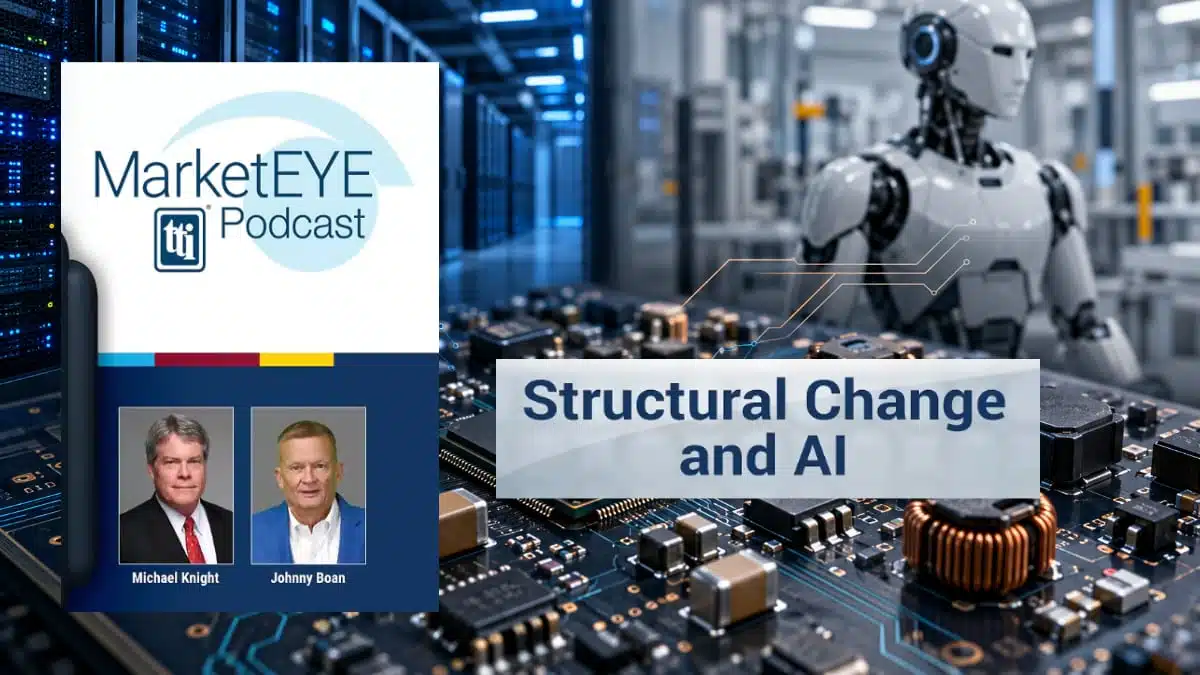
In the first MarketEYE podcast, TTI’s Michael Knight and YAGEO Group’s Johnny Boan examine that possibility through a supply-chain lens: whether AI represents a lasting change in electronics demand, and what could constrain its deployment.
Why structural change matters for passive components
Michael Knight, Corporate Senior Vice President of Strategy at TTI, and Johnny Boan, Executive Vice President of Sales and Marketing at YAGEO Group, frame AI as a potential structural change rather than simply another electronics upcycle.
Their distinction concerns how technology creates demand. A cyclical recovery increases activity within established markets. A structural change alters how people use technology, enabling applications and product categories that expand the underlying market for electronics.
The discussion draws parallels with the transition from vacuum tubes to transistors, the spread of personal computing and the internet, and the migration of computing into smartphones. The useful connection is not a fixed historical sequence or component-count relationship. It is the way an enabling technology can create reasons to build—and buy—new electronic systems.
Knight describes AI as a general-purpose technology: a foundation for many applications rather than a single end product. For passive-component suppliers, that distinction broadens the opportunity from components installed in AI infrastructure to components used throughout an increasingly AI-enabled hardware ecosystem.
This is the speakers’ industry outlook, not a quantified forecast of capacitor, resistor, or inductor demand.
Long-term growth does not eliminate supply-chain cycles
Both participants argue that AI has lasting significance. Neither suggests that this would make the component market immune to overcapacity, ordering errors, or inventory corrections.
Boan explicitly identifies several ways the supply chain can become unbalanced:
- Manufacturers may invest in too much capacity.
- Capacity may be added for the wrong component mix.
- Distributors, electronics manufacturing services providers, and customers may order too much of one product and too little of another.
- Short-term supply and demand can diverge even while the underlying technology continues to develop.
The distinction matters for purchasing and capacity planning. A positive long-term application outlook does not establish the timing, volume, or product mix of near-term orders.
Knight raises a related concern: technology demand may accelerate faster than the supply chain’s planning and capital-investment processes. In his interpretation, incremental capacity expansion could constrain the deployment of new systems.
Boan approaches the same issue from the supplier side. Customer demand must ultimately be supported by investment in operations and technology.
Taken together, their arguments describe a coordination problem. Demand expectations, manufacturing capability, and actual customer deployment must progress together; enthusiasm for an application cannot substitute for that alignment.
AI deployment depends on infrastructure, power, and access
Boan organizes the AI ecosystem around three interdependent elements:
| Element | Role in the discussion | Potential deployment constraint |
|---|---|---|
| Computing infrastructure | Data centers and the systems being built by large cloud operators | Hardware must be available and installed |
| Electrical power | Energy required to operate that infrastructure | Installed servers cannot deliver useful capacity without power |
| User interface | Devices and interfaces through which people access AI capabilities | Computing resources must connect to practical user applications |
This framework shifts attention away from processor availability alone.
A data-center project can have computing hardware without sufficient electrical power. Equally, infrastructure investment needs applications and interfaces that allow customers to use the resulting capability. Boan raises more capable phones and laptops as possibilities to consider, rather than establishing that every AI application requires a new endpoint device.
For passive-component businesses, the editorial implication is to track these demand channels separately. Data-center construction, power-infrastructure development, and endpoint-device introductions should not automatically be treated as synchronized purchasing cycles.
Power is a deployment constraint, not a solved problem
Knight identifies electrical power as a gating factor for AI infrastructure. He discusses interest in data centers securing their own power sources, alongside a possible future mix of solar, nuclear fission, and fusion.
These remarks are strategic observations and expectations. The episode does not provide a verified energy-development model, a defined generation architecture, or evidence supporting a specific fusion-commercialization timetable.
Similarly, a grid-connection waiting-time estimate mentioned in the conversation is not accompanied by an identifiable underlying source or a defined geographic scope. It should not be used as a universal project-planning assumption.
The central point is narrower and more useful: computing deployment depends on power becoming available, not merely on servers being manufactured.
Readers seeking circuit-level background can explore passive components and interconnects for AI systems. That engineering context is separate from the podcast’s market assessment.
Humanoid robots provide a concrete component-content example
Humanoid robotics produces the episode’s most tangible example of potential component demand.
Boan describes visiting an unnamed customer developing an unreleased robot. The base unit contained more than 1,000 component positions that YAGEO could potentially supply across its capacitor, resistor, inductor, and sensor offerings.
The boundaries of that example are important:
- It concerns one customer platform.
- It refers to the robot’s base unit as described by Boan, not a documented whole-system bill of materials.
- It includes sensors as well as passive components.
- It does not identify a breakdown by component category.
- It does not establish that YAGEO had secured every eligible position.
- It provides no production volume, component value, or shipment schedule.
Consequently, “more than 1,000” should not be presented as a standard passive-component count for humanoid robots or converted into a market-revenue estimate.
Its significance is qualitative: a new application can contain many component opportunities before it reaches commercial production.
Why the speakers connect robotics with AI
Boan’s interest centers on robots that assist people with varied tasks rather than perform only a fixed industrial operation. He discusses possibilities such as household work, gardening assistance, and support for older people.
Knight connects that vision with the convergence of several technologies:
- Motors and actuators with lower power requirements.
- Low-power electronics.
- AI embedded within the robot.
- Low-power communications connecting robots with other systems.
The argument is that progress in these areas could make a more adaptable physical product possible. The episode does not demonstrate a robot’s operating performance, establish affordability, or validate its suitability for care-related tasks.
For component planning, the opportunity therefore remains platform-specific. The reported component count is evidence of one design’s content, not proof of a standardized architecture or a predictable adoption curve.
Edge AI could broaden the hardware opportunity
Knight also anticipates a replacement cycle as AI becomes embedded in everyday devices. He expects this to support new products and additional companies entering the electronics ecosystem.
This extends the discussion beyond centralized computing. In his outlook, demand could emerge through both large infrastructure programs and a wider population of smaller hardware developers.
The transcript does not quantify that replacement cycle. It also does not establish how much processing would occur locally, how much would remain remote, or which device categories would change first.
For engineers and purchasing teams, the useful distinction is between an application gaining AI functionality and a product requiring a substantially different bill of materials. Those are questions to resolve at platform level, not assumptions to derive from the AI label alone.
Space commercialization is a longer-horizon scenario
The conversation moves from robotics to the commercialization and industrialization of space. Knight discusses possible future applications including space-based data centers, power generation, manufacturing, and resource extraction.
These are exploratory scenarios, not announced programs with defined component requirements.
Boan’s contribution emphasizes his impressions of privately developed launch infrastructure and his expectation that commercial competition can support further development. Neither speaker provides a component-level demand model for the space applications discussed.
For an electronics-industry reader, this section is best treated as horizon scanning. It identifies possible future markets without establishing their timing, scale, technical feasibility, or contribution to passive-component sales.
Planning notes for engineers and purchasing professionals
The following points are editorial guidance drawn from the discussion’s planning implications, rather than design requirements supplied by the speakers:
- Separate long-term market direction from near-term purchasing commitments. Structural growth can coexist with inventory corrections and misplaced capacity.
- Track deployment milestones, not just project announcements. Distinguish planned infrastructure, installed hardware, available power, and operational systems.
- Forecast by component family and customer platform. A broad AI-growth narrative does not reveal the required capacitor, resistor, inductor, or sensor mix.
- Keep prototype content separate from production demand. A component-rich development platform is not a volume order.
- Distinguish eligible component positions from awarded business. The robot example describes parts a supplier could supply, not a disclosed sourcing award.
- Request platform-specific evidence before extrapolating. Relevant inputs include the actual bill of materials, design maturity, sourcing status, production schedule, and intended build volume.
- Do not derive electrical specifications from this episode. Component ratings and validation requirements must come from the application design and verified product documentation.
For deeper engineering treatment of these applications, the Industrial Robotics Dossier provides a separate route into component-level design and selection.
Disclaimer of the discussion
MarketEYE’s opening episode is an executive technology and market conversation, not a component-design tutorial or a measured market study.
It does not supply:
- A passive-component market-size forecast or category-level growth model.
- A documented AI-server or humanoid-robot bill of materials.
- Capacitor dielectric selections, inductor core materials, or resistor specifications.
- Converter topologies, operating voltages, switching frequencies, or efficiency measurements.
- Thermal, EMI, reliability, or qualification test results.
- Evidence that every application discussed will reach commercial scale.
The participants also represent companies that supply and distribute electronic components. Their experience informs the discussion, but their confidence in future demand should remain identifiable as an industry perspective rather than independent confirmation of market outcomes.
Conclusion
Knight and Boan present AI as an enabling technology whose hardware consequences could extend from data centers into endpoint devices and robotics. Their most useful distinction is between the durability of a technology transition and the uneven purchasing cycles that can occur within it.
For passive-component businesses, the practical response is disciplined, application-level planning: follow where hardware is being designed, determine which component positions are real, and connect production expectations to infrastructure readiness. The opportunity may be broad, but the demand evidence still needs to be specific.
Further reading
- Murata Publishes Power Delivery Guide for AI Servers
- Passive Components for Power Converters Dossier
- Single Pair Ethernet for Humanoid Robot In-Robot Networks
Source
Adapted from the first episode of TTI’s MarketEYE podcast, featuring Michael Knight of TTI and Johnny Boan of YAGEO Group, published on October 2, 2026. The article treats forward-looking statements as the participants’ opinions and distinguishes editorial planning guidance from source-reported examples. No figures or screenshots are proposed.
References
- Original podcast and transcript: YouTube MarketEYE: Structural Change and AI (Ep. 1).
- Link to TTI Market Eye Podcasts with access to Apple, Spotify podcast platforms: https://www.tti.com/content/ttiinc/en/resources/podcasts.html