













Passive Components Blog
No Result
View All Result
  • Home
  • NewsFilter
    • All
    • Aerospace & Defence
    • Antenna
    • Applications
    • Automotive
    • Capacitors
    • Circuit Protection Devices
    • electro-mechanical news
    • Filters
    • Fuses
    • Inductors
    • Industrial
    • Integrated Passives
    • inter-connect news
    • Market & Supply Chain
    • Market Insights
    • Medical
    • Modelling and Simulation
    • New Materials & Supply
    • New Technologies
    • Non-linear Passives
    • Oscillators
    • Passive Sensors News
    • Resistors
    • RF & Microwave
    • Telecommunication
    • Weekly Digest

    Smiths Interconnect invests £2m in Costa Rica electronics plant

    Kyocera Offers Small SAW Filters for IoT RF Modules

    Bourns Unveils High Volt GDT for High‑Energy Surge Protection

    TDK Releases DC Link Aluminum Capacitors for EV On‑Board Chargers

    Capacitech C-Link Supercapacitors for AI Data Center Voltage Spikes Mitigation

    Wk 8 Electronics Supply Chain Digest

    Modelithics Library for MATLAB: Measurement-Based Models for Microwave and RF Passive Components

    Bourns Extends Multilayer Chip Inductors Offer for RF and Wireless Designs

    Researchers developed a polymer capacitor by combining two cheap, commercially available plastics. The new polymer capacitor makes use of the transparent material — pictured here, with vintage Penn State athletic marks visible through it — to store four times the energy and withstand significantly more heat.  Credit: Penn State

    Penn State Demonstrated Polymer Alloy Capacitor Film with 4× Energy Density up to 250C

    Trending Tags

    • Ripple Current
    • RF
    • Leakage Current
    • Tantalum vs Ceramic
    • Snubber
    • Low ESR
    • Feedthrough
    • Derating
    • Dielectric Constant
    • New Products
    • Market Reports
  • VideoFilter
    • All
    • Antenna videos
    • Capacitor videos
    • Circuit Protection Video
    • Filter videos
    • Fuse videos
    • Inductor videos
    • Inter-Connect Video
    • Non-linear passives videos
    • Oscillator videos
    • Passive sensors videos
    • Resistor videos

    2026 Power Magnetics Design Trends: Flyback, DAB and Planar

    Enabling Software‑Defined Vehicle Architectures: Automotive Ethernet and Zonal Smart Power

    Calculating Resistance Value of a Flyback RC Snubber 

    One‑Pulse Characterization of Nonlinear Power Inductors

    Thermistor Linearization Challenges

    Coaxial Connectors and How to Connect with PCB

    PCB Manufacturing, Test Methods, Quality and Reliability

    Transformer Behavior – Current Transfer and Hidden Feedback

    Choosing the Right Capacitor: The Importance of Accurate Measurements

    Trending Tags

    • Capacitors explained
    • Inductors explained
    • Resistors explained
    • Filters explained
    • Application Video Guidelines
    • EMC
    • New Products
    • Ripple Current
    • Simulation
    • Tantalum vs Ceramic
  • Knowledge Blog
  • DossiersNew
  • Suppliers
    • Who is Who
  • PCNS
    • PCNS 2025
    • PCNS 2023
    • PCNS 2021
    • PCNS 2019
    • PCNS 2017
  • Events
  • Home
  • NewsFilter
    • All
    • Aerospace & Defence
    • Antenna
    • Applications
    • Automotive
    • Capacitors
    • Circuit Protection Devices
    • electro-mechanical news
    • Filters
    • Fuses
    • Inductors
    • Industrial
    • Integrated Passives
    • inter-connect news
    • Market & Supply Chain
    • Market Insights
    • Medical
    • Modelling and Simulation
    • New Materials & Supply
    • New Technologies
    • Non-linear Passives
    • Oscillators
    • Passive Sensors News
    • Resistors
    • RF & Microwave
    • Telecommunication
    • Weekly Digest

    Smiths Interconnect invests £2m in Costa Rica electronics plant

    Kyocera Offers Small SAW Filters for IoT RF Modules

    Bourns Unveils High Volt GDT for High‑Energy Surge Protection

    TDK Releases DC Link Aluminum Capacitors for EV On‑Board Chargers

    Capacitech C-Link Supercapacitors for AI Data Center Voltage Spikes Mitigation

    Wk 8 Electronics Supply Chain Digest

    Modelithics Library for MATLAB: Measurement-Based Models for Microwave and RF Passive Components

    Bourns Extends Multilayer Chip Inductors Offer for RF and Wireless Designs

    Researchers developed a polymer capacitor by combining two cheap, commercially available plastics. The new polymer capacitor makes use of the transparent material — pictured here, with vintage Penn State athletic marks visible through it — to store four times the energy and withstand significantly more heat.  Credit: Penn State

    Penn State Demonstrated Polymer Alloy Capacitor Film with 4× Energy Density up to 250C

    Trending Tags

    • Ripple Current
    • RF
    • Leakage Current
    • Tantalum vs Ceramic
    • Snubber
    • Low ESR
    • Feedthrough
    • Derating
    • Dielectric Constant
    • New Products
    • Market Reports
  • VideoFilter
    • All
    • Antenna videos
    • Capacitor videos
    • Circuit Protection Video
    • Filter videos
    • Fuse videos
    • Inductor videos
    • Inter-Connect Video
    • Non-linear passives videos
    • Oscillator videos
    • Passive sensors videos
    • Resistor videos

    2026 Power Magnetics Design Trends: Flyback, DAB and Planar

    Enabling Software‑Defined Vehicle Architectures: Automotive Ethernet and Zonal Smart Power

    Calculating Resistance Value of a Flyback RC Snubber 

    One‑Pulse Characterization of Nonlinear Power Inductors

    Thermistor Linearization Challenges

    Coaxial Connectors and How to Connect with PCB

    PCB Manufacturing, Test Methods, Quality and Reliability

    Transformer Behavior – Current Transfer and Hidden Feedback

    Choosing the Right Capacitor: The Importance of Accurate Measurements

    Trending Tags

    • Capacitors explained
    • Inductors explained
    • Resistors explained
    • Filters explained
    • Application Video Guidelines
    • EMC
    • New Products
    • Ripple Current
    • Simulation
    • Tantalum vs Ceramic
  • Knowledge Blog
  • DossiersNew
  • Suppliers
    • Who is Who
  • PCNS
    • PCNS 2025
    • PCNS 2023
    • PCNS 2021
    • PCNS 2019
    • PCNS 2017
  • Events
No Result
View All Result
Passive Components Blog
No Result
View All Result

Exxelia Releases Custom Smart Integrated Magnetics for Space Applications

5.1.2026
Reading Time: 2 mins read
A A

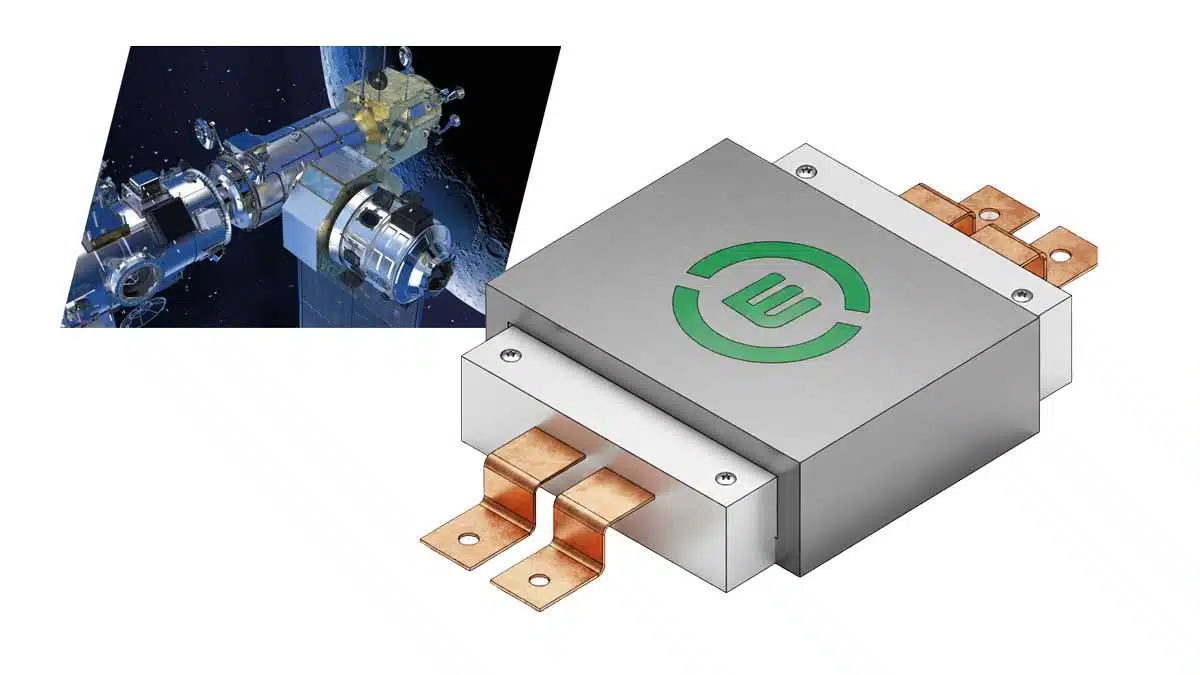
Exxelia introduces a custom Smart Integrated Magnetics solution for space power conversion applications.

Exxelia has developed a new Smart Integrated Magnetics solution designed for advanced power conditioning and distribution units (PCDUs) operating in constrained and demanding environments such as space systems.

RelatedPosts

Exxelia Publishes Micropen White Papers for Printed Electronics

Exxelia Offers Custom Naval Transformers and Inductors

Exxelia Presents Smart Integrated Magnetics Solution at Space Tech Expo 2025 

This solution is not a standard catalog product; it is the result of a custom development. It has been engineered to meet specific electrical, thermal and mechanical requirements defined at system level and can be adapted to meet any set of customer specifications.

Exxelia new Smart Integrated Magnetics solution combines the transformer and the inductor of a Dual Active Bridge (DAB) within a single, compact magnetic assembly. This integrated approach aims to reduce volume, mass and interconnection complexity while maintaining electrical performance at high switching frequencies. The targeted application is isolated DC-DC power conversion in space-grade PCDUs, where efficiency, reliability, and mechanical robustness are key design drivers. 

From a technical standpoint, this Smart Integrated Magnetic is designed for a power level of 1 to 2kW at a switching frequency of 100 to 200kHz (example). The associated inductor provides an inductance of few µH. The overall assembly reaches an efficiency level close to 99% under nominal operating conditions, reflecting careful optimization of core materials, winding architecture and magnetic coupling. Particular attention has been paid to losses and thermal behavior, which are critical in low-convection environments. 

Mechanical integration was a central aspect of the development. The complete magnetic solution fits into a low-profile / planar package measuring approximately 75 × 65 × 20 mm, with a total mass of around 250 g. This compact form factor is intended to facilitate integration into densely populated power electronics modules, while also supporting resistance to mechanical stresses typically encountered during launch and operation. 

The design was carried out to address severe environmental constraints, including thermal cycling and mechanical loads, which are characteristic of space applications. Material selection, impregnation processes and structural design were adapted accordingly to ensure long-term stability and compatibility with qualification requirements. 

This Smart Integrated Magnetics solution illustrates Exxelia’s capability to deliver fully customised magnetic components, developed in close interaction with system architects and power electronics engineers. While the solution presented here is specific to a given program and set of constraints, it reflects a broader approach that can be adapted to other high-reliability applications requiring compact, efficient and integrated magnetic designs.


Related

Source: Exxelia

Recent Posts

Bourns Extends Multilayer Chip Inductors Offer for RF and Wireless Designs

20.2.2026
12

Würth Elektronik Component Data Live in Accuris

19.2.2026
16

Coilcraft Releases Automotive Common Mode Chokes

19.2.2026
18

SCHURTER Introduces 2410 SMD Fuse for Robust AC/DC Protection

17.2.2026
13

2026 Power Magnetics Design Trends: Flyback, DAB and Planar

13.2.2026
54

Vishay Releases Sulfur‑Resistant Chip Resistors

12.2.2026
13

Vishay Releases Compact 0806 Low‑DCR Power Inductor

5.2.2026
36

Murata Publishes Power Delivery Guide for AI Servers

4.2.2026
130

Selecting Current Sense Transformers with Würth Elektronik REDEXPERT

3.2.2026
38

Upcoming Events

Feb 24
16:00 - 17:00 CET

Mastering Galvanic Isolation: Ensuring Safety in Power Electronics

Feb 25
16:00 - 17:00 CET

Magnetic Modeling – How Frenetic Models Magnetics

Mar 3
16:00 - 17:00 CET

Cybersecurity at the Eleventh Hour – from RED to CRA – Information and Discussion

View Calendar

Popular Posts

  • Buck Converter Design and Calculation

    0 shares
    Share 0 Tweet 0
  • Boost Converter Design and Calculation

    0 shares
    Share 0 Tweet 0
  • LLC Resonant Converter Design and Calculation

    0 shares
    Share 0 Tweet 0
  • Flyback Converter Design and Calculation

    0 shares
    Share 0 Tweet 0
  • Ripple Current and its Effects on the Performance of Capacitors

    3 shares
    Share 3 Tweet 0
  • Dual Active Bridge (DAB) Topology

    0 shares
    Share 0 Tweet 0
  • What is a Dielectric Constant and DF of Plastic Materials?

    4 shares
    Share 4 Tweet 0
  • MLCC and Ceramic Capacitors

    0 shares
    Share 0 Tweet 0
  • MLCC Manufacturers Consider Price Increase as AI Demand Outpaces Supply

    0 shares
    Share 0 Tweet 0
  • MLCC Case Sizes Standards Explained

    0 shares
    Share 0 Tweet 0

Newsletter Subscription


Passive Components Blog

© EPCI - Leading Passive Components Educational and Information Site

  • Home
  • Privacy Policy
  • EPCI Membership & Advertisement
  • About

No Result
View All Result
  • Home
  • Knowledge Blog
  • PCNS

© EPCI - Leading Passive Components Educational and Information Site

This website uses cookies. By continuing to use this website you are giving consent to cookies being used. Visit our Privacy and Cookie Policy.
Go to mobile version