






Passive Components Blog
No Result
View All Result
  • Home
  • NewsFilter
    • All
    • Aerospace & Defence
    • Antenna
    • Applications
    • Automotive
    • Capacitors
    • Circuit Protection Devices
    • electro-mechanical news
    • Filters
    • Fuses
    • Inductors
    • Industrial
    • Integrated Passives
    • inter-connect news
    • Market & Supply Chain
    • Market Insights
    • Medical
    • Modelling and Simulation
    • New Materials & Supply
    • New Technologies
    • Non-linear Passives
    • Oscillators
    • Passive Sensors News
    • Resistors
    • RF & Microwave
    • Telecommunication
    • Weekly Digest

    Capacitances of Nonlinear MLCCs: What Datasheets Don’t Tell You

    Stackpole Releases Automotive Wide‑Termination Resistors

    How a Digital Structural Twin Can Predict Tantalum Capacitor Reliability

    SCHURTER Buys Biaodi to Boost High-Voltage Protection Portfolio

    Binder Hybrid Connector Simplifies One Cable Automation

    Tapped Inductor Buck Converter Fundamentals

    TAIYO YUDEN Releases Mini Metal Power Inductors

    Molecular Memristor Shows Record 145 kH Emergent Inductance

    Planar vs Conventional Transformer: When it Make Sense

    Trending Tags

    • Ripple Current
    • RF
    • Leakage Current
    • Tantalum vs Ceramic
    • Snubber
    • Low ESR
    • Feedthrough
    • Derating
    • Dielectric Constant
    • New Products
    • Market Reports
  • VideoFilter
    • All
    • Antenna videos
    • Capacitor videos
    • Circuit Protection Video
    • Filter videos
    • Fuse videos
    • Inductor videos
    • Inter-Connect Video
    • Non-linear passives videos
    • Oscillator videos
    • Passive sensors videos
    • Resistor videos

    Capacitances of Nonlinear MLCCs: What Datasheets Don’t Tell You

    Tapped Inductor Buck Converter Fundamentals

    Planar vs Conventional Transformer: When it Make Sense

    Modeling Fringing Field Losses in Inductors & Transformers

    Why Power Inductors Use a Ferrite Core With an Air Gap

    Transformer-Based Power-Line Harvester Magnetic Design

    Thermal Modeling of Magnetics

    Standard vs Planar LLC transformers Comparison for Battery Chargers

    How Modern Tools Model Magnetic Components for Power Electronics

    Trending Tags

    • Capacitors explained
    • Inductors explained
    • Resistors explained
    • Filters explained
    • Application Video Guidelines
    • EMC
    • New Products
    • Ripple Current
    • Simulation
    • Tantalum vs Ceramic
  • Knowledge Blog
  • DossiersNew
  • Suppliers
    • Who is Who
  • PCNS
    • PCNS 2025
    • PCNS 2023
    • PCNS 2021
    • PCNS 2019
    • PCNS 2017
  • Events
  • Home
  • NewsFilter
    • All
    • Aerospace & Defence
    • Antenna
    • Applications
    • Automotive
    • Capacitors
    • Circuit Protection Devices
    • electro-mechanical news
    • Filters
    • Fuses
    • Inductors
    • Industrial
    • Integrated Passives
    • inter-connect news
    • Market & Supply Chain
    • Market Insights
    • Medical
    • Modelling and Simulation
    • New Materials & Supply
    • New Technologies
    • Non-linear Passives
    • Oscillators
    • Passive Sensors News
    • Resistors
    • RF & Microwave
    • Telecommunication
    • Weekly Digest

    Capacitances of Nonlinear MLCCs: What Datasheets Don’t Tell You

    Stackpole Releases Automotive Wide‑Termination Resistors

    How a Digital Structural Twin Can Predict Tantalum Capacitor Reliability

    SCHURTER Buys Biaodi to Boost High-Voltage Protection Portfolio

    Binder Hybrid Connector Simplifies One Cable Automation

    Tapped Inductor Buck Converter Fundamentals

    TAIYO YUDEN Releases Mini Metal Power Inductors

    Molecular Memristor Shows Record 145 kH Emergent Inductance

    Planar vs Conventional Transformer: When it Make Sense

    Trending Tags

    • Ripple Current
    • RF
    • Leakage Current
    • Tantalum vs Ceramic
    • Snubber
    • Low ESR
    • Feedthrough
    • Derating
    • Dielectric Constant
    • New Products
    • Market Reports
  • VideoFilter
    • All
    • Antenna videos
    • Capacitor videos
    • Circuit Protection Video
    • Filter videos
    • Fuse videos
    • Inductor videos
    • Inter-Connect Video
    • Non-linear passives videos
    • Oscillator videos
    • Passive sensors videos
    • Resistor videos

    Capacitances of Nonlinear MLCCs: What Datasheets Don’t Tell You

    Tapped Inductor Buck Converter Fundamentals

    Planar vs Conventional Transformer: When it Make Sense

    Modeling Fringing Field Losses in Inductors & Transformers

    Why Power Inductors Use a Ferrite Core With an Air Gap

    Transformer-Based Power-Line Harvester Magnetic Design

    Thermal Modeling of Magnetics

    Standard vs Planar LLC transformers Comparison for Battery Chargers

    How Modern Tools Model Magnetic Components for Power Electronics

    Trending Tags

    • Capacitors explained
    • Inductors explained
    • Resistors explained
    • Filters explained
    • Application Video Guidelines
    • EMC
    • New Products
    • Ripple Current
    • Simulation
    • Tantalum vs Ceramic
  • Knowledge Blog
  • DossiersNew
  • Suppliers
    • Who is Who
  • PCNS
    • PCNS 2025
    • PCNS 2023
    • PCNS 2021
    • PCNS 2019
    • PCNS 2017
  • Events
No Result
View All Result
Passive Components Blog
No Result
View All Result

Exxelia Releases Custom Smart Integrated Magnetics for Space Applications

5.1.2026
Reading Time: 2 mins read
A A

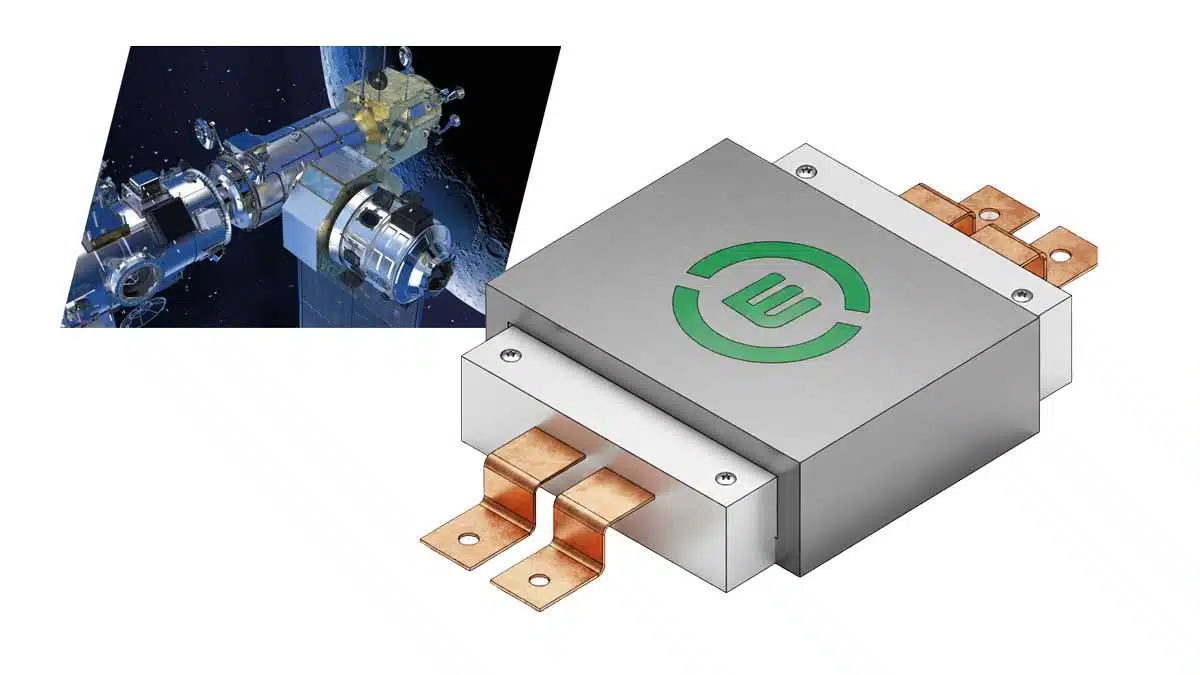
Exxelia introduces a custom Smart Integrated Magnetics solution for space power conversion applications.

Exxelia has developed a new Smart Integrated Magnetics solution designed for advanced power conditioning and distribution units (PCDUs) operating in constrained and demanding environments such as space systems.

RelatedPosts

Exxelia Introduces SMD High‑Voltage Mica Capacitors

Exxelia Releases Updated Microwave Materials and Frequency Tuning Catalogues

Exxelia Miniaturized 400 MHz Inverted‑F Antenna

This solution is not a standard catalog product; it is the result of a custom development. It has been engineered to meet specific electrical, thermal and mechanical requirements defined at system level and can be adapted to meet any set of customer specifications.

Exxelia new Smart Integrated Magnetics solution combines the transformer and the inductor of a Dual Active Bridge (DAB) within a single, compact magnetic assembly. This integrated approach aims to reduce volume, mass and interconnection complexity while maintaining electrical performance at high switching frequencies. The targeted application is isolated DC-DC power conversion in space-grade PCDUs, where efficiency, reliability, and mechanical robustness are key design drivers. 

From a technical standpoint, this Smart Integrated Magnetic is designed for a power level of 1 to 2kW at a switching frequency of 100 to 200kHz (example). The associated inductor provides an inductance of few µH. The overall assembly reaches an efficiency level close to 99% under nominal operating conditions, reflecting careful optimization of core materials, winding architecture and magnetic coupling. Particular attention has been paid to losses and thermal behavior, which are critical in low-convection environments. 

Mechanical integration was a central aspect of the development. The complete magnetic solution fits into a low-profile / planar package measuring approximately 75 × 65 × 20 mm, with a total mass of around 250 g. This compact form factor is intended to facilitate integration into densely populated power electronics modules, while also supporting resistance to mechanical stresses typically encountered during launch and operation. 

The design was carried out to address severe environmental constraints, including thermal cycling and mechanical loads, which are characteristic of space applications. Material selection, impregnation processes and structural design were adapted accordingly to ensure long-term stability and compatibility with qualification requirements. 

This Smart Integrated Magnetics solution illustrates Exxelia’s capability to deliver fully customised magnetic components, developed in close interaction with system architects and power electronics engineers. While the solution presented here is specific to a given program and set of constraints, it reflects a broader approach that can be adapted to other high-reliability applications requiring compact, efficient and integrated magnetic designs.

Related

Source: Exxelia

Recent Posts

Tapped Inductor Buck Converter Fundamentals

13.5.2026
27

TAIYO YUDEN Releases Mini Metal Power Inductors

13.5.2026
27

Planar vs Conventional Transformer: When it Make Sense

11.5.2026
52

High-Crystallinity Nanocrystalline Composites for MHz Chip Inductors

7.5.2026
65

Würth Elektronik Introduces Compact Flat-wire SMT Power Inductors for Automotive

5.5.2026
55

Vishay Introduced Thin Film Submount Platform for Optical and RF Modules

30.4.2026
35

Modeling Fringing Field Losses in Inductors & Transformers

30.4.2026
57

Exxelia Introduces SMD High‑Voltage Mica Capacitors

28.4.2026
43

Modelithics Releases COMPLETE v26.1 for Keysight ADS

23.4.2026
24

Upcoming Events

May 19
16:00 - 17:00 CEST

Designing Qi2 Wireless Power Systems: Practical Development and EMC Optimization

Jun 2
16:00 - 17:00 CEST

Calculation, Simulation and Measurement of 800V EMC Filters

Jun 16
16:00 - 17:00 CEST

EMC with EMC – EMC‑compliant design with electromechanical connectors

View Calendar

Popular Posts

  • Buck Converter Design and Calculation

    0 shares
    Share 0 Tweet 0
  • Boost Converter Design and Calculation

    0 shares
    Share 0 Tweet 0
  • Flyback Converter Design and Calculation

    0 shares
    Share 0 Tweet 0
  • LLC Resonant Converter Design and Calculation

    0 shares
    Share 0 Tweet 0
  • MLCC and Ceramic Capacitors

    0 shares
    Share 0 Tweet 0
  • Dual Active Bridge (DAB) Topology

    0 shares
    Share 0 Tweet 0
  • What Electronics Engineer Needs to Know About Passive Low Pass Filters

    0 shares
    Share 0 Tweet 0
  • Capacitor Charging and Discharging

    0 shares
    Share 0 Tweet 0
  • Ripple Current and its Effects on the Performance of Capacitors

    3 shares
    Share 3 Tweet 0
  • MLCC Case Sizes Standards Explained

    0 shares
    Share 0 Tweet 0

Newsletter Subscription


Passive Components Blog

© EPCI - Leading Passive Components Educational and Information Site

  • Home
  • Privacy Policy
  • EPCI Membership & Advertisement
  • About

No Result
View All Result
  • Home
  • Knowledge Blog
  • PCNS

© EPCI - Leading Passive Components Educational and Information Site

This website uses cookies. By continuing to use this website you are giving consent to cookies being used. Visit our Privacy and Cookie Policy.
Go to mobile version