











Passive Components Blog
No Result
View All Result
  • Home
  • NewsFilter
    • All
    • Aerospace & Defence
    • Antenna
    • Applications
    • Automotive
    • Capacitors
    • Circuit Protection Devices
    • electro-mechanical news
    • Filters
    • Fuses
    • Inductors
    • Industrial
    • Integrated Passives
    • inter-connect news
    • Market & Supply Chain
    • Market Insights
    • Medical
    • Modelling and Simulation
    • New Materials & Supply
    • New Technologies
    • Non-linear Passives
    • Oscillators
    • Passive Sensors News
    • Resistors
    • RF & Microwave
    • Telecommunication
    • Weekly Digest

    2025 Annual Capacitor Technology Dossier

    Panasonic High Precision Chip Resistors Bridge Gap Between Thin and Thick Technology

    ROHM Extends 2012 Shunt Resistors Power Rating up to 1.25 W

    January 2026 Interconnect, Passives and Electromechanical Components Market Insights

    Passive Components in Quantum Computing

    0603 Automotive Chip Varistors as TVS Diode Replacements, TDK Tech Note

    Miniaturization of MLCCs and Electrolytics, KAVX Tech Chat

    Exxelia Offers Custom Naval Transformers and Inductors

    Researchers Demonstrated 32nm Aluminum Vacuum Gap Capacitor

    Trending Tags

    • Ripple Current
    • RF
    • Leakage Current
    • Tantalum vs Ceramic
    • Snubber
    • Low ESR
    • Feedthrough
    • Derating
    • Dielectric Constant
    • New Products
    • Market Reports
  • VideoFilter
    • All
    • Antenna videos
    • Capacitor videos
    • Circuit Protection Video
    • Filter videos
    • Fuse videos
    • Inductor videos
    • Inter-Connect Video
    • Non-linear passives videos
    • Oscillator videos
    • Passive sensors videos
    • Resistor videos

    One‑Pulse Characterization of Nonlinear Power Inductors

    Thermistor Linearization Challenges

    Coaxial Connectors and How to Connect with PCB

    PCB Manufacturing, Test Methods, Quality and Reliability

    Transformer Behavior – Current Transfer and Hidden Feedback

    Choosing the Right Capacitor: The Importance of Accurate Measurements

    RF Inductors: Selection and Design Challenges for High-Frequency Circuits

    Transformer Safety IEC 61558 Standard

    3-Phase EMI Filter Design, Simulation, Calculation and Test

    Trending Tags

    • Capacitors explained
    • Inductors explained
    • Resistors explained
    • Filters explained
    • Application Video Guidelines
    • EMC
    • New Products
    • Ripple Current
    • Simulation
    • Tantalum vs Ceramic
  • Knowledge Blog
  • DossiersNew
  • Suppliers
    • Who is Who
  • PCNS
    • PCNS 2025
    • PCNS 2023
    • PCNS 2021
    • PCNS 2019
    • PCNS 2017
  • Events
  • Home
  • NewsFilter
    • All
    • Aerospace & Defence
    • Antenna
    • Applications
    • Automotive
    • Capacitors
    • Circuit Protection Devices
    • electro-mechanical news
    • Filters
    • Fuses
    • Inductors
    • Industrial
    • Integrated Passives
    • inter-connect news
    • Market & Supply Chain
    • Market Insights
    • Medical
    • Modelling and Simulation
    • New Materials & Supply
    • New Technologies
    • Non-linear Passives
    • Oscillators
    • Passive Sensors News
    • Resistors
    • RF & Microwave
    • Telecommunication
    • Weekly Digest

    2025 Annual Capacitor Technology Dossier

    Panasonic High Precision Chip Resistors Bridge Gap Between Thin and Thick Technology

    ROHM Extends 2012 Shunt Resistors Power Rating up to 1.25 W

    January 2026 Interconnect, Passives and Electromechanical Components Market Insights

    Passive Components in Quantum Computing

    0603 Automotive Chip Varistors as TVS Diode Replacements, TDK Tech Note

    Miniaturization of MLCCs and Electrolytics, KAVX Tech Chat

    Exxelia Offers Custom Naval Transformers and Inductors

    Researchers Demonstrated 32nm Aluminum Vacuum Gap Capacitor

    Trending Tags

    • Ripple Current
    • RF
    • Leakage Current
    • Tantalum vs Ceramic
    • Snubber
    • Low ESR
    • Feedthrough
    • Derating
    • Dielectric Constant
    • New Products
    • Market Reports
  • VideoFilter
    • All
    • Antenna videos
    • Capacitor videos
    • Circuit Protection Video
    • Filter videos
    • Fuse videos
    • Inductor videos
    • Inter-Connect Video
    • Non-linear passives videos
    • Oscillator videos
    • Passive sensors videos
    • Resistor videos

    One‑Pulse Characterization of Nonlinear Power Inductors

    Thermistor Linearization Challenges

    Coaxial Connectors and How to Connect with PCB

    PCB Manufacturing, Test Methods, Quality and Reliability

    Transformer Behavior – Current Transfer and Hidden Feedback

    Choosing the Right Capacitor: The Importance of Accurate Measurements

    RF Inductors: Selection and Design Challenges for High-Frequency Circuits

    Transformer Safety IEC 61558 Standard

    3-Phase EMI Filter Design, Simulation, Calculation and Test

    Trending Tags

    • Capacitors explained
    • Inductors explained
    • Resistors explained
    • Filters explained
    • Application Video Guidelines
    • EMC
    • New Products
    • Ripple Current
    • Simulation
    • Tantalum vs Ceramic
  • Knowledge Blog
  • DossiersNew
  • Suppliers
    • Who is Who
  • PCNS
    • PCNS 2025
    • PCNS 2023
    • PCNS 2021
    • PCNS 2019
    • PCNS 2017
  • Events
No Result
View All Result
Passive Components Blog
No Result
View All Result

First programmable memristor computer aims to bring AI processing down from the cloud

17.7.2019
Reading Time: 4 mins read
A A

Source: University of Michigan news

ANN ARBOR—The first programmable memristor computer—not just a memristor array operated through an external computer—has been developed at the University of Michigan.

RelatedPosts

2025 Annual Capacitor Technology Dossier

Panasonic High Precision Chip Resistors Bridge Gap Between Thin and Thick Technology

ROHM Extends 2012 Shunt Resistors Power Rating up to 1.25 W

It could lead to the processing of artificial intelligence directly on small, energy-constrained devices such as smartphones and sensors. A smartphone AI processor would mean that voice commands would no longer have to be sent to the cloud for interpretation, speeding up response time.

“Everyone wants to put an AI processor on smartphones, but you don’t want your cell phone battery to drain very quickly,” said Wei Lu, U-M professor of electrical and computer engineering and senior author of the study in Nature Electronics.

In medical devices, the ability to run AI algorithms without the cloud would enable better security and privacy.

Why memristors are good for machine learning

The key to making this possible could be an advanced computer component called the memristor. This circuit element, an electrical resistor with a memory, has a variable resistance that can serve as a form of information storage. Because memristors store and process information in the same location, they can get around the biggest bottleneck for computing speed and power: the connection between memory and processor.

This is especially important for machine-learning algorithms that deal with lots of data to do things like identify objects in photos and videos—or predict which hospital patients are at higher risk of infection. Already, programmers prefer to run these algorithms on graphical processing units rather than a computer’s main processor, the central processing unit.

“GPUs and very customized and optimized digital circuits are considered to be about 10-100 times better than CPUs in terms of power and throughput.” Lu said. “Memristor AI processors could be another 10-100 times better.”

GPUs perform better at machine learning tasks because they have thousands of small cores for running calculations all at once, as opposed to the string of calculations waiting their turn on one of the few powerful cores in a CPU.

A memristor array takes this even further. Each memristor is able to do its own calculation, allowing thousands of operations within a core to be performed at once. In this experimental-scale computer, there were more than 5,800 memristors. A commercial design could include millions of them.

Memristor arrays are especially suited to machine learning problems. The reason for this is the way that machine learning algorithms turn data into vectors—essentially, lists of data points. In predicting a patient’s risk of infection in a hospital, for instance, this vector might list numerical representations of a patient’s risk factors.

Then, machine learning algorithms compare these “input” vectors with “feature” vectors stored in memory. These feature vectors represent certain traits of the data (such as the presence of an underlying disease). If matched, the system knows that the input data has that trait. The vectors are stored in matrices, which are like the spreadsheets of mathematics, and these matrices can be mapped directly onto the memristor arrays.

What’s more, as data is fed through the array, the bulk of the mathematical processing occurs through the natural resistances in the memristors, eliminating the need to move feature vectors in and out of the memory to perform the computations. This makes the arrays highly efficient at complicated matrix calculations. Earlier studies demonstrated the potential of memristor arrays for speeding up machine learning, but they needed external computing elements to function.

Building a programmable memristor computer

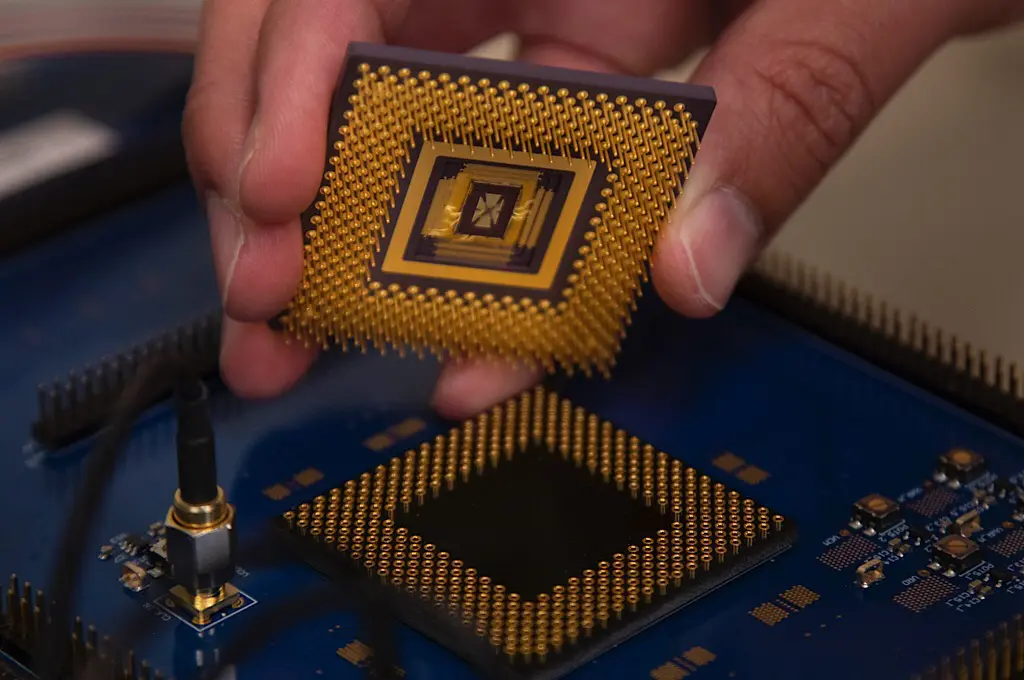
To build the first programmable memristor computer, Lu’s team worked with associate professor Zhengya Zhang and professor Michael Flynn, both of electrical and computer engineering at U-M, to design a chip that could integrate the memristor array with all the other elements needed to program and run it. Those components included a conventional digital processor and communication channels, as well as digital/analog converters to serve as interpreters between the analog memristor array and the rest of the computer.

Lu’s team then integrated the memristor array directly on the chip at U-M’s Lurie Nanofabrication Facility. They also developed software to map machine learning algorithms onto the matrix-like structure of the memristor array.

The team demonstrated the device with three bread-and-butter machine learning algorithms:

Perceptron, which is used to classify information. They were able to identify imperfect Greek letters with 100% accuracy

Sparse coding, which compresses and categorizes data, particularly images. The computer was able to find the most efficient way to reconstruct images in a set and identified patterns with 100% accuracy

Two-layer neural network, designed to find patterns in complex data. This two-layer network found commonalities and differentiating factors in breast cancer screening data and then classified each case as malignant or benign with 94.6% accuracy.

There are challenges in scaling up for commercial use—memristors can’t yet be made as identical as they need to be and the information stored in the array isn’t entirely reliable because it runs on analog’s continuum rather than the digital either/or. These are future directions of Lu’s group.

Lu plans to commercialize this technology. The study is titled, “A fully integrated reprogrammable memristor–CMOS system for efficient multiply–accumulate operations.” The research is funded by the Defense Advanced Research Projects Agency, the center for Applications Driving Architectures (ADA), and the National Science Foundation.

Featured Image: The memristor array chip plugs into the custom computer chip, forming the first programmable memristor computer. The team demonstrated that it could run three standard types of machine learning algorithms. Image credit: Robert Coelius, Michigan Engineering


 

Related

Recent Posts

Panasonic High Precision Chip Resistors Bridge Gap Between Thin and Thick Technology

23.1.2026
18

ROHM Extends 2012 Shunt Resistors Power Rating up to 1.25 W

23.1.2026
12

Passive Components in Quantum Computing

22.1.2026
75

Researchers Demonstrated 32nm Aluminum Vacuum Gap Capacitor

20.1.2026
32

Würth Elektronik Introduces Product Navigator for Passive Components

14.1.2026
79

Panasonic Passive Components for Reliable Robotic Arms

14.1.2026
102

How Metal Prices Are Driving Passive Component Price Hikes

8.1.2026
397

Modelithics COMPLETE Library v25.8 for Keysight ADS

7.1.2026
44

2025 Top Passive Components Blog Articles

5.1.2026
129

Upcoming Events

Jan 27
16:00 - 17:00 CET

Simplifying Vehicle Development with Automotive Ethernet and Zonal Smart Switch Technologies

Feb 24
16:00 - 17:00 CET

Designing Qi2 Wireless Power Systems: Practical Development and EMC Optimization

Mar 21
All day

PSMA Capacitor Workshop 2026

View Calendar

Popular Posts

  • Buck Converter Design and Calculation

    0 shares
    Share 0 Tweet 0
  • Boost Converter Design and Calculation

    0 shares
    Share 0 Tweet 0
  • LLC Resonant Converter Design and Calculation

    0 shares
    Share 0 Tweet 0
  • Flyback Converter Design and Calculation

    0 shares
    Share 0 Tweet 0
  • Ripple Current and its Effects on the Performance of Capacitors

    3 shares
    Share 3 Tweet 0
  • How Metal Prices Are Driving Passive Component Price Hikes

    0 shares
    Share 0 Tweet 0
  • MLCC and Ceramic Capacitors

    0 shares
    Share 0 Tweet 0
  • What is a Dielectric Constant and DF of Plastic Materials?

    4 shares
    Share 4 Tweet 0
  • Dual Active Bridge (DAB) Topology

    0 shares
    Share 0 Tweet 0
  • Degradation of Capacitors and its Failure Mechanisms

    0 shares
    Share 0 Tweet 0

Newsletter Subscription


Passive Components Blog

© EPCI - Leading Passive Components Educational and Information Site

  • Home
  • Privacy Policy
  • EPCI Membership & Advertisement
  • About

No Result
View All Result
  • Home
  • Knowledge Blog
  • PCNS

© EPCI - Leading Passive Components Educational and Information Site

This website uses cookies. By continuing to use this website you are giving consent to cookies being used. Visit our Privacy and Cookie Policy.
Go to mobile version