












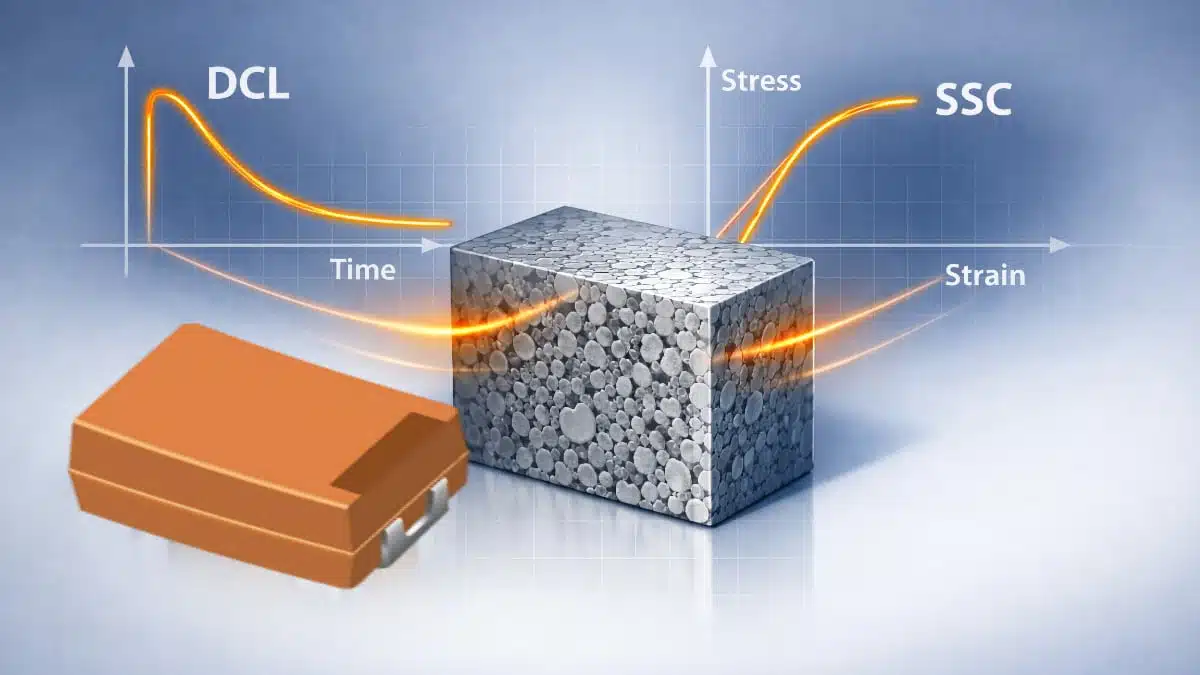
In this article, we look at how tantalum anode SSC (stress–strain characteristics) diagnostics can be used as a structural indicator in tantalum capacitors to complement DCL (direct current leakage) and other electrical tests, based on work by Dr. Vladimir Azbel. The focus is on practical positioning for reliability engineers and space assurance. The article is based on an edited source article written by Vladimir Azbel and adapted for the Passive Components Blog audience.
Space‑grade and other high‑reliability tantalum capacitors are usually qualified and screened using electrical tests such as DCL leakage current, capacitance, ESR, and burn‑in. These tests answer a binary question: did the part pass or fail under the specified conditions?
What they do not tell us directly is how close the device is to its structural limits, or which part of the anode structure is drifting when electrical behavior becomes unstable.
DCL as an electrical symptom
DCL is one of the most important electrical parameters in tantalum capacitor technology, both in production and in space‑grade screening. When DCL is unstable or drifts during testing, it is treated as a symptom that something in the capacitor is not stable under the applied conditions.
However, DCL alone does not identify the root structural cause, and its absolute value shall not be considered as a reliability indicator. The origin of the instability may be related to powder behavior, sintering quality, neck geometry, residual stress, oxide integrity, or the dielectric/interface zone, and conventional electrical tests only show the end result of all these factors combined.
From a reliability perspective, this means that even when DCL remains within limits, there can still be hidden structural differences between lots, processes, or powder sources that only become visible under mission‑specific stresses (reverse bias, humidity, thermal cycling, ripple current, long‑term storage).
SSC as a structural indicator
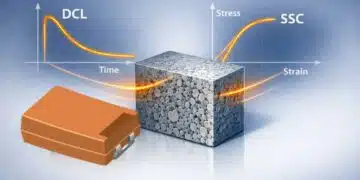
SSC stress–strain characteristics diagnostics add a structural viewpoint by measuring the stress–strain response of the porous tantalum anode. In simple terms, they characterize how the porous skeleton of the anode deforms and carries mechanical load, which reflects interparticle bonding, residual stress, and the ability of the structure to accommodate strain without cracking or losing connectivity.
This makes SSC a structural indicator: it does not replace DCL or capacitance testing but provides a diagnostic layer between process history and electrical reliability results. Instead of only asking “Did the capacitor pass the electrical test?”, SSC allows engineers to ask “Does this anode still have the same structural margin as the qualified reference design?”
In practice, SSC can show whether a change in powder, sintering, formation, or other steps has modified the structural state of the anode, even when electrical parameters at room conditions still appear acceptable.
The benchmark principle: referencing a qualified structure
A key concept in positioning SSC for reliability is the benchmark principle. SSC values are not meant to be interpreted as universal “good” or “bad” numbers across all tantalum designs and manufacturers.
Instead, a benchmark is defined per qualified design: a measured SSC signature (or window) of an anode structure that has already demonstrated stable electrical and reliability behavior under the relevant mission conditions. The primary question becomes:
- Does the current anode SSC remain close to the benchmark SSC of this specific qualified design?
This benchmark‑based approach aligns well with how space programs handle configuration control and equivalence: comparisons are made against a known, qualified baseline rather than against arbitrary mechanical limits.
Stage‑by‑stage structural benchmarking
SSC benchmarking can be applied at different stages of the tantalum anode process flow:
- Powder conversion
- Sintered pellet
- Formed anode
- Anode extracted from a finished capacitor
By comparing SSC at each stage to the benchmark, engineers can identify where structural deviations start and how they propagate towards the final device. For example, a powder lot may pass incoming inspection but, after pressing and sintering, produce a different neck structure or residual stress state that shows up in SSC before any DCL deviation is observed.
Similarly, a formed anode may pass initial electrical testing yet exhibit reduced structural margin under reverse bias, humidity, or thermal cycling when compared to the benchmark SSC. SSC at different stages thus supports both process development and change control by indicating where structural equivalence is preserved or lost.
Where SSC fits in existing reliability workflows
From an engineering point of view, SSC diagnostics can be integrated into several familiar reliability and QA activities.
- Design and process development:
SSC comparisons help evaluate whether a new anode design approaches the structural state of a proven qualified design, reducing trial‑and‑error in development. - Powder lot and material comparison:
A powder lot can meet formal specifications yet behave differently during pressing and sintering; SSC can show whether its structural behavior matches that of the qualified material. - Process validation and change control:
When a qualified process changes (powder source, pressing density, sintering profile, formation or thermal treatment), SSC helps assess whether structural equivalence to the baseline has been preserved. - Lot‑to‑lot structural reproducibility:
SSC can distinguish normal manufacturing scatter from meaningful structural drift, giving an additional dimension beyond electrical parametrics. - Post‑stress degradation analysis:
Comparing SSC before and after stresses such as reverse bias, humidity, thermal cycling, or thermal shock indicates whether electrical degradation is accompanied by irreversible structural change. - DPA and failure analysis support:
Cross‑section and SEM show local defects; SSC adds an integral structural response of the porous anode, helping assess whether observed defects are structurally significant at the device level.
Correlating SSC drift with DCL behavior
For reliability engineers, the most practical use of SSC is in correlation with established electrical tests. The main points are:
- SSC drift should be evaluated together with DCL drift under matched stress conditions (e.g., same humidity profile, same reverse bias level, same thermal cycling condition).
- If DCL deviates but SSC remains within the benchmark window, the issue may be related to surface or interface phenomena that do not significantly change bulk structural response.
- If both DCL and SSC deviate from the benchmark, this indicates that the underlying porous skeleton has changed in a way that reduces structural margin and increases the risk of electrical instability under stress.
Mechanistically, SSC drift can be linked to factors such as changes in residual stress, neck instability, degradation of the oxide/interface zone, hydrogen effects, or loss of plastic accommodation capability. For non‑materials specialists, these can be grouped as structural weakening mechanisms that reduce the capacity of the anode to withstand mission stresses without developing new defects.
Why this matters for high-rel, space‑grade or other mission critical applications
In high‑reliability grade tantalum capacitors, design, material selection, powder behavior, sintering conditions, formation process, oxide/interface stability, and manufacturing reproducibility are all tightly coupled. Two capacitors can pass the same initial electrical requirements and yet have different hidden structural margins, leading to different long‑term robustness under mission profiles.
Because initial pass/fail tests do not always fully represent robustness against reverse bias, thermal cycling, humidity, ripple current, or long‑term storage, an additional structural indicator such as SSC can be valuable. It helps engineers go beyond “did it pass the electrical test?” to “does this anode still have the structural margin required for the intended stress environment?”
For high-rel assurance, SSC can support:
- Equivalence demonstrations when changing powder or process
- Risk assessments for lot releases with borderline but still acceptable DCL behavior
- Interpretation of DPA and failure‑analysis results in terms of structural margin rather than only local defects.
Practical points for implementation
When adopting SSC diagnostics, several practical aspects should be emphasized:
- The benchmark must be defined for each qualified design; there is no universal SSC pass/fail value.
- Normal manufacturing scatter needs to be separated from meaningful structural drift by appropriate statistical treatment and sample sizes.
- SSC drift should be correlated with DCL drift and other electrical changes under matched stress conditions to build a robust interpretation framework.
- Sample size and statistical confidence should be selected according to the use case: design development, powder lot comparison, process validation, failure analysis, or qualification support.
- SSC diagnostics should be positioned as a complementary tool, not as a replacement for qualification tests, screening, DPA, or conventional failure analysis.
Conclusion
Electrical testing remains the primary tool to qualify and screen tantalum capacitors, but it only shows the electrical outcome, not the internal structural state that produced it. SSC diagnostics provide a way to benchmark the anode structure against a known qualified state and to detect structural drift that may not yet be visible in standard electrical tests.
In this framework, DCL can be viewed as an electrical symptom and SSC as a structural indicator that links process history and microstructure to reliability behavior. For space‑grade and other high‑reliability applications, this combination offers a more mechanism‑oriented view of capacitor robustness, supporting better process control, more informed change management, and deeper insight into the causes of electrical instabilities.
Source
Adapted from the article by Vladimir Azbel, available at https://zenodo.org/records/21187992.
Acknowledgement
The author, Dr. Vladimir Azbel, thanks Tomas Zednicek, Ph.D., EPCI, for his assistance in editing the article, helping to recast the methodology into the language of reliability testing and to clarify the concrete practical benefits for manufacturers, reliability engineers, and management.
References
For deeper dives into SSC and structural diagnostics by Vladimir Azbel, see also:
- Practical Value of Structural Diagnostics for Tantalum Capacitor Anodes
Explains why structural diagnostics, including SSC, add value beyond conventional electrical tests in controlling tantalum anode quality and capacitor reliability. - Powder Stress–Strain Curves for Tantalum Capacitors Reliability
Introduces SSC‑type stress–strain curves as a tool to characterize tantalum powders and predict their impact on resulting capacitor reliability. - Mechanical SSC Testing as a Structural Diagnostic Tool for Tantalum Capacitor Anodes
Describes how mechanical SSC testing of porous anodes can be used as a structural diagnostic and benchmark method during manufacturing. - Mechanical Drift Indicator of Tantalum Capacitor Anodes Degradation under Reverse Bias
Shows how changes in mechanical response (SSC drift) can indicate anode degradation mechanisms during reverse bias stresses. - Energy-Controlled Structural Evolution of Amorphous Ta₂O₅ in Tantalum Anodes
Analyzes how the amorphous Ta₂O₅ dielectric layer structurally evolves under energy input, linking oxide structure to leakage and reliability. - Mechano-Chemical Model of Sintered Tantalum Capacitor Pellets
Proposes a mechano‑chemical model describing how sintered pellet structure, stress, and chemistry interact to influence DCL and failure risk. - Mechanical Testing of Tantalum Anodes to Predict Tantalum Capacitor Quality
Demonstrates how mechanical tests on anodes during production can predict leakage stability and screening performance of finished capacitors. - Digital Twin of a Tantalum Capacitor Anode: From Powder to Formation
Presents a digital structural twin of the anode that connects powder, sintering, and formation parameters to predicted structural and electrical behavior. - How a Digital Structural Twin Can Predict Tantalum Capacitor Reliability
Explains how combining SSC‑based diagnostics with a digital structural twin allows prediction of leakage stability and reliability before full testing. - Using a Virtual Anode Thermal Model to Evaluate Miniaturization Risk in Tantalum Capacitors
Uses a virtual thermal model to estimate how far anode designs can be miniaturized without compromising structural and reliability margins. - Reliability of Tantalum Capacitors: the Role of Internal Stress
Discusses how internal mechanical stress in tantalum anodes and dielectrics affects leakage current stability and long‑term reliability. - Enhancement of Tantalum Capacitors Reliability: Innovative Approach to Anode Production Control
Proposes an anode production‑control strategy that reduces DCL‑related failures by integrating structural diagnostics into the manufacturing flow.