









Passive Components Blog
No Result
View All Result
  • Home
  • NewsFilter
    • All
    • Aerospace & Defence
    • Antenna
    • Applications
    • Automotive
    • Capacitors
    • Circuit Protection Devices
    • electro-mechanical news
    • Filters
    • Fuses
    • Inductors
    • Industrial
    • Integrated Passives
    • inter-connect news
    • Market & Supply Chain
    • Market Insights
    • Medical
    • Modelling and Simulation
    • New Materials & Supply
    • New Technologies
    • Non-linear Passives
    • Oscillators
    • Passive Sensors News
    • Resistors
    • RF & Microwave
    • Telecommunication
    • Weekly Digest

    Murata and Xona Partner on LEO Satellite Navigation for Industrial Applications

    Bourns Offers Custom Magnetics for 3‑Phase Flying Capacitor Inverters

    YAGEO Releases Cost Efficient Pt‑RTD Sensors with Ni wires

    Nvidia Vera Rubin: Why One AI Rack Needs So Many More MLCC Capacitors

    Stackpole Introduces 1400A Busbar Shunt Resistors

    Tecate Unveils High‑temp 105C Supercapacitors for Harsh‑Environment Designs

    Bourns Expands 1000V High‑Power Fuses for Semiconductor and Battery Protection

    Passive Components in 2026: From Invisible Commodity to Design Parameter

    Bourns Introduces High Current Chip Ferrite Beads for Dense Power Rails

    Trending Tags

    • Ripple Current
    • RF
    • Leakage Current
    • Tantalum vs Ceramic
    • Snubber
    • Low ESR
    • Feedthrough
    • Derating
    • Dielectric Constant
    • New Products
    • Market Reports
  • VideoFilter
    • All
    • Antenna videos
    • Capacitor videos
    • Circuit Protection Video
    • Filter videos
    • Fuse videos
    • Inductor videos
    • Inter-Connect Video
    • Non-linear passives videos
    • Oscillator videos
    • Passive sensors videos
    • Resistor videos

    Current Sense Transformer Datasheet and Design‑in Guide

    Designing a USB Type‑C Flyback Planar Transformer with Frenetic’s Planar Tool

    Magnetics Design in High‑Frequency GaN Converters

    Qi2 Wireless Charging: Inductors, Capacitors and EMC Filters

    Two‑capacitor paradox explained for engineers

    Capacitances of Nonlinear MLCCs: What Datasheets Don’t Tell You

    Tapped Inductor Buck Converter Fundamentals

    Planar vs Conventional Transformer: When it Make Sense

    Modeling Fringing Field Losses in Inductors & Transformers

    Trending Tags

    • Capacitors explained
    • Inductors explained
    • Resistors explained
    • Filters explained
    • Application Video Guidelines
    • EMC
    • New Products
    • Ripple Current
    • Simulation
    • Tantalum vs Ceramic
  • Knowledge Blog
  • DossiersNew
  • Suppliers
    • Who is Who
  • PCNS
    • PCNS 2025
    • PCNS 2023
    • PCNS 2021
    • PCNS 2019
    • PCNS 2017
  • Events
  • Home
  • NewsFilter
    • All
    • Aerospace & Defence
    • Antenna
    • Applications
    • Automotive
    • Capacitors
    • Circuit Protection Devices
    • electro-mechanical news
    • Filters
    • Fuses
    • Inductors
    • Industrial
    • Integrated Passives
    • inter-connect news
    • Market & Supply Chain
    • Market Insights
    • Medical
    • Modelling and Simulation
    • New Materials & Supply
    • New Technologies
    • Non-linear Passives
    • Oscillators
    • Passive Sensors News
    • Resistors
    • RF & Microwave
    • Telecommunication
    • Weekly Digest

    Murata and Xona Partner on LEO Satellite Navigation for Industrial Applications

    Bourns Offers Custom Magnetics for 3‑Phase Flying Capacitor Inverters

    YAGEO Releases Cost Efficient Pt‑RTD Sensors with Ni wires

    Nvidia Vera Rubin: Why One AI Rack Needs So Many More MLCC Capacitors

    Stackpole Introduces 1400A Busbar Shunt Resistors

    Tecate Unveils High‑temp 105C Supercapacitors for Harsh‑Environment Designs

    Bourns Expands 1000V High‑Power Fuses for Semiconductor and Battery Protection

    Passive Components in 2026: From Invisible Commodity to Design Parameter

    Bourns Introduces High Current Chip Ferrite Beads for Dense Power Rails

    Trending Tags

    • Ripple Current
    • RF
    • Leakage Current
    • Tantalum vs Ceramic
    • Snubber
    • Low ESR
    • Feedthrough
    • Derating
    • Dielectric Constant
    • New Products
    • Market Reports
  • VideoFilter
    • All
    • Antenna videos
    • Capacitor videos
    • Circuit Protection Video
    • Filter videos
    • Fuse videos
    • Inductor videos
    • Inter-Connect Video
    • Non-linear passives videos
    • Oscillator videos
    • Passive sensors videos
    • Resistor videos

    Current Sense Transformer Datasheet and Design‑in Guide

    Designing a USB Type‑C Flyback Planar Transformer with Frenetic’s Planar Tool

    Magnetics Design in High‑Frequency GaN Converters

    Qi2 Wireless Charging: Inductors, Capacitors and EMC Filters

    Two‑capacitor paradox explained for engineers

    Capacitances of Nonlinear MLCCs: What Datasheets Don’t Tell You

    Tapped Inductor Buck Converter Fundamentals

    Planar vs Conventional Transformer: When it Make Sense

    Modeling Fringing Field Losses in Inductors & Transformers

    Trending Tags

    • Capacitors explained
    • Inductors explained
    • Resistors explained
    • Filters explained
    • Application Video Guidelines
    • EMC
    • New Products
    • Ripple Current
    • Simulation
    • Tantalum vs Ceramic
  • Knowledge Blog
  • DossiersNew
  • Suppliers
    • Who is Who
  • PCNS
    • PCNS 2025
    • PCNS 2023
    • PCNS 2021
    • PCNS 2019
    • PCNS 2017
  • Events
No Result
View All Result
Passive Components Blog
No Result
View All Result

High-Precision TCXOs for 5G Base Stations

20.4.2023
Reading Time: 3 mins read
A A

5G base stations require components that enable high-speed and high-capacity communications. In this article Kyocera explains how High-Precision TCXOs (Temperature-Compensated Crystal Oscillators) meet demand from 5G base stations with more stable frequency-temperature characteristics than conventional products.

Development Background

5G communications, featuring high-speed, high-capacity, ultra-low latency, and multiple connections at the same time, is now entering its full-fledged introduction phase as IoT technology advances.

RelatedPosts

KYOCERA Releases SAW Devices with Significantly Lower Loss

KYOCERA Releases Industry Smallest SAW Quadplexer

KYOCERA Developed Industry Leading 008004 Hi-Q MLCC for PA Modules

Among these, 5G base stations are being installed ahead of others. Demand for miniaturization of 5G base stations has been increasing year by year, and crystal oscillators, which are responsible for communication quality, are also required to be miniaturized and highly accurate.

Against this backdrop, Kyocera has developed a High-Precision TCXOs (Temperature-Compensated Crystal Oscillator) that further improves the characteristics of TCXO, which holds the top share* in devices used in mobile communications terminals. It is currently being mass-produced for 5G base stations.

* Estimates by Kyocera based on market research reports

TCXO Features

High-Precision TCXOs has stabilized the frequency stability to about 1/10 of that of TCXO, which is commonly used in smartphones.

We have also been able to supply products with extremely high temperature characteristics by using low-dispersion crystal unit, which we have cultivated through the development of compact crystal unit.

Kyocera’s High-Precision TCXOs are currently used in 5G base stations as a reference clock to achieve low-latency communication.
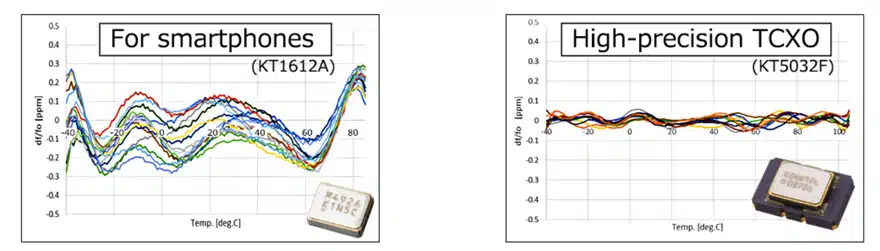
Example of Frequency Temperature Characteristics of Crystals and High-Precision TCXOs; source: KYOCERA

As the internal temperature of the set increases due to the internal heat generation of the IC used and the compact and sealed structure, a value of ± 0.1 ppm has been achieved with + 105°C operation, which has been difficult with OCXO (Constant Temperature Chamber Controlled Oscillator).

  • Standard frequency [MHz]: 10, 19.2, 20, 24.576, 26, 30.72, 38.88, 40
  • Dimensions: 5.0 x 3.2mm, 7.0 x 5.0mm
  • Frequency temperature characteristic: ±0.1ppm or ±0.28ppm / -40 to +105°C

Applications

  • 5G base stations, RF for networks, Wire communication infrastructure
  • Reference clock for high-precision measuring instrument

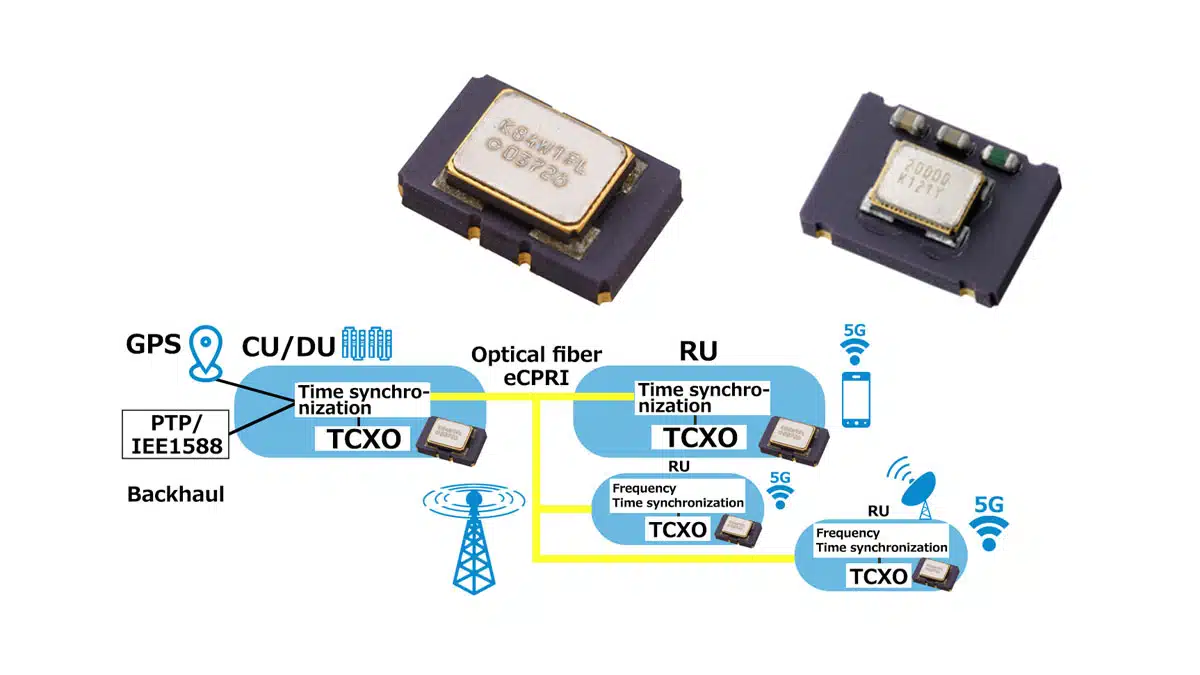
5G Base Station Example

High-Precision TCXO is used as a reference clock to achieve the low-latency communication required by 5G.
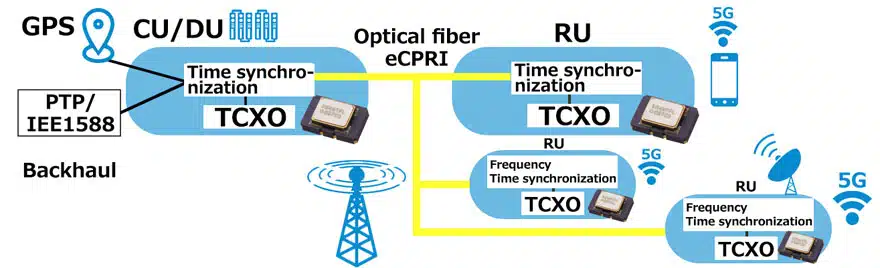
High-Precision TCXO Application Example in 5G Communication Network; source: Kyocera

Related

Source: KYOCERA

Recent Posts

Murata Introduces Crystal and NTC Set for Automotive UWB Timing

30.4.2026
50

Equivalent Circuit Constants of Crystal Units Explained

26.3.2026
80

Exxelia Miniaturized 400 MHz Inverted‑F Antenna

24.3.2026
28

Kyocera Releases 30fs Jitter Differential Clock Oscillator

10.3.2026
37

Würth Elektronik IQD Awarded by EcoVadis Gold Sustainability Medal

4.3.2026
7

Bourns Extends PPTC Resettable High‑Power, High‑Voltage Protection Fuses

2.3.2026
45

Littelfuse NANO2 415 SMD Fuse Wins 2025 Product of the Year

26.2.2026
24

KYOCERA AVX Extends Ultra‑Broadband RF Capacitor Series

24.2.2026
72

Bourns Extends Multilayer Chip Inductors Offer for RF and Wireless Designs

20.2.2026
37

Upcoming Events

Jun 16
16:00 - 17:00 CEST

EMC with EMC – EMC‑compliant design with electromechanical connectors

View Calendar

Popular Posts

  • Buck Converter Design and Calculation

    0 shares
    Share 0 Tweet 0
  • Boost Converter Design and Calculation

    0 shares
    Share 0 Tweet 0
  • Flyback Converter Design and Calculation

    0 shares
    Share 0 Tweet 0
  • MLCC and Ceramic Capacitors

    0 shares
    Share 0 Tweet 0
  • LLC Resonant Converter Design and Calculation

    0 shares
    Share 0 Tweet 0
  • Capacitor Charging and Discharging

    0 shares
    Share 0 Tweet 0
  • What Electronics Engineer Needs to Know About Passive Low Pass Filters

    0 shares
    Share 0 Tweet 0
  • Dual Active Bridge (DAB) Topology

    0 shares
    Share 0 Tweet 0
  • Ripple Current and its Effects on the Performance of Capacitors

    3 shares
    Share 3 Tweet 0
  • SEPIC Converter Design and Calculation

    0 shares
    Share 0 Tweet 0

Newsletter Subscription


Passive Components Blog

© EPCI - Leading Passive Components Educational and Information Site

  • Home
  • Privacy Policy
  • EPCI Membership & Advertisement
  • About

No Result
View All Result
  • Home
  • Knowledge Blog
  • Dossiers
  • PCNS

© EPCI - Leading Passive Components Educational and Information Site

This website uses cookies. By continuing to use this website you are giving consent to cookies being used. Visit our Privacy and Cookie Policy.
Go to mobile version