






Passive Components Blog
No Result
View All Result
  • Home
  • NewsFilter
    • All
    • Aerospace & Defence
    • Antenna
    • Applications
    • Automotive
    • Capacitors
    • Circuit Protection Devices
    • electro-mechanical news
    • Filters
    • Fuses
    • Inductors
    • Industrial
    • Integrated Passives
    • inter-connect news
    • Market & Supply Chain
    • Market Insights
    • Medical
    • Modelling and Simulation
    • New Materials & Supply
    • New Technologies
    • Non-linear Passives
    • Oscillators
    • Passive Sensors News
    • Resistors
    • RF & Microwave
    • Telecommunication
    • Weekly Digest

    Binder Hybrid Connector Simplifies One Cable Automation

    Tapped Inductor Buck Converter Fundamentals

    TAIYO YUDEN Releases Mini Metal Power Inductors

    Molecular Memristor Shows Record 145 kH Emergent Inductance

    Planar vs Conventional Transformer: When it Make Sense

    Researchers Propose Next‑Gen Compact Memory Using Ultra-thin Ferroelectric Capacitors

    Nichicon ADN Automotive Hybrid Aluminum Capacitors Now Available in EMEA

    Wk 19 Electronics Supply Chain Digest

    Electrocaloric Multilayer Capacitors: Towards Quiet, Solid‑State Cooling Around Room Temperature

    Trending Tags

    • Ripple Current
    • RF
    • Leakage Current
    • Tantalum vs Ceramic
    • Snubber
    • Low ESR
    • Feedthrough
    • Derating
    • Dielectric Constant
    • New Products
    • Market Reports
  • VideoFilter
    • All
    • Antenna videos
    • Capacitor videos
    • Circuit Protection Video
    • Filter videos
    • Fuse videos
    • Inductor videos
    • Inter-Connect Video
    • Non-linear passives videos
    • Oscillator videos
    • Passive sensors videos
    • Resistor videos

    Tapped Inductor Buck Converter Fundamentals

    Planar vs Conventional Transformer: When it Make Sense

    Modeling Fringing Field Losses in Inductors & Transformers

    Why Power Inductors Use a Ferrite Core With an Air Gap

    Transformer-Based Power-Line Harvester Magnetic Design

    Thermal Modeling of Magnetics

    Standard vs Planar LLC transformers Comparison for Battery Chargers

    How Modern Tools Model Magnetic Components for Power Electronics

    Advanced Loss Modeling for Planar Magnetics in the Frenetic Planar Tool

    Trending Tags

    • Capacitors explained
    • Inductors explained
    • Resistors explained
    • Filters explained
    • Application Video Guidelines
    • EMC
    • New Products
    • Ripple Current
    • Simulation
    • Tantalum vs Ceramic
  • Knowledge Blog
  • DossiersNew
  • Suppliers
    • Who is Who
  • PCNS
    • PCNS 2025
    • PCNS 2023
    • PCNS 2021
    • PCNS 2019
    • PCNS 2017
  • Events
  • Home
  • NewsFilter
    • All
    • Aerospace & Defence
    • Antenna
    • Applications
    • Automotive
    • Capacitors
    • Circuit Protection Devices
    • electro-mechanical news
    • Filters
    • Fuses
    • Inductors
    • Industrial
    • Integrated Passives
    • inter-connect news
    • Market & Supply Chain
    • Market Insights
    • Medical
    • Modelling and Simulation
    • New Materials & Supply
    • New Technologies
    • Non-linear Passives
    • Oscillators
    • Passive Sensors News
    • Resistors
    • RF & Microwave
    • Telecommunication
    • Weekly Digest

    Binder Hybrid Connector Simplifies One Cable Automation

    Tapped Inductor Buck Converter Fundamentals

    TAIYO YUDEN Releases Mini Metal Power Inductors

    Molecular Memristor Shows Record 145 kH Emergent Inductance

    Planar vs Conventional Transformer: When it Make Sense

    Researchers Propose Next‑Gen Compact Memory Using Ultra-thin Ferroelectric Capacitors

    Nichicon ADN Automotive Hybrid Aluminum Capacitors Now Available in EMEA

    Wk 19 Electronics Supply Chain Digest

    Electrocaloric Multilayer Capacitors: Towards Quiet, Solid‑State Cooling Around Room Temperature

    Trending Tags

    • Ripple Current
    • RF
    • Leakage Current
    • Tantalum vs Ceramic
    • Snubber
    • Low ESR
    • Feedthrough
    • Derating
    • Dielectric Constant
    • New Products
    • Market Reports
  • VideoFilter
    • All
    • Antenna videos
    • Capacitor videos
    • Circuit Protection Video
    • Filter videos
    • Fuse videos
    • Inductor videos
    • Inter-Connect Video
    • Non-linear passives videos
    • Oscillator videos
    • Passive sensors videos
    • Resistor videos

    Tapped Inductor Buck Converter Fundamentals

    Planar vs Conventional Transformer: When it Make Sense

    Modeling Fringing Field Losses in Inductors & Transformers

    Why Power Inductors Use a Ferrite Core With an Air Gap

    Transformer-Based Power-Line Harvester Magnetic Design

    Thermal Modeling of Magnetics

    Standard vs Planar LLC transformers Comparison for Battery Chargers

    How Modern Tools Model Magnetic Components for Power Electronics

    Advanced Loss Modeling for Planar Magnetics in the Frenetic Planar Tool

    Trending Tags

    • Capacitors explained
    • Inductors explained
    • Resistors explained
    • Filters explained
    • Application Video Guidelines
    • EMC
    • New Products
    • Ripple Current
    • Simulation
    • Tantalum vs Ceramic
  • Knowledge Blog
  • DossiersNew
  • Suppliers
    • Who is Who
  • PCNS
    • PCNS 2025
    • PCNS 2023
    • PCNS 2021
    • PCNS 2019
    • PCNS 2017
  • Events
No Result
View All Result
Passive Components Blog
No Result
View All Result

Influence of Shielding Materials on Shielding Effectiveness

10.4.2025
Reading Time: 5 mins read
A A

This article provides an overview of impact of shielding materials on shielding effectiveness. The post is based on Würth Elektronik‘s “Reference Guide ABC of Shielding” that can be ordered from WE website here. Published under permission by Würth Elektronik.

The fundamental principle of shielding enclosures against electromagnetic fields is to construct a Faraday cage around an electrical device.

RelatedPosts

Mastering Galvanic Isolation in Power Electronics: Methods, Standards, and Implementation

Earthing Systems and IEC Classification Explained

Transient Suppression Guide

If PCBs and internal cabling are meticulously designed, the amount of enclosure shielding required can be significantly reduced. However, if it becomes evident that enclosure shielding is necessary, the design of the enclosure to meet EMC requirements will become a crucial cost factor for the product.

A shielded enclosure must be constructed using materials that possess the requisite electrical properties and adhere to the application-specific requirements. Discontinuities, such as housing openings, seams, and sheet metal overlaps, should be minimized and designed in a manner that maintains the effectiveness of the housing shielding.

This can be achieved through the appropriate use of EMI shielding gaskets, ventilation, window shields, and shielded and filtered peripheral cables. The materials employed in the manufacture of enclosures include metal sheet and foil, non-metallic materials like plastic materials with conductive coatings, conductive plastics, and various composites.

Metal Sheets

Metal sheets are effective in shielding electrical (high-impedance) fields due to their high conductivity, as illustrated in Figure 1.
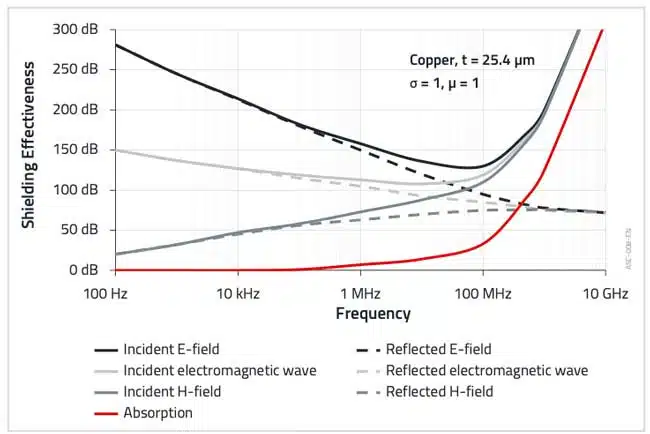
Fig.1. Shielding effectiveness with copper sheet above frequency for electric and magnetic fields and plane waves

The shielding effect for electric fields is infinite for direct current and decreases with increasing frequency. However, magnetic fields are more challenging to shield. As frequency decreases, non-magnetic materials like aluminum exhibit reduced reflection and absorption losses, making it difficult to shield magnetic fields using them.

At high frequencies, the shielding effectiveness is high due to reflection and absorption losses, so the choice of materials becomes less critical. Regarding plane waves, magnetic materials offer better absorption attenuation, while well-conducting materials provide better reflection attenuation. Table 1. provides a qualitative overview of these parameters.
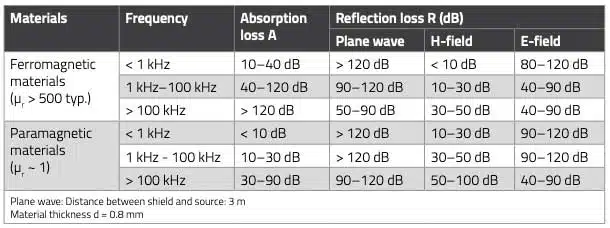
Tab. 1.:  Overview of the shielding attenuation properties of materials depending on the field types.

Some of the values in Table 1. are quite high because they were measured in the laboratory under ideal conditions for comparison purposes and are rarely achieved in practice. It is often assumed that materials with sufficient structural stiffness also have sufficient thickness to achieve a sufficient shielding effect. However, this is not always the case for devices operating in the low-frequency range (typically <100 kHz). At these low frequencies, it is necessary to use a highly permeable material to achieve sufficiently high shielding effectiveness against magnetic fields.

Plastics with Shielding Attenuation Properties

Plastics, synthetic materials derived from raw materials called monomers, exhibit diverse physical properties like melting point, strength, and formability. However, these properties can hinder their processing and usability. Composite materials have emerged as a solution to address these shortcomings. Composite materials are combinations of two or more materials designed to achieve a property that none of the individual materials can provide. This combination often results in enhanced strength, but it can also increase electrical conductivity and improve electromagnetic shielding properties.

To improve the electrical and electromagnetic properties of plastics, graphite mats or other materials can be used, such as the addition of conductive fillers. Typical conductive fillers are graphite flakes, metal-coated graphite fibres, and metal flakes or fibres. The resistivity of carbon fibre composites ranges from 4 mΩ/cm to some 100 mΩ/cm, depending on the number of layers and their weaving angle.

This is three to four orders of magnitude greater than copper or aluminum. Thus, most composites pose serious problems for electrical connections. The establishment of low-impedance and long-term reliable electrical contact between a housing ground and the electronics is essential for a functioning EMC concept. The conductivity of the housing surface can also be achieved by integrating a conductive screen or by coating the housing with conductive paint. The technologies used to apply conductive enclosure coatings include flame spraying, arc spraying, vacuum metallization, painting with conductive paints, and covering with conductive foil. This can further improve the surface conductivity of composite materials. Surface resistance can thus be reduced to 5 to 100 mΩ/cm.

All these plastics with shielding attenuation properties offer a certain degree of attenuation within a limited frequency range. Table 2. compares the conductivity and magnetic permeability of various materials. It’s evident that only materials containing ferromagnetic components exhibit effective attenuation of low-frequency magnetic field components, as only these have a magnetic permeability exceeding 1.
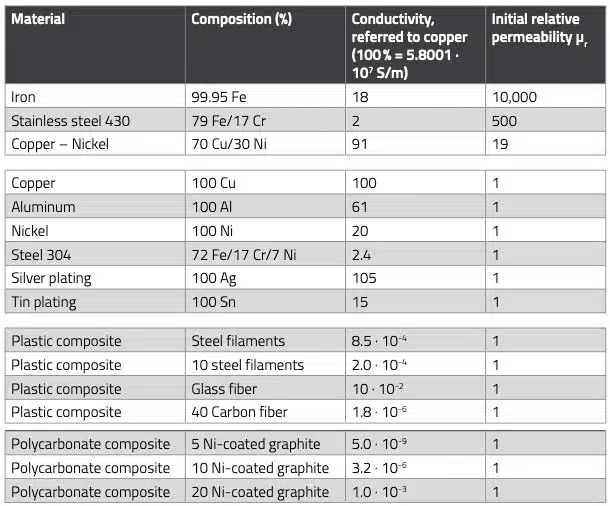
Tab. 2.: Conductivity and magnetic permeability of different materials

Plastic housings have a crucial aspect to consider: their interference resistance against electrostatic discharges. Materials with a specific surface resistance of less than 1 · 107 Ω/square can accumulate static charge if electrically connected to a conductive structure like a wire, allowing the charge to flow. Conversely, materials with a resistivity of more than 1 · 1013 Ω/square can build up static charge that remains undissipated even when the housing is grounded by a conductor.

Graphite-reinforced materials are generally conductive enough to prevent static charge buildup when graphite particles protrude through the plastic to the surface. In contrast, epoxy resin surface coatings lack conductivity, necessitating an additional conductive coating in certain cases.

Related articles:

  • Electromagnetic Housing Shielding and Its Effectiveness
  • Parameters of Shielding Attenuation

Related

Source: Reference Guide on Shielding

Recent Posts

Tapped Inductor Buck Converter Fundamentals

13.5.2026
7

Molecular Memristor Shows Record 145 kH Emergent Inductance

12.5.2026
10

Planar vs Conventional Transformer: When it Make Sense

11.5.2026
34

Energy Localization in Tantalum Anode Formation: A Structural Perspective

4.5.2026
46

Modeling Fringing Field Losses in Inductors & Transformers

30.4.2026
53

Miniaturization of Tantalum Capacitors: Structural Limit Under Constant Rating

27.4.2026
54

Heatsink Design and Thermal Interface Materials for Reliable Electronics

27.4.2026
35

Murata New MLCC Bulk Case Packaging Cuts Packaging Material by 99%

27.4.2026
104

When More Capacitance Hurts Reliability: The Role of the Metallic Skeleton in Tantalum Anodes

20.4.2026
63

Upcoming Events

May 13
17:00 - 17:30 CEST

Winding Loss Modeling for Toroidal Magnetics – Including Gapped Cores

May 19
16:00 - 17:00 CEST

Designing Qi2 Wireless Power Systems: Practical Development and EMC Optimization

Jun 2
16:00 - 17:00 CEST

Calculation, Simulation and Measurement of 800V EMC Filters

View Calendar

Popular Posts

  • Buck Converter Design and Calculation

    0 shares
    Share 0 Tweet 0
  • Boost Converter Design and Calculation

    0 shares
    Share 0 Tweet 0
  • Flyback Converter Design and Calculation

    0 shares
    Share 0 Tweet 0
  • LLC Resonant Converter Design and Calculation

    0 shares
    Share 0 Tweet 0
  • MLCC and Ceramic Capacitors

    0 shares
    Share 0 Tweet 0
  • Dual Active Bridge (DAB) Topology

    0 shares
    Share 0 Tweet 0
  • What Electronics Engineer Needs to Know About Passive Low Pass Filters

    0 shares
    Share 0 Tweet 0
  • Capacitor Charging and Discharging

    0 shares
    Share 0 Tweet 0
  • Ripple Current and its Effects on the Performance of Capacitors

    3 shares
    Share 3 Tweet 0
  • MLCC Case Sizes Standards Explained

    0 shares
    Share 0 Tweet 0

Newsletter Subscription


Passive Components Blog

© EPCI - Leading Passive Components Educational and Information Site

  • Home
  • Privacy Policy
  • EPCI Membership & Advertisement
  • About

No Result
View All Result
  • Home
  • Knowledge Blog
  • PCNS

© EPCI - Leading Passive Components Educational and Information Site

This website uses cookies. By continuing to use this website you are giving consent to cookies being used. Visit our Privacy and Cookie Policy.
Go to mobile version