

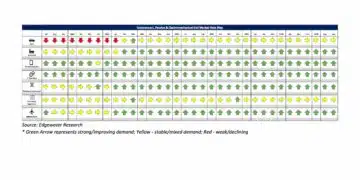




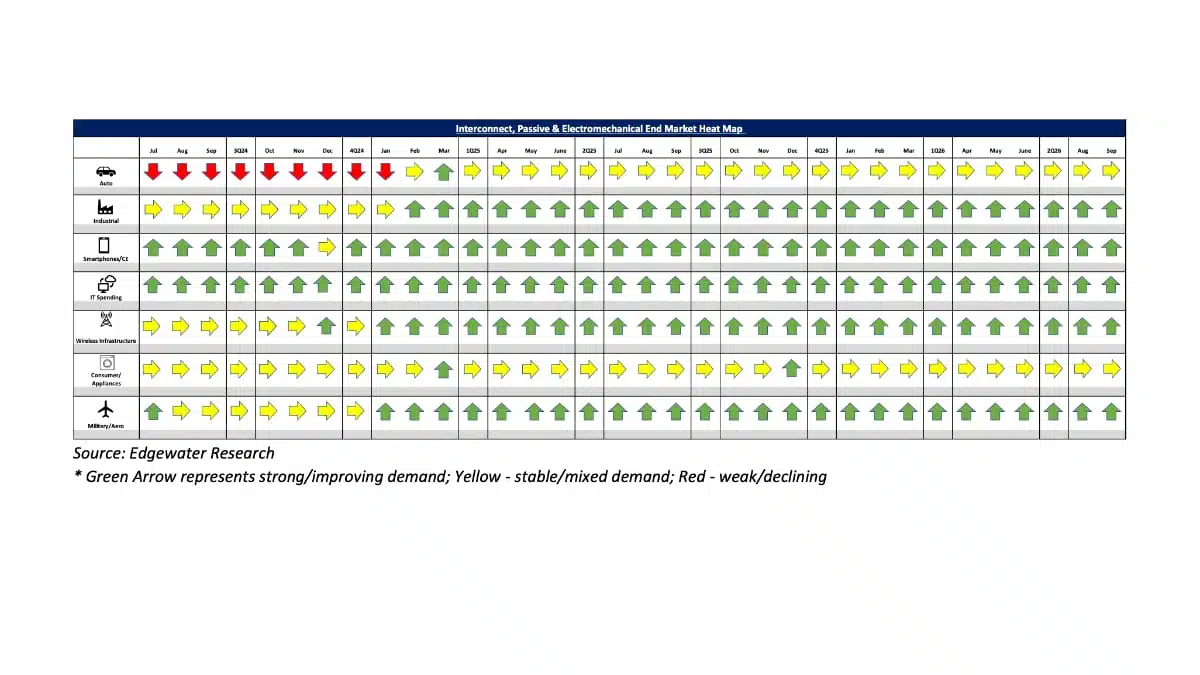
Edgewater Research’s latest IP&E report highlights sustained momentum and encouraging demand trends across the broader market.
This September 2026 collection of news summaries, survey results, and channel market insights, covers Interconnect, Passives, and Electromechanical Components from Edgewater Research.
AI infrastructure investment continues to drive demand for interconnects, passive components and electromechanical devices, while industrial and military/aerospace markets provide additional support. Edgewater Research’s October 2026 IP&E Insights report points to strong bookings, lean distribution inventories and lengthening lead times heading into 2027. For component buyers, the central issue is availability: capacity shifts toward AI and data centers are beginning to affect products serving other end markets.
Strong Bookings Meet Lean Inventories
The report places broad IP&E book-to-bill ratios at approximately 1.1–1.3, indicating that incoming orders continue to exceed shipments. AI/data centers and military/aerospace lead the market, while automotive demand remains closer to the lower end of the range. Channel feedback also suggests that stronger orders are increasingly translating into actual sell-through, with above-seasonal demand expected in the fourth quarter of 2026 and early 2027.
Distributors are attempting to replenish stock, but incoming deliveries are being absorbed quickly. Consequently, inventory remains lean despite more aggressive purchasing. Some customers are considering precautionary inventory builds across their bills of materials rather than focusing only on components already facing shortages.
Capacity Reallocation Broadens Supply Constraints
One of the report’s most important findings is that supply constraints are not solely a consequence of rising demand for individual components. Suppliers are reportedly reallocating manufacturing capacity from automotive and industrial applications toward AI and data-center programs. This can extend lead times even for product categories where underlying demand is relatively modest.
For passive-component readers, this is the report’s most relevant cross-market signal. However, the detailed research concentrates primarily on connectors and cable assemblies; it does not provide separate demand, pricing or lead-time forecasts for capacitors, resistors and inductors. Its findings therefore indicate broader IP&E supply-chain pressure rather than a uniform shortage across all passive-component technologies.
Further Price Increases Expected in 2027
Edgewater’s channel checks suggest that pricing will continue to trend upward, with additional supplier increases anticipated across distribution and direct customers in early 2027. Raw-material inflation is identified as the main driver, alongside some transportation-cost pressure.
The report specifically flags the possibility of another double-digit channel price increase from TE Connectivity, although timing and implementation remain uncertain. Automotive pricing appears more restrained, with feedback pointing to low-single-digit realized increases in 2026 and expectations for similar increases in 2027. These are channel expectations, not confirmed industry-wide price schedules.
AI Racks Continue to Expand Copper Interconnect Content
Despite growing interest in optical connectivity, Edgewater expects increasingly complex AI architectures to sustain demand for copper backplanes, flyover cables and intra-rack connections. Moving toward systems that connect multiple racks does not eliminate the substantial copper connectivity required inside each rack.
The report illustrates this trend with estimated data/signal connector and cable content of approximately $73,570 for an Nvidia VR200 NVL72 system, compared with $66,610 for a GB200/GB300 NVL72 system. It also estimates that higher backplane density could increase VR300 content by a further 60–70% relative to VR200. These figures are Edgewater’s architecture-specific estimates, not supplier quotations or total rack component costs.
Optical Adoption Is Creating a Mixed Transition
Near-packaged optics—optical engines positioned close to processing or switching chips—offers longer-term opportunities, but supply readiness and qualification remain concerns. According to the report, AWS is reducing the planned near-packaged-optics deployment rate in Trainium 4, while AMD is considering on-board optics as an alternative for MI500. Such changes could preserve or increase copper connectivity content in the near term.
The transition to 1.6-terabit active electrical cables also appears slower than previously expected at several major customers. Some deployments may remain on 800-gigabit electrical links for longer, while others could move to optical solutions. Meanwhile, Edgewater sees a growing opportunity for passive fiber cables and specialized optical connectors inside next-generation systems, although content will depend heavily on the final architecture.
Industrial Demand Remains Healthy; Automotive Faces Financial Pressure
Outside AI, industrial demand remains constructive, supported by semiconductor manufacturing equipment, test and measurement, power infrastructure, drones, and military/aerospace applications. Industrial connector demand is reported to be growing at a high-single-digit rate quarter over quarter.
Automotive demand is more stable than buoyant. Some connector suppliers report annual growth of approximately 5–7%, but financial pressure among vehicle manufacturers and Tier 1 suppliers is making pricing negotiations more difficult. The report therefore distinguishes between positive component demand and the financial health of the customers purchasing those components.
Implications for the Passive Components Supply Chain
For the passive-components industry, the report highlights three developments to monitor:
- Capacity allocation: AI-driven production priorities may affect availability beyond components designed specifically for data centers.
- Inventory behavior: lean channel stock and precautionary purchasing could add pressure to an already tightening supply environment.
- Pricing exposure: rising input costs and further supplier price actions remain important considerations for 2027 purchasing plans.
The overall outlook is constructive, but uneven: AI infrastructure remains the strongest growth engine, while availability, pricing and program-execution risks increasingly shape the wider IP&E market.
Full report available from: Dennis Reed, Sr. Research Analyst, Edgewater Research
Source: Edgewater Research, “Interconnect, Passives & Electromechanical Insights—Component Insights,” October 27, 2026, by Dennis Reed, Nik Todorov and Stelio Kanaras.