





Passive Components Blog
No Result
View All Result
  • Home
  • NewsFilter
    • All
    • Aerospace & Defence
    • Antenna
    • Applications
    • Automotive
    • Capacitors
    • Circuit Protection Devices
    • electro-mechanical news
    • Filters
    • Fuses
    • Inductors
    • Industrial
    • Integrated Passives
    • inter-connect news
    • Market & Supply Chain
    • Market Insights
    • Medical
    • Modelling and Simulation
    • New Materials & Supply
    • New Technologies
    • Non-linear Passives
    • Oscillators
    • Passive Sensors News
    • Resistors
    • RF & Microwave
    • Telecommunication
    • Weekly Digest

    Samsung Launches Worlds First Automotive 47uF 4V MLCC in 0805 Size

    Würth Elektronik Present in IEEE APEC

    Samsung Three Pillars MLCC Strategy for AI Hardware Topology

    Bourns Releases High Clearance Transformer for Isolated DC/DC Supplies

    KYOCERA AVX Extends Ultra‑Broadband RF Capacitor Series

    Earthing Systems and IEC Classification Explained

    Smiths Interconnect invests £2m in Costa Rica electronics plant

    Kyocera Offers Small SAW Filters for IoT RF Modules

    Bourns Unveils High Volt GDT for High‑Energy Surge Protection

    Trending Tags

    • Ripple Current
    • RF
    • Leakage Current
    • Tantalum vs Ceramic
    • Snubber
    • Low ESR
    • Feedthrough
    • Derating
    • Dielectric Constant
    • New Products
    • Market Reports
  • VideoFilter
    • All
    • Antenna videos
    • Capacitor videos
    • Circuit Protection Video
    • Filter videos
    • Fuse videos
    • Inductor videos
    • Inter-Connect Video
    • Non-linear passives videos
    • Oscillator videos
    • Passive sensors videos
    • Resistor videos

    2026 Power Magnetics Design Trends: Flyback, DAB and Planar

    Enabling Software‑Defined Vehicle Architectures: Automotive Ethernet and Zonal Smart Power

    Calculating Resistance Value of a Flyback RC Snubber 

    One‑Pulse Characterization of Nonlinear Power Inductors

    Thermistor Linearization Challenges

    Coaxial Connectors and How to Connect with PCB

    PCB Manufacturing, Test Methods, Quality and Reliability

    Transformer Behavior – Current Transfer and Hidden Feedback

    Choosing the Right Capacitor: The Importance of Accurate Measurements

    Trending Tags

    • Capacitors explained
    • Inductors explained
    • Resistors explained
    • Filters explained
    • Application Video Guidelines
    • EMC
    • New Products
    • Ripple Current
    • Simulation
    • Tantalum vs Ceramic
  • Knowledge Blog
  • DossiersNew
  • Suppliers
    • Who is Who
  • PCNS
    • PCNS 2025
    • PCNS 2023
    • PCNS 2021
    • PCNS 2019
    • PCNS 2017
  • Events
  • Home
  • NewsFilter
    • All
    • Aerospace & Defence
    • Antenna
    • Applications
    • Automotive
    • Capacitors
    • Circuit Protection Devices
    • electro-mechanical news
    • Filters
    • Fuses
    • Inductors
    • Industrial
    • Integrated Passives
    • inter-connect news
    • Market & Supply Chain
    • Market Insights
    • Medical
    • Modelling and Simulation
    • New Materials & Supply
    • New Technologies
    • Non-linear Passives
    • Oscillators
    • Passive Sensors News
    • Resistors
    • RF & Microwave
    • Telecommunication
    • Weekly Digest

    Samsung Launches Worlds First Automotive 47uF 4V MLCC in 0805 Size

    Würth Elektronik Present in IEEE APEC

    Samsung Three Pillars MLCC Strategy for AI Hardware Topology

    Bourns Releases High Clearance Transformer for Isolated DC/DC Supplies

    KYOCERA AVX Extends Ultra‑Broadband RF Capacitor Series

    Earthing Systems and IEC Classification Explained

    Smiths Interconnect invests £2m in Costa Rica electronics plant

    Kyocera Offers Small SAW Filters for IoT RF Modules

    Bourns Unveils High Volt GDT for High‑Energy Surge Protection

    Trending Tags

    • Ripple Current
    • RF
    • Leakage Current
    • Tantalum vs Ceramic
    • Snubber
    • Low ESR
    • Feedthrough
    • Derating
    • Dielectric Constant
    • New Products
    • Market Reports
  • VideoFilter
    • All
    • Antenna videos
    • Capacitor videos
    • Circuit Protection Video
    • Filter videos
    • Fuse videos
    • Inductor videos
    • Inter-Connect Video
    • Non-linear passives videos
    • Oscillator videos
    • Passive sensors videos
    • Resistor videos

    2026 Power Magnetics Design Trends: Flyback, DAB and Planar

    Enabling Software‑Defined Vehicle Architectures: Automotive Ethernet and Zonal Smart Power

    Calculating Resistance Value of a Flyback RC Snubber 

    One‑Pulse Characterization of Nonlinear Power Inductors

    Thermistor Linearization Challenges

    Coaxial Connectors and How to Connect with PCB

    PCB Manufacturing, Test Methods, Quality and Reliability

    Transformer Behavior – Current Transfer and Hidden Feedback

    Choosing the Right Capacitor: The Importance of Accurate Measurements

    Trending Tags

    • Capacitors explained
    • Inductors explained
    • Resistors explained
    • Filters explained
    • Application Video Guidelines
    • EMC
    • New Products
    • Ripple Current
    • Simulation
    • Tantalum vs Ceramic
  • Knowledge Blog
  • DossiersNew
  • Suppliers
    • Who is Who
  • PCNS
    • PCNS 2025
    • PCNS 2023
    • PCNS 2021
    • PCNS 2019
    • PCNS 2017
  • Events
No Result
View All Result
Passive Components Blog
No Result
View All Result

KYOCERA AVX Extends Ultra‑Broadband RF Capacitor Series

24.2.2026
Reading Time: 7 mins read
A A

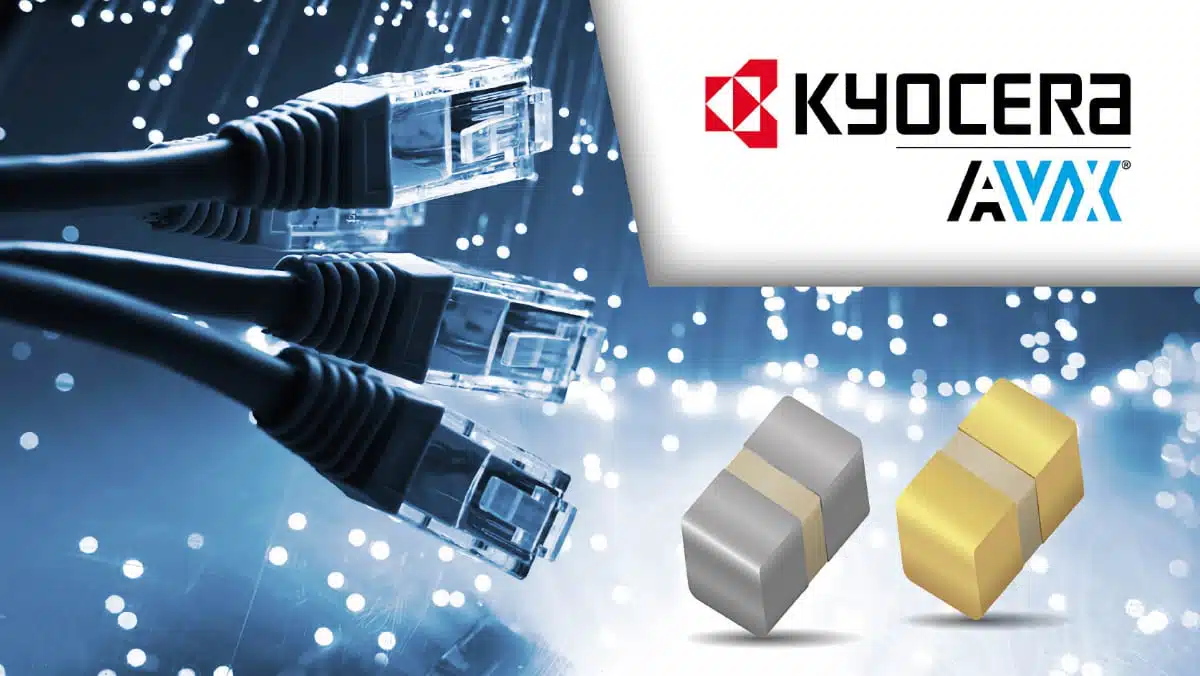
Kyocera AVX has extended its 550/560 Series ultra‑broadband RF capacitors (UBC) with four new components aimed at high‑speed, high‑bandwidth optical communication systems and RF front ends.

The additions bring higher working voltages and more capacitance options in the compact 0402 footprint, helping design engineers improve signal integrity while saving PCB real estate in dense optical and RF modules.

RelatedPosts

Kyocera Offers Small SAW Filters for IoT RF Modules

Miniaturization of MLCCs and Electrolytics, KAVX Tech Chat

Conductive Polymer Capacitor Market and Design‑In Guide to 2035

Key features and benefits

KYOCERA AVX’s UBC ceramic capacitor construction family is positioned as a wideband, low‑loss solution for RF, microwave, and optical communication circuits that must operate from kilohertz through millimeter‑wave frequencies. The latest extension targets designers who need higher voltage margins and more flexibility in impedance matching and broadband decoupling.

Key characteristics of the extended 550/560 Series UBC range include:

  • Frequency coverage from approximately 7 kHz up to 110 GHz, suitable for broadband RF/microwave and optical front‑end use.
  • Capacitance values spanning 1 nF to 220 nF in the overall series, with four new 0402 parts added at 1 nF, 10 nF, 22 nF, and 47 nF.
  • Maximum working voltage rating extended from 16 V up to 100 V in the new parts, supporting higher signal swings and bias levels.
  • Operating temperature range from −55 °C to +125 °C, compatible with typical telecom, datacom, and industrial environments.
  • Compact SMD packages, including 0402 case size for the new releases, supporting dense layouts and short RF paths.
  • Designed for high signal integrity with high reliability, high precision, and ultra‑low insertion loss over the specified frequency range.

In practice, the combination of high capacitance at small size, wide frequency coverage, and higher working voltage allows a single capacitor type to cover multiple roles: broadband DC blocking, AC coupling, and decoupling in high‑speed optical and RF systems. This reduces the number of different capacitor types on the BOM and simplifies matching networks, which is attractive for purchasing and platform‑level design reuse.

Typical applications

The expanded UBC range targets high‑speed data transmission, especially where optical links and RF/microwave circuitry intersect. Typical use cases called out by the manufacturer include:

  • Transimpedance amplifiers (TIA) in optical receivers, where low‑loss AC coupling and decoupling are critical for noise performance.
  • Receive and transmit optical subassemblies (ROSA/TOSA), including pluggable optical modules.
  • Synchronous optical networks (SONET) and related telecom backhaul equipment.
  • Broadband and RF test and measurement equipment that must maintain flat response and low distortion over wide bandwidths.
  • Vertical cavity surface emitting lasers (VCSEL) drivers and associated high‑speed digital front ends.
  • Fiber‑optic communication systems and high‑speed serializer/deserializer (SerDes) interfaces.
  • Analog and digital RF front ends for 5G and satellite communication networks.
  • High‑resolution sensing, imaging, and radar systems used in industrial automation, security screening, and driverless/assisted driving platforms.

In many of these systems, designers face the challenge of maintaining consistent impedance and low return loss across decades of frequency. Ultra‑broadband capacitors with controlled behavior up to 110 GHz can significantly simplify matching networks and bias‑tee designs compared to general‑purpose MLCCs, which tend to exhibit strong self‑resonance and loss peaks.

Technical highlights

From a component selection perspective, the extended 550/560 UBC series is notable for a few technical points that differentiate it from conventional chip capacitors:

  • Very wide usable frequency range: The specified 7 kHz to 110 GHz bandwidth allows a single capacitor type to bridge low‑frequency bias/decoupling needs and very high‑frequency RF functions. This is especially relevant for broadband amplifiers, RF sampling front ends, and wideband test fixtures.
  • High working voltage headroom: Increasing the series maximum working voltage from 16 V to 100 V in the new part numbers reduces the risk of over‑voltage in systems with higher bias rails or large RF swings. This is important in line‑powered optical modules, power‑over‑fiber interfaces, or RF power stages where traditional low‑voltage UBCs could be a limitation.
  • Expanded 0402 capacitance set: Adding 1 nF, 10 nF, 22 nF, and 47 nF in 0402 gives RF designers more granularity when tuning broadband impedance or designing compact bias‑tees. 0402 is a common compromise between minimal parasitics and assembly robustness.
  • Tight and controlled tolerances: The series covers capacitance tolerances from ±10% up to ±100% depending on value and part type, with the tighter bins suitable for precision matching and equalization networks.
  • Temperature range and stability: The −55 °C to +125 °C operating range supports deployment in telecom shelters, base stations, industrial environments, and equipment racks with limited cooling. For exact dielectric type and detailed capacitance versus temperature behavior, designers should refer to the manufacturer datasheet.

Compared with standard high‑frequency MLCCs, UBC parts are optimized not just for low ESR at a single band, but for predictable impedance and ultra‑low insertion loss over a very broad spectrum. This often justifies their use in critical RF signal paths even if the unit price is higher than generic MLCC options.

With the latest extension, the 550/560 Series UBC portfolio now comprises a total of 15 part numbers. The four new devices are 0402 case size parts with capacitance values of 1 nF, 10 nF, 22 nF, and 47 nF and a maximum working voltage of up to 100 V.

Design‑in notes for engineers

When designing in the 550/560 Series ultra‑broadband capacitors, a few practical points can help extract the intended RF performance:

  • Treat the capacitor as a transmission‑line component at higher frequencies. Pad geometry, via placement, and reference planes should be optimized to minimize additional parasitic inductance and capacitance that could spoil the ultra‑broadband behavior.
  • Use manufacturer‑provided S‑parameter data. For accurate simulation of insertion loss, return loss, and group delay up to tens of GHz, import the official S‑parameter models into your RF CAD/EM tools rather than relying on ideal capacitor models.
  • Pay attention to voltage derating. Even though the new parts extend working voltage up to 100 V, it is good practice to apply derating in applications with high RF swing, transient exposure, or elevated temperatures. The appropriate derating curve should be taken from the datasheet.
  • Consider thermal environment. While the −55 °C to +125 °C rating covers most telecom and industrial uses, hotspots on densely packed PCBs (especially near laser drivers or power amplifiers) can locally raise temperature. Placement near airflow or heatsinks may be beneficial in tightly integrated optical modules.
  • Implement good grounding and decoupling practices. When using UBCs for broadband decoupling or bias‑tees, pair them with solid ground planes and short return paths to avoid unintended resonances. It can be effective to combine different capacitance values in parallel to flatten impedance over the target band.
  • Coordinate with test engineering. Because these parts are often used at the boundary between RF and optical domains, early coordination with test engineers on fixture design and de‑embedding can avoid characterization issues and re‑spins.

For purchasing teams, the key benefit of the extended UBC range is a broader set of drop‑in options within the same qualified family. This can reduce second‑source complexity and simplify maintaining common platforms across different optical module generations or RF product variants.

Source

This article is based on information from an official Kyocera AVX press release and associated product details. For precise ratings, electrical characteristics, and full part number definitions, always refer to the current manufacturer datasheet and product pages.
References

  1. Kyocera AVX press release – New capacitors for optical communications (UBC Series extension)
  2. Kyocera AVX – Corporate website

Related

Recent Posts

Samsung Launches Worlds First Automotive 47uF 4V MLCC in 0805 Size

24.2.2026
2

Würth Elektronik Present in IEEE APEC

24.2.2026
1

Samsung Three Pillars MLCC Strategy for AI Hardware Topology

24.2.2026
4

Kyocera Offers Small SAW Filters for IoT RF Modules

23.2.2026
5

TDK Releases DC Link Aluminum Capacitors for EV On‑Board Chargers

23.2.2026
8

Capacitech C-Link Supercapacitors for AI Data Center Voltage Spikes Mitigation

23.2.2026
15

Bourns Extends Multilayer Chip Inductors Offer for RF and Wireless Designs

20.2.2026
12
Researchers developed a polymer capacitor by combining two cheap, commercially available plastics. The new polymer capacitor makes use of the transparent material — pictured here, with vintage Penn State athletic marks visible through it — to store four times the energy and withstand significantly more heat.  Credit: Penn State

Penn State Demonstrated Polymer Alloy Capacitor Film with 4× Energy Density up to 250C

19.2.2026
31

Würth Elektronik Component Data Live in Accuris

19.2.2026
17

Upcoming Events

Feb 24
16:00 - 17:00 CET

Mastering Galvanic Isolation: Ensuring Safety in Power Electronics

Feb 25
16:00 - 17:00 CET

Magnetic Modeling – How Frenetic Models Magnetics

Mar 3
16:00 - 17:00 CET

Cybersecurity at the Eleventh Hour – from RED to CRA – Information and Discussion

View Calendar

Popular Posts

  • Buck Converter Design and Calculation

    0 shares
    Share 0 Tweet 0
  • Boost Converter Design and Calculation

    0 shares
    Share 0 Tweet 0
  • LLC Resonant Converter Design and Calculation

    0 shares
    Share 0 Tweet 0
  • Flyback Converter Design and Calculation

    0 shares
    Share 0 Tweet 0
  • Ripple Current and its Effects on the Performance of Capacitors

    3 shares
    Share 3 Tweet 0
  • Dual Active Bridge (DAB) Topology

    0 shares
    Share 0 Tweet 0
  • What is a Dielectric Constant and DF of Plastic Materials?

    4 shares
    Share 4 Tweet 0
  • MLCC Manufacturers Consider Price Increase as AI Demand Outpaces Supply

    0 shares
    Share 0 Tweet 0
  • MLCC and Ceramic Capacitors

    0 shares
    Share 0 Tweet 0
  • MLCC Case Sizes Standards Explained

    0 shares
    Share 0 Tweet 0

Newsletter Subscription


Passive Components Blog

© EPCI - Leading Passive Components Educational and Information Site

  • Home
  • Privacy Policy
  • EPCI Membership & Advertisement
  • About

No Result
View All Result
  • Home
  • Knowledge Blog
  • PCNS

© EPCI - Leading Passive Components Educational and Information Site

This website uses cookies. By continuing to use this website you are giving consent to cookies being used. Visit our Privacy and Cookie Policy.
Go to mobile version